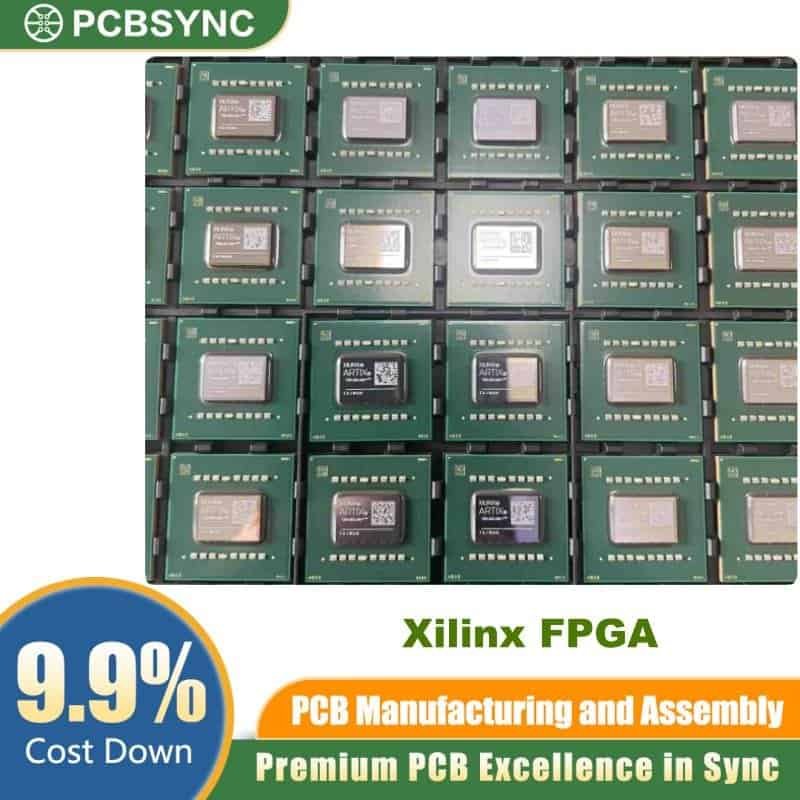
The XCKU115-L1FLVD1924I is a high-performance, low-power Xilinx FPGA from the Kintex® UltraScale™ family, manufactured by AMD (formerly Xilinx). Designed for demanding signal processing, networking, and industrial applications, this device combines the flagship KU115 silicon with the low-power “-1L” speed grade and industrial temperature range support — making it one of the most capable mid-range FPGAs available for production designs.
Whether you are building 100G networking infrastructure, medical imaging equipment, or high-throughput data center systems, the XCKU115-L1FLVD1924I offers an exceptional balance of logic capacity, DSP performance, transceiver bandwidth, and power efficiency in a single device.
What Is the XCKU115-L1FLVD1924I?
The part number can be decoded as follows:
| Segment |
Meaning |
| XC |
Xilinx commercial FPGA |
| KU115 |
Kintex UltraScale family, KU115 die |
| -L1 |
Low-power (-1L) speed grade; operates at VCCINT = 0.90V or 0.95V |
| FLVD |
FCBGA package, low-voltage version, D = specific variant |
| 1924 |
1924-pin package (FCBGA) |
| I |
Industrial temperature range (–40°C to +100°C) |
This device is part of the XCKU115 subfamily — the largest single die in the original Kintex UltraScale lineup, implemented using AMD’s stacked silicon interconnect (SSI) technology at 20nm process node.
Key Features at a Glance
| Feature |
Specification |
| FPGA Family |
Kintex UltraScale |
| Part Number |
XCKU115-L1FLVD1924I |
| Process Node |
20nm |
| System Logic Cells |
1,451,100 |
| CLB Flip-Flops |
1,326,720 |
| CLB LUTs |
663,360 |
| Block RAM (Total) |
75.9 Mb |
| DSP Slices |
5,520 |
| GTH Transceivers |
64 (up to 16.3 Gb/s each) |
| User I/O Pins |
832 |
| Package |
FCBGA-1924 |
| Speed Grade |
-1L (Low Power) |
| VCCINT Options |
0.90V or 0.95V |
| Temperature Range |
Industrial (–40°C to +100°C) |
| PCIe Support |
PCIe Gen3 x8 (hard IP) |
| Clock Management |
MMCM and PLL |
| Configuration Interfaces |
JTAG, SPI, BPI, SelectMAP |
| RoHS Compliance |
Yes |
Detailed Specifications
Logic Resources
The XCKU115-L1FLVD1924I provides 1,451,100 system logic cells, making it one of the highest-capacity devices in the Kintex UltraScale series. These are organized into Configurable Logic Blocks (CLBs), each containing:
- 8 x 6-input LUTs (each usable as logic, 64-bit distributed RAM, or 32-bit shift register)
- 16 flip-flops per CLB
- Carry chain logic for efficient arithmetic operations
This architecture enables extremely dense packing of both control logic and datapath functions without the need to overprovision resources.
DSP Performance
With 5,520 DSP48E2 slices, the XCKU115 is optimized for signal processing workloads. Each DSP48E2 slice supports:
| DSP48E2 Capability |
Detail |
| Arithmetic Width |
27×18-bit multiplier, 48-bit accumulator |
| Cascade |
Full cascade chaining across slices |
| SIMD Support |
Dual 24-bit or quad 12-bit SIMD arithmetic |
| Pre-adder |
Symmetric filter optimization |
| Max Throughput |
Up to 725 MHz (speed grade dependent) |
This density makes the XCKU115-L1FLVD1924I ideal for FFT engines, FIR filters, convolutional neural networks, and image processing pipelines.
Block RAM
The device integrates 36 Kb Block RAM tiles providing approximately 75.9 Mb total on-chip memory, configurable as:
- True dual-port RAM
- Simple dual-port or single-port RAM
- FIFO buffers
- ROM
High block RAM density eliminates the need for external SRAM in many buffering, packet processing, and lookup table applications.
GTH Transceivers (High-Speed Serial I/O)
The XCKU115-L1FLVD1924I includes 64 GTH transceivers, organized in groups of four (quads). These transceivers support the following protocols and standards:
| Protocol |
Line Rate |
| PCIe Gen3 |
8.0 Gb/s |
| 10G/25G Ethernet |
Up to 16.3 Gb/s |
| CPRI/eCPRI |
Multiple rates |
| Interlaken |
Up to 16.3 Gb/s |
| SATA/SAS |
6.0 Gb/s |
| Aurora |
Configurable |
| Custom serial |
User-defined |
The GTH transceivers deliver total bidirectional bandwidth exceeding 2 Tb/s, making this device well-suited for 100G networking line cards and high-density backplane connectivity.
I/O and Package
| I/O Parameter |
Value |
| Package |
FCBGA-1924 (Flip-Chip Ball Grid Array) |
| Total User I/O |
832 |
| HP I/O Banks |
High-Performance I/O (1.0V – 1.8V) |
| HR I/O Banks |
High-Range I/O (up to 3.3V) |
| DCI Support |
Yes (calibrated on-die termination) |
| LVDS Pairs |
Extensive |
| SSTL / HSTL Support |
Yes |
Power Specifications
The “-L” (low-voltage) designation means the XCKU115-L1FLVD1924I supports dual VCCINT operation:
| Mode |
VCCINT |
Performance |
| Standard Mode |
0.95V |
Equivalent to -1 speed grade (up to 725 MHz) |
| Low Power Mode |
0.90V |
Reduced static and dynamic power |
This flexibility allows designers to balance performance and power budget depending on application requirements. The device is screened for lower maximum static power compared to standard -1 grade parts.
Part Number Comparison: XCKU115 Variants
The XCKU115 die is available in several configurations. The table below highlights key differentiators among the most common variants with the 1924-pin package:
| Part Number |
Speed Grade |
Temp Range |
VCCINT |
Package |
| XCKU115-L1FLVD1924I |
-1L (Low Power) |
Industrial |
0.90V / 0.95V |
FCBGA-1924 |
| XCKU115-1FLVD1924I |
-1 |
Industrial |
0.95V |
FCBGA-1924 |
| XCKU115-2FLVD1924I |
-2 |
Industrial |
0.95V |
FCBGA-1924 |
| XCKU115-3FLVD1924E |
-3 |
Extended |
0.95V |
FCBGA-1924 |
| XCKU115-L1FLVF1924I |
-1L |
Industrial |
0.90V / 0.95V |
FCBGA-1924 (F variant) |
Note: The “-1L” speed grade is listed in Vivado as -1LV when operating at VCCINT = 0.90V.
Target Applications
The XCKU115-L1FLVD1924I is engineered for the following application domains:
#### 100G Networking and Data Centers
Its 64 GTH transceivers and large logic capacity support full-duplex 100G Ethernet MAC/PHY implementations, deep packet inspection, OpenFlow forwarding, and network function virtualization (NFV) acceleration.
#### Wireless Infrastructure
The device excels in heterogeneous wireless base stations, Remote Radio Head (RRH) digital front-end (DFE) processing, massive MIMO beamforming, and multi-band CPRI aggregation.
#### Medical Imaging
High DSP density and on-chip memory make this FPGA ideal for CT reconstruction, MRI signal processing, ultrasound beamforming, and real-time 3D image rendering pipelines.
#### Video Processing (8K/4K)
With over 5,500 DSP slices and abundant block RAM, the device supports real-time 8K video transcoding, frame buffering, and color space conversion without external processing elements.
#### Defense and Aerospace (Industrial Grade)
The industrial temperature rating (–40°C to +100°C) and low-power operation make this part suitable for ruggedized radar signal processing, EW systems, and secure communications requiring extended environmental tolerance.
#### High-Performance Computing (HPC) Acceleration
PCIe Gen3 x8 hard IP enables direct attachment to host CPUs for low-latency FPGA-based acceleration of machine learning inference, financial analytics, and genomics workloads.
Design Toolchain and Support
| Tool |
Details |
| Primary IDE |
AMD Vivado Design Suite (Design or System Edition required) |
| IP Integrator |
Vivado IP Integrator (block design flow) |
| HLS Support |
Vitis HLS (C/C++/OpenCL to RTL) |
| Simulation |
Vivado Simulator, ModelSim, Questa, VCS |
| Minimum Vivado Version |
See Table 22 in AMD DS892 for production release info |
| Debug Tools |
Integrated Logic Analyzer (ILA), Virtual I/O (VIO), JTAG-to-AXI |
The free Vivado WebPACK edition does not support Kintex UltraScale devices. A paid Design Edition or device-locked evaluation license is required.
Ordering Information
| Attribute |
Value |
| Manufacturer |
AMD (Xilinx) |
| Full Part Number |
XCKU115-L1FLVD1924I |
| Package |
FCBGA-1924 |
| Moisture Sensitivity Level (MSL) |
Per JEDEC J-STD-020 |
| RoHS Status |
Compliant |
| Lead-Free |
Yes |
| NCNR Policy |
Non-Cancellable, Non-Returnable (NCNR) — confirm with distributor |
Frequently Asked Questions (FAQ)
What is the difference between XCKU115-L1FLVD1924I and XCKU115-1FLVD1924I?
The key difference is the speed grade designation. The -L1 part is the low-power variant, supporting VCCINT at either 0.90V or 0.95V and screened for lower static power. When operated at 0.95V, it matches the -1 speed grade performance. The standard -1 part is fixed at 0.95V and is not screened for reduced static power.
Is the XCKU115-L1FLVD1924I footprint-compatible with other UltraScale devices?
Yes. Packages using the same alphanumeric suffix (e.g., “D1924”) are footprint-compatible across the UltraScale architecture family, enabling migration between density variants without PCB redesign. Confirm pin compatibility using the UltraScale Architecture Product Selection Guide.
What temperature range does this device support?
The “I” suffix indicates Industrial temperature range: –40°C to +100°C. This is distinct from Commercial (0°C to +85°C) and Extended (0°C to +100°C) grades.
Does the XCKU115-L1FLVD1924I include hard PCIe IP?
Yes. The XCKU115 devices include hard PCIe Gen3 x8 intellectual property blocks, reducing logic resource consumption and improving timing closure compared to soft PCIe implementations.
How many transceivers does this FPGA have?
The XCKU115-L1FLVD1924I contains 64 GTH transceivers, each capable of line rates up to 16.3 Gb/s, organized in 16 quads of four transceivers each.
Summary
The XCKU115-L1FLVD1924I is one of the most capable members of Xilinx’s Kintex UltraScale portfolio. Its combination of 1.45 million logic cells, 5,520 DSP slices, 64 GTH transceivers, and industrial temperature qualification — all in a low-power -1L speed grade — delivers exceptional value for production designs that demand high throughput, rich I/O connectivity, and extended environmental reliability. Supported by AMD’s Vivado design suite and a broad IP library, this device accelerates time-to-market for engineers targeting networking, wireless, medical, and defense applications.