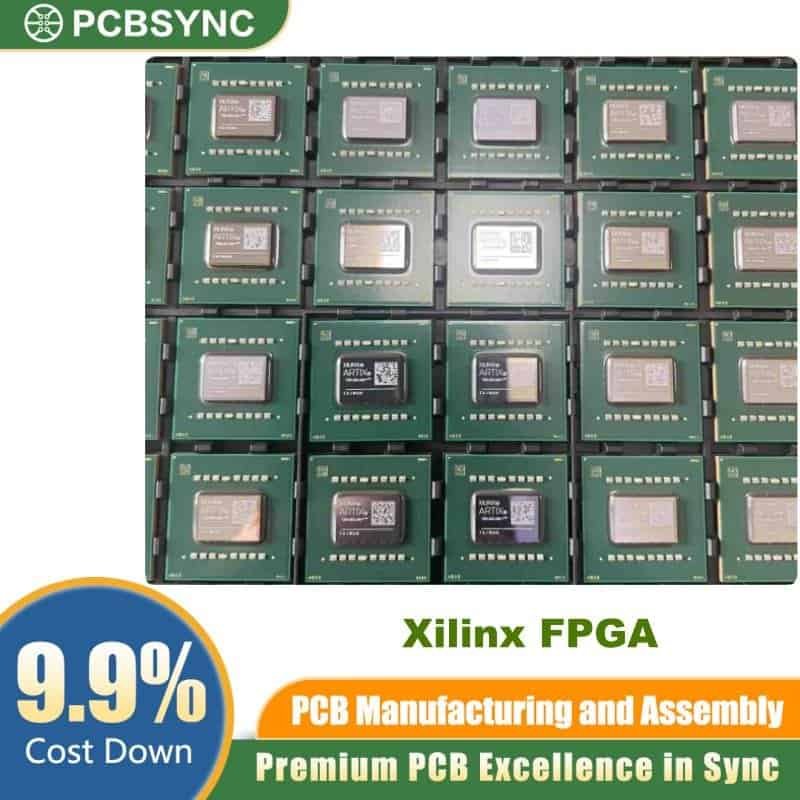
The XCKU115-L1FLVA2104I is a high-performance, low-power Field Programmable Gate Array (FPGA) from AMD Xilinx, part of the industry-leading Kintex® UltraScale™ family. Built on a cutting-edge 20nm process node, this device delivers exceptional logic density, advanced DSP capability, and next-generation transceiver performance — making it a top choice for demanding applications in industrial, networking, and signal-processing environments.
Whether you are developing 100G networking equipment, high-throughput data acquisition systems, or advanced wireless infrastructure, the XCKU115-L1FLVA2104I offers the performance headroom, I/O flexibility, and power efficiency your design demands. Browse a wide range of Xilinx FPGA options to find the right fit for your next project.
What Is the XCKU115-L1FLVA2104I?
The XCKU115-L1FLVA2104I is a member of the Kintex UltraScale product family manufactured by AMD (formerly Xilinx). The part number can be decoded as follows:
| Part Number Segment |
Meaning |
| XC |
Xilinx Commercial silicon |
| KU115 |
Kintex UltraScale, Device 115 (largest in family) |
| L1 |
Low-power speed grade (-1L), screened for reduced static power |
| FLV |
Flip-Chip Low-Voltage package variant |
| A |
Package lead-free (RoHS-compliant) |
| 2104 |
2104-pin FCBGA (Flip-Chip Ball Grid Array) package |
| I |
Industrial temperature range (–40°C to +100°C) |
The -1L speed grade is a unique feature of this variant. It supports dual VCCINT voltage operation at either 0.95V or 0.90V. When operating at 0.95V, timing performance is identical to the standard -1 speed grade. When operating at 0.90V, this device delivers measurably lower static power — ideal for power-sensitive industrial deployments.
XCKU115-L1FLVA2104I Key Specifications
Core Logic Resources
| Parameter |
Value |
| System Logic Cells |
1,451,100 |
| CLB Flip-Flops |
1,326,720 |
| CLB LUTs |
663,360 |
| Logic Blocks |
663,360 |
| Max Distributed RAM (Kb) |
9,180 |
Memory Resources
| Parameter |
Value |
| Block RAM (36Kb blocks) |
2,160 |
| Total Block RAM (Kb) |
77,760 |
| Total RAM Bits |
77,721,600 |
| UltraRAM (288Kb blocks) |
0 (Kintex UltraScale; not UltraScale+) |
DSP and Processing
| Parameter |
Value |
| DSP Slices |
5,520 |
| Peak DSP Performance (GMAC/s) |
8,916 |
| Maximum Operating Frequency |
Up to 661 MHz (speed grade dependent) |
I/O and Transceivers
| Parameter |
Value |
| User I/O (Max) |
832 |
| HP (High-Performance) I/O Banks |
24 |
| HR (High-Range) I/O Banks |
0 |
| GTH Transceivers |
64 |
| GTH Line Rate (Max) |
16.3 Gb/s |
| PCIe Gen3 Blocks |
4 |
| 100G Ethernet MACs |
2 |
Package and Environmental
| Parameter |
Value |
| Package Type |
2104-BBGA / FCBGA |
| Package Dimensions |
45mm × 45mm |
| Pin Count |
2,104 |
| Technology Node |
20nm |
| VCCINT |
0.95V / 0.90V (-1L) |
| Operating Temperature |
–40°C to +100°C (Industrial) |
| Moisture Sensitivity Level |
MSL 3 |
| RoHS Compliance |
Yes (Lead-Free) |
| Mounting Type |
Surface Mount |
XCKU115-L1FLVA2104I vs. Other XCKU115 Variants
The XCKU115 die is shared across several package and speed-grade options. Understanding how the L1FLVA2104I compares to its siblings helps engineers select the right part.
| Part Number |
Speed Grade |
VCCINT |
Temp Range |
Package Pins |
I/O Count |
| XCKU115-3FLVA2104E |
-3 (High Performance) |
0.95V |
Extended (0–100°C) |
2104 |
832 |
| XCKU115-2FLVA2104I |
-2 (Mid Performance) |
0.95V |
Industrial |
2104 |
832 |
| XCKU115-L1FLVA2104I |
-1L (Low Power) |
0.95V / 0.90V |
Industrial |
2104 |
832 |
| XCKU115-L1FLVB2104I |
-1L (Low Power) |
0.95V / 0.90V |
Industrial |
2104 |
702 |
| XCKU115-L1FLVA1517I |
-1L (Low Power) |
0.95V / 0.90V |
Industrial |
1517 |
624 |
Note: The “A” package variant (FLVA2104) provides the maximum I/O count of 832 pins, making the XCKU115-L1FLVA2104I the best option when both maximum I/O and industrial low-power operation are required.
Architecture Overview: Kintex UltraScale Technology
UltraScale ASIC-Like Clocking
The XCKU115-L1FLVA2104I leverages Xilinx’s UltraScale architecture, which introduces ASIC-like clocking with fine-grained clock gating across the entire device. This reduces dynamic power by enabling designers to shut down unused logic regions without impacting overall system performance.
Next-Generation GTH Transceivers
With 64 GTH transceivers capable of line rates up to 16.3 Gb/s, this device supports the most demanding high-speed serial protocols, including:
- PCIe Gen3 (×1, ×2, ×4, ×8, ×16)
- 100GbE (IEEE 802.3ba)
- JESD204B for high-speed ADC/DAC interfaces
- Interlaken for chip-to-chip and board-to-board links
- SATA, SAS, and other storage protocols
Stacked Silicon Interconnect (SSI) Technology
The KU115 device is implemented using SSI technology, where multiple super-logic regions (SLRs) are stacked on a silicon interposer. This provides die-to-die bandwidth far exceeding conventional package integration methods, enabling a unified programming model while supporting extreme resource density.
High-Density DSP Architecture
At 5,520 DSP48E2 slices, the XCKU115 delivers up to 8,916 GMAC/s of signal processing performance. Each DSP48E2 slice supports:
- 27×18 multiplier
- 48-bit accumulator
- Pre-adder for efficient filtering
- Cascade chains for FIR, FFT, and floating-point implementations
Power Management: The -1L Advantage
Dual VCCINT Voltage Operation
The -1L speed grade is uniquely screened for reduced static power. Compared to the standard -1 device:
| Operating Mode |
VCCINT |
Speed Performance |
Static Power |
| Standard mode |
0.95V |
Same as -1 speed grade |
Standard |
| Low-power mode |
0.90V |
Slightly reduced |
Significantly lower |
This makes the XCKU115-L1FLVA2104I ideal for:
- Always-on industrial equipment with tight thermal budgets
- Rack-mounted systems where power density is critical
- Remote deployments operating from battery or limited power sources
Up to 40% Lower Power vs. Previous Generation
Compared to older 28nm Kintex-7 devices, the Kintex UltraScale family delivers up to 40% power reduction for equivalent workloads, primarily through fine-grained clock gating, process node improvements, and architectural optimizations.