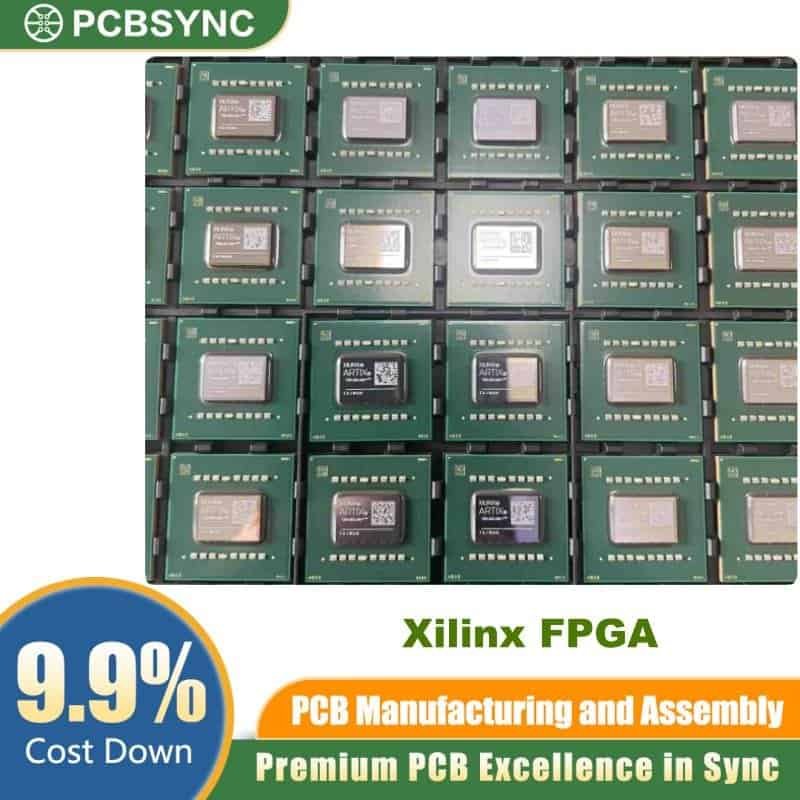
The XCKU115-2FLVD1924E is a high-performance, mid-range Xilinx FPGA from the Kintex® UltraScale™ family, manufactured by AMD (formerly Xilinx). Built on a 20nm process node, this device delivers an outstanding balance of logic density, DSP throughput, memory bandwidth, and transceiver performance — all packaged in a cost-optimized 1924-pin FCBGA footprint. Whether you are designing next-generation 100G networking systems, high-resolution medical imaging hardware, or advanced wireless base stations, the XCKU115-2FLVD1924E is engineered to meet the most demanding real-world requirements.
What Is the XCKU115-2FLVD1924E?
The XCKU115-2FLVD1924E belongs to the Kintex UltraScale FPGA product line — AMD’s flagship mid-range programmable logic family. The device identifier breaks down as follows:
| Part Number Segment |
Meaning |
| XC |
Xilinx Commercial |
| KU115 |
Kintex UltraScale, device size 115 (largest in family) |
| -2 |
Speed grade 2 (standard commercial speed) |
| FLVD |
Package type: Fine-pitch Land-Grid, Very thin, D-variant |
| 1924 |
1924-pin package |
| E |
Commercial temperature grade (0°C to +85°C) |
This part number convention allows engineers to immediately identify the device family, speed grade, package, and operating temperature range at a glance.
XCKU115-2FLVD1924E Key Specifications
The table below summarizes the most critical electrical and functional parameters of the XCKU115-2FLVD1924E.
General Specifications
| Parameter |
Value |
| Manufacturer |
AMD (Xilinx) |
| Product Family |
Kintex® UltraScale™ |
| Part Number |
XCKU115-2FLVD1924E |
| Process Technology |
20nm |
| Core Supply Voltage (VCCINT) |
0.95V (nominal) |
| Temperature Grade |
Commercial (0°C to +85°C) |
| Package Type |
1924-Pin FCBGA (BBGA) |
| Package Dimensions |
45mm × 45mm |
| RoHS Compliant |
Yes |
Logic Resources
| Resource |
Count |
| System Logic Cells |
1,451,100 |
| CLB Flip-Flops |
1,326,720 |
| CLB LUTs |
663,360 |
| Distributed RAM (Kb) |
10,680 |
| Block RAM (Kb) |
75,900 |
| UltraRAM (Kb) |
0 (UltraScale, not UltraScale+) |
| DSP Slices |
5,520 |
I/O and Clocking
| Parameter |
Value |
| Total I/O Pins |
832 |
| User I/O Pins |
728 (varies by configuration) |
| Maximum I/O Banks |
20 |
| MMCM |
20 |
| PLL |
20 |
| Maximum Clock Frequency |
725 MHz |
| I/O Standards Supported |
LVCMOS, LVDS, SSTL, HSTL, and more |
Transceiver Specifications
| Parameter |
Value |
| GTH Transceivers |
32 |
| GTY Transceivers |
16 |
| Total Serial Transceivers |
48 |
| Maximum Transceiver Data Rate (GTH) |
Up to 16.3 Gb/s |
| Maximum Transceiver Data Rate (GTY) |
Up to 32.75 Gb/s |
| Integrated 100G Ethernet MAC |
Yes |
| Integrated Interlaken |
Yes |
Ordering and Package Information
| Parameter |
Value |
| Digi-Key Part Number |
1100-1325-ND |
| Package |
1924-BBGA, FCBGA |
| Moisture Sensitivity Level (MSL) |
3 |
| Operating Temperature |
0°C ~ 85°C |
| Series |
Kintex® UltraScale™ |
XCKU115-2FLVD1924E Architecture Overview
UltraScale Architecture: What Sets It Apart
The XCKU115-2FLVD1924E is built on AMD’s UltraScale™ architecture, the first ASIC-class programmable architecture to address needs of next-generation systems. Key architectural innovations include:
ASIC-like Clocking: The UltraScale architecture implements an advanced clocking methodology using fine-grained clock gating techniques that dramatically reduce dynamic power consumption without sacrificing timing performance.
Next-Generation Routing: A massively parallel global interconnect fabric enables predictable performance scaling across design complexity levels. The routing architecture reduces critical path delay and improves timing closure efficiency compared to previous 7-series devices.
High DSP-to-Logic Ratio: With 5,520 DSP48E2 slices, the XCKU115-2FLVD1924E delivers exceptional signal processing throughput, making it ideal for radar, sonar, communications, and image processing workloads.
Block RAM Architecture: The 75,900 Kb of on-chip Block RAM is organized for maximum flexibility, supporting simple dual-port and true dual-port configurations at up to 36Kb per block, with built-in ECC support.
Stacked Silicon Interconnect (SSI) Technology
The KU115 device utilizes AMD’s Stacked Silicon Interconnect (SSI) technology, which interconnects multiple silicon dies on a passive silicon interposer using micro-bumps. This approach enables a density level that exceeds what monolithic silicon alone can achieve, while preserving signal integrity and minimizing inter-die communication latency — a critical feature for bandwidth-intensive applications.
Speed Grade and Variant Comparison
The XCKU115 device is available in multiple speed grades and temperature variants. The table below shows how the -2FLVD1924E compares to related parts.
| Part Number |
Speed Grade |
Temperature |
Package |
Key Difference |
| XCKU115-1FLVD1924E |
-1 (Slowest) |
Commercial |
1924-FCBGA |
Lower max frequency |
| XCKU115-2FLVD1924E |
-2 (Standard) |
Commercial |
1924-FCBGA |
This product |
| XCKU115-3FLVD1924E |
-3 (Fastest) |
Commercial |
1924-FCBGA |
Highest performance |
| XCKU115-2FLVD1924I |
-2 |
Industrial (-40°C~100°C) |
1924-FCBGA |
Extended temperature |
| XCKU115-2FLVD1517E |
-2 |
Commercial |
1517-FCBGA |
Smaller pin count |
| XCKU115-L1FLVD1924I |
L1 (Low Power) |
Industrial |
1924-FCBGA |
Reduced power envelope |
The -2 speed grade is the most widely used commercial variant, balancing performance, availability, and cost for production designs.
Target Applications for the XCKU115-2FLVD1924E
100G Networking and Data Center Acceleration
The XCKU115-2FLVD1924E’s high-bandwidth transceivers (up to 32.75 Gb/s per GTY channel) and integrated 100G Ethernet MAC make it an ideal solution for:
- 100GbE line cards and switching fabrics
- Network function virtualization (NFV) accelerators
- SmartNIC and DPU implementations
- Deep packet inspection (DPI) engines
- High-frequency trading (HFT) co-processors
Wireless Infrastructure and 5G
The enormous DSP slice count and flexible transceiver architecture directly address the requirements of:
- Heterogeneous wireless base stations (Massive MIMO)
- Remote Radio Head (RRH) digital front-end (DFE)
- Baseband unit (BBU) processing
- TD-LTE and 5G NR signal chain processing
- CPRI/eCPRI fronthaul interface implementations
Medical Imaging
The combination of large logic capacity, high memory bandwidth, and DSP throughput is well-suited for:
- CT scanner reconstruction engines
- Ultrasound beamforming processors
- 8K4K video processing pipelines
- Real-time MRI image reconstruction
- Digital X-ray and PET scan systems
Defense and Aerospace
The XCKU115-2FLVD1924E’s architecture supports mission-critical defense applications including:
- Software-defined radio (SDR) waveform processing
- Radar signal processing and SIGINT systems
- Electronic warfare (EW) countermeasure systems
- Secure communications hardware
High-Performance Computing (HPC)
- FPGA-accelerated compute offload (OpenCL / HLS)
- Genomics and bioinformatics acceleration
- Machine learning inference at the edge
Power Consumption and Thermal Management
Power Reduction vs. Previous Generation
Compared to Xilinx 7-series devices, the UltraScale architecture on 20nm delivers up to 40% lower total power consumption for equivalent workloads. This is achieved through:
- Advanced clock gating granularity
- Reduced supply voltage (0.95V core)
- Improved routing efficiency reducing glitching activity
- Optimized block memory and DSP power states
Thermal Guidelines
| Parameter |
Value |
| Recommended Operating Conditions (VCCINT) |
0.922V – 0.979V |
| Maximum Junction Temperature (Tj) |
100°C (Commercial Grade) |
| Thermal Resistance (θJA) |
Depends on PCB and airflow — consult package thermal model |
| Cooling Recommendation |
Forced air or heatsink required for high-utilization designs |
Always perform power analysis using the AMD Power Design Manager (PDM) or XPE (Xilinx Power Estimator) early in the design cycle to accurately size your power delivery network.
Design Tools and Software Support
Vivado Design Suite
The XCKU115-2FLVD1924E is fully supported by AMD’s Vivado Design Suite, which provides:
- RTL synthesis and implementation
- IP Integrator for block design methodology
- High-Level Synthesis (HLS) for C/C++ to RTL
- Timing analysis and power estimation
- In-circuit debugging with Integrated Logic Analyzer (ILA)
IP Cores Available
| IP Category |
Examples |
| Networking |
100G MAC, Interlaken, PCIe Gen3/4 |
| Memory |
DDR4/3, HBM interface controllers |
| DSP |
FFT, FIR Compiler, DDS, CORDIC |
| Clocking |
Mixed Mode Clock Manager (MMCM), PLL |
| High-Speed Serial |
Aurora 64B66B, JESD204B/C |
| Security |
AES, RSA, SHA encryption cores |
Partial Reconfiguration Support
The XCKU115-2FLVD1924E fully supports Partial Reconfiguration (PR), allowing portions of the FPGA fabric to be reconfigured at runtime without interrupting the operation of the rest of the device. This capability is essential for multi-function platforms and adaptive hardware acceleration.
Frequently Asked Questions (FAQ)
Q: What is the difference between XCKU115-2FLVD1924E and XCKU115-2FLVF1924E? The “D” variant (XCKU115-2FLVD1924E) has 832 total I/O pins, while the “F” variant (XCKU115-2FLVF1924E) has 728 user I/Os. Both share the same 1924-pin FCBGA package and logic resources. The “D” suffix indicates a different I/O bank configuration optimized for specific interface requirements. Always verify pinout compatibility in the AMD UltraScale packaging and pinout product guide before PCB layout.
Q: Is the XCKU115-2FLVD1924E RoHS compliant? Yes. The “E” suffix in the part number denotes a commercial temperature, lead-free (RoHS compliant) device.
Q: What programming interface does this FPGA use? The XCKU115-2FLVD1924E supports JTAG programming as well as Slave SelectMAP, Master SelectMAP, and Serial (SPI) configuration modes. Production boards typically use an external SPI flash or processor-driven configuration.
Q: What development kit is recommended for prototyping with the KU115? AMD offers the KCU116 Evaluation Kit and the VCU118 (Virtex UltraScale+) for reference. For the KU115 specifically, third-party vendors such as Avnet and Fidus offer evaluation platforms. Check AMD’s partner ecosystem for currently available boards.
Q: Can this FPGA implement PCIe interfaces? Yes. The XCKU115-2FLVD1924E includes integrated PCIe Gen3 x16 hard IP blocks, enabling high-bandwidth host interface connectivity for data center and embedded compute applications.
Summary: Why Choose the XCKU115-2FLVD1924E?
The XCKU115-2FLVD1924E represents the apex of AMD’s mid-range programmable logic portfolio. With over 1.4 million logic cells, 5,520 DSP slices, 75,900 Kb of Block RAM, 48 high-speed transceivers reaching up to 32.75 Gb/s, and a proven 20nm UltraScale architecture, this device gives system architects the flexibility and raw processing power to tackle the most demanding next-generation designs — from 100G data center networking to 5G massive MIMO, medical imaging, and beyond.
Combined with full support in AMD Vivado Design Suite and a rich IP ecosystem, the XCKU115-2FLVD1924E delivers a compelling combination of performance, power efficiency, and design productivity that makes it a preferred choice for engineers worldwide.