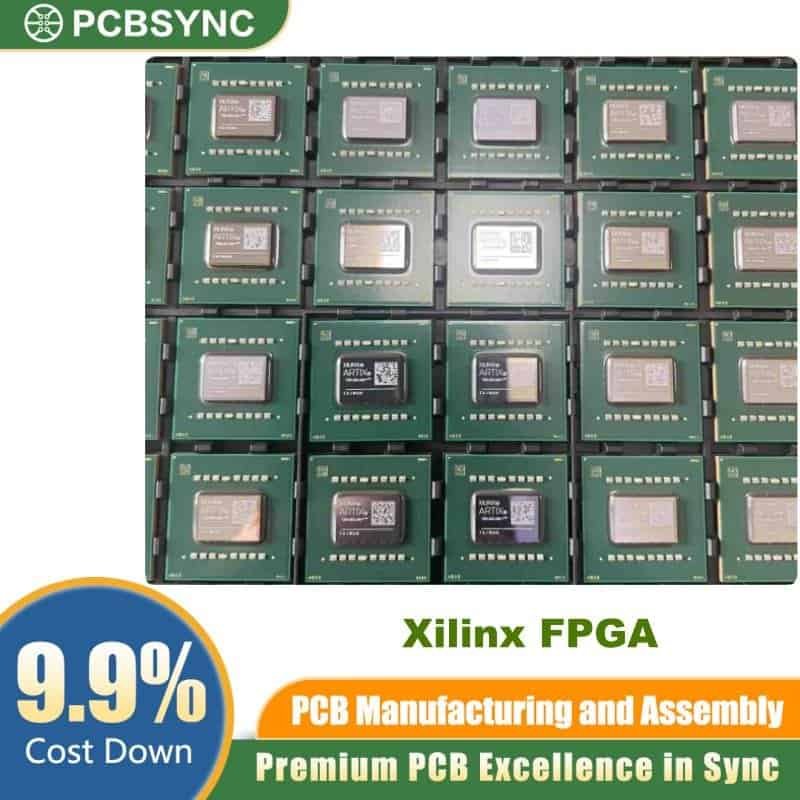
The XCKU115-1FLVD1924C is a high-performance Field Programmable Gate Array (FPGA) manufactured by AMD Xilinx, belonging to the flagship Kintex UltraScale family. Designed for demanding applications in 100G networking, data centers, medical imaging, and wireless infrastructure, this device delivers an industry-leading price-to-performance ratio at the 20nm process node. Whether you are an embedded systems engineer, hardware architect, or procurement specialist, this guide covers everything you need to know about the XCKU115-1FLVD1924C.
What Is the XCKU115-1FLVD1924C?
The XCKU115-1FLVD1924C is part of AMD Xilinx’s Kintex UltraScale FPGA series, a family built on the advanced UltraScale architecture. The part number breaks down as follows:
| Part Number Segment |
Meaning |
| XCKU115 |
Kintex UltraScale, 115 device (largest in the KU series) |
| -1 |
Speed grade 1 (standard performance) |
| FLVD |
Package type: Flip-Chip Land Grid Array, Low-Profile, Variant D |
| 1924 |
1924 total pin count |
| C |
Commercial temperature grade (0°C to +100°C) |
As a Xilinx FPGA, the XCKU115-1FLVD1924C uses both monolithic and stacked silicon interconnect (SSI) technology to deliver the highest signal processing bandwidth available in a mid-range device.
XCKU115-1FLVD1924C Key Specifications
Core Logic and Fabric Resources
| Parameter |
Value |
| FPGA Family |
Kintex UltraScale |
| Logic Cells |
1,160,880 |
| System Logic Cells |
1,451,100 |
| CLB Flip-Flops |
1,326,720 |
| Look-Up Tables (LUTs) |
663,360 |
| Process Node |
20nm |
Memory Resources
| Resource |
Value |
| Block RAM (BRAM) |
75.9 Mb total |
| Total RAM Bits |
~77,722 Kbit |
| UltraRAM Blocks |
Supported (on UltraScale+ variants) |
DSP and Signal Processing
| Resource |
Value |
| DSP Slices |
5,520 |
| Peak DSP Performance |
High-bandwidth signal processing |
The DSP-to-logic ratio of the XCKU115-1FLVD1924C is one of the highest in its class, making it the go-to solution for compute-intensive applications such as radar processing, high-frequency trading (HFT) algorithms, and 5G baseband processing.
I/O and Connectivity
| Parameter |
Value |
| User I/O Pins |
832 |
| GTH Transceivers |
64 |
| Maximum Transceiver Data Rate |
Up to 16.3 Gb/s (GTH) |
| Clock Management Tiles (CMT) |
MMCM and PLL |
| Maximum Operating Frequency |
~630 MHz |
| I/O Supply Voltage |
Up to 3.3V |
Package and Electrical
| Parameter |
Value |
| Package |
1924-Pin FCBGA (Flip-Chip Ball Grid Array) |
| Package Designation |
FLVD1924 |
| Core Supply Voltage |
0.95V (922 mV – 979 mV range) |
| Temperature Grade |
Commercial (0°C to +100°C) |
| RoHS Compliant |
Yes |
| Speed Grade |
-1 (Standard) |
XCKU115-1FLVD1924C Part Number Breakdown
Understanding the part numbering system helps engineers compare variants and select the right device.
Speed Grade Comparison (XCKU115 Family)
| Speed Grade |
Suffix |
Typical Use |
| -1 (Standard) |
XCKU115-1FLVD1924C |
General-purpose, cost-sensitive designs |
| -2 (Fast) |
XCKU115-2FLVD1924E |
Higher clock performance requirements |
| -3 (Fastest) |
XCKU115-3FLVD1924E |
Maximum speed, aerospace/defense |
| -1L (Low Power) |
XCKU115-L1FLVD1924I |
Power-constrained deployments |
Temperature Grade Comparison
| Suffix |
Grade |
Range |
| C |
Commercial |
0°C to +100°C |
| I |
Industrial |
–40°C to +100°C |
| E |
Extended |
0°C to +100°C (extended screening) |
Architecture Overview: Kintex UltraScale Technology
## What Makes UltraScale Architecture Different?
The UltraScale architecture introduced by AMD Xilinx was a generational leap over the older 7-Series devices. The XCKU115-1FLVD1924C benefits from all of these architectural advances:
ASIC-Like Clocking: Fine-grained clock gating eliminates unnecessary switching activity, reducing dynamic power by up to 40% compared to previous-generation FPGAs.
Next-Generation GTH Transceivers: The 64 embedded GTH transceivers support high-speed serial communication protocols including PCIe Gen3, 100GbE, Interlaken, OTN, and JESD204B — directly on chip with no external serializer/deserializer (SerDes) required.
SSI Technology: For the XCKU115, AMD Xilinx employs stacked silicon interconnect (SSI) technology, bonding multiple silicon dies together into a single package. This achieves a larger effective device size while maintaining high yield and competitive pricing.
UltraRAM (Selected Variants): On-chip UltraRAM blocks provide large, high-bandwidth memory without requiring external SRAM or DDR, helping to reduce bill-of-materials (BOM) cost and PCB complexity.
Target Applications for XCKU115-1FLVD1924C
#### 100G Networking and Data Center
The XCKU115-1FLVD1924C is purpose-built for 100 Gigabit Ethernet (100GbE) packet processing. Its 64 GTH transceivers, coupled with on-chip hard IP for Ethernet FEC and MAC, allow designers to build high-throughput network line cards, SmartNICs, and data center switches without a separate ASIC.
#### DSP-Intensive Signal Processing
With 5,520 DSP48E2 slices, the XCKU115-1FLVD1924C delivers massive multiply-accumulate throughput for:
- Medical imaging (CT reconstruction, MRI signal processing, ultrasound beamforming)
- Radar and electronic warfare (pulse compression, STAP, waveform generation)
- Software-defined radio (SDR) and heterogeneous wireless infrastructure
- Financial HFT (low-latency market data processing and order matching)
#### 8K4K Video Processing
The device supports real-time processing of 8K Ultra High Definition (UHD) video streams, including format conversion, multi-channel compression, and real-time effects pipelines used in broadcast production.
#### Heterogeneous Wireless Infrastructure
The XCKU115-1FLVD1924C is widely deployed in Remote Radio Heads (RRH) and Digital Front-End (DFE) units for LTE, 5G NR, and millimeter-wave systems. The combination of high DSP density and multi-gigabit serial transceivers meets the demanding processing requirements of modern wireless base stations.
Development Tools: Programming the XCKU115-1FLVD1924C
Vivado Design Suite
AMD Xilinx’s Vivado Design Suite is the primary toolchain for targeting the XCKU115-1FLVD1924C. Vivado offers:
- RTL synthesis and place-and-route optimized for UltraScale devices
- Out-of-context (OOC) compilation for faster iterative design
- Integrated logic analyzer (ILA) and virtual I/O (VIO) for in-system debug
- IP Integrator for rapid block design assembly
Supported IP Cores
The XCKU115-1FLVD1924C is compatible with a wide range of Xilinx IP cores available in the Vivado IP Catalog, including:
| IP Core |
Application |
| 100G Ethernet Subsystem |
Data center networking |
| PCIe Gen3 x16 |
Host interface for server applications |
| JESD204B |
High-speed ADC/DAC interfacing |
| CPRI / eCPRI |
Fronthaul for 5G RAN |
| DDR4 Memory Controller |
External high-bandwidth memory |
| FEC IP |
Forward error correction for optical links |
Ordering Information and Variants
XCKU115 Package Options
The XCKU115 die is available in multiple package configurations to suit different board constraints:
| Part Number |
Package |
Pins |
User I/O |
Temperature |
| XCKU115-1FLVD1924C |
FCBGA-1924 |
1924 |
832 |
Commercial |
| XCKU115-1FLVD1924I |
FCBGA-1924 |
1924 |
832 |
Industrial |
| XCKU115-1FLVD1517C |
FCBGA-1517 |
1517 |
624 |
Commercial |
| XCKU115-1FLVB2104C |
FCBGA-2104 |
2104 |
832 |
Commercial |
| XCKU115-2FLVD1924E |
FCBGA-1924 |
1924 |
832 |
Extended |
Compliance and Certifications
| Standard |
Status |
| RoHS (Restriction of Hazardous Substances) |
Compliant |
| REACH |
Compliant |
| Moisture Sensitivity Level (MSL) |
Per JEDEC J-STD-020 |
| Export Classification (ECCN) |
Consult AMD Xilinx for current classification |
XCKU115-1FLVD1924C vs. Competing Devices
How Does It Compare Within the Kintex UltraScale Family?
| Device |
Logic Cells |
DSP Slices |
GTH Transceivers |
User I/O (1924-pin) |
| XCKU035 |
341,550 |
1,872 |
20 |
— |
| XCKU060 |
725,625 |
2,760 |
32 |
— |
| XCKU085 |
892,800 |
4,320 |
48 |
— |
| XCKU115 |
1,451,100 |
5,520 |
64 |
832 |
The XCKU115-1FLVD1924C is the largest device in the Kintex UltraScale family, offering maximum logic density, DSP resources, and I/O count in the most capable package.
Frequently Asked Questions (FAQ)
What is the difference between XCKU115-1FLVD1924C and XCKU115-1FLVF1924C?
Both parts use the XCKU115 die in the 1924-pin FCBGA package, but they differ in the exact package variant:
- FLVD = Flip-Chip Land-Grid Array, Low-Profile, Variant D (832 user I/Os available)
- FLVF = Flip-Chip Land-Grid Array, Low-Profile, Variant F (728 user I/Os available in that configuration)
Always verify the I/O count and pinout with the AMD Xilinx packaging documentation to ensure compatibility with your PCB layout.
Is the XCKU115-1FLVD1924C pin-compatible with other XCKU115 variants?
Pin compatibility depends on the package. Parts sharing the same package designator (e.g., FLVD1924) may be pin-compatible across speed grades and temperature grades. Always consult AMD Xilinx’s official packaging documentation and migration guides before assuming pin compatibility.
What software tools are required to program the XCKU115-1FLVD1924C?
The XCKU115-1FLVD1924C requires AMD Vivado Design Suite 2014.1 or later for synthesis, implementation, and bitstream generation. For in-system programming, a compatible JTAG cable (e.g., Xilinx Platform Cable USB II or Digilent JTAG-HS3) is required.
Does the XCKU115-1FLVD1924C support partial reconfiguration?
Yes. Like all UltraScale devices, the XCKU115-1FLVD1924C supports Partial Reconfiguration (PR), allowing sections of the FPGA fabric to be reprogrammed at runtime without affecting the rest of the design. This is particularly valuable in 5G and cognitive radio applications.
Summary: Why Choose the XCKU115-1FLVD1924C?
The XCKU115-1FLVD1924C stands out as the premier choice for engineers who need maximum FPGA resources in a cost-effective, commercially graded package. Its combination of 1.45 million logic cells, 5,520 DSP slices, 64 GTH transceivers, and 832 user I/Os — all housed in the widely supported 1924-pin FCBGA package — makes it one of the most capable mid-range FPGAs ever produced.
Built on the proven UltraScale architecture with 20nm process technology, and fully supported by AMD Xilinx’s mature Vivado toolchain and ecosystem, the XCKU115-1FLVD1924C enables faster time-to-market for complex designs in networking, defense, broadcast, medical, and financial technology.