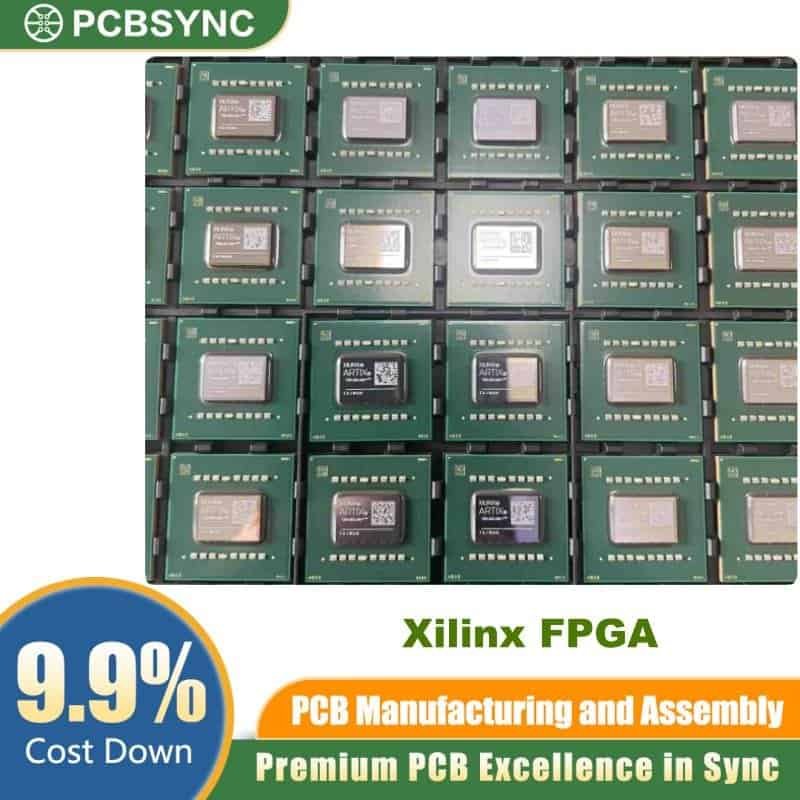
The XCKU115-1FLVB2104C is a high-performance field-programmable gate array (FPGA) from AMD Xilinx, belonging to the Kintex UltraScale family. Built on a 20nm architecture and housed in a 2104-pin FCBGA package, this device delivers an exceptional combination of signal processing power, transceiver bandwidth, and cost efficiency — making it a go-to solution for demanding mid-range FPGA applications. If you are looking for a capable Xilinx FPGA for your next design, the XCKU115-1FLVB2104C deserves serious consideration.
What Is the XCKU115-1FLVB2104C?
The XCKU115-1FLVB2104C is a commercial-grade (0°C to 100°C), speed-grade -1, Kintex UltraScale FPGA. It is the flagship device in the KU115 sub-family, integrating over 1.16 million logic cells alongside a massive array of DSP slices, block RAM, and high-speed transceivers. The part number breaks down as follows:
| Field |
Value |
Meaning |
| XC |
XC |
Xilinx Commercial |
| KU |
KU |
Kintex UltraScale |
| 115 |
115 |
Density designator (largest in family) |
| -1 |
-1 |
Speed grade (slowest/most conservative) |
| FLV |
FLV |
FCBGA, Low Voltage |
| B |
B |
Silicon revision |
| 2104 |
2104 |
Number of package pins |
| C |
C |
Commercial temperature range (0°C to 100°C) |
Key Specifications at a Glance
| Parameter |
Value |
| Manufacturer |
AMD (Xilinx) |
| Part Number |
XCKU115-1FLVB2104C |
| FPGA Family |
Kintex UltraScale |
| Process Node |
20nm |
| System Logic Cells |
1,160,880 |
| CLB Flip-Flops |
1,063,680 |
| Logic Slices (CLBs) |
663,360 |
| DSP Slices |
5,520 |
| Block RAM (Mb) |
~75.9 Mb |
| GTH Transceivers |
64 |
| Maximum User I/O |
702 |
| Package |
2104-pin FCBGA (55mm × 55mm) |
| Core Supply Voltage |
0.95V |
| Speed Grade |
-1 (Commercial) |
| Operating Temperature |
0°C to 100°C (Commercial) |
| RoHS Compliance |
Yes |
| MMCM / PLL |
12 MMCMs / 24 PLLs |
XCKU115-1FLVB2104C: Detailed Technical Features
H3: Fabric and Logic Resources
The XCKU115-1FLVB2104C leverages AMD’s UltraScale architecture, which uses an ASIC-like design methodology to eliminate traditional FPGA routing bottlenecks. With 1,160,880 system logic cells and 663,360 configurable logic blocks (CLBs), the device supports highly complex designs that would otherwise require multiple smaller FPGAs or expensive ASICs. Both monolithic and stacked silicon interconnect (SSI) technology are employed to achieve this density within a single package.
H4: DSP Performance
With 5,520 DSP48E2 slices, the XCKU115-1FLVB2104C delivers the highest DSP processing bandwidth in the Kintex UltraScale mid-range class. Each DSP48E2 slice supports 27×18-bit multiplications, pre-adders, and cascading capabilities. This translates directly to high-throughput signal processing performance essential for radar, image processing, and wireless baseband applications.
H4: Memory Architecture
The device includes a large on-chip block RAM array totaling approximately 75.9 Mb of true dual-port block RAM, organized for flexible width and depth configurations. This is complemented by a rich UltraRAM option on UltraScale+ successors; on the KU115, the block RAM-to-logic ratio is deliberately optimized for DSP-centric workloads such as filter banks, FIFOs, and packet buffers.
H3: High-Speed Transceivers
The XCKU115-1FLVB2104C includes 64 GTH (Gigabit Transceiver High-performance) channels capable of operating at line rates suitable for 100G Ethernet, PCIe Gen3, Interlaken, CPRI, and JESD204B interfaces. These transceivers support advanced equalization, clock data recovery (CDR), and are organized into quads of four channels each for efficient clocking and layout.
| Transceiver Type |
Count |
Max Line Rate |
Key Protocols |
| GTH |
64 |
Up to ~16.375 Gbps |
100GbE, PCIe Gen3, CPRI, JESD204B |
H3: I/O and Packaging
The 2104-pin FCBGA (Flip-Chip Ball Grid Array) package provides access to up to 702 maximum user I/Os, distributed across multiple HP (High-Performance) and HR (High-Range) I/O banks. The high-performance I/O banks support LVDS, DDR4/DDR3, and various single-ended standards at speeds up to 1,600 Mb/s.
| I/O Feature |
Detail |
| Maximum User I/O |
702 |
| Package Pin Count |
2104 |
| Package Body Size |
55mm × 55mm |
| HP I/O Banks |
Multiple (supports 1.0V–1.8V VCCIO) |
| Max LVDS Pairs |
336+ |
| SelectIO Standards |
LVDS, LVCMOS, SSTL, POD, HSUL |
H3: Clocking Architecture
The device features 12 Mixed-Mode Clock Managers (MMCMs) and 24 Phase-Locked Loops (PLLs), enabling flexible clock generation, multiplication, and deskewing across the entire fabric. This ASIC-like clocking structure supports fine-granular clock gating for aggressive power management without sacrificing performance.
H3: Power and Process Technology
Fabricated on TSMC’s 20nm planar process, the XCKU115-1FLVB2104C delivers up to 40% lower dynamic power compared to previous-generation 28nm Kintex-7 devices at equivalent logic density. The core operates at 0.95V VCCINT, reducing overall system power consumption and simplifying power supply design.
H2: XCKU115-1FLVB2104C Part Number Variants Comparison
The KU115 device is available in multiple speed grades, temperature ranges, and packages. The table below shows how the XCKU115-1FLVB2104C compares to related variants:
| Part Number |
Speed Grade |
Temperature |
Package |
Pins |
Key Difference |
| XCKU115-1FLVB2104C |
-1 |
Commercial (0–100°C) |
FCBGA |
2104 |
This product |
| XCKU115-2FLVB2104C |
-2 |
Commercial (0–100°C) |
FCBGA |
2104 |
Higher speed grade |
| XCKU115-1FLVB2104I |
-1 |
Industrial (−40–100°C) |
FCBGA |
2104 |
Extended temp |
| XCKU115-1FLVB1760C |
-1 |
Commercial (0–100°C) |
FCBGA |
1760 |
Smaller package |
| XCKU115-1FLVA2104C |
-1 |
Commercial (0–100°C) |
FCBGA |
2104 |
A-grade silicon |
H2: Target Applications for the XCKU115-1FLVB2104C
The XCKU115-1FLVB2104C is purpose-built for applications that demand massive parallelism, high-bandwidth I/O, and advanced DSP capability. Key application areas include:
H3: 100G Networking and Data Center
With 64 GTH transceivers and over 5,500 DSP slices, this device handles 100 Gigabit Ethernet line-rate packet processing, deep-packet inspection, and network function virtualization (NFV) workloads without external co-processors.
H3: DSP-Intensive Signal Processing
The 5,520 DSP48E2 slices make the XCKU115-1FLVB2104C ideal for radar signal processing, software-defined radio (SDR), OFDM modems, forward error correction (FEC), and beamforming in phased-array antenna systems.
H3: Medical Imaging
High-performance medical systems such as MRI, CT reconstruction, and ultrasound beamformers benefit from the device’s DSP density and low latency I/O, enabling real-time image pipeline processing previously only achievable with custom ASICs.
H3: Video and Broadcast
The device supports 8K4K video processing pipelines, multi-channel encode/decode, and HDR tone mapping — tasks that demand both the logic density and the memory bandwidth provided by the KU115.
H3: Wireless Infrastructure
Heterogeneous wireless base stations (LTE, 5G NR, CPRI/eCPRI fronthaul) rely on the XCKU115’s JESD204B transceiver support, high DSP throughput, and flexible clocking to implement DFE, CFR, and DPD algorithms at baseband.
H2: Development Tools and Design Flow
The XCKU115-1FLVB2104C is fully supported by AMD Vivado Design Suite, which provides:
| Tool |
Function |
| Vivado Synthesis |
RTL to netlist, with technology-aware optimization |
| Vivado Implementation |
Placement, routing, and timing closure |
| Vivado Simulator |
Functional and timing simulation |
| Vivado IP Integrator |
Block design with pre-validated IP |
| SDK / Vitis |
Embedded software development (if using soft CPU) |
| ChipScope / ILA |
In-system debugging and logic analysis |
The device supports MicroBlaze soft-processor cores and is compatible with a wide range of Xilinx IP cores including AXI4 interconnects, PCIe endpoint IP, Ethernet subsystems, and FEC cores available through the Vivado IP Catalog.
H2: Ordering and Availability Information
| Attribute |
Detail |
| Manufacturer Part Number |
XCKU115-1FLVB2104C |
| Manufacturer |
AMD (formerly Xilinx) |
| DigiKey Part Number |
122-2110-ND |
| Product Category |
Embedded – FPGAs (Field Programmable Gate Array) |
| RoHS Status |
RoHS Compliant |
| Moisture Sensitivity Level |
MSL 3 (See JEDEC J-STD-020) |
| Lead Finish |
SnAgCu (Lead-Free) |
| Warranty |
12 months from date of purchase |
Note: The XCKU115-1FLVB2104C is a Non-Cancellable, Non-Returnable (NCNR) component due to its specialized nature. Confirm design requirements before ordering.
H2: Frequently Asked Questions (FAQ)
H3: What is the difference between XCKU115-1FLVB2104C and XCKU115-2FLVB2104C?
The primary difference is the speed grade. The -1 suffix indicates a slower timing bin, which typically means more conservative timing margins and potentially lower cost. The -2 variant offers higher maximum operating frequencies. Both devices are identical in logic resources and package.
H3: Is the XCKU115-1FLVB2104C RoHS compliant?
Yes. The XCKU115-1FLVB2104C uses a lead-free SnAgCu ball finish and is fully RoHS compliant.
H3: What is the maximum operating temperature for the XCKU115-1FLVB2104C?
The C suffix denotes the commercial temperature range: 0°C to +100°C junction temperature. For industrial temperature applications (−40°C to +100°C), the XCKU115-1FLVB2104I should be selected instead.
H3: What design software supports the XCKU115-1FLVB2104C?
AMD’s Vivado Design Suite provides full support, including synthesis, implementation, IP integration, and simulation. Vivado HLS (now Vitis HLS) is also available for C/C++ to RTL synthesis.
H3: What package does the XCKU115-1FLVB2104C use?
The device is packaged in a 2104-pin Flip-Chip Ball Grid Array (FCBGA) measuring 55mm × 55mm with a 1.0mm ball pitch.
H2: Summary
The XCKU115-1FLVB2104C stands as one of the most capable devices in the Kintex UltraScale family, combining 1.16 million logic cells, 5,520 DSP slices, 64 GTH transceivers, and 702 user I/Os in a single 2104-pin FCBGA package — all on a power-efficient 20nm process. Whether your design targets 100G networking, advanced radar signal processing, medical imaging, or next-generation wireless infrastructure, the XCKU115-1FLVB2104C delivers the performance density and flexibility needed to bring complex systems to market quickly and cost-effectively.