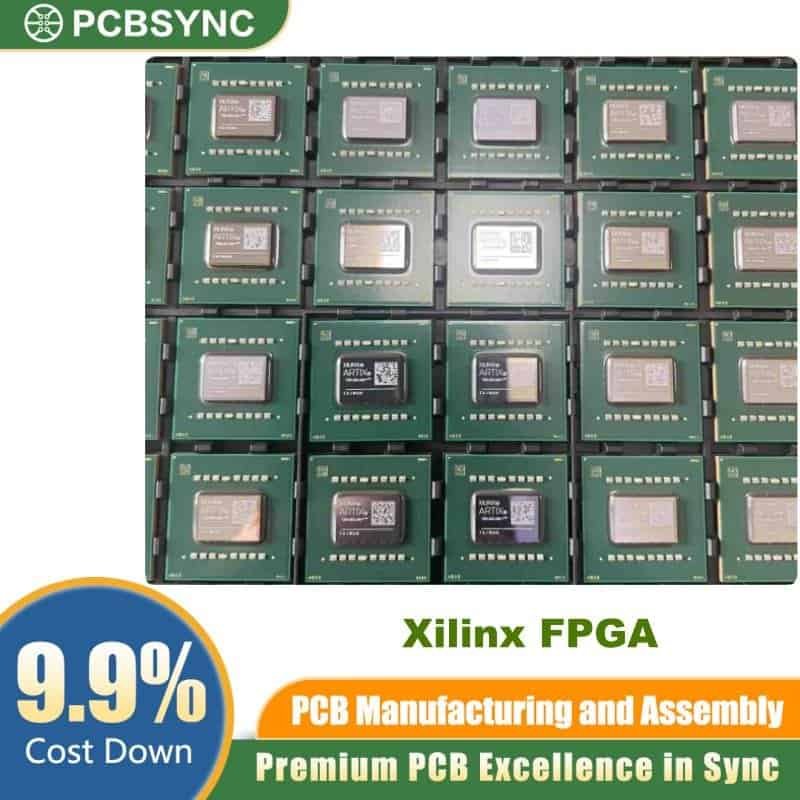
The XCKU115-1FLVB1760C is a high-performance Field Programmable Gate Array (FPGA) manufactured by AMD Xilinx, belonging to the flagship Kintex UltraScale family. Built on a 20nm process node and packaged in a 1760-pin FCBGA form factor, this device delivers an exceptional blend of logic density, DSP throughput, high-speed serial connectivity, and cost-effectiveness — making it one of the most capable mid-range Xilinx FPGA solutions available for demanding production designs.
Whether you are targeting 100G networking, next-generation medical imaging, 8K/4K video processing, or heterogeneous wireless infrastructure, the XCKU115-1FLVB1760C provides the resources and flexibility to meet your most challenging system-level requirements.
What Is the XCKU115-1FLVB1760C?
The XCKU115-1FLVB1760C is part of AMD Xilinx’s Kintex UltraScale product line — the highest-capacity device within this mid-range family. The part number breaks down as follows:
| Part Number Element |
Meaning |
| XCKU115 |
Kintex UltraScale, KU115 die (largest in family) |
| -1 |
Speed grade –1 (slowest/most conservative timing) |
| FLV |
Flip-chip Low-Voltage packaging |
| B |
Ball material variant (lead-free) |
| 1760 |
1760-pin package |
| C |
Commercial temperature range (0°C to +100°C) |
The XCKU115 uses Stacked Silicon Interconnect (SSI) technology, combining two super-logic regions (SLRs) on a single interposer to achieve its massive logic capacity while maintaining a cost-competitive package format.
XCKU115-1FLVB1760C Key Specifications at a Glance
| Parameter |
Value |
| Manufacturer |
AMD (Xilinx) |
| Part Number |
XCKU115-1FLVB1760C |
| FPGA Family |
Kintex UltraScale |
| Process Node |
20nm |
| System Logic Cells |
~1,160,880 |
| Package Type |
FCBGA (Flip-Chip Ball Grid Array) |
| Pin Count |
1760 |
| Core Voltage (VCCINT) |
0.95V |
| Temperature Range |
Commercial (0°C to +100°C) |
| Speed Grade |
–1 |
| User I/O |
Up to 702 |
| SSI Technology |
Yes (2 SLRs) |
| RoHS Compliant |
Yes |
XCKU115-1FLVB1760C Detailed Logic Resources
The XCKU115 die offers some of the densest resource counts available in a mid-range FPGA. The table below summarizes the on-chip programmable logic resources:
| Resource |
XCKU115 Count |
| System Logic Cells |
~1,160,880 |
| CLB LUTs (6-input) |
~663,360 |
| CLB Flip-Flops |
~1,326,720 |
| DSP Slices (27×18) |
5,520 |
| Block RAM (36Kb each) |
2,160 blocks (~75.9 Mb) |
| Max. Distributed RAM |
~36.1 Mb |
| Super-Logic Regions (SLRs) |
2 |
| PCIe Gen3 Hard Blocks |
4 (×8 Gen3) |
| 100G Ethernet MAC |
Yes |
| 150G Interlaken |
Yes |
Note: The XCKU115 uses SSI technology, combining two XCKU060-equivalent dies. Signals cross between SLRs via dedicated, low-latency SLR crossing tiles. For multi-SLR devices, certain device parameters (such as DCI resistance) are multiplied by the number of SLRs.
High-Speed Transceiver Specifications
The XCKU115-1FLVB1760C is equipped with GTH (Gen-3 High-performance) transceivers, which are essential for applications demanding high-bandwidth, low-latency serial communication such as 100G Ethernet, PCIe, Interlaken, and JESD204B.
| Transceiver Parameter |
Specification |
| Transceiver Type |
GTH |
| Maximum Data Rate |
Up to 16.3 Gb/s |
| Transceiver Organization |
Arranged in Quads (4 channels each) |
| Protocol Support |
PCIe Gen3, 100G Ethernet, Interlaken, JESD204B, CPRI, OBSAI |
| PLL Architecture |
Advanced phase-locked loop (QPLL + CPLL per Quad) |
| Parallel Data Widths |
16, 32, or 64 bits (20/40/80 in 8b/10b bypass mode) |
| Equalization |
CTLE + DFE for long-reach/backplane |
| Eye Scan |
Yes (on-chip) |
The GTH transceivers support advanced transmitter pre- and post-emphasis, on-chip eye scan for signal integrity validation, and auto-adaptive receiver equalization — features critical for reliable high-speed board-to-board, optical module, and backplane connections.
Package and Electrical Characteristics
Package Details
| Parameter |
Value |
| Package |
FCBGA (Flip-Chip BGA) |
| Pin Count |
1760 |
| Package Variant |
B (lead-free) |
| Footprint Compatibility |
Compatible with other UltraScale devices in same “B1760” package sequence |
Power Supply Requirements
| Supply Rail |
Typical Voltage |
Purpose |
| VCCINT |
0.95V |
Core logic |
| VCCO |
1.0V / 1.2V / 1.5V / 1.8V / 2.5V / 3.3V |
I/O banks (HP/HR) |
| VCCAUX |
1.8V |
Auxiliary circuits |
| VMGTAVCC |
1.0V |
GTH transceiver analog supply |
| VMGTAVTT |
1.2V |
GTH transceiver termination |
| VMGTVCCAUX |
1.8V |
GTH transceiver aux supply |
The recommended power-on sequence is: VCCINT → VMGTAVCC → VMGTAVTT (or VMGTAVCC and VCCINT simultaneously). Always refer to UltraScale Architecture PCB Design Guide (UG583) for full power distribution system design guidance.
I/O Characteristics
| Parameter |
Detail |
| Max. User I/O (1760 pkg) |
702 |
| I/O Bank Types |
HP (High-Performance) and HR (High-Range) |
| HP I/O Voltage Support |
1.0V, 1.2V, 1.35V, 1.5V, 1.8V |
| HR I/O Voltage Support |
1.2V, 1.5V, 1.8V, 2.5V, 3.3V |
| On-Die Termination (DCI) |
Calibrated, programmable (HP I/O banks) |
| SERDES (IOSERDES) |
High-speed serialization/deserialization on SelectIO |
Block RAM and Memory Architecture
The XCKU115 provides deep on-chip memory resources, allowing designers to store large intermediate data sets without relying on off-chip memory:
| Memory Resource |
XCKU115 Value |
| Block RAM Blocks |
2,160 |
| Block RAM Total Capacity |
~75.9 Mb |
| Block RAM Width |
36 Kb per block (splittable as two 18 Kb) |
| Built-in FIFO Support |
Yes |
| ECC Support |
Yes |
| Distributed RAM (from LUTs) |
~36.1 Mb |
Block RAMs in the UltraScale architecture offer built-in FIFO and ECC (Error-Correcting Code) support, significantly reducing the logic overhead required for memory-intensive designs.
DSP Slice Architecture
With 5,520 DSP48E2 slices, the XCKU115-1FLVB1760C delivers industry-leading signal processing bandwidth for a mid-range device. Each DSP slice features:
| DSP Slice Feature |
Specification |
| Multiplier |
27 × 18 bits |
| Pre-Adder |
27-bit |
| A Input |
30-bit |
| XOR Functionality |
96-bit wide |
| Functions |
Multiply-accumulate, multiply-add, pattern detect |
The wide XOR functionality and pre-adder enable efficient implementation of FIR filters, FFTs, and advanced communications algorithms without consuming additional fabric resources.
Clocking Resources
| Clocking Resource |
Detail |
| Global Clock Networks |
Yes, abundant across SLRs |
| MMCM (Mixed-Mode Clock Manager) |
Yes — per SLR |
| PLL |
Yes — per SLR |
| SLR Clock Crossing |
Dedicated BUFGCE_DIV, BUFGCTRL primitives |
| MicroBlaze Soft Processor |
Supported (>200 DMIPs with 800 Mb/s DDR3 support) |
Hard IP Blocks
The XCKU115-1FLVB1760C integrates several hard IP cores to reduce power consumption and logic usage compared to soft-IP implementations:
| Hard IP Block |
Description |
| PCIe Gen3 ×8 |
Up to 4 integrated blocks |
| 100G Ethernet MAC |
High-speed Ethernet for data center/networking |
| 150G Interlaken |
Chip-to-chip and chip-to-module serial interface |
| CMAC / ILKN |
Hard MAC and Interlaken cores |
Supported Design Tools
The XCKU115-1FLVB1760C is fully supported by AMD’s Vivado Design Suite, which provides comprehensive synthesis, implementation, simulation, and verification tools.
| Tool |
Details |
| Vivado Design Suite |
Full support (Design / System Edition required) |
| Vivado HLS |
High-Level Synthesis from C/C++ |
| HDL Support |
Verilog, VHDL, SystemVerilog |
| IP Integrator |
Block design environment |
| SDx Toolchain |
For embedded + accelerator designs |
| Constraint File |
XDC (Xilinx Design Constraints) |
The XCKU115 is not supported by the free Vivado WebPACK edition. A Vivado Design Edition license or higher is required.
Typical Application Areas
The XCKU115-1FLVB1760C is engineered for high-throughput, latency-sensitive, and DSP-heavy use cases:
| Application |
Why XCKU115 Excels |
| 100G/400G Networking |
GTH transceivers + 100G MAC hard IP |
| Data Center Acceleration |
High LUT + DSP density, PCIe Gen3 |
| Medical Imaging |
5,520 DSP slices for real-time processing |
| 8K/4K Video Processing |
Large block RAM + distributed RAM capacity |
| Wireless Infrastructure (5G) |
JESD204B, multi-channel DSP, Interlaken |
| Radar & Signal Intelligence |
High logic density, GTH for IF digitization |
| Industrial Automation |
Flexible I/O standards, robust reliability |
| Scientific Instruments |
Large FPGA fabric + high-speed ADC interfacing |
XCKU115-1FLVB1760C vs. Other XCKU115 Variants
The XCKU115 die is available in multiple package/speed-grade/temperature combinations. The table below helps select the right variant for your design:
| Part Number |
Speed Grade |
Temp Range |
Package |
User I/O |
| XCKU115-1FLVB1760C |
–1 |
Commercial |
1760-pin FCBGA |
702 |
| XCKU115-2FLVB1760I |
–2 |
Industrial |
1760-pin FCBGA |
702 |
| XCKU115-1FLVB2104C |
–1 |
Commercial |
2104-pin FCBGA |
~832 |
| XCKU115-2FLVF1924I |
–2 |
Industrial |
1924-pin FCBGA |
~728 |
| XCKU115-1FLVA1517I |
–1 |
Industrial |
1517-pin FCBGA |
~624 |
C suffix = Commercial grade (0°C to 100°C). I suffix = Industrial grade (–40°C to 100°C). Higher pin counts expose additional user I/O from the same die.
Part Number Decoding Guide
Understanding the XCKU115-1FLVB1760C naming convention makes comparing variants straightforward:
| Field |
Code |
Meaning |
| Family |
XC |
Xilinx FPGA |
| Sub-family |
KU |
Kintex UltraScale |
| Density |
115 |
Die size / logic capacity tier |
| Speed Grade |
-1 |
Slowest (most power efficient); -2 is faster; -3 fastest |
| Package Code |
FLV |
Flip-chip Low-Voltage BGA |
| Ball Material |
B |
Ball variant (lead-free) |
| Pin Count |
1760 |
Number of package pins |
| Temp |
C |
Commercial (0°C to +100°C); I = Industrial |
Ordering and Compliance Information
| Attribute |
Details |
| Manufacturer |
AMD (formerly Xilinx) |
| Part Number |
XCKU115-1FLVB1760C |
| Package |
1760-Ball FCBGA |
| RoHS Status |
RoHS Compliant |
| ECCN |
Consult AMD export compliance documentation |
| Warranty |
12 months from date of purchase (standard) |
| NCNR Status |
This device is typically Non-Cancellable / Non-Returnable (NCNR) |
Frequently Asked Questions (FAQ)
What is the XCKU115-1FLVB1760C used for?
The XCKU115-1FLVB1760C is used in applications requiring very high logic density, large numbers of DSP slices, and high-speed serial connectivity. Common uses include 100G networking, data center acceleration, medical imaging, 8K video processing, and 5G wireless infrastructure.
What is the difference between the –1, –2, and –3 speed grades?
The speed grade indicates the timing performance of the device. A –1 device is the slowest (most power-efficient and conservative) while –3 is the fastest. For commercial temperature applications with standard performance requirements, –1 is the typical choice.
Does the XCKU115-1FLVB1760C support PCIe?
Yes. The XCKU115 integrates up to 4 hard PCIe Gen3 ×8 blocks, enabling high-bandwidth host connectivity without consuming programmable fabric resources.
Is the XCKU115 compatible with Vivado?
Yes, but it requires a Vivado Design Edition or System Edition license. It is not supported by the free Vivado WebPACK edition.
What memory interfaces does the XCKU115 support?
The XCKU115 supports DDR4, DDR3, LPDDR4, QDR II+, and other high-speed memory interfaces through its HP I/O banks, which support voltages down to 1.0V for modern DDR4 operation.
Can the XCKU115-1FLVB1760C be used in industrial temperature applications?
No — the C suffix indicates a commercial temperature range (0°C to +100°C). For industrial-grade operation (–40°C to +100°C), select a variant with the I suffix, such as XCKU115-1FLVB1760I.
Summary
The XCKU115-1FLVB1760C represents the peak of AMD Xilinx’s Kintex UltraScale family — combining approximately 1.16 million system logic cells, 5,520 DSP slices, 2,160 Block RAM blocks, up to 702 user I/O pins, and GTH transceivers capable of 16.3 Gb/s in a 1760-pin FCBGA package at a 0.95V core voltage. Its dual-SLR SSI architecture bridges the gap between traditional monolithic FPGAs and full Virtex-class devices, delivering Virtex-tier capacity at a more accessible price point. Designed for commercial temperature operation and supported by the Vivado Design Suite, this device is a proven platform for the most demanding signal processing, networking, and compute acceleration workloads.