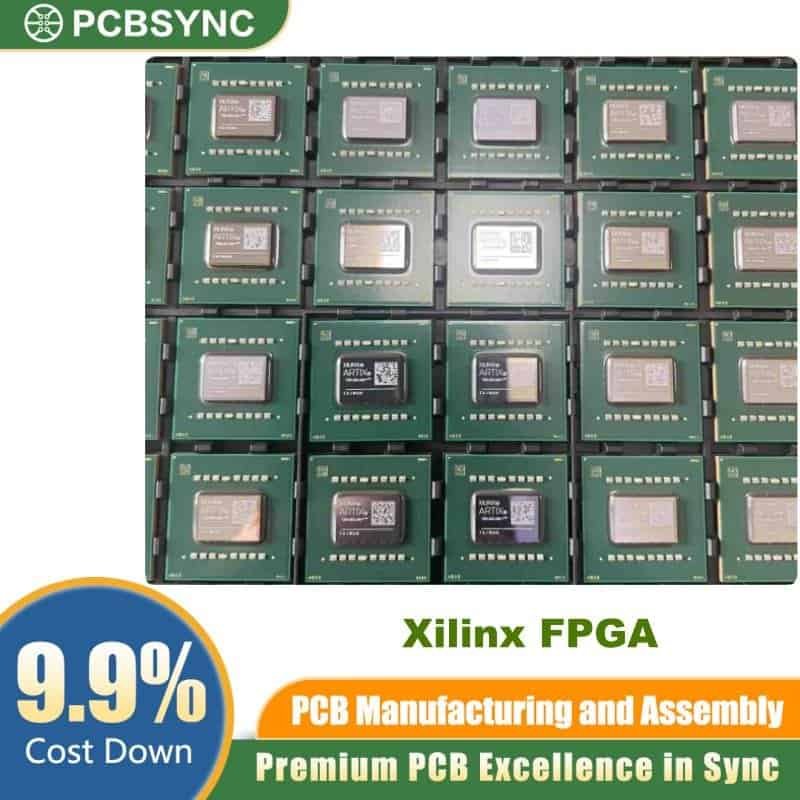
The XCKU095-1FFVB2104I is a high-performance, industrial-grade Xilinx FPGA from the Kintex® UltraScale™ family, manufactured by AMD (formerly Xilinx). Built on a 20 nm process node and housed in a 2104-pin FCBGA package, this device delivers an outstanding balance of logic density, DSP throughput, high-speed serial connectivity, and power efficiency — making it one of the most capable mid-range FPGAs available for demanding applications in networking, wireless infrastructure, medical imaging, and data center computing.
What Is the XCKU095-1FFVB2104I?
The XCKU095-1FFVB2104I is a member of AMD Xilinx’s Kintex UltraScale FPGA series, designed to provide the best price/performance/watt ratio at the 20 nm technology node. The “XCKU095” denotes the device die, “-1” indicates the speed grade (standard production), “FFVB2104” specifies the 2104-pin flip-chip ball grid array (FCBGA) package, and the trailing “I” confirms industrial temperature grade operation (-40°C to +100°C junction temperature).
This combination makes the XCKU095-1FFVB2104I a highly versatile, rugged, and scalable component for professional and industrial design teams who need a single device to handle complex logic, heavy signal processing, and multi-protocol high-speed interfaces.
XCKU095-1FFVB2104I Key Specifications
General Identification
| Parameter |
Value |
| Part Number |
XCKU095-1FFVB2104I |
| Manufacturer |
AMD (Xilinx) |
| Family |
Kintex® UltraScale™ |
| Technology Node |
20 nm |
| Speed Grade |
-1 (Standard) |
| Package Type |
FCBGA (Flip-Chip Ball Grid Array) |
| Pin Count |
2104 |
| Temperature Grade |
Industrial (Tj: -40°C to +100°C) |
| VCCINT Supply Voltage |
0.922 V to 0.979 V (nominal 0.95 V) |
Logic Resources
| Resource |
XCKU095 Count |
| CLB Logic Cells |
1,176,000 |
| CLB LUTs (6-input) |
537,600 |
| CLB Flip-Flops / Registers |
1,075,200 |
| Max User I/O (FFVB2104 package) |
702 |
| Distributed RAM |
~16.5 Mb |
The configurable logic blocks (CLBs) in the XCKU095 use 6-input look-up tables (LUTs) that can also be configured as distributed memory, shift registers, or multiplexers — giving designers maximum flexibility without consuming dedicated block RAM resources.
Memory Resources
| Memory Type |
Capacity |
| Block RAM (36Kb blocks) |
1,080 blocks |
| Total Block RAM |
~38 Mb |
| Block RAM Features |
Built-in FIFO, ECC support |
The 36 Kb block RAMs support read-first, write-first, and no-change modes, with optional error correction coding (ECC) for safety-critical applications. Each block can also be split into two independent 18 Kb RAMs for finer-grained memory management.
DSP and Signal Processing
| Parameter |
Value |
| DSP48E2 Slices |
1,680 |
| DSP Multiplier Width |
27 × 18 bits |
| Pre-Adder Width |
27 bits |
| Maximum FMAX (Speed Grade -1) |
594 MHz |
| Maximum DSP Throughput (-1 grade) |
~6,558 GMAC/s |
Each DSP48E2 slice includes a 27-bit pre-adder, a 27×18-bit multiplier, a 48-bit accumulator, and 96-bit XOR functionality. This architecture is ideal for floating-point math, FIR/IIR filters, FFT pipelines, and forward error correction (FEC) algorithms including CRC, ECC, and enhanced FEC (EFEC).
High-Speed Serial Transceivers
| Transceiver Type |
Count |
Max Data Rate |
| GTH Transceivers |
32 |
Up to 16.3 Gb/s |
| GTY Transceivers |
32 |
Up to 16.3 Gb/s (in KU095) |
| Total Transceivers |
64 |
— |
The XCKU095-1FFVB2104I features 64 high-speed serial transceivers, enabling multi-protocol serial connectivity for applications such as 100G Ethernet, PCIe Gen3, Interlaken (up to 150G), and OTU4. The transceivers are engineered for superior signal integrity in real-world environments with advanced equalization and CDR circuits.
Clocking Resources
| Resource |
Detail |
| MMCMs (Mixed-Mode Clock Manager) |
16 |
| PLLs |
40 |
| Clock Regions |
16 (5×8 array, FFVB2104 package) |
| HR I/O Banks |
1 |
| HP I/O Banks |
15 |
The ASIC-like clocking architecture in the Kintex UltraScale family provides deterministic, low-skew clock distribution across the entire device. MMCMs enable fine-grained clock synthesis, deskewing, and phase shifting, while the dual PLL architecture offers separate frequency domains for mixed-signal applications.
PCIe and Protocol Blocks
| Feature |
Detail |
| PCIe Blocks |
4 |
| PCIe Generation |
Gen3 (up to 8 GT/s) |
| 100G Ethernet MACs |
2 |
| 150G Interlaken |
2 |
| Memory Controller |
DDR4 support |
| Serial Memory |
Hybrid Memory Cube (HMC) support |
Package and Physical Characteristics
| Parameter |
Value |
| Package Designator |
FFVB2104 |
| Package Dimensions |
~52.5 mm × 52.5 mm |
| Ball Pitch |
1.0 mm |
| HR I/Os (FFVB2104) |
52 |
| HP I/Os (FFVB2104) |
650 |
| Mounting Style |
Surface Mount (SMD) |
XCKU095-1FFVB2104I Part Number Decoder
Understanding the AMD Xilinx FPGA part numbering system helps engineers quickly identify key parameters:
| Field |
Value |
Meaning |
| XC |
XC |
Xilinx Commercial Silicon |
| Family |
KU |
Kintex UltraScale |
| Device |
095 |
Die size / logic density variant |
| Speed Grade |
-1 |
Standard speed grade (0.95 V VCCINT) |
| Package |
FF |
Flip-Chip Ball Grid Array |
| Package Variant |
VB |
Package variant identifier |
| Pin Count |
2104 |
2104 solder balls |
| Temperature |
I |
Industrial grade (-40°C to +100°C Tj) |
The industrial “I” suffix means this device is fully characterized and guaranteed to operate reliably across the entire industrial temperature range — a critical requirement for defense, telecom infrastructure, transportation, and harsh-environment industrial systems.
XCKU095-1FFVB2104I vs. XCKU095-2FFVB2104I: Speed Grade Comparison
Engineers often evaluate both speed grades when selecting the XCKU095 in the FFVB2104 package. Here is a side-by-side comparison:
| Parameter |
XCKU095-1FFVB2104I |
XCKU095-2FFVB2104I |
| Speed Grade |
-1 (Standard) |
-2 (Mid-High) |
| VCCINT |
0.95 V |
0.95 V |
| Max DSP FMAX |
~594 MHz |
~661 MHz |
| Max DSP Throughput |
~6,558 GMAC/s |
~7,297 GMAC/s |
| Temperature Grade |
Industrial |
Industrial |
| Package |
FCBGA-2104 |
FCBGA-2104 |
| Logic Resources |
Identical |
Identical |
The -1 speed grade is the right choice for most industrial designs where the performance target falls within 594 MHz and cost or power optimization is prioritized. The -2 grade suits designs requiring the higher clock speeds or tighter timing margins.
Top Application Areas for the XCKU095-1FFVB2104I
100G Networking and Packet Processing
The XCKU095-1FFVB2104I is purpose-built for line-rate 100G networking. Its integrated 100G Ethernet MACs, 64 high-speed GTH/GTY transceivers, and 150G Interlaken blocks enable low-latency, deterministic packet forwarding, deep packet inspection (DPI), and traffic shaping in carrier-grade routers and switches.
Wireless Infrastructure (4G/5G)
The device’s extraordinary DSP throughput — up to 6,558 GMAC/s — makes it ideal for baseband processing in 4G LTE and 5G NR radio units. Remote radio head (RRH) DFE, MIMO signal processing (8×8 and beyond), and TD-LTE radio units are among the established use cases for Kintex UltraScale devices in this class.
Medical Imaging
High-resolution medical imaging systems, including MRI, CT, and ultrasound, demand real-time signal acquisition, filtering, and reconstruction at high data rates. The XCKU095-1FFVB2104I’s block RAM depth, distributed memory, and DSP pipeline capacity deliver the compute performance needed for next-generation 8K/4K medical display and image reconstruction pipelines.
Data Center Acceleration
Data center FPGA accelerator cards benefit from the KU095’s PCIe Gen3 ×16 interface and DDR4 memory controller support. Applications include database query acceleration, machine learning inference, video transcoding offload, and financial analytics.
Defense and Aerospace
The industrial temperature grade and rugged packaging of the XCKU095-1FFVB2104I make it appropriate for defense electronics platforms requiring reliable operation in wide temperature excursions, including avionics, radar signal processing, and secure communications.
Development and Design Tools
The XCKU095-1FFVB2104I is fully supported by AMD’s Vivado Design Suite, the industry-standard development environment for UltraScale architecture devices. Vivado provides:
- RTL synthesis, place and route, and timing closure
- IP integrator for rapid block design creation
- Vivado Simulator for functional and timing simulation
- Xilinx Power Estimator (XPE) for accurate power budgeting
- Partial reconfiguration support for dynamic design updates
Minimum supported Vivado version for the XCKU095 is Vivado Tools 2015.3 (speed spec v1.24). Designers should use Vivado 2016.4 or later for production designs to access the final production speed specifications.
Ordering Information
| Parameter |
Value |
| Full Part Number |
XCKU095-1FFVB2104I |
| Manufacturer |
AMD / Xilinx |
| Manufacturer Part Number |
XCKU095-1FFVB2104I |
| Package |
2104-FCBGA |
| RoHS Compliance |
Consult distributor for current status |
| Export Control |
ECCN 3A001 (consult distributor) |
Frequently Asked Questions
What does the “I” suffix mean in XCKU095-1FFVB2104I?
The “I” suffix designates the industrial temperature grade, meaning the device is tested and guaranteed for junction temperatures from -40°C to +100°C. This is in contrast to the “C” (commercial, 0°C to +85°C) and “E” (extended, 0°C to +100°C) grades.
Is the XCKU095-1FFVB2104I footprint-compatible with other UltraScale devices?
Yes. AMD Xilinx UltraScale devices sharing the same package footprint identifier (in this case, “B2104”) are footprint compatible with each other, enabling design scalability and migration — for example, between XCKU095 and XCKU115 in the same B2104 package family.
What memory interfaces does the XCKU095-1FFVB2104I support?
The device supports high-performance external memory interfaces including DDR4, as well as serial memory interfaces such as Hybrid Memory Cube (HMC). The integrated memory controller circuitry is tightly coupled with the clocking network for maximum memory bandwidth and low latency.
Can the XCKU095-1FFVB2104I be used for partial reconfiguration?
Yes. The UltraScale architecture fully supports partial reconfiguration (PR), allowing specific regions of the FPGA to be reprogrammed while the rest of the device continues operating. This is particularly valuable for multi-mode systems, time-sliced hardware acceleration, and adaptive communication platforms.