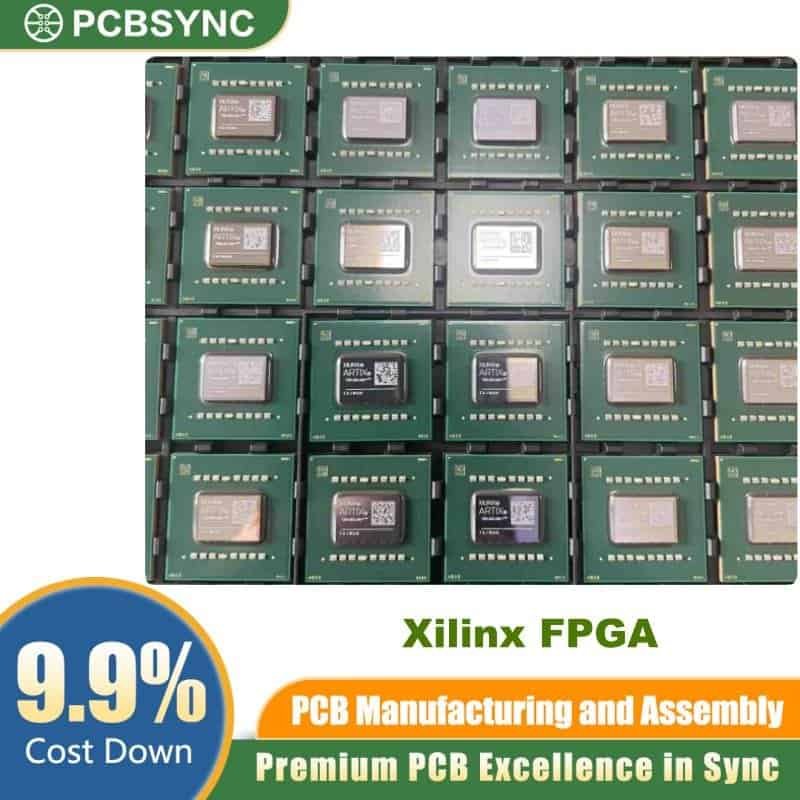
The XCKU095-1FFVB2104C is a high-performance, mid-range FPGA from AMD’s Kintex® UltraScale™ family. Designed for demanding signal processing, data center acceleration, and high-speed communications applications, this device delivers exceptional logic density, advanced DSP capabilities, and multi-gigabit transceiver support — all in a single chip. If you’re looking for a reliable, production-ready Xilinx FPGA for your next design, the XCKU095-1FFVB2104C deserves serious consideration.
What Is the XCKU095-1FFVB2104C?
The XCKU095-1FFVB2104C belongs to AMD Xilinx’s Kintex UltraScale product line — a family engineered on TSMC’s 20nm planar process. “KU095” refers to the specific device size within the Kintex UltraScale series, while “-1” indicates the speed grade (commercial slowest), “FFVB2104” identifies the flip-chip fine-pitch BGA package with 2,104 pins, and “C” denotes the commercial temperature range (0°C to +85°C).
This FPGA targets applications that need more performance than cost-optimized devices but don’t require the extreme scale of Virtex-class parts — making it a sweet spot for engineers working on ASIC prototyping, test & measurement, medical imaging, and wireless infrastructure.
XCKU095-1FFVB2104C Key Specifications
| Parameter |
Value |
| Manufacturer |
AMD (Xilinx) |
| Part Number |
XCKU095-1FFVB2104C |
| Series |
Kintex® UltraScale™ |
| Process Technology |
20nm TSMC |
| Speed Grade |
-1 (Standard) |
| Package |
FFVB2104 (Flip-Chip BGA) |
| Package Pins |
2,104 |
| Temperature Range |
Commercial (0°C to +85°C) |
| Operating Voltage (VCCINT) |
0.95V |
| RoHS Compliant |
Yes |
XCKU095-1FFVB2104C Logic & Fabric Resources
The core logic fabric of the XCKU095-1FFVB2104C is built on Xilinx’s 6-input LUT (LUT6) architecture, providing exceptional efficiency per resource.
| Resource |
Quantity |
| System Logic Cells |
1,143,000 |
| CLB Flip-Flops |
1,056,000 |
| CLB LUTs |
528,000 |
| CLBs |
82,500 |
| Max Distributed RAM (Mb) |
~18 |
| Block RAM Tiles (36Kb) |
912 |
| Total Block RAM (Mb) |
32.1 |
| UltraRAM Blocks (288Kb) |
N/A (UltraRAM introduced in UltraScale+) |
| DSP48E2 Slices |
2,760 |
DSP and Signal Processing Capabilities
High-Performance DSP Architecture
With 2,760 DSP48E2 slices, the XCKU095-1FFVB2104C excels in compute-intensive workloads:
- Each DSP48E2 slice supports 27×18-bit multipliers with pre-adder and post-adder stages
- Cascade chains enable wide arithmetic without routing overhead
- Supports single-instruction, multiple-data (SIMD) configurations
- Peak DSP performance reaches over 900 GMACs at -1 speed grade
This makes the XCKU095-1FFVB2104C ideal for radar signal processing, software-defined radio (SDR), FEC (Forward Error Correction), and image/video processing pipelines.
XCKU095-1FFVB2104C I/O and Connectivity
General Purpose I/O
| I/O Parameter |
Value |
| Maximum User I/O |
520 |
| HP (High Performance) I/O Banks |
Yes |
| HR (High Range) I/O Banks |
Yes |
| VCCO Voltage Range |
1.0V – 3.3V |
| Single-Ended I/O Standards |
LVCMOS, LVTTL, PCI, HSTL, SSTL |
| Differential I/O Standards |
LVDS, RSDS, BLVDS, TMDS |
High-Speed Serial Transceivers (GTH)
| Transceiver Parameter |
Value |
| GTH Transceiver Count |
32 |
| Max Line Rate per GTH |
16.3 Gbps |
| Supported Protocols |
PCIe Gen3, 100GbE, Interlaken, JESD204B, SATA, SAS, CPRI |
| PCIe Hard IP Blocks |
2 × Gen3 ×8 |
The 32 GTH transceivers make this device a powerful choice for high-speed backplane designs, optical networking, and data center switch fabrics.
Package and Physical Dimensions
FFVB2104 Package Details
| Package Parameter |
Value |
| Package Type |
Flip-Chip Ball Grid Array (fcBGA) |
| Total Ball Count |
2,104 |
| Package Body Size |
45mm × 45mm |
| Ball Pitch |
1.0mm |
| Mounting Style |
SMD / Surface Mount |
| Height (Seated) |
~2.69mm |
The large 45mm × 45mm footprint requires careful PCB design with controlled impedance routing, thermal vias, and potentially active or passive heatsink attachment for sustained operation at high utilization.
Clock Management Resources
| Clock Resource |
Count |
| CMTs (Clock Management Tiles) |
12 |
| MMCMs per CMT |
1 |
| PLLs per CMT |
1 |
| Global Clock Buffers (BUFG) |
32 |
| Regional Clock Buffers (BUFR) |
Available per bank |
| Max Input Clock Frequency |
800 MHz (MMCM) |
Twelve CMTs with combined MMCM and PLL resources enable complex, multi-clock domain designs with precise phase relationships — critical for DDR4 memory interfaces and high-speed serial links.
Memory Interface Capabilities
External Memory Support
| Memory Type |
Maximum Interface Width |
Max Data Rate |
| DDR4 |
72-bit (with ECC) |
2,400 Mbps |
| DDR3 |
72-bit (with ECC) |
1,866 Mbps |
| LPDDR3 |
32-bit |
1,600 Mbps |
| QDR II+ |
36-bit |
Supported |
| RLDRAM 3 |
36-bit |
Supported |
The Xilinx Memory Interface Generator (MIG) IP simplifies DDR4 integration with built-in calibration, error correction, and timing closure support.
Configuration and Security
Configuration Options
| Method |
Interface |
| Master SPI |
Up to ×4 (Quad SPI) |
| Slave SelectMAP |
×8, ×16, ×32 |
| JTAG |
Standard IEEE 1149.1 |
| Slave Serial |
Single-bit |
Security Features
- AES-256 bitstream encryption with HMAC authentication
- eFUSE-based key storage
- Secure boot chain support
- RSA-2048 bitstream authentication
Power Consumption Estimates
Power consumption varies significantly with design activity. Below are typical estimates using Xilinx Power Estimator (XPE):
| Power Domain |
Typical Estimate |
| VCCINT (0.95V) Static |
~1.5W |
| Total Static Power |
~3–5W |
| Dynamic Power (50% utilization) |
~10–20W |
| Maximum TDP |
Up to ~35W (high utilization) |
⚠️ Thermal Note: Always run Xilinx Power Estimator (XPE) with your specific design parameters. A heatsink and thermal interface material (TIM) are strongly recommended for sustained operation above 50% resource utilization.
Supported Development Tools
Xilinx/AMD Design Flow
| Tool |
Purpose |
| Vivado Design Suite |
RTL synthesis, implementation, bitstream generation |
| Vitis HLS |
High-level synthesis (C/C++/OpenCL to RTL) |
| Vitis AI |
AI/ML inference acceleration |
| Xilinx Power Estimator (XPE) |
Pre-implementation power analysis |
| ChipScope Pro / ILA |
In-circuit debug and verification |
| Vivado Simulator |
Functional and timing simulation |
The XCKU095-1FFVB2104C is fully supported by Vivado 2014.1 and later (including all Vivado ML editions), ensuring long-term design tool availability.
Target Applications
Where Is the XCKU095-1FFVB2104C Used?
| Industry |
Application |
| Wireless / Telecom |
4G/5G baseband processing, CPRI/eCPRI fronthaul, beamforming |
| Data Center |
Network acceleration, storage controllers, SmartNICs |
| Defense & Aerospace |
Radar, EW signal processing, secure communications |
| Test & Measurement |
High-speed data acquisition, protocol analysis |
| Medical Imaging |
MRI reconstruction, CT scan processing, ultrasound |
| ASIC Prototyping |
Multi-chip ASIC emulation platforms |
| Video & Broadcast |
4K/8K video processing, SDI interfaces |
XCKU095-1FFVB2104C vs. Similar Kintex UltraScale Devices
| Part Number |
Logic Cells |
DSP Slices |
GTH Transceivers |
Block RAM (Mb) |
Package Pins |
| XCKU025-1FFVB676C |
330,000 |
1,080 |
20 |
11.7 |
676 |
| XCKU060-1FFVB1517C |
726,000 |
2,760 |
32 |
21.1 |
1,517 |
| XCKU095-1FFVB2104C |
1,143,000 |
2,760 |
32 |
32.1 |
2,104 |
| XCKU115-1FLVB2104C |
1,451,000 |
5,520 |
32 |
44.3 |
2,104 |
The XCKU095 sits between the KU060 and KU115 in terms of logic density, offering the maximum DSP and transceiver count of the mid-range Kintex UltraScale family with significantly more Block RAM than the KU060.
Ordering Information
| Attribute |
Detail |
| Full Part Number |
XCKU095-1FFVB2104C |
| Manufacturer |
AMD (formerly Xilinx) |
| Product Status |
Active |
| ECCN (Export Classification) |
3E001 |
| HTSUS Code |
8542.39.00.01 |
| RoHS Status |
RoHS Compliant |
| Packaging |
Tray |
| Lead Time |
Varies by distributor (typically 12–26 weeks for production quantities) |
🔍 Procurement Tip: Always verify part authenticity through authorized distribution channels such as Digi-Key, Mouser, or Avnet. Counterfeit FPGAs are a known problem in the secondary market — purchase from authorized sources only.
Frequently Asked Questions (FAQ)
What is the difference between XCKU095-1FFVB2104C and XCKU095-2FFVB2104C?
The only difference is the speed grade: “-1” is the standard commercial speed grade, while “-2” is faster with tighter timing margins. For most designs, the -1 grade is sufficient and more cost-effective. Choose -2 only if your design has critical timing paths that cannot be met at -1.
Can the XCKU095-1FFVB2104C support PCIe Gen3?
Yes. The device includes two hardened PCIe Gen3 ×8 IP blocks, enabling up to 16 Gbps of PCIe bandwidth per block without consuming soft logic resources.
What programming languages can I use with this FPGA?
The XCKU095-1FFVB2104C supports VHDL, Verilog, SystemVerilog for RTL design, as well as C/C++ via Vitis HLS for high-level synthesis. OpenCL is also supported through the Vitis platform.
Is the XCKU095-1FFVB2104C suitable for space or defense applications?
The “C” suffix indicates the commercial temperature range (0°C to +85°C). For extended industrial (-40°C to +100°C) or military-grade requirements, look for the “I” (industrial) or “Q” (automotive/defense) temperature range variants, or consider the Virtex UltraScale family for radiation-tolerant options.
How do I decrypt the part number XCKU095-1FFVB2104C?
| Segment |
Meaning |
| XC |
Xilinx Commercial |
| KU |
Kintex UltraScale family |
| 095 |
Device size (logic density tier) |
| -1 |
Speed grade (commercial, standard) |
| FF |
Flip-chip packaging |
| VB |
Package variant |
| 2104 |
Number of package pins |
| C |
Commercial temperature (0°C to +85°C) |
Summary
The XCKU095-1FFVB2104C is a versatile, high-density FPGA that balances logic resources, DSP throughput, and high-speed I/O in a single device. With over 1.1 million logic cells, 2,760 DSP slices, 32 GTH transceivers capable of 16.3 Gbps each, and robust memory interface support, it addresses a wide range of compute-intensive and connectivity-demanding applications.
Whether you’re designing a 5G radio unit, a data center accelerator card, or an ASIC prototype platform, the XCKU095-1FFVB2104C provides the fabric capacity and high-speed connectivity to meet your project’s requirements — backed by AMD Xilinx’s mature 20nm process technology and industry-leading Vivado toolchain support.