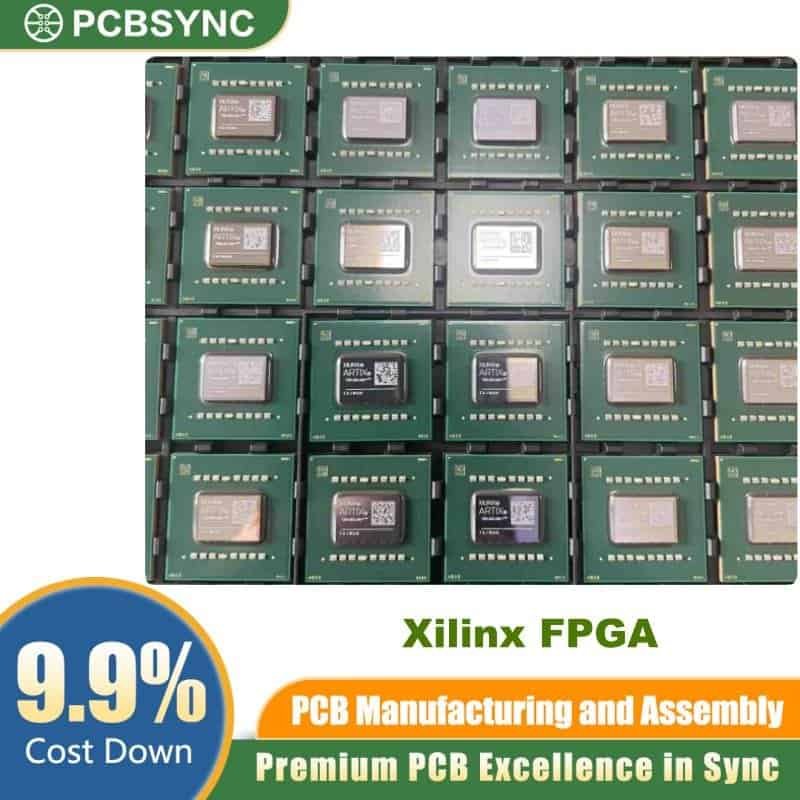
The XCKU085-2FLVB1760I is a high-performance Field Programmable Gate Array (FPGA) from AMD (formerly Xilinx), belonging to the Kintex® UltraScale™ family. Engineered at 20nm process technology, this device delivers an exceptional balance of signal processing bandwidth, DSP throughput, and I/O density — making it a top choice for engineers designing next-generation telecom, data center, medical imaging, and video processing systems.
If you are looking for a powerful mid-range Xilinx FPGA that combines industrial-grade reliability with advanced UltraScale architecture, the XCKU085-2FLVB1760I is a compelling solution.
What Is the XCKU085-2FLVB1760I?
The XCKU085-2FLVB1760I is a member of AMD’s Kintex UltraScale FPGA family — a device series purpose-built to achieve the best price-per-performance-per-watt ratio at the 20nm node. The part number decodes as follows:
| Part Number Field |
Meaning |
| XCKU085 |
Kintex UltraScale, 085 device size |
| -2 |
Speed grade 2 (mid-range performance) |
| FLVB |
Flip-chip Low Voltage Ball grid array, B package size |
| 1760 |
1760 total package pins |
| I |
Industrial temperature range (–40°C to +100°C) |
This device is manufactured by AMD (Xilinx) and is distributed through authorized channels including DigiKey (part number: XCKU085-2FLVB1760I-ND).
XCKU085-2FLVB1760I Key Specifications
Core Device Parameters
| Parameter |
Value |
| Manufacturer |
AMD (Xilinx) |
| Series |
Kintex® UltraScale™ |
| Part Number |
XCKU085-2FLVB1760I |
| Logic Cells |
1,088,325 |
| System Logic Cells |
870,660 |
| Process Node |
20nm |
| Core Voltage (VCCINT) |
0.95V |
| Speed Grade |
–2 |
| Temperature Range |
Industrial: –40°C to +100°C |
| Package Type |
1760-BBGA, FCBGA (Flip-Chip Ball Grid Array) |
| Total Package Pins |
1760 |
| User I/O Pins |
676 |
| RoHS Compliant |
Yes |
Logic and Memory Resources
| Resource |
Quantity |
| Logic Cells |
1,088,325 |
| CLB Flip-Flops |
1,045,440 |
| CLB LUTs |
522,720 |
| Block RAM (36Kb Blocks) |
1,080 |
| Total Block RAM |
38.0 Mb |
| DSP Slices (DSP48E2) |
2,760 |
| Ultra RAMs (288Kb) |
0 (KU085 monolithic) |
Clocking and Connectivity Resources
| Resource |
Quantity |
| CMTs (Clock Management Tiles) |
12 |
| MMCMs |
12 |
| PLLs |
12 |
| GTH Transceivers (16.3 Gb/s) |
32 |
| PCIe Gen3 x8 Hard Blocks |
2 |
| 100G Ethernet MACs |
2 |
| 150G Interlaken |
2 |
| Max Clock Frequency |
661 MHz |
Package and Physical Characteristics
| Parameter |
Value |
| Package |
FCBGA (Flip-Chip Ball Grid Array) |
| Pin Count |
1760 |
| Package Designation |
FLVB1760 |
| Mounting Type |
Surface Mount |
| Operating Voltage |
0.95V (VCCINT) |
| Operating Temperature |
–40°C to +100°C (Industrial) |
XCKU085-2FLVB1760I Architecture Overview
## UltraScale Architecture: What Sets It Apart
The XCKU085-2FLVB1760I is built on AMD’s UltraScale architecture, the first ASIC-class programmable architecture to address the needs of next-generation system integration. Key architectural advantages include:
- Advanced Routing Architecture: Eliminates the interconnect bottleneck found in previous 7-series devices, enabling near-ASIC routing efficiency.
- Next-Generation CLBs: Configurable Logic Blocks with 8-input LUTs and enhanced carry logic for faster arithmetic operations.
- Stacked Silicon Interconnect (SSI) Technology: While the XCKU085 uses a monolithic die, the UltraScale family supports SSI for larger devices, enabling seamless scaling.
- UltraRAM (on select variants): High-density on-chip memory blocks that significantly reduce BOM costs in memory-intensive designs.
### DSP48E2 Slices: Signal Processing Powerhouse
With 2,760 DSP48E2 slices, the XCKU085-2FLVB1760I delivers exceptional fixed-point and floating-point signal processing capability. Each DSP48E2 slice supports:
- Pre-adder, multiplier, and accumulator in a single clock cycle
- Cascade connections for implementing large multipliers and filters
- Optional pattern detection for overflow detection and counter auto-reset
- 27×18-bit two’s complement multiplication
This makes the XCKU085-2FLVB1760I ideal for FFTs, FIR filters, matrix computations, and machine learning inference engines.
### GTH Transceivers: High-Speed Serial I/O
The 32 GTH transceivers support data rates up to 16.3 Gb/s, enabling high-bandwidth serial communication across a broad range of protocols:
| Protocol |
Supported |
| PCIe Gen1/2/3 |
✅ Yes |
| 10GbE / 40GbE / 100GbE |
✅ Yes |
| SATA / SAS |
✅ Yes |
| JESD204B |
✅ Yes |
| CPRI / OBSAI |
✅ Yes |
| Aurora 8B/10B / 64B/66B |
✅ Yes |
| Interlaken (150G) |
✅ Yes |
| DisplayPort / HDMI (via soft IP) |
✅ Yes |
Decoding the Part Number: XCKU085-2FLVB1760I
Understanding the part number helps engineers quickly identify device capabilities and compare alternatives:
| Segment |
Code |
Description |
| Family |
XC |
Xilinx/AMD Commercial |
| Device Family |
KU |
Kintex UltraScale |
| Device Size |
085 |
Mid-to-high capacity KU device |
| Speed Grade |
2 |
Standard performance (–1 lowest, –3 highest) |
| Package Type |
FLV |
Flip-chip Low Voltage |
| Package Size |
B |
B-size footprint |
| Pin Count |
1760 |
1760 BGA balls |
| Temp Grade |
I |
Industrial (–40°C to +100°C) |
XCKU085-2FLVB1760I vs. Similar Kintex UltraScale Devices
| Feature |
XCKU085-2FLVB1760I |
XCKU060-2FFVA1156I |
XCKU115-2FLVB1760I |
| Logic Cells |
1,088,325 |
580,440 |
1,160,880 |
| DSP Slices |
2,760 |
1,680 |
3,456 |
| Block RAM (Mb) |
38.0 |
21.1 |
44.2 |
| GTH Transceivers |
32 |
32 |
32 |
| User I/O |
676 |
520 |
702 |
| Package / Pins |
FCBGA-1760 |
FCBGA-1156 |
FCBGA-1760 |
| Temp Grade |
Industrial |
Industrial |
Industrial |
| Process Node |
20nm |
20nm |
20nm |
The XCKU085-2FLVB1760I offers a middle-ground solution: significantly more resources than the KU060 while sharing the same 1760-pin footprint as the larger KU115, providing a straightforward upgrade path.
Applications: Where Is the XCKU085-2FLVB1760I Used?
#### 100G Networking and Packet Processing
The combination of hard 100G Ethernet MACs, 150G Interlaken blocks, and 32 GTH transceivers makes the XCKU085-2FLVB1760I a natural fit for high-throughput network line cards, packet classifiers, and traffic management engines.
#### Wireless Infrastructure (5G / LTE)
CPRI and JESD204B transceiver support, combined with the massive DSP slice count, enables multi-antenna radio processing, beamforming, and digital pre-distortion (DPD) for next-generation wireless base stations.
#### Medical Imaging
The device’s high logic density and DSP resources support real-time CT, MRI, and ultrasound image reconstruction pipelines that demand simultaneous multi-channel data processing.
#### 8K Video and Broadcast
With sufficient LUT and BRAM density, the XCKU085-2FLVB1760I handles 8K/4K video processing tasks including multi-channel encode/decode, color space conversion, and video routing for broadcast infrastructure.
#### Data Center Acceleration
As a PCIe Gen3 x8-capable FPGA, it integrates directly into server platforms as an accelerator card for compression, encryption, database search, and AI inference offloading.
#### Defense and Aerospace (via equivalent -Q-grade variants)
While the XCKU085-2FLVB1760I targets industrial applications, its architecture mirrors military-grade counterparts used in radar signal processing, EW systems, and secure communications.
Development Tools and Ecosystem
#### Vivado Design Suite
AMD’s Vivado Design Suite is the primary design environment for all UltraScale devices. Vivado provides:
- IP Integrator for block diagram-based design
- Vivado HLS (High-Level Synthesis) for C/C++ to RTL
- Hardware-in-the-Loop (HIL) debugging via JTAG
- Power analysis via Xilinx Power Estimator (XPE)
- Timing closure tools and advanced placement & routing algorithms
#### Available IP Cores
| IP Category |
Examples |
| Networking |
10G/25G/100G Ethernet MAC, PCIe Gen3 |
| Memory |
DDR4/DDR3 MIG, HBM interfaces |
| Video |
HDMI 1.4/2.0 Rx/Tx, Video Timing Controller |
| DSP |
FFT, FIR Compiler, DDS Compiler |
| Compression |
GZIP, LZ4, Zlib |
| Security |
AES-256, SHA-3, RSA |
Ordering Information
| Field |
Details |
| Manufacturer Part Number |
XCKU085-2FLVB1760I |
| Manufacturer |
AMD (Xilinx) |
| DigiKey Part Number |
XCKU085-2FLVB1760I-ND |
| Package |
1760-BBGA, FCBGA |
| Temperature Grade |
Industrial (–40°C to +100°C) |
| RoHS Status |
Compliant |
| Lead-Free |
Yes |
| Moisture Sensitivity Level |
MSL 3 (168 Hours) |
Frequently Asked Questions (FAQ)
Q: What is the difference between the XCKU085-2FLVB1760I and XCKU085-1FLVB1760I? The “-2” speed grade variant operates at a higher maximum clock frequency and offers tighter timing margins compared to the “-1” grade. The “-2” is the standard production speed grade, while “-1” is a lower-cost, lower-performance option.
Q: Is the XCKU085-2FLVB1760I RoHS compliant? Yes, the XCKU085-2FLVB1760I is fully RoHS compliant and lead-free.
Q: What programming tools are required for the XCKU085-2FLVB1760I? AMD Vivado Design Suite 2014.4 or later is required. The device is also supported by the Vitis unified software platform for hardware acceleration use cases.
Q: What is the core supply voltage for this FPGA? The VCCINT (core voltage) is 0.95V. Auxiliary voltages (VCCAUX, VCCO) vary by I/O standard.
Q: Can the XCKU085-2FLVB1760I support DDR4 memory interfaces? Yes, using the Xilinx Memory Interface Generator (MIG), the device supports DDR4 interfaces at speeds up to 2,400 Mb/s, limited by I/O bank voltage and pin selection.
Q: What is the maximum transceiver data rate? The GTH transceivers support line rates up to 16.3 Gb/s per lane.
Summary
The XCKU085-2FLVB1760I is one of AMD Xilinx’s most capable mid-range FPGAs, delivering over one million logic cells, 2,760 DSP slices, 38 Mb of block RAM, and 32 high-speed GTH transceivers — all in an industrial-grade 1760-pin FCBGA package. Its 20nm UltraScale architecture enables performance levels that were previously only achievable in much more expensive, higher-power devices, making it an outstanding choice for telecom, data center, medical, and broadcast applications that demand performance, flexibility, and proven reliability.
For engineers building complex, high-throughput digital systems, the XCKU085-2FLVB1760I represents a mature, well-supported platform backed by AMD’s comprehensive IP ecosystem and Vivado toolchain.