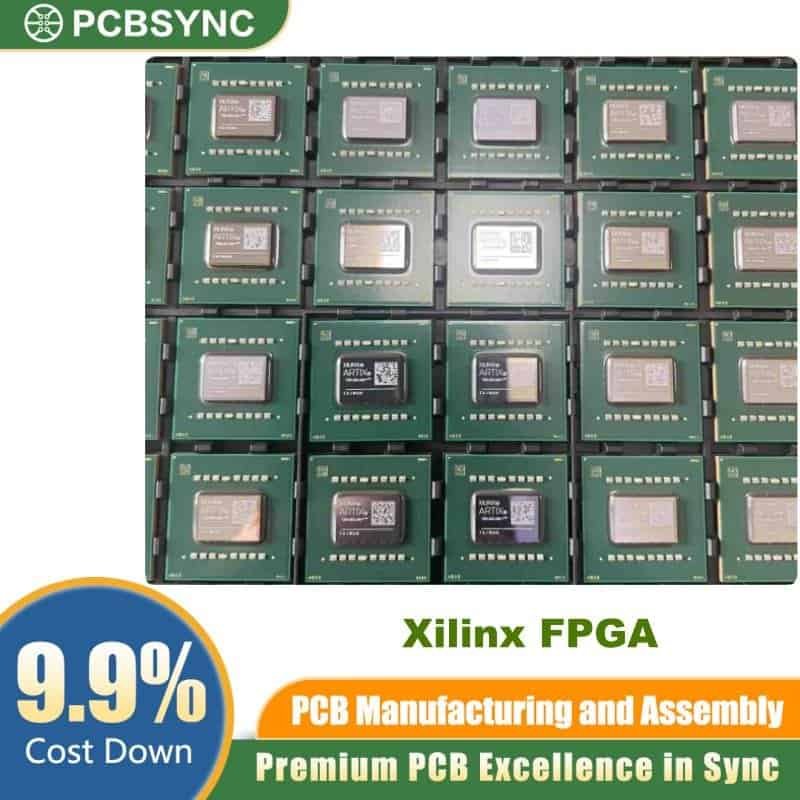
The XCKU060-3FFVA1517E is a high-performance Field Programmable Gate Array (FPGA) from AMD Xilinx’s Kintex UltraScale family. Designed on advanced 20nm technology, this device delivers an exceptional balance of logic density, DSP throughput, memory bandwidth, and high-speed serial connectivity — all housed in a compact 1517-pin FCBGA package. Whether you’re building next-generation wireless infrastructure, 100G networking equipment, medical imaging systems, or high-performance data center accelerators, the XCKU060-3FFVA1517E is engineered to meet demanding real-world requirements.
For engineers and procurement teams sourcing high-performance programmable logic, exploring the full range of Xilinx FPGA solutions can help identify the right device for your design goals and budget.
What Is the XCKU060-3FFVA1517E?
The XCKU060-3FFVA1517E belongs to the Kintex UltraScale FPGA family — AMD Xilinx’s mid-range product line built on the UltraScale architecture. The part number encodes critical information about the device:
| Part Number Segment |
Meaning |
| XC |
Xilinx Commercial Device |
| KU060 |
Kintex UltraScale, 60th density variant |
| -3 |
Speed Grade 3 (fastest commercial speed grade) |
| FFVA |
Flip-Chip Fine-Pitch Ball Grid Array package type |
| 1517 |
1517 total package pins |
| E |
Extended commercial temperature range (0°C to +100°C) |
The “-3” speed grade designation means this is the fastest commercially available version of the XCKU060 device, operating at a VCCINT core voltage of 1.0V. This makes it the preferred choice for timing-critical applications that demand maximum clock frequencies and signal processing throughput.
XCKU060-3FFVA1517E Key Specifications
Core Logic and Fabric Resources
| Specification |
Value |
| FPGA Family |
Kintex UltraScale |
| Technology Node |
20nm |
| Logic Cells |
580,440 |
| CLB Flip-Flops |
663,360 |
| CLB LUTs |
331,680 |
| Maximum Distributed RAM |
9,180 Kb |
| Total Block RAM |
38,000 Kb |
| Block RAM Blocks (36Kb each) |
1,080 |
| UltraRAM Blocks |
0 (UltraRAM is Kintex UltraScale+) |
DSP and Signal Processing
| Specification |
Value |
| DSP48E2 Slices |
2,760 |
| Peak DSP Performance |
High-bandwidth signal processing |
| Cascade Capability |
Full cascade chains supported |
I/O and Connectivity
| Specification |
Value |
| Total I/O Pins |
624 |
| Package |
1517-Pin FCBGA (FFVA1517) |
| Maximum Single-Ended I/O |
624 |
| Maximum Differential Pairs |
312 |
| HP I/O Banks |
Yes (High Performance) |
| GTH Transceiver Pairs |
32 |
| Maximum GTH Line Rate |
16.3 Gb/s |
| PCIe Gen3 Hard Block |
Yes (x8) |
| 100G Ethernet (CAUI-4) |
Yes |
Power and Packaging
| Specification |
Value |
| Core Voltage (VCCINT) |
1.0V (Speed Grade -3) |
| Package Type |
FCBGA (Flip-Chip Ball Grid Array) |
| Package Code |
FFVA1517 |
| Pin Count |
1,517 |
| Temperature Grade |
E — Extended Commercial (0°C to +100°C) |
| Package Body Size |
40mm × 40mm (approx.) |
| Ball Pitch |
1.0mm |
Clocking Resources
| Specification |
Value |
| MMCMs (Mixed-Mode Clock Managers) |
10 |
| PLLs (Phase-Locked Loops) |
20 |
| Global Clock Buffers |
196 |
| Regional Clock Buffers |
Supported |
XCKU060-3FFVA1517E Detailed Technical Overview
## 20nm UltraScale Architecture Advantages
The XCKU060-3FFVA1517E is built on TSMC’s 20nm planar process, using AMD Xilinx’s proprietary UltraScale architecture. Unlike previous-generation 28nm devices, the UltraScale platform eliminates traditional routing congestion bottlenecks by implementing an ASIC-like clocking methodology with a next-generation interconnect fabric. This results in higher utilization efficiency — designs can routinely achieve 85%+ logic utilization without the performance penalties seen in older devices.
The architecture uses staggered columnar structures for CLBs (Configurable Logic Blocks), DSP slices, and Block RAM, enabling predictable timing closure even for complex, high-speed designs. This is particularly beneficial for pipelined DSP chains, wide bus structures, and multi-clock domain systems.
## High-Performance GTH Transceivers
One of the most compelling features of the XCKU060-3FFVA1517E is its 32 GTH (Gigabit Transceiver High-performance) transceiver pairs, each capable of operating at line rates up to 16.3 Gb/s. These transceivers support a wide variety of industry-standard serial protocols:
- PCIe Gen3 x8 — via integrated hard IP block
- 100 Gigabit Ethernet (100GbE / CAUI-4)
- CPRI / eCPRI — for wireless base station fronthaul
- JESD204B / JESD204C — for high-speed ADC/DAC interfaces
- Interlaken — for chip-to-chip high-bandwidth interconnect
- Aurora 64B/66B — for custom high-throughput serial links
- SATA / SAS — storage interface protocols
The GTH transceivers include integrated CDR (Clock Data Recovery), equalization, and pre-emphasis circuitry, minimizing external analog components and simplifying PCB layout.
## DSP Processing Power
With 2,760 DSP48E2 slices, the XCKU060-3FFVA1517E delivers formidable arithmetic processing capability. Each DSP48E2 slice can perform a 27×18 two’s complement multiply-accumulate in a single clock cycle, with full cascade chaining support for building large FIR filters, FFT engines, and matrix multiplication pipelines without consuming fabric routing.
At 500+ MHz clock rates achievable with the -3 speed grade, this device can sustain hundreds of Giga multiply-accumulate operations per second (GMAC/s), making it competitive with contemporary DSP processors for signal processing workloads while offering the parallelism and determinism unique to FPGAs.
## Memory Architecture
The XCKU060-3FFVA1517E provides 1,080 Block RAM tiles (36Kb each), totaling approximately 38 Mb of on-chip true dual-port block memory. These BRAMs can be configured as:
- Simple dual-port or true dual-port 36Kb memories
- FIFO generators for clock domain crossing
- ROM initialization for coefficient storage
- SRL16/SRL32 shift registers when distributed RAM is insufficient
In addition to Block RAM, the device supports external DDR4, LPDDR4, and QDR memory interfaces through its HP I/O banks, enabling off-chip memory bandwidths exceeding 100 GB/s in multi-interface configurations.
XCKU060-3FFVA1517E Package Information: FFVA1517
## FCBGA Package Physical Details
The FFVA1517 package is a Flip-Chip Fine-Pitch Ball Grid Array with a 40×40 array of solder balls on a 1.0mm pitch. The flip-chip attachment method provides superior thermal performance compared to wire-bonded packages, as the die heat spreads more uniformly through the package substrate.
| Package Parameter |
Value |
| Package Designation |
FFVA1517 |
| Package Type |
FCBGA (Flip-Chip BGA) |
| Total Balls |
1,517 |
| Ball Pitch |
1.0mm |
| Package Dimensions |
Approx. 40mm × 40mm |
| Die Attach Method |
Flip-Chip (C4 bumps) |
| PCB Via Recommendation |
Via-in-pad or dogleg via |
## PCB Design Considerations for FFVA1517
Designing a PCB to host the XCKU060-3FFVA1517E in the FFVA1517 package requires careful attention to signal integrity and power delivery:
- PCB Layer Count: Minimum 12–16 layers recommended for a high-performance design with GTH transceivers
- Controlled Impedance: 50Ω single-ended, 100Ω differential for high-speed signal lines
- Decoupling Capacitors: Place ceramic capacitors (100nF and 10µF) close to each VCCINT, VCCAUX, and VCCO power pin
- GTH Routing: AC-coupled differential traces with 100Ω differential impedance; minimize via stubs on transceiver lanes
- Power Planes: Dedicated planes for VCCINT (1.0V), VCCAUX (1.8V), and each VCCO bank voltage
Target Applications for the XCKU060-3FFVA1517E
The combination of 580K logic cells, 32 GTH transceivers, 2,760 DSP slices, and 38Mb of Block RAM makes this device exceptionally well-suited for:
## Wireless Infrastructure and 5G Systems
The XCKU060-3FFVA1517E is extensively used in 5G base station RRU (Remote Radio Units) and BBU (Baseband Units). Its CPRI/eCPRI transceiver support, combined with deep DSP resources for massive MIMO beamforming and LDPC/Turbo decoding, makes it a natural fit for next-generation wireless systems.
## 100G Networking and Data Center
With native 100GbE support via CAUI-4 and PCIe Gen3 connectivity, this FPGA accelerates packet processing workloads in network interface cards (SmartNICs), network switches, and FPGA-based DPUs (Data Processing Units) for hyperscale data centers.
## Medical Imaging Systems
Applications such as ultrasound beamforming, CT reconstruction, and MRI signal processing demand the kind of deterministic, parallel computation that the XCKU060-3FFVA1517E delivers. Its high Block RAM density enables large on-chip image buffer storage while DSP slices execute filtering and reconstruction algorithms at real-time rates.
## Radar and Electronic Warfare (EW)
Defense radar systems leverage the XCKU060-3FFVA1517E for pulse compression, synthetic aperture radar (SAR) processing, and electronic intelligence (ELINT) signal analysis. The -3 speed grade’s maximum performance ensures radar processing pipelines meet demanding real-time latency requirements.
## Test and Measurement Equipment
High-end oscilloscopes, protocol analyzers, and automated test equipment (ATE) use XCKU060-class devices to implement high-speed digital front ends, pattern generators, and real-time signal analysis engines.
## High-Performance Computing (HPC) Acceleration
FPGA-based accelerator cards using the XCKU060-3FFVA1517E offload computationally intensive tasks — such as genomics, financial analytics, and machine learning inference — from host CPUs, reducing latency and improving overall system throughput.
Development Tools for XCKU060-3FFVA1517E
| Tool |
Purpose |
| AMD Vivado Design Suite |
Primary RTL synthesis, implementation, and bitstream generation |
| Vitis Unified Platform |
HLS-based design, embedded software, and hardware acceleration |
| Vitis HLS (formerly Vivado HLS) |
Compile C/C++ to RTL for hardware acceleration |
| System Generator for DSP |
Model-based DSP design using MATLAB/Simulink |
| Vivado IP Integrator |
Block diagram-based system design |
| ChipScope Pro / ILA |
On-chip debug and signal probing |
The XCKU060-3FFVA1517E is fully supported by Vivado Design Suite 2015.4 and all subsequent releases. AMD recommends using Vivado 2022.2 or later for optimal timing closure performance and updated IP cores.
XCKU060-3FFVA1517E Ordering and Part Number Breakdown
| Field |
Code |
Description |
| Device Family |
XC |
Xilinx Commercial |
| FPGA Series |
KU060 |
Kintex UltraScale 060 |
| Speed Grade |
-3 |
Fastest commercial speed, VCCINT = 1.0V |
| Package Type |
FF |
Flip-Chip Fine-Pitch BGA |
| Package Variant |
VA |
Variant A |
| Pin Count |
1517 |
1,517 total solder balls |
| Temperature |
E |
Extended Commercial: 0°C to +100°C |
## Comparable Devices in the Kintex UltraScale Family
| Part Number |
Logic Cells |
I/O |
GTH |
Package |
Speed Grade |
| XCKU025-2FFVA1156E |
326,400 |
468 |
20 |
FFVA1156 |
-2 |
| XCKU035-2FFVA1156E |
349,920 |
468 |
20 |
FFVA1156 |
-2 |
| XCKU060-2FFVA1517E |
580,440 |
624 |
32 |
FFVA1517 |
-2 |
| XCKU060-3FFVA1517E |
580,440 |
624 |
32 |
FFVA1517 |
-3 (Fastest) |
| XCKU085-2FFVA1517E |
742,560 |
624 |
32 |
FFVA1517 |
-2 |
| XCKU115-2FLVB2104E |
1,451,520 |
832 |
64 |
FLVB2104 |
-2 |
The XCKU060-3FFVA1517E occupies the sweet spot in the Kintex UltraScale lineup — offering close to maximum I/O and transceiver count in the FFVA1517 package footprint while delivering the -3 speed grade’s timing headroom that simplifies timing closure in high-clock-rate designs.
Frequently Asked Questions (FAQ)
#### What is the difference between XCKU060-2FFVA1517E and XCKU060-3FFVA1517E?
The key difference is speed grade and core voltage. The -2 device operates at VCCINT = 0.95V and targets moderate performance applications, while the -3 device operates at VCCINT = 1.0V and achieves higher maximum clock frequencies. The -3 variant is preferred when timing margins are tight or when maximum DSP/transceiver throughput is required.
#### Is the XCKU060-3FFVA1517E RoHS compliant?
Yes. AMD Xilinx Kintex UltraScale devices are manufactured and packaged in compliance with RoHS (Restriction of Hazardous Substances) directives. The FFVA1517 package uses lead-free solder balls.
#### What memory interfaces does the XCKU060-3FFVA1517E support?
Through its HP (High Performance) I/O banks, the device supports DDR4, DDR3, LPDDR4, QDR II+, RLDRAM 3, and other high-speed memory interfaces via Xilinx’s MIG (Memory Interface Generator) IP core.
#### Can the XCKU060-3FFVA1517E be used in defense or aerospace applications?
The “E” temperature suffix indicates Extended Commercial grade (0°C to +100°C junction temperature). For aerospace and defense applications requiring wider temperature ranges, Xilinx offers the “I” (Industrial: -40°C to +100°C) variants. A radiation-hardened equivalent exists in the XQKU series.
#### What is the maximum PCIe lane width supported?
The XCKU060-3FFVA1517E includes a hardened PCIe Gen3 IP block supporting up to x8 lanes, delivering up to 64 Gb/s bidirectional bandwidth for host system connectivity.
Summary: Why Choose the XCKU060-3FFVA1517E?
The XCKU060-3FFVA1517E delivers a uniquely powerful combination of capabilities that makes it a top-tier choice for demanding FPGA design challenges:
- Maximum commercial speed with -3 speed grade for timing-critical applications
- 580,440 logic cells for complex parallel processing workloads
- 32 GTH transceivers at 16.3 Gb/s for 100G networking, 5G, and high-speed I/O
- 2,760 DSP48E2 slices for high-throughput signal processing
- 38Mb on-chip Block RAM for large data buffering and filter coefficient storage
- 624 user I/Os in a well-established FFVA1517 1517-pin FCBGA package
- 20nm technology for optimal power efficiency at performance targets
- Full Vivado Design Suite support for streamlined development workflows
For engineers designing 5G RRU/BBU systems, 100GbE network accelerators, medical imaging platforms, or radar signal processing systems, the XCKU060-3FFVA1517E provides the silicon resources, I/O flexibility, and raw performance needed to bring ambitious designs to production.