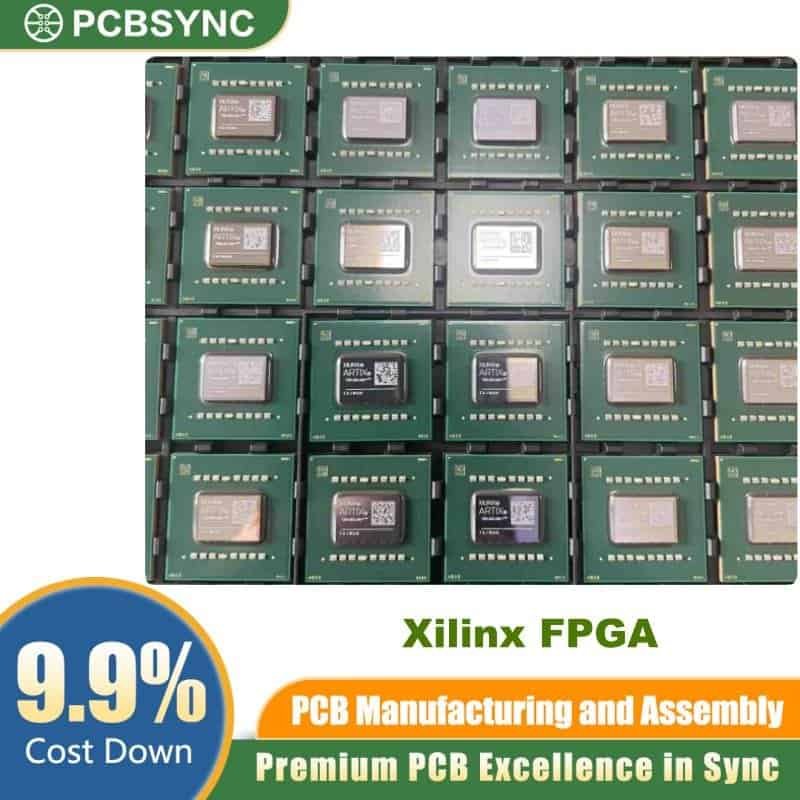
The XCKU035-2FFVA1156I is a high-performance Field Programmable Gate Array (FPGA) from AMD Xilinx’s Kintex UltraScale family. Built on 20nm process technology, this industrial-grade device delivers an optimal balance of price, performance, and power efficiency — making it one of the most capable mid-range FPGAs available for demanding embedded applications.
Whether you are designing for communications infrastructure, signal processing, or industrial automation, the XCKU035-2FFVA1156I offers the logic density, memory, and I/O bandwidth needed to implement complex digital systems. As part of the broader Xilinx FPGA portfolio, this device sits in a sweet spot for engineers who require high-performance logic without the cost of top-tier devices.
What Is the XCKU035-2FFVA1156I?
The XCKU035-2FFVA1156I is a member of the Kintex UltraScale family — AMD Xilinx’s mid-range FPGA line optimized for price-to-performance. The part number breaks down as follows:
| Part Number Segment |
Meaning |
| XCKU035 |
Kintex UltraScale, density level 035 |
| -2 |
Speed grade 2 (higher performance) |
| FFVA |
Flip-Chip Fine-pitch Ball Grid Array (FC-BGA) package type |
| 1156 |
1156-pin package |
| I |
Industrial temperature range (–40°C to +100°C) |
This device is manufactured by AMD (formerly Xilinx) and is categorized under Embedded – FPGAs (Field Programmable Gate Arrays) in the integrated circuits product hierarchy.
XCKU035-2FFVA1156I Key Specifications
Core Device Parameters
| Parameter |
Value |
| Manufacturer |
AMD (Xilinx) |
| Part Number |
XCKU035-2FFVA1156I |
| FPGA Family |
Kintex UltraScale |
| Process Node |
20nm |
| System Logic Cells |
355,474 |
| CLB LUTs |
203,128 |
| CLB Flip-Flops |
406,256 |
| DSP Slices |
1,620 |
| Block RAM |
19,000 Kb (Total RAM Bits) |
| Max User I/O |
520 |
| Number of Pins |
1,156 |
| Speed Grade |
-2 |
| Operating Voltage (VCCINT) |
0.95V |
| Temperature Range |
–40°C to +100°C (Industrial) |
Package and Physical Characteristics
| Parameter |
Value |
| Package Type |
FC-BGA (Flip-Chip Ball Grid Array) |
| Package Designator |
FFVA1156 |
| Ball Pitch |
1.0mm |
| Mounting Type |
Surface Mount |
| RoHS Compliance |
Yes |
| Container / Tray |
Tray |
Transceiver and High-Speed I/O Specifications
| Parameter |
Value |
| GTH Transceiver Count |
16 |
| Max GTH Data Rate |
Up to 16.3 Gb/s |
| PCIe Hard Block |
Gen3 ×8 |
| 100G Ethernet MAC |
Yes (Hard Block) |
| Interlaken |
Yes (150G, Hard Block) |
XCKU035-2FFVA1156I Architecture Overview
## UltraScale Architecture: Next-Generation FPGA Design
The XCKU035-2FFVA1156I is built on AMD Xilinx’s UltraScale architecture, which introduced a number of innovations over the previous 7 Series families. At its core, the architecture is designed around an ASIC-like routing structure that minimizes timing uncertainty and maximizes system clock frequencies. Unlike earlier generations that relied on ring-based clocking, UltraScale devices use a scalable clock distribution network that improves determinism across the device.
Key architectural highlights include:
- 6-input LUTs (LUT6) with optional dual-output configuration for efficient logic utilization
- Cascadable DSP48E2 slices supporting high-throughput arithmetic, filtering, and multiply-accumulate (MAC) operations
- 36Kb Block RAMs that can be configured as single 36Kb or dual 18Kb memories
- UltraRAM memory blocks for high-density on-chip storage (available in UltraScale+ generation)
## CLB Structure and Logic Resources
The Configurable Logic Blocks (CLBs) in the XCKU035-2FFVA1156I are organized in a regular grid pattern. Each CLB contains two slices, and each slice includes four LUT6s, eight flip-flops, carry logic, and wide-function multiplexers. With 203,128 LUTs and 406,256 flip-flops, this device can implement large state machines, complex datapaths, and substantial control logic in a single chip.
## DSP Processing Capabilities
With 1,620 DSP48E2 slices, the XCKU035-2FFVA1156I is well-suited for digital signal processing applications. Each DSP slice includes a pre-adder, 27×18-bit multiplier, and a 48-bit accumulator with cascading capabilities. This makes the device highly effective for implementing:
- FIR and IIR digital filters
- FFT engines
- Matrix multiplication for machine learning inference
- Direct digital synthesis (DDS)
## Block RAM and On-Chip Memory
The device provides approximately 19,000 Kb of total Block RAM, distributed across the chip. Each 36Kb BRAM tile is a true dual-port memory configurable as a FIFO, ROM, or RAM. The distributed nature of the block RAM allows system designers to place memory close to the logic that consumes it, minimizing routing delays and improving system timing closure.
High-Speed Serial Transceivers
## GTH Transceivers – Up to 16.3 Gb/s
The XCKU035-2FFVA1156I includes 16 GTH (Gigabit Transceiver High-performance) serial transceivers. These transceivers support a data rate range from 500 Mb/s up to 16.3 Gb/s per lane in the FFVA1156 package, enabling interfaces such as:
- PCIe Gen3 ×8 (hard IP block included)
- 100G Ethernet (using multiple lanes)
- CPRI / OBSAI for wireless infrastructure (fronthaul)
- Serial RapidIO for embedded processing
- Custom high-speed protocols
The GTH transceivers feature embedded clock and data recovery (CDR), on-chip termination, and programmable pre-emphasis and equalization, making them straightforward to implement across a range of signaling standards.
I/O Banks and Programmable I/O
## 520 User I/O Pins in a 1156-Ball Package
The XCKU035-2FFVA1156I provides up to 520 user-configurable I/O pins in the FFVA1156 package. These are grouped into High-Performance (HP) I/O banks, supporting single-ended and differential standards at voltages from 1.0V to 1.8V. Supported I/O standards include:
| I/O Standard |
Type |
| LVCMOS 1.2V / 1.5V / 1.8V |
Single-ended |
| LVDS, LVDS_25 |
Differential |
| SSTL 1.2V / 1.5V |
Memory interfacing |
| HSTL |
High-speed logic |
| DIFF_SSTL |
Differential memory |
| MIPI D-PHY |
Display / camera interfaces |
## SelectIO Technology and IDELAY
HP I/O banks include IDELAY and ODELAY primitives for fine-grained timing adjustment on each pin, critical for interfacing to DDR memory, parallel buses, and source-synchronous interfaces. Dedicated ISERDES and OSERDES elements allow high-speed serialization and deserialization at up to 1,600 Mb/s per pin, enabling cost-effective implementation of wide parallel interfaces.
Hard IP Blocks and System Features
The XCKU035-2FFVA1156I includes several embedded hard blocks that reduce FPGA fabric utilization and improve performance compared to soft-logic implementations:
| Hard Block |
Details |
| PCIe Gen3 ×8 |
Compliant with PCI Express 3.0 spec |
| 100G Ethernet MAC |
Full IEEE 802.3ba compliant |
| 150G Interlaken |
High-bandwidth chip-to-chip interface |
| XADC |
Dual 12-bit, 1 MSPS ADC for system monitoring |
| CMTs (PLLs/MMCMs) |
Clock management tiles for frequency synthesis |
## Clock Management Tiles (CMT)
The device includes multiple Clock Management Tiles, each containing a Mixed-Mode Clock Manager (MMCM) and a Phase-Locked Loop (PLL). These allow precise clock synthesis, multiplication, division, and phase shifting across the design. The MMCM supports fractional divide ratios and spread-spectrum clocking for EMI reduction, a key requirement in industrial and communications equipment.
Temperature Range and Reliability: Industrial Grade
The suffix “I” in the part number XCKU035-2FFVA1156I designates an industrial temperature range device, rated for operation from –40°C to +100°C (junction temperature). This makes it suitable for deployment in environments that experience wide temperature variation, including:
- Outdoor telecom base stations and remote radio units
- Industrial control and automation systems
- Transportation and avionics electronics
- Test and measurement equipment
Industrial-grade FPGAs also undergo more rigorous screening during manufacturing compared to commercial-grade parts, providing a higher level of confidence for production applications.
Supported Development Tools
The XCKU035-2FFVA1156I is fully supported by AMD Xilinx’s Vivado Design Suite, the primary development environment for UltraScale and UltraScale+ devices.
| Tool |
Purpose |
| Vivado ML Edition |
Synthesis, implementation, timing analysis |
| Vitis HLS |
High-Level Synthesis from C/C++ |
| IP Integrator |
Block diagram-based system assembly |
| ChipScope / ILA |
On-chip logic debugging |
| Vivado Simulator |
Functional and timing simulation |
Vivado provides a complete design flow from HDL entry through bitstream generation. The device is also supported by third-party synthesis tools such as Synopsys Synplify Pro and Mentor Precision RTL.
Typical Applications for the XCKU035-2FFVA1156I
The combination of 355,474 logic cells, 1,620 DSP slices, 16 GTH transceivers, and industrial temperature rating makes the XCKU035-2FFVA1156I an excellent fit for a broad range of demanding applications:
| Application Area |
Use Case |
| Wireless Infrastructure |
LTE / 5G baseband processing, CPRI fronthaul |
| Wired Networking |
Line-rate packet processing, switching fabrics |
| Defense & Aerospace |
Radar signal processing, EW, secure communications |
| Industrial Automation |
Real-time control, machine vision, motor drives |
| Test & Measurement |
High-speed data acquisition, protocol analysis |
| High-Performance Computing |
FPGA-accelerated workloads, HPC offload engines |
| Medical Imaging |
Ultrasound, CT reconstruction pipelines |
XCKU035-2FFVA1156I vs. Related Kintex UltraScale Devices
Understanding where the XCKU035-2FFVA1156I sits within the Kintex UltraScale family helps engineers select the right device for their application.
| Device |
Logic Cells |
DSP Slices |
Block RAM (Kb) |
GTH Transceivers |
Package Options |
| XCKU025-2FFVA1156I |
318,150 |
1,440 |
16,000 |
16 |
FFVA1156 |
| XCKU035-2FFVA1156I |
355,474 |
1,620 |
19,000 |
16 |
FFVA1156, FBVA900, FBVA676 |
| XCKU040-2FFVA1156I |
444,343 |
1,920 |
21,000 |
20 |
FFVA1156 |
| XCKU060-2FFVA1156I |
725,550 |
2,760 |
38,912 |
32 |
FFVA1156 |
The XCKU035 occupies the second tier in the Kintex UltraScale line — offering more logic density and DSP capacity than the KU025, while being more cost-effective than the KU040 and above. For designs that have outgrown the KU025 but do not yet require the full capacity of the KU040, the XCKU035-2FFVA1156I is the natural choice.
Ordering Information
The XCKU035-2FFVA1156I is available from authorized AMD Xilinx distributors and independent component suppliers. The table below summarizes available variants in the XCKU035 product line sharing the FFVA1156 package:
| Part Number |
Speed Grade |
Temperature |
Package |
| XCKU035-1FFVA1156C |
-1 |
Commercial (0°C to +85°C) |
FFVA1156 |
| XCKU035-1FFVA1156I |
-1 |
Industrial (–40°C to +100°C) |
FFVA1156 |
| XCKU035-2FFVA1156C |
-2 |
Commercial (0°C to +85°C) |
FFVA1156 |
| XCKU035-2FFVA1156I |
-2 |
Industrial (–40°C to +100°C) |
FFVA1156 |
| XCKU035-3FFVA1156E |
-3 |
Extended (-40°C to +100°C) |
FFVA1156 |
Note: Speed grade -2 offers higher performance than -1, with tighter timing constraints that allow the device to achieve higher system clock frequencies. Industrial (“-I”) suffix parts are screened for wider temperature operation compared to commercial (“-C”) parts.
Package Compatibility and Migration
One of the notable benefits of the UltraScale architecture is its footprint compatibility across families. Kintex UltraScale devices in the A1156 package are footprint compatible with Kintex UltraScale+ devices in the A1156 package. This means that a board designed for the XCKU035-2FFVA1156I can potentially migrate to a Kintex UltraScale+ device such as the XCKU15P without PCB redesign, providing a clear upgrade path as design requirements evolve.
Frequently Asked Questions (FAQ)
### What does the “I” suffix mean in XCKU035-2FFVA1156I?
The “I” suffix indicates the industrial temperature grade, specifying that the device is tested and guaranteed to operate from –40°C to +100°C junction temperature. This is distinct from commercial-grade (“C”) devices rated for 0°C to +85°C.
### What is the speed grade “-2” for this FPGA?
Speed grade -2 indicates the device’s timing performance relative to other parts in the same family. A -2 device supports higher clock frequencies and faster I/O timing than a -1 device, because it is manufactured from silicon with tighter performance distributions. Kintex UltraScale parts are available in -1, -2, and -3 speed grades, with -3 being the fastest.
### What design software supports the XCKU035-2FFVA1156I?
The device is fully supported by AMD Vivado Design Suite (version 2014.2 and later). Vivado provides synthesis, place-and-route, static timing analysis, and bitstream generation. Vitis HLS is available for high-level synthesis from C/C++.
### Is the XCKU035-2FFVA1156I footprint compatible with other UltraScale devices?
Yes. Kintex UltraScale devices in the FFVA1156 package share the same footprint as other UltraScale and UltraScale+ devices using the A1156 package designation, enabling PCB-level migration between family members.
### What are the key differences between XCKU035 and XCKU040?
The XCKU040 provides approximately 25% more LUTs (444,343 vs. 355,474), more DSP slices (1,920 vs. 1,620), and more block RAM. The XCKU035-2FFVA1156I is the preferred choice when the design fits within its resource budget, as it offers a lower cost at similar performance per unit of logic.