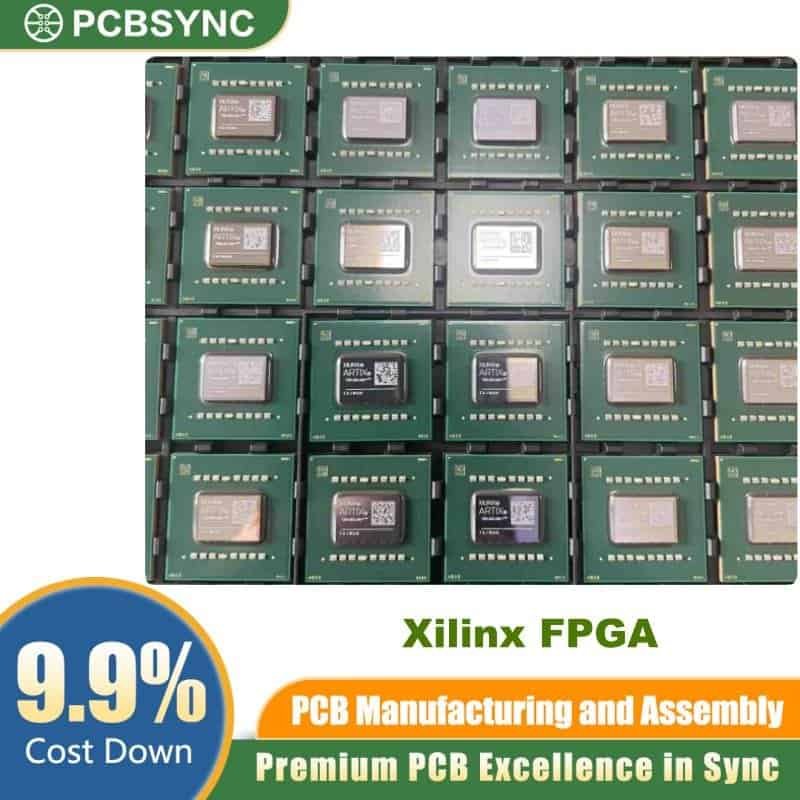
Meta Description: The XCKU035-2FBVA676I is a Xilinx Kintex UltraScale FPGA featuring 444,343 logic cells, 312 I/Os, 20nm technology, and a 676-pin FCBGA package. Ideal for 100G networking, DSP, and industrial applications.
What Is the XCKU035-2FBVA676I?
The XCKU035-2FBVA676I is a high-performance Field Programmable Gate Array (FPGA) from AMD/Xilinx, part of the Kintex® UltraScale™ family. Built on an advanced 20nm process node, this device delivers an exceptional balance of price, performance, and power efficiency — making it one of the most sought-after mid-range FPGAs for demanding embedded and signal-processing applications.
The “2” in the part number denotes Speed Grade 2, and the suffix “I” indicates an Industrial temperature range (-40°C to +100°C), confirming its suitability for rugged, mission-critical environments. The FBVA676 package designator specifies a 676-pin Fine-pitch Ball Grid Array (FCBGA) footprint.
Whether you are designing for 100G networking infrastructure, next-generation medical imaging, or heterogeneous wireless systems, the XCKU035-2FBVA676I provides the programmable fabric and on-chip resources to meet your system requirements.
For a broader selection of compatible devices and design resources, visit Xilinx FPGA.
XCKU035-2FBVA676I Key Specifications
The table below summarizes the primary technical parameters of the XCKU035-2FBVA676I at a glance.
| Parameter |
Value |
| Manufacturer |
AMD (Xilinx) |
| Part Number |
XCKU035-2FBVA676I |
| FPGA Family |
Kintex® UltraScale™ |
| Process Technology |
20nm |
| Speed Grade |
-2 |
| Temperature Grade |
Industrial (-40°C to +100°C) |
| Logic Cells |
444,343 |
| CLB LUTs |
~203,000 Logic Slices |
| Package Type |
FCBGA (Fine-pitch BGA) |
| Package Pin Count |
676 Pins |
| I/O Count (Max) |
312 |
| Core Voltage (VCC) |
0.95V (922mV – 979mV) |
| Maximum Frequency |
725 MHz |
| Block RAM |
19,456 Kb (Total) |
| Clock Management |
MMCM + PLL |
XCKU035-2FBVA676I Detailed Technical Specifications
Logic and Programmable Resources
The XCKU035-2FBVA676I is built around Xilinx’s UltraScale architecture, which introduces ASIC-class routing and clocking to the FPGA domain. The core programmable logic includes Configurable Logic Blocks (CLBs) with 6-input Look-Up Tables (LUTs) and flip-flops, enabling highly dense logic implementation across a wide range of designs.
| Logic Resource |
Specification |
| Total Logic Cells |
444,343 |
| CLB LUTs |
~203,128 Logic Slices |
| Flip-Flops |
Available per LUT |
| Distributed RAM |
Configurable via LUTs |
| Configurable Logic Blocks (CLBs) |
High-density, low-latency layout |
Memory Resources
On-chip memory is critical for high-throughput designs. The XCKU035-2FBVA676I provides substantial Block RAM capacity with built-in FIFO and ECC support, reducing the need for external memory in many use cases.
| Memory Resource |
Specification |
| Total Block RAM |
19,456 Kb |
| Block RAM Architecture |
36Kb per block (dual 18Kb mode supported) |
| ECC Support |
Yes (built-in) |
| FIFO Support |
Yes (built-in) |
| Distributed RAM |
Configurable via CLB LUTs |
DSP and Signal Processing
The Kintex UltraScale DSP slice features a 27×18 multiplier, a 27-bit pre-adder, and a 30-bit A input capable of performing multiply-accumulate, multiply-add, pattern detect, and 96-bit XOR operations — all within a single DSP48E2 slice. This makes the XCKU035-2FBVA676I a top choice for radar, software-defined radio (SDR), and image processing applications.
| DSP Resource |
Specification |
| DSP Architecture |
DSP48E2 Slice |
| Multiplier Width |
27 × 18 |
| Pre-Adder Width |
27-bit |
| Operations Supported |
Multiply-Accumulate, Multiply-Add, Pattern Detect, XOR |
I/O and Connectivity
| I/O Resource |
Specification |
| Maximum User I/Os |
312 |
| I/O Standard Support |
LVCMOS, LVDS, SSTL, HSTL, and more |
| HP I/O Banks |
Yes (High-Performance) |
| Differential I/O Pairs |
Supported |
| Maximum I/O Voltage |
Up to 1.8V (HP banks) |
Clocking and Timing
| Clocking Resource |
Specification |
| Clock Management Tiles (CMT) |
Multiple (MMCM + PLL per tile) |
| MMCM |
Yes |
| PLL |
Yes |
| Maximum Operating Frequency |
725 MHz |
| ASIC-Like Clocking |
Yes (UltraScale architecture) |
| Fine-Grain Clock Gating |
Yes |
Package and Mechanical
| Package Parameter |
Specification |
| Package Type |
FCBGA (Fine-pitch Ball Grid Array) |
| Pin Count |
676 Pins |
| Package Code |
FBVA676 |
| Mounting Style |
Surface Mount (SMD) |
| Footprint Compatibility |
Compatible with other UltraScale FBVA676 packages |
XCKU035-2FBVA676I Part Number Decoder
Understanding the part number helps engineers quickly identify the exact variant needed for their design.
| Segment |
Meaning |
| XC |
Xilinx (AMD) |
| KU |
Kintex UltraScale Family |
| 035 |
Device density (mid-range) |
| -2 |
Speed Grade 2 (standard performance) |
| F |
Flip-chip BGA package |
| BVA |
Package body/ball layout designator |
| 676 |
676 total pins/balls |
| I |
Industrial temperature grade (-40°C to +100°C) |
XCKU035-2FBVA676I vs. Related Variants
The XCKU035 is available in multiple speed grades and packages. The table below compares common variants to help you select the right device.
| Part Number |
Speed Grade |
Temperature |
Package |
Pins |
| XCKU035-1FBVA676I |
-1 |
Industrial |
FCBGA |
676 |
| XCKU035-2FBVA676I |
-2 |
Industrial |
FCBGA |
676 |
| XCKU035-2FBVA676E |
-2 |
Extended |
FCBGA |
676 |
| XCKU035-2FBVA900I |
-2 |
Industrial |
FCBGA |
900 |
| XCKU035-2FFVA1156I |
-2 |
Industrial |
FCBGA |
1156 |
| XCKU035-3FBVA676E |
-3 |
Extended |
FCBGA |
676 |
Note: All FBVA676 variants share footprint compatibility, simplifying PCB design across different speed and temperature grades.
Key Features and Architecture Highlights
## UltraScale Architecture: ASIC-Class Performance in FPGA
The UltraScale architecture is Xilinx’s first ASIC-class all-programmable architecture. It introduces next-generation routing resources, ASIC-like clocking with fine-grained clock gating, and multi-hundred Gbps system performance capabilities. Compared to the 7 Series, UltraScale devices offer up to 40% lower power consumption through advanced power management and reduced dynamic switching.
## Kintex UltraScale: The Sweet Spot for Price/Performance/Watt
The Kintex UltraScale family sits between the cost-optimized Artix and the high-end Virtex families. It delivers the highest signal processing bandwidth available in a mid-range device, supported by next-generation GTH transceivers and high DSP-to-logic ratios. The 20nm process node ensures the XCKU035-2FBVA676I consumes far less power than competing devices at equivalent logic densities.
## 20nm Process Technology
Fabricated on a 20nm planar process, the XCKU035-2FBVA676I benefits from reduced leakage current and tighter transistor geometry. This translates directly into lower static power and higher achievable clock frequencies compared to older 28nm or 40nm FPGA families.
## Industrial Temperature Range (-40°C to +100°C)
The “I” suffix confirms full industrial temperature qualification, making the XCKU035-2FBVA676I suitable for deployment in:
- Outdoor telecommunications equipment
- Industrial automation and robotics
- Military and defense electronics
- Avionics and embedded computing systems
## FCBGA-676 Low-Profile Package
The 676-ball Fine-pitch BGA package provides a compact footprint that simplifies PCB layout while maintaining signal integrity. The FBVA676 pinout is footprint-compatible across multiple UltraScale density variants, enabling design scalability without PCB respins.
Target Applications for XCKU035-2FBVA676I
The combination of high logic density, deep DSP resources, and industrial-grade reliability makes the XCKU035-2FBVA676I a strong candidate for a wide range of applications.
| Application Area |
Use Case |
| 100G Networking |
Packet processing, line cards, OTN framing |
| Data Center |
Hardware acceleration, FPGA SmartNICs |
| Wireless Infrastructure |
Remote Radio Head (RRH) DFE, TD-LTE, 5G baseband |
| Medical Imaging |
Ultrasound, MRI reconstruction, X-ray signal processing |
| Video Processing |
8K/4K video encode/decode, broadcast |
| Radar & EW |
Waveform generation, pulse compression, beamforming |
| Industrial Automation |
Machine vision, motor control, real-time control loops |
| Test & Measurement |
High-speed data acquisition, protocol analysis |
| Defense & Aerospace |
Signal intelligence, avionics, hardened computing |
Design Tools and Ecosystem
### Vivado Design Suite
The XCKU035-2FBVA676I is fully supported by AMD Vivado Design Suite, the industry-leading FPGA development environment. Vivado provides:
- RTL synthesis and implementation
- Timing analysis and constraint management
- Simulation and functional verification
- IP integrator for block-level design
### Supported IP Cores
Xilinx provides a rich ecosystem of verified IP cores for the Kintex UltraScale family, including PCIe Gen3, 100G Ethernet, Interlaken, JESD204B for high-speed ADC/DAC interfacing, and memory controllers for DDR4 and LPDDR4.
### JTAG Programming
The XCKU035-2FBVA676I supports standard JTAG-based configuration and boundary scan. Compatible programming hardware includes the Digilent JTAG-SMT2 surface-mount programmer and the AMD Platform Cable USB II.
Power Considerations
The UltraScale architecture incorporates multiple power-saving features that contribute to system-level efficiency:
| Power Feature |
Benefit |
| Fine-grain clock gating |
Reduces dynamic power in idle blocks |
| Multiple power domains |
Independent voltage control per region |
| 20nm process node |
Lower leakage vs. 28nm/40nm |
| ASIC-like clocking |
Minimizes clock tree power consumption |
| Power optimizer in Vivado |
Automated power reduction during implementation |
A 0.95V core voltage (VCC range: 922mV–979mV) keeps dynamic power low even at the 725 MHz maximum operating frequency.
Ordering Information
| Field |
Detail |
| Manufacturer Part Number |
XCKU035-2FBVA676I |
| Manufacturer |
AMD (formerly Xilinx) |
| RoHS Status |
RoHS Compliant |
| Packaging |
Tray |
| ECCN |
3A001.a.7.b (verify with your distributor) |
| Authorized Distributors |
Digi-Key, Mouser, Arrow, Avnet |
Frequently Asked Questions (FAQ)
#### What does the “-2” speed grade mean on the XCKU035-2FBVA676I?
Speed Grade -2 is an intermediate performance tier within the Kintex UltraScale family. A higher number means faster timing characteristics and a higher maximum operating frequency. The -2 grade supports up to 725 MHz and offers a balance between performance and cost compared to the highest -3 speed grade.
#### Is the XCKU035-2FBVA676I pin-compatible with other XCKU035 variants?
Yes. All XCKU035 devices in the FBVA676 package share the same footprint. This means you can upgrade from a -1 to a -2 speed grade, or switch between industrial and extended temperature variants, without redesigning your PCB.
#### What programming tools are required for the XCKU035-2FBVA676I?
The device is programmed using AMD Vivado Design Suite. For hardware configuration, a JTAG programmer such as the Digilent JTAG-SMT2 or JTAG-SMT3 is required. Configuration can also be performed via SPI flash or SelectMAP interface.
#### What is the difference between XCKU035-2FBVA676I (I-grade) and XCKU035-2FBVA676E (E-grade)?
The “I” suffix denotes Industrial temperature range (-40°C to +100°C), while the “E” suffix denotes Extended commercial temperature range (0°C to +100°C). For applications exposed to cold environments or wider ambient temperature swings, the I-grade device is the appropriate choice.
#### What memory interface standards does the XCKU035-2FBVA676I support?
The device supports DDR4, DDR3L, LPDDR3, QDR-IV, and RLDRAM 3 via the high-performance HP I/O banks, depending on the package selected. External memory controllers and PHY IP are available through the Xilinx IP catalog in Vivado.
Summary
The XCKU035-2FBVA676I is a versatile, high-performance Kintex UltraScale FPGA that combines 444,343 logic cells, a rich DSP fabric, 19,456 Kb of Block RAM, and 312 user I/Os in a compact 676-pin FCBGA package. Its Speed Grade -2 performance and industrial temperature qualification make it ideal for demanding real-time processing in networking, wireless infrastructure, imaging, and defense applications. Backed by AMD’s Vivado ecosystem and a broad IP library, this device offers engineers a proven path from prototype to production.
For more information on compatible Xilinx devices and purchasing options, visit Xilinx FPGA.