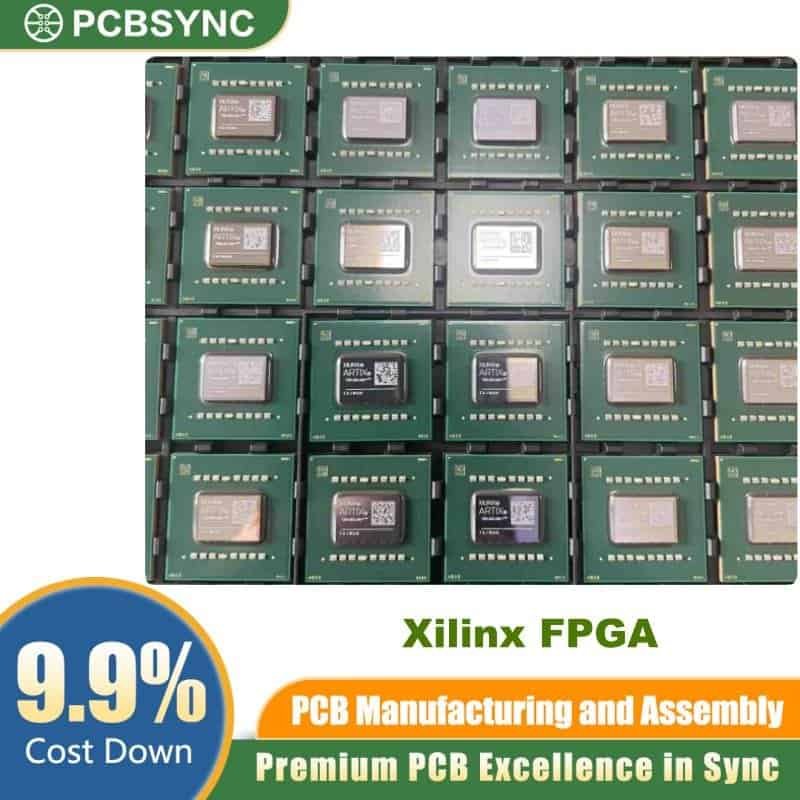
The XC7VX690T-L2FFG1927E is a high-performance, low-power Xilinx FPGA from AMD’s Virtex-7 XT family. Built on 28nm HKMG process technology, it delivers 693,120 logic cells, up to 1.4 Tb/s I/O bandwidth, and exceptional DSP performance — making it one of the most capable FPGAs available for demanding applications including 100G networking, aerospace, radar signal processing, and ASIC prototyping. Whether you are sourcing this part or evaluating it for your next design, this page covers everything you need: full specifications, package details, key features, and application guidance.
What Is the XC7VX690T-L2FFG1927E?
The XC7VX690T-L2FFG1927E is a member of the Xilinx Virtex-7 XT FPGA family, manufactured by AMD (formerly Xilinx). The part number breaks down as follows:
| Part Number Segment |
Meaning |
| XC7VX |
Xilinx 7-Series Virtex XT |
| 690T |
690K logic cells, XT transceiver variant |
| L2 |
Low-power speed grade 2 |
| FFG |
Flip-chip fine-pitch BGA package |
| 1927 |
1927-pin package |
| E |
Extended temperature / defense-grade qualification |
The “L2” speed grade designation indicates a low-power operating mode optimized for power-sensitive designs, while the “E” suffix denotes extended operating temperature range suitability, particularly relevant for defense, aerospace, and harsh-environment industrial applications.
XC7VX690T-L2FFG1927E Key Specifications
Core Logic and Memory Resources
| Parameter |
Value |
| FPGA Family |
Virtex-7 XT |
| Logic Cells |
693,120 |
| CLB Logic Blocks |
108,300 |
| CLB Flip-Flops |
866,400 |
| 6-Input LUTs |
433,200 |
| Distributed RAM (Kb) |
10,888 |
| Block RAM (36Kb tiles) |
1,470 |
| Total Block RAM (Mb) |
52.92 |
| DSP48E1 Slices |
3,600 |
| Peak DSP Performance |
4.7 TMAC/s |
I/O and Packaging
| Parameter |
Value |
| Package Type |
FCBGA (Flip-Chip BGA) |
| Total Pin Count |
1,927 |
| User I/O Pins |
600 |
| I/O Standards Supported |
LVCMOS, LVDS, SSTL, HSTL, and more |
| SelectIO Max Data Rate |
DDR3-1866 (1,866 Mb/s) |
| I/O Supply Voltage (VCCO) |
Up to 3.3V |
High-Speed Serial Transceivers (GTX)
| Parameter |
Value |
| GTX Transceiver Count |
80 |
| Min Transceiver Rate |
600 Mb/s |
| Max Transceiver Rate |
12.5 Gb/s |
| Total Serial Bandwidth |
Up to 1.4 Tb/s |
| Supported Protocols |
PCIe Gen3, 10G/40G/100G Ethernet, SRIO, CPRI, and more |
Clock Management
| Parameter |
Value |
| Clock Management Tiles (CMT) |
18 |
| MMCMs per CMT |
1 |
| PLLs per CMT |
1 |
| Max Operating Frequency |
710 MHz |
| Core Supply Voltage (VCCINT) |
0.97V – 1.03V (nominal 1.0V) |
Process Technology and Power
| Parameter |
Value |
| Process Node |
28nm HPL (High Performance Low Power) |
| Gate Technology |
High-K Metal Gate (HKMG) |
| Speed Grade |
L2 (Low Power) |
| Temperature Grade |
E (Extended / Defense-grade) |
| RoHS Compliance |
Yes |
XC7VX690T-L2FFG1927E Package Information
FCBGA-1927 Package Details
| Parameter |
Value |
| Package Designator |
FFG1927 |
| Package Style |
Flip-Chip Fine-Pitch Ball Grid Array (FCBGA) |
| Total Ball Count |
1,927 |
| Package Body Size |
45mm × 45mm |
| Ball Pitch |
1.0mm |
| Mounting Type |
Surface Mount (SMT) |
The FFG1927 package offers a dense 1,927-ball footprint that provides designers with 600 user I/O pins, ample power and ground connections, and full routing access to all on-chip resources. This package is commonly used in high-channel-count applications such as network line cards, radar front-ends, and high-performance test equipment.
XC7VX690T-L2FFG1927E vs. Other Virtex-7 Variants
Understanding how this part compares to similar variants helps engineers select the right component for their design.
Part Number Comparison – XC7VX690T Family
| Part Number |
Speed Grade |
I/O Count |
Pin Count |
Temp Grade |
| XC7VX690T-L2FFG1927E |
L2 (Low Power) |
600 |
1,927 |
Extended (E) |
| XC7VX690T-L2FFG1926E |
L2 (Low Power) |
600 |
1,926 |
Extended (E) |
| XC7VX690T-2FFG1927C |
2 (Commercial) |
600 |
1,927 |
Commercial (C) |
| XC7VX690T-2FFG1927I |
2 (Industrial) |
600 |
1,927 |
Industrial (I) |
| XC7VX690T-2FFG1761C |
2 (Commercial) |
850 |
1,761 |
Commercial (C) |
| XC7VX690T-L2FFG1761E |
L2 (Low Power) |
850 |
1,761 |
Extended (E) |
Key Takeaway: The XC7VX690T-L2FFG1927E is the low-power, extended-temperature variant in the 1927-pin package. It is ideal for designs requiring defense-grade reliability combined with power-efficiency, while the 1761-pin packages offer more user I/O (850 pins) for I/O-intensive applications.
Key Features of the XC7VX690T-L2FFG1927E
#### Advanced 28nm HKMG Process Technology
The XC7VX690T-L2FFG1927E is fabricated on a state-of-the-art 28nm high-performance, low-power (HPL) process using High-K Metal Gate (HKMG) technology. Compared to prior 40nm-generation Virtex devices, this delivers approximately 50% lower power consumption at equivalent performance levels — a critical advantage for thermally constrained or battery-sensitive systems.
#### High-Density Logic Fabric with 6-Input LUTs
At its core, the XC7VX690T provides 433,200 six-input LUTs (Look-Up Tables) that can be configured both as logic and as distributed RAM. This dual-use fabric maximizes resource utilization and enables designers to implement complex state machines, custom DSP pipelines, and memory structures without consuming dedicated BRAM resources.
#### 3,600 DSP48E1 Slices for Signal Processing
With 3,600 DSP48E1 slices delivering up to 4.7 TMAC/s of peak DSP performance, the XC7VX690T-L2FFG1927E is purpose-built for signal processing workloads. Each DSP slice features a 25×18-bit multiplier, a 48-bit accumulator, pre-adder, and dynamic datapath control — supporting applications including FIR/IIR filters, FFTs, matrix operations, and floating-point arithmetic.
#### 80 GTX High-Speed Serial Transceivers
The device integrates 80 GTX transceivers capable of operating from 600 Mb/s up to 12.5 Gb/s. These transceivers support a broad range of industry-standard protocols — including PCIe Gen1/2/3, 10G/40G/100G Ethernet, Serial RapidIO, CPRI, JESD204B, and more — enabling seamless connectivity in networking, telecom, and instrumentation platforms without external serializer/deserializer chips.
#### 52.92 Mb of On-Chip Block RAM
A total of 1,470 dual-port 36Kb Block RAM tiles provide 52.92 Mb of on-chip memory with built-in FIFO logic. Block RAM resources support true dual-port access, enabling concurrent read/write from two independent clock domains — essential for data buffering, packet FIFOs, lookup tables, and memory-mapped register files in high-throughput designs.
#### 18 Clock Management Tiles (CMT)
Each of the 18 CMTs contains one MMCM (Mixed-Mode Clock Manager) and one PLL, offering fine-grained, low-jitter clock synthesis, multiplication, division, and phase adjustment. This enables precise timing control across multiple independent clock domains — a necessity for complex multi-protocol FPGA designs.
#### XADC: Integrated 12-Bit Analog-to-Digital Converter
The on-chip XADC block incorporates dual 12-bit, 1 MSPS ADCs with on-chip thermal diodes and voltage sensors. This built-in analog front-end allows designers to monitor die temperature, supply voltages, and up to 16 external analog inputs — reducing BOM cost and enabling real-time system health monitoring.
#### SelectIO with DDR3-1866 Support
The SelectIO interface technology supports DDR3 memory interfaces at speeds up to 1,866 Mb/s, enabling high-bandwidth external memory access. The I/O banks also support a wide range of voltage standards (LVCMOS, LVDS, SSTL15, HSTL, etc.), ensuring compatibility with a broad ecosystem of memory devices and external peripherals.
Applications for the XC7VX690T-L2FFG1927E
The XC7VX690T-L2FFG1927E is designed for demanding, high-performance applications where logic density, serial bandwidth, and power efficiency must coexist. Typical use cases include:
| Application Area |
Why This Device |
| 100G/400G Networking |
80 GTX transceivers + high-bandwidth I/O fabric |
| Aerospace & Defense |
Extended temp grade (E), defense-qualified process |
| Radar & Electronic Warfare |
4.7 TMAC/s DSP performance, GTX connectivity |
| ASIC Prototyping |
693K logic cells replicate complex ASIC designs |
| Medical Imaging |
High logic + DSP density for image reconstruction |
| High-Performance Computing |
Serial connectivity + distributed memory |
| Wireless Infrastructure |
CPRI/JESD204B transceiver protocol support |
| Test & Measurement |
Precision clocking, analog I/O via XADC |
Design Tools and Software Support
The XC7VX690T-L2FFG1927E is fully supported by AMD’s Vivado Design Suite, which provides:
- RTL synthesis, place-and-route, and bitstream generation
- IP Integrator for block-diagram-based design
- Integrated logic analyzer (ILA) and virtual I/O debug cores
- Power analysis (Xilinx Power Estimator)
- Partial reconfiguration support
The device is also supported by legacy ISE Design Suite for designs requiring backward compatibility, though Vivado is the recommended toolchain for all new projects targeting 7-series devices.
Ordering Information
| Parameter |
Details |
| Manufacturer |
AMD (Xilinx) |
| Part Number |
XC7VX690T-L2FFG1927E |
| FPGA Family |
Virtex-7 XT |
| Package |
FCBGA-1927 |
| Speed Grade |
L2 (Low Power) |
| Temperature Range |
Extended (E) |
| Logic Cells |
693,120 |
| Mounting |
Surface Mount |
| RoHS Status |
Compliant |
Frequently Asked Questions
What does the “L2” speed grade mean on the XC7VX690T-L2FFG1927E?
The “L2” speed grade designates a low-power variant of the standard speed grade 2 device. Compared to a standard “-2” part, the L2 variant is optimized for reduced static and dynamic power consumption, trading a small amount of worst-case timing margin for significantly lower power — making it well-suited for power-sensitive or thermally constrained applications.
What is the difference between the XC7VX690T-L2FFG1927E and XC7VX690T-L2FFG1926E?
Both parts share the same die and logic resources. The primary difference lies in the package ball count and pinout revision — the 1927 and 1926 designations reflect different package revisions. Always verify the exact footprint against the Xilinx package files before PCB layout to ensure pinout compatibility.
Is the XC7VX690T-L2FFG1927E suitable for military or aerospace applications?
The “E” temperature suffix indicates the part is qualified for extended temperature range operation and is intended for defense-grade applications. It is part of Xilinx’s Defense-grade 7 Series FPGA offering, which undergoes additional qualification testing beyond the standard commercial and industrial grades.
What programming software is required for the XC7VX690T-L2FFG1927E?
The device is programmed and implemented using AMD Vivado Design Suite (version 2014.1 and later). Vivado provides full support for synthesis, implementation, simulation, and debug of Virtex-7 FPGA designs.