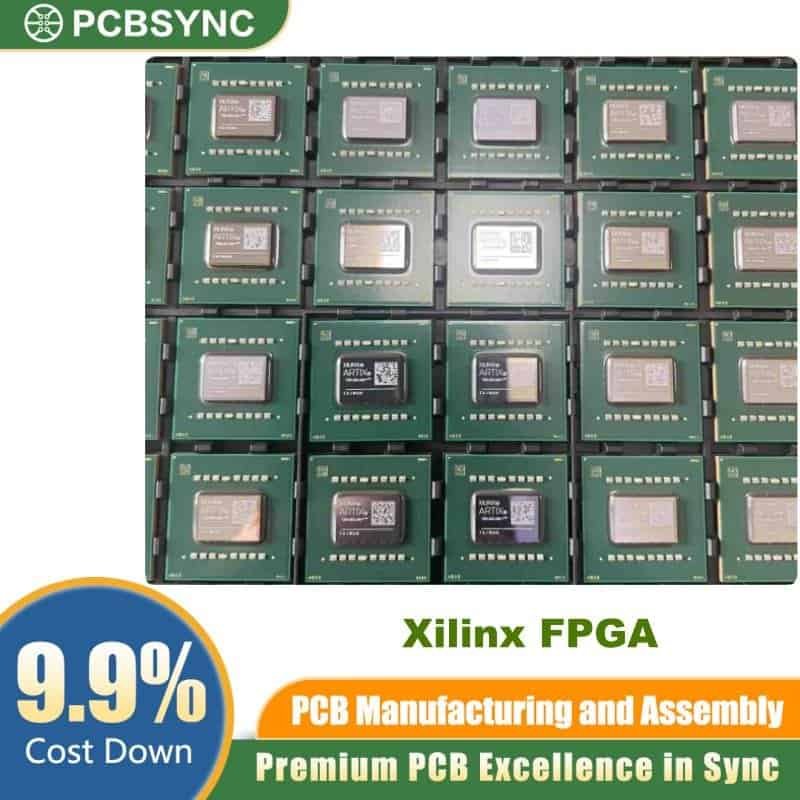
The XC7VX690T-L2FFG1926E is a high-performance, low-power Field Programmable Gate Array (FPGA) from AMD Xilinx’s Virtex-7 XT family. Manufactured on a cutting-edge 28nm High-Performance Low-Power (HPL) process with High-K Metal Gate (HKMG) technology, this device delivers unmatched logic density, DSP throughput, and I/O bandwidth — making it a top choice for 100G networking, ASIC prototyping, radar signal processing, and advanced computing applications.
Whether you are sourcing components for a new PCB design or evaluating high-end FPGAs for an existing system, this guide covers everything you need to know about the XC7VX690T-L2FFG1926E, including full specifications, key features, application use cases, and ordering information.
What Is the XC7VX690T-L2FFG1926E?
The XC7VX690T-L2FFG1926E is part of the Xilinx Virtex-7 XT sub-family, which is specifically optimized for connectivity bandwidth, signal processing, and logic capacity. The part number breaks down as follows:
| Segment |
Meaning |
| XC7V |
Xilinx 7 Series Virtex family |
| X690T |
XT variant with 693,120 logic cells |
| L2 |
Low-power speed grade (-2L) |
| FFG1926 |
Flip-Chip Fine-pitch Ball Grid Array, 1926-ball package |
| E |
Extended (commercial) temperature grade |
This device is sold in Tray packaging and is ideal for prototype, lab, and production environments. For designs requiring the same silicon with different packaging or speed grades, Xilinx offers compatible variants like the XC7VX690T-L2FFG1930E and XC7VX690T-2FFG1926I.
For a broader overview of the entire product line, visit our resource page on Xilinx FPGA devices and families.
XC7VX690T-L2FFG1926E Full Technical Specifications
General Specifications
| Parameter |
Value |
| Manufacturer |
AMD (formerly Xilinx) |
| Part Number |
XC7VX690T-L2FFG1926E |
| Series / Family |
Virtex-7 XT |
| Technology Node |
28nm HPL (HKMG) |
| Core Supply Voltage (VCCINT) |
1.0V |
| Logic Cells |
693,120 |
| System Logic Cells (Equivalent) |
54,190,080 |
| CLB Flip-Flops |
866,400 |
| CLB LUT Count |
433,200 |
| Package |
1924-Pin FCBGA (BBGA) |
| Package Footprint |
FFG1926 (45mm × 45mm) |
| Mounting Type |
Surface Mount |
| Operating Temperature (Commercial) |
0°C to +85°C |
| Packaging |
Tray |
| RoHS Compliant |
Yes |
Logic & Memory Resources
| Resource |
Count / Capacity |
| Configurable Logic Blocks (CLBs) |
108,300 |
| 6-Input LUTs |
433,200 |
| Flip-Flops |
866,400 |
| Block RAM (36Kb each) |
1,470 blocks |
| Total Block RAM Capacity |
52,920 Kb (~52 Mb) |
| Distributed RAM |
Configurable via LUTs |
| FIFO Logic |
Built-in per Block RAM |
The XC7VX690T-L2FFG1926E features 36Kb dual-port Block RAM tiles with built-in FIFO logic, enabling on-chip data buffering without external SRAM in most signal processing and networking designs.
DSP Performance
| Parameter |
Value |
| DSP48E1 Slices |
3,600 |
| Peak DSP Performance |
4.7 TMAC/s |
| Pre-adder Support |
Yes (for symmetric FIR filters) |
| Multiplier Width |
18 × 25 bits |
| Accumulator Width |
48 bits |
The DSP48E1 architecture supports cascade connections, enabling high-throughput digital filtering, FFT pipelines, and matrix operations with minimal routing overhead.
I/O and Connectivity
| Parameter |
Value |
| Total User I/O Pins |
720 |
| I/O Banks |
24 |
| SelectIO Standards Supported |
LVCMOS, LVDS, SSTL, HSTL, and more |
| DDR3 Interface Support |
Up to 1,866 Mb/s |
| Total I/O Bandwidth |
1.4 Tb/s |
| XADC (Analog-to-Digital) |
Dual 12-bit, 1 MSPS ADC |
| XADC Thermal/Supply Sensors |
Yes (on-chip) |
High-Speed Serial Transceivers (GTH)
| Parameter |
Value |
| Transceiver Type |
GTH |
| Number of GTH Transceivers |
48 |
| Line Rate Range |
600 Mb/s to 13.1 Gb/s |
| Low-Power Mode |
Yes (optimized for chip-to-chip) |
| Serial Bandwidth (Total) |
Up to 1.4 Tb/s |
| Protocol Compliance |
10GBASE-KR (100% electrical conformance) |
| Supported Interfaces |
PCIe Gen3, SRIO, CPRI, 10GbE, XAUGE, OBSAI |
The GTH transceivers have achieved 100% electrical conformance to the 10GBASE-KR standard, making this device a natural fit for 10G and 100G backplane networking designs.
Clock Management
| Parameter |
Value |
| Clock Management Tiles (CMTs) |
18 |
| Phase-Locked Loops (PLLs) |
18 |
| Mixed-Mode Clock Managers (MMCMs) |
18 |
| Clock Regions |
18 |
| Maximum Frequency |
Speed-grade dependent (up to ~700 MHz fabric) |
Each CMT combines both a PLL and an MMCM, giving designers precise, low-jitter clock generation and distribution flexibility across the entire device.
PCIe & Configuration
| Parameter |
Value |
| Integrated PCIe Blocks |
4 |
| PCIe Generation |
Gen1 / Gen2 / Gen3 |
| Configuration Modes |
Master SPI, Slave SPI, JTAG, SelectMAP, BPI |
| Encryption |
AES-256 bitstream encryption |
| Partial Reconfiguration |
Supported |
Key Features of the XC7VX690T-L2FFG1926E
#### Advanced 28nm HKMG Process Technology
Built on TSMC’s 28nm HPL process with High-K Metal Gate transistors, the XC7VX690T-L2FFG1926E consumes up to 50% less power than previous-generation Virtex-6 devices while delivering significantly higher performance. The low-power (-2L) speed grade variant in this part number is specifically tuned for power-sensitive deployments.
#### High-Density Logic Fabric
With 693,120 logic cells and over 866,000 flip-flops, this FPGA supports even the most complex custom digital logic designs. The 6-input LUT architecture allows each lookup table to be configured as dual 5-input LUTs with shared inputs, or as distributed RAM for small FIFOs and register files.
#### Massive On-Chip Memory
The 1,470 Block RAM tiles provide approximately 52 Mb of on-chip storage, enabling packet buffering, frame storage, and large coefficient tables without costly off-chip memory interfaces in many designs.
#### Integrated High-Speed Transceivers
The 48 GTH transceivers support rates from 600 Mb/s up to 13.1 Gb/s, covering all major optical and backplane communication standards. A special low-power mode makes this chip ideal for chip-to-chip links where power budget is critical.
#### Flexible Analog Interface (XADC)
The dual 12-bit, 1 MSPS XADC block includes on-chip thermal and supply voltage sensors, supporting system health monitoring, power management, and analog signal digitization without requiring external ADC components.
#### Long Lifecycle Support
AMD has committed to supporting 7 Series FPGAs through 2040, giving engineering teams confidence for long-lifecycle programs in defense, aerospace, and critical infrastructure.
Applications and Use Cases
The XC7VX690T-L2FFG1926E is deployed across a wide range of demanding application domains:
| Application Domain |
How This FPGA Helps |
| 100G Networking |
48× GTH transceivers at 13.1 Gb/s enable line-rate packet processing |
| ASIC Prototyping |
High logic density supports full-chip ASIC emulation |
| Radar & Signal Processing |
4.7 TMAC/s DSP performance handles real-time beamforming and FFT |
| Aerospace & Defense |
AES-256 bitstream encryption, long lifecycle, and high reliability |
| Scientific Computing |
Large on-chip memory and high-bandwidth I/O for HPC workloads |
| Financial Trading Systems |
Ultra-low latency logic for algorithmic trading acceleration |
| Video & Image Processing |
High I/O count and DDR3 support enable real-time HD/4K pipelines |
| Medical Equipment |
Reliable XADC and precise clock management for diagnostic systems |
| Oil & Gas |
Industrial-grade signal processing and robust I/O capability |
XC7VX690T-L2FFG1926E Ordering & Package Information
| Parameter |
Detail |
| Manufacturer Part Number |
XC7VX690T-L2FFG1926E |
| Manufacturer |
AMD (Xilinx) |
| Package Type |
FCBGA (Flip-Chip Ball Grid Array) |
| Pin Count |
1924 Balls |
| Package Size |
45mm × 45mm |
| Ball Pitch |
1.0mm |
| Packaging / Shipping Format |
Tray |
| RoHS Status |
Compliant |
| Export Classification (ECCN) |
3A001.a.7 (verify with distributor) |
Related Part Numbers / Variants
| Part Number |
Difference |
| XC7VX690T-L2FFG1930E |
Same silicon, alternate package footprint |
| XC7VX690T-L2FFG1927E |
Same silicon, alternate package footprint |
| XC7VX690T-2FFG1926I |
Commercial speed grade (-2), Industrial temp |
| XC7VX690T-2FFG1761C |
850 I/O, 1761-pin FCBGA package |
| XC7VX980T-L2FFG1926E |
Higher density (979,200 cells), same package |
Development Tools & Software Support
The XC7VX690T-L2FFG1926E is fully supported by AMD’s Vivado Design Suite, which provides synthesis, implementation, simulation, and hardware debugging capabilities. Vivado replaced the legacy ISE toolchain for 7 Series devices and offers a significantly improved design flow.
| Tool |
Use Case |
| Vivado Design Suite |
Primary synthesis, P&R, simulation, and debug |
| Vivado HLS (Vitis HLS) |
High-level synthesis from C/C++ |
| ChipScope Pro / ILA |
On-chip debug and logic analysis |
| Vivado IP Integrator |
Block-level IP-based design |
| PetaLinux |
Embedded Linux (applicable for SoC designs) |
Frequently Asked Questions (FAQ)
Q: What is the core voltage for the XC7VX690T-L2FFG1926E? A: The VCCINT (core logic) supply voltage is 1.0V. I/O voltage varies by bank and configured I/O standard (typically 1.2V to 3.3V).
Q: What is the difference between the -L2 and -2 speed grade? A: The -L2 (low-power) speed grade operates the core at a lower voltage (0.95V typical) to reduce dynamic power consumption, with slightly reduced maximum operating frequency compared to the standard -2 grade.
Q: Is this FPGA suitable for defense and aerospace programs? A: Yes. It supports AES-256 bitstream encryption, partial reconfiguration, and has an AMD-committed lifecycle to 2040. For fully screened MIL-spec devices, consult AMD’s defense-grade product line.
Q: Can the XC7VX690T-L2FFG1926E be used for PCIe Gen3 applications? A: Yes. It includes 4 integrated PCIe hard IP blocks supporting up to Gen3 (8 GT/s per lane).
Q: What configuration memory is needed for this FPGA? A: This device requires external configuration memory such as Xilinx SPI flash (e.g., Macronix or Micron NOR flash). Configuration can be done via Master SPI, Slave SPI, JTAG, BPI, or SelectMAP modes.
Summary
The XC7VX690T-L2FFG1926E is one of the most capable FPGAs in the Xilinx 7 Series portfolio. With 693K logic cells, 48 GTH transceivers at 13.1 Gb/s, 4.7 TMAC/s DSP throughput, 52 Mb of on-chip block RAM, and 720 user I/Os — all housed in a 1924-ball FCBGA package on energy-efficient 28nm HKMG technology — it addresses the demands of high-density networking, defense, scientific, and industrial applications.
AMD’s commitment to supporting this device through 2040 further makes it a reliable long-lifecycle solution for mission-critical designs. If you are evaluating this FPGA for your next project, consult the Xilinx FPGA resources page for additional design guidance and family comparisons.