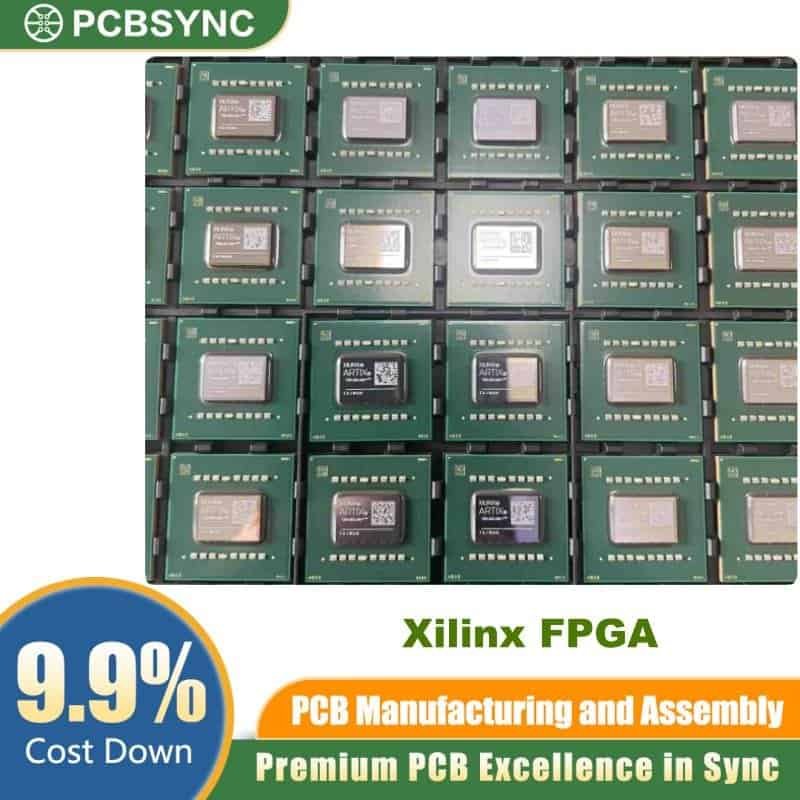
The XC7VX690T-3FFG1927E is a high-performance, high-capacity Field Programmable Gate Array (FPGA) from AMD’s Xilinx Virtex-7 XT family. Engineered on an advanced 28 nm High-Performance Low-Power (HPL) High-K Metal Gate (HKMG) process node, this device delivers an exceptional balance of logic density, DSP throughput, and I/O bandwidth — making it one of the most capable programmable logic devices available for demanding signal processing, networking, and high-reliability applications.
Whether you are designing next-generation ASIC prototypes, high-speed communications systems, or test and measurement platforms, the XC7VX690T-3FFG1927E provides the raw resources and connectivity options to meet your most challenging design requirements. Explore the full range of solutions built around this device by visiting Xilinx FPGA.
What Is the XC7VX690T-3FFG1927E?
The part number breaks down as follows:
| Segment |
Meaning |
| XC |
Xilinx Commercial device |
| 7V |
7 Series — Virtex family |
| X |
XT (Extended Transceiver) subfamily |
| 690T |
690K logic cell density |
| -3 |
Speed grade 3 (fastest commercial grade) |
| FFG |
Flip-chip fine-pitch BGA package type |
| 1927 |
1927-pin package footprint |
| E |
Extended temperature range (0°C to 100°C junction) |
This is the speed grade -3 variant of the XC7VX690T, which represents the highest-performance commercial silicon bin in the Virtex-7 XT lineup, housed in a 1927-ball FCBGA package.
Key Features of the XC7VX690T-3FFG1927E
- 693,120 logic cells organized in 54,150 Configurable Logic Blocks (CLBs)
- 28 nm HPL HKMG process technology for low power and high switching speed
- Speed Grade -3 — highest-performance commercial speed grade
- 600 user I/O pins in the FFG1927 package
- Up to 741 MHz internal clock performance
- 3,600 DSP48E1 slices for high-throughput arithmetic
- 52.5 Mb total block RAM (54,190,080 bits) in 36 Kb tiles
- 80 GTH transceivers supporting up to 13.1 Gb/s
- 1,927-pin Flip-Chip BGA (FCBGA) package, 45 mm × 45 mm
- Supply voltage: 0.97 V – 1.03 V (VCCINT)
- Operating temperature: 0°C to 100°C (TJ)
XC7VX690T-3FFG1927E Full Technical Specifications
General Device Specifications
| Parameter |
Value |
| Manufacturer |
AMD (Xilinx) |
| Part Number |
XC7VX690T-3FFG1927E |
| FPGA Family |
Virtex-7 XT |
| Process Technology |
28 nm HPL HKMG |
| Speed Grade |
-3 (Fastest Commercial) |
| Temperature Grade |
E (Extended: 0°C to 100°C TJ) |
| RoHS Compliant |
Yes |
Logic Resources
| Resource |
Quantity |
| Logic Cells |
693,120 |
| CLBs (Slices) |
54,150 |
| Flip-Flops |
866,400 |
| LUT6 Elements |
433,200 |
| Distributed RAM |
10,888 Kb |
| Max Frequency |
741 MHz |
Memory Resources
| Resource |
Value |
| Block RAM Tiles (36 Kb) |
1,470 |
| Total Block RAM |
52,920 Kb (54,190,080 bits) |
| FIFO Logic |
Built-in per BRAM tile |
| Dual-Port RAM |
Yes (up to 72-bit wide) |
DSP Performance
| Parameter |
Value |
| DSP48E1 Slices |
3,600 |
| Max DSP Clock |
640 MHz |
| Peak DSP Performance |
4.61 TMAC/s |
| Multiplier Width |
18 × 27 bit (signed) |
I/O and Connectivity
| Parameter |
Value |
| User I/O Pins |
600 |
| I/O Standards Supported |
LVDS, LVCMOS, SSTL, HSTL, HSUL, etc. |
| SelectIO Banks |
HP (High-Performance) |
| DDR3 Interface Speed |
Up to 1,866 Mb/s |
| I/O Bandwidth |
Up to 1.4 Tb/s system-level |
High-Speed Serial Transceivers (GTH)
| Parameter |
Value |
| GTH Transceiver Count |
80 |
| Min Data Rate |
600 Mb/s |
| Max Data Rate |
13.1 Gb/s |
| Low-Power Mode |
Yes (optimized for chip-to-chip) |
| Supported Protocols |
PCIe Gen3, 10GbE, JESD204B, CPRI, OTU2, and more |
Clocking Resources
| Resource |
Value |
| Clock Management Tiles (CMT) |
14 (each with 1 MMCM + 2 PLLs) |
| MMCMs |
14 |
| PLLs |
28 |
| Global Clock Networks |
32 |
| Regional Clock Networks |
96 |
PCIe Interface
| Feature |
Value |
| PCIe Blocks |
4 |
| PCIe Generation |
Gen 3 |
| Max Lanes |
x8 |
| Max Throughput |
~64 Gb/s aggregate |
Package and Physical
| Parameter |
Value |
| Package Type |
FCBGA (Flip-Chip BGA) |
| Package Code |
FFG1927 |
| Pin Count |
1,927 |
| Package Size |
45 mm × 45 mm |
| Ball Pitch |
1.0 mm |
| Mounting |
Surface Mount (SMT) |
Electrical Characteristics
| Parameter |
Min |
Typical |
Max |
Unit |
| VCCINT (Core) |
0.97 |
1.00 |
1.03 |
V |
| VCCAUX |
1.71 |
1.80 |
1.89 |
V |
| VCCO (HP banks) |
1.14 |
— |
1.89 |
V |
| Junction Temperature |
0 |
— |
100 |
°C |
Understanding the Part Number: XC7VX690T-3FFG1927E
Decoding the part number provides instant insight into the device’s capabilities:
- XC7V — Identifies this as a Xilinx 7 Series Virtex-class device
- X — Denotes the XT subfamily, which integrates GTH high-speed transceivers for multi-gigabit serial communication
- 690T — Indicates approximately 690K logic cells with stacked silicon interconnect (SSI) technology for maximum die area
- -3 — Speed grade 3 is the fastest available in the commercial temperature range, ideal for timing-critical designs
- FFG — Flip-chip fine-pitch ball grid array, enabling high pin density with excellent signal integrity
- 1927 — Total ball count for this particular package; paired with 600 accessible user I/O pins
- E — Extended commercial temperature range (0°C to 100°C junction temperature)
Virtex-7 XT Architecture: What Sets It Apart
H2: Advanced 28 nm HPL HKMG Process
The XC7VX690T-3FFG1927E is manufactured using a 28 nm High-Performance Low-Power (HPL) High-K Metal Gate (HKMG) process. Compared to the 40 nm node used in previous-generation Virtex-6 devices, this process offers roughly 50% lower static power consumption while simultaneously improving switching speed and logic density. For system designers, this translates directly to lower thermal dissipation, reduced cooling costs, and the ability to deploy high-density logic in size-constrained enclosures.
H3: 6-Input LUT Architecture
The Virtex-7 fabric uses true 6-input LUT (LUT6) slices, which pack more logic per cell than older 4-input LUT architectures. Each LUT6 can be split into two independent 5-input functions, effectively doubling routing flexibility. Additionally, the LUT fabric is configurable as distributed RAM or shift-register delay elements, enabling designers to embed small memories directly into the logic fabric without consuming precious block RAM resources.
H3: GTH Multi-Gigabit Transceivers
The “XT” designation in the Virtex-7 XT family reflects the device’s emphasis on high-speed serial I/O. The XC7VX690T-3FFG1927E integrates 80 GTH transceivers, each supporting line rates from 600 Mb/s to 13.1 Gb/s. Key features include:
- Integrated PLL per transceiver channel for low-jitter clock recovery
- Support for advanced protocols including 10GbE, PCIe Gen3, JESD204B, CPRI, OBSAI, OTN, and SONET/SDH
- A dedicated low-power mode that reduces power consumption by up to 50% for chip-to-chip links
- Automatic equalization and pre-emphasis for long trace and backplane applications
H3: Block RAM with Built-In FIFO
Each of the 1,470 block RAM tiles provides 36 Kb of true dual-port memory, configurable in a wide variety of aspect ratios (from 1-bit wide × 32K deep, up to 72-bit wide × 512 deep). Integrated FIFO logic eliminates the need to instantiate external FIFO controllers, simplifying designs and improving timing closure. With a total of over 52 MB of on-chip RAM, the XC7VX690T-3FFG1927E can buffer large data sets locally, reducing external memory bandwidth requirements.
H3: Clock Management Tiles (CMTs)
The device contains 14 Clock Management Tiles, each comprising one Mixed-Mode Clock Manager (MMCM) and two Phase-Locked Loops (PLLs). MMCMs support fine-phase shifting, fractional divide, and spread-spectrum modulation — capabilities essential for DDR memory interfaces, SerDes clocking, and EMI-sensitive designs. The 32 global clock networks and 96 regional clock networks allow designers to distribute multiple independent clocks across the device fabric with minimal skew.
Common Applications for the XC7VX690T-3FFG1927E
The high logic density, abundant DSP resources, and multi-gigabit transceiver count of this device make it well-suited for a broad range of high-performance applications:
H3: High-Performance Networking and Communications
With 80 GTH transceivers supporting up to 13.1 Gb/s and integrated PCIe Gen3 x8 blocks, the XC7VX690T-3FFG1927E excels as a line-card processor or packet-forwarding engine in high-speed Ethernet switches, optical transport equipment, and base station baseband units. The device can simultaneously terminate dozens of 10 Gb/s optical lanes while performing wire-speed packet processing in the logic fabric.
H3: ASIC Prototyping and Emulation
With 693K logic cells and nearly 55K CLBs, this FPGA provides enough capacity to prototype mid-to-large-scale ASICs before committing to costly mask sets. Multi-die SoC designs can be partitioned across FPGA boundaries using the GTH transceivers as chip-to-chip links, enabling realistic pre-silicon validation of complex IPs including processors, interconnects, and custom accelerators.
H3: Test and Measurement Equipment
The combination of high-speed ADC interfaces (DDR3 at 1,866 Mb/s), abundant DSP slices (3,600 × DSP48E1), and on-chip analog monitoring via the integrated XADC (dual 12-bit, 1 MSPS ADC) makes the XC7VX690T-3FFG1927E ideal for oscilloscopes, signal analyzers, and ATE systems requiring real-time data acquisition and digital signal processing.
H3: Defense and Aerospace
The extended temperature range (0°C to 100°C TJ) and the availability of military and space-grade versions of the Virtex-7 family make this device suitable for ruggedized systems. Applications include radar signal processing, electronic warfare, software-defined radio (SDR), and secure communications platforms.
H3: Medical Imaging and Diagnostics
High-speed, high-resolution medical imaging systems — including MRI gradient controllers, ultrasound beamformers, and CT scanners — leverage the DSP throughput and memory bandwidth of the XC7VX690T-3FFG1927E to perform real-time image reconstruction and filtering at frame rates that would be impossible with microprocessor-based solutions.
XC7VX690T-3FFG1927E vs. Related Virtex-7 Variants
| Part Number |
Logic Cells |
GTH/GTX |
I/O Pins |
Package |
Speed Grade |
Temp |
| XC7VX690T-3FFG1927E |
693,120 |
80 GTH |
600 |
1927-FCBGA |
-3 |
E (0–100°C) |
| XC7VX690T-2FFG1927C |
693,120 |
80 GTH |
600 |
1927-FCBGA |
-2 |
C (0–85°C) |
| XC7VX690T-1FFG1927C |
693,120 |
80 GTH |
600 |
1927-FCBGA |
-1 |
C (0–85°C) |
| XC7VX690T-L2FFG1927E |
693,120 |
80 GTH |
600 |
1927-FCBGA |
-2L |
E (Low Power) |
| XC7VX485T-3FFG1927E |
485,760 |
56 GTH |
600 |
1927-FCBGA |
-3 |
E (0–100°C) |
| XC7VX980T-2FFG1930C |
979,200 |
80 GTH |
600 |
1930-FCBGA |
-2 |
C (0–85°C) |
The -3 speed grade provides the fastest timing characteristics, enabling the highest clock frequencies and tightest setup/hold margins. For power-sensitive designs, the -L2 (Low Voltage) variant reduces VCCINT to 0.9 V, cutting dynamic power at the cost of slightly reduced maximum frequency.
Design Tools and Software Support
H3: AMD Vivado Design Suite
The XC7VX690T-3FFG1927E is fully supported by the AMD Vivado Design Suite, which provides:
- HDL synthesis (VHDL, Verilog, SystemVerilog)
- Implementation (place and route) with timing-driven algorithms optimized for 7 Series devices
- Static Timing Analysis (STA) with full Virtex-7 device models
- IP Integrator for block-based design entry
- Integrated Logic Analyzer (ILA) for in-system debug
H3: IP Core Ecosystem
Thousands of verified IP cores are available for the Virtex-7 family through the Vivado IP Catalog and Xilinx IP licensing portal. Critical IP for the XC7VX690T-3FFG1927E includes PCIe Gen3 x8 Endpoint/Root Complex, 10/40/100GbE MACs, DDR3/DDR4 PHY, and JESD204B data converter interfaces — accelerating time-to-market for complex system designs.
H3: Characterization Kit Support
AMD offers the VC7215 Characterization Kit, which features the XC7VX690T-3FFG1927E as its central FPGA. The board includes 20 Samtec BullsEye connector pads for GTH transceiver access, SMA-connected differential MRCC inputs, a USB-to-UART bridge, a fixed 200 MHz LVDS oscillator, SuperClock-2 module, three VITA 57.1 FMC HPC connectors, and a Digilent USB JTAG programming port — providing a comprehensive hardware platform for device characterization and design bring-up.
Ordering Information
| Parameter |
Details |
| Manufacturer Part Number |
XC7VX690T-3FFG1927E |
| Manufacturer |
AMD (formerly Xilinx) |
| DigiKey Part Number |
122-1752-ND |
| Product Category |
Embedded — FPGAs (Field Programmable Gate Arrays) |
| RoHS Status |
Compliant (Pb-Free) |
| Package |
1927-FCBGA (45 × 45 mm) |
| Minimum Order Quantity |
1 |
Frequently Asked Questions
Q: What is the maximum clock frequency of the XC7VX690T-3FFG1927E? The device supports internal logic frequencies up to 741 MHz at speed grade -3. Actual achieved frequencies depend on the specific logic path, placement, routing, and operating conditions.
Q: How many PCIe lanes does this FPGA support? The XC7VX690T-3FFG1927E includes four integrated PCIe blocks, each supporting up to x8 Gen 3, delivering up to 8 Gb/s per lane in each direction.
Q: What is the difference between the -3 and -2 speed grades? Speed grade -3 is the fastest commercial silicon bin and is typically selected when maximum performance is required. Speed grade -2 is more widely available and is generally sufficient for most high-performance designs.
Q: Is this device supported in Xilinx ISE? Vivado Design Suite is the primary supported tool. Legacy ISE 14.7 provides partial support for 7 Series devices but is no longer actively developed by AMD.
Q: What is the XADC block? The XADC is a user-configurable analog interface embedded in all 7 Series FPGAs. It incorporates dual 12-bit, 1 MSPS analog-to-digital converters with on-chip thermal and supply voltage sensors, enabling system monitoring without external ADC components.
Summary
The XC7VX690T-3FFG1927E represents the pinnacle of the Virtex-7 XT family for commercial applications that demand maximum throughput and connectivity. With 693,120 logic cells, 3,600 DSP slices, 80 GTH transceivers at 13.1 Gb/s, and 52.5 Mb of block RAM — all in a 1,927-pin flip-chip BGA — this device provides the resources needed to implement the most demanding digital systems in a single programmable chip.
Its 28 nm HPL HKMG process node ensures that performance comes without excessive power consumption, while the speed grade -3 designation guarantees the tightest timing margins available in the commercial Virtex-7 lineup.
For engineers and procurement teams seeking this device or related solutions, visit Xilinx FPGA for additional resources, pricing, and application support.