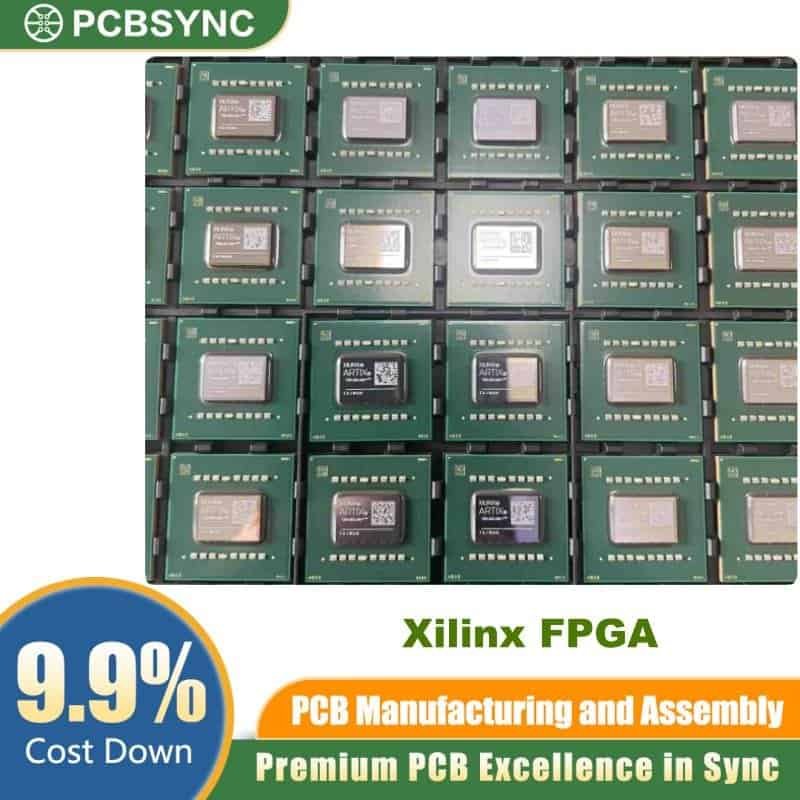
The XC7VX485T-2FFG1158C is a high-performance field-programmable gate array (FPGA) from AMD Xilinx’s Virtex-7 XT family. Built on a 28nm process node, this device delivers exceptional logic density, transceiver bandwidth, and DSP throughput — making it one of the most capable Xilinx FPGA solutions available for demanding system-level designs. Whether you are working in 100G networking, aerospace, high-performance computing, or ASIC prototyping, the XC7VX485T-2FFG1158C offers the processing muscle and I/O flexibility your design demands.
What Is the XC7VX485T-2FFG1158C?
The XC7VX485T-2FFG1158C is part of Xilinx’s Virtex-7 XT subfamily, which is optimized specifically for serial connectivity and transceiver performance. The part number breaks down as follows:
| Part Number Segment |
Meaning |
| XC |
Xilinx Commercial product |
| 7V |
7 Series (Virtex-7 family) |
| X |
XT subfamily (transceiver-optimized) |
| 485T |
485,760 logic cells |
| -2 |
Speed grade 2 (standard commercial) |
| FFG |
Flip-chip Fine-pitch Ball Grid Array |
| 1158 |
1,158 total ball count |
| C |
Commercial temperature range (0°C to +85°C) |
This device belongs to the commercial temperature grade, packaged in a 1158-pin FCBGA (Flip-Chip Ball Grid Array) format — a compact yet high-density footprint suitable for high-speed PCB designs.
XC7VX485T-2FFG1158C Key Specifications
Core Logic and Fabric
| Parameter |
Value |
| FPGA Family |
Virtex-7 XT |
| Technology Node |
28nm |
| Logic Cells (Macrocells) |
485,760 |
| Logic Blocks (CLBs) |
75,900 |
| Total RAM Bits |
37,080 Kbit (~4.5 MB) |
| DSP Slices |
2,800 |
| Speed Grade |
-2 (Standard Commercial) |
I/O and Connectivity
| Parameter |
Value |
| User I/O Count |
350 |
| Maximum User I/O |
700 (package-dependent) |
| GTX Transceivers |
56 |
| Transceiver Data Rate |
Up to 12.5 Gb/s (GTX) |
| Total Serial Bandwidth |
Up to 2.8 Tb/s (family-wide) |
| Memory Interface Support |
DDR3-1866 |
| Clock Management |
MMCM (Mixed-Mode Clock Manager), PLL |
| Maximum Operating Frequency |
710 MHz |
Power and Package
| Parameter |
Value |
| Core Supply Voltage (VCCINT) |
0.97V – 1.03V (nominal 1.0V) |
| I/O Supply Voltage (VCCO) |
Up to 3.3V |
| Auxiliary Supply Voltage (VCCAUX) |
1.8V |
| Package Type |
FC-BGA (Flip-Chip Ball Grid Array) |
| Package Designation |
FFG1158 |
| Total Pin Count |
1,158 |
| Operating Temperature |
0°C to +85°C (Commercial) |
| RoHS Compliant |
Yes |
| Lead-Free |
Yes |
Design Tool Support
| Tool |
Minimum Version |
| Xilinx Vivado Design Suite |
2012.4 v1.08 |
| Xilinx ISE Design Suite |
14.2 v1.06 |
XC7VX485T-2FFG1158C Part Number Decoder
Understanding a Xilinx part number helps engineers quickly identify exactly what device they are ordering. The XC7VX485T-2FFG1158C encodes all critical attributes in a compact string:
- XC — Xilinx commercial-grade device
- 7V — 7 Series, Virtex product line
- X — XT subfamily (transceiver-focused variant of the Virtex-7 family)
- 485T — 485,760 equivalent logic cell count
- -2 — Speed grade 2, the standard performance tier for commercial designs
- FFG — Flip-Chip Fine-Pitch Ball Grid Array package
- 1158 — Ball count in the package (1,158 total balls)
- C — Commercial temperature range
Virtex-7 XT Family Overview
The XC7VX485T-2FFG1158C sits within Xilinx’s Virtex-7 XT subfamily. The XT designation indicates transceivers-optimized devices within the broader Virtex-7 portfolio. Below is a comparison of key Virtex-7 XT devices to help you choose the right part:
Virtex-7 XT Family Comparison
| Device |
Logic Cells |
GTX Transceivers |
Max User I/O |
Package Options |
| XC7VX330T |
326,400 |
28 |
700 |
FFG1157, FFG1761 |
| XC7VX485T |
485,760 |
56 |
700 |
FFG1157, FFG1158, FFG1761, FFG1927 |
| XC7VX550T |
554,240 |
80 |
600 |
FFG1158, FFG1927 |
| XC7VX690T |
693,120 |
80 |
1,000 |
FFG1157, FFG1158, FFG1761, FFG1927 |
| XC7VX980T |
979,200 |
72 |
1,200 |
FFG1926, FFG1930 |
The XC7VX485T strikes a favorable balance between transceiver count (56 GTX lanes), logic capacity (~485K cells), and package size — making it a popular mid-tier choice within the XT lineup.
Detailed Feature Breakdown
High-Capacity Block RAM
The XC7VX485T-2FFG1158C provides 37,080 Kbits of total block RAM, organized as 36Kb dual-port RAM blocks. This on-chip memory is essential for buffering high-speed data streams, implementing FIFOs, and storing lookup tables in signal-processing pipelines. With approximately 4.5MB of embedded RAM, designers can avoid costly off-chip memory accesses for many applications.
GTX High-Speed Transceivers
One of the defining features of the XT subfamily is its 56 GTX transceivers, capable of operating at up to 12.5 Gb/s per lane. These transceivers support a wide range of high-speed serial standards including PCIe Gen2/Gen3, 10GbE, CPRI, SRIO, and more. The integrated transceiver architecture simplifies PCB design by eliminating external serializer/deserializer components.
Advanced Clock Management
The FPGA integrates MMCM (Mixed-Mode Clock Manager) and PLL resources to support precise, low-jitter clock synthesis and distribution. These resources allow designs to generate multiple derived clocks from a single reference, implement dynamic clock gating, and meet tight timing closure requirements at frequencies up to 710 MHz.
DSP Performance
With 2,800 DSP48E1 slices, the XC7VX485T-2FFG1158C delivers significant fixed-point arithmetic throughput for signal-processing applications. Each DSP48E1 slice implements a 25×18 multiplier with accumulator, enabling efficient implementation of FIR filters, FFTs, matrix multiplications, and similar compute-intensive functions without consuming general-purpose fabric resources.
Flexible I/O Architecture
The device’s 350 user I/Os are distributed across High-Performance (HP) and High-Range (HR) I/O banks, supporting a wide range of single-ended and differential signaling standards. HP banks support voltages up to 1.8V with high-speed performance, while HR banks extend compatibility to 3.3V legacy interfaces.
Applications for the XC7VX485T-2FFG1158C
Thanks to its combination of high logic density, abundant GTX transceivers, and strong DSP performance, the XC7VX485T-2FFG1158C is well-suited for a diverse range of application domains:
Networking and Communications
- 10G to 100G line cards — Multiple GTX lanes enable aggregation of high-speed Ethernet links
- Packet processing engines — Large BRAM and fabric capacity support deep-packet inspection and QoS engines
- CPRI/OBSAI fronthaul — Used in 4G/5G radio access network infrastructure
High-Performance Computing (HPC)
- Hardware accelerators — Offload compute-intensive workloads from CPUs/GPUs
- ASIC prototyping — Large logic capacity makes it ideal for pre-silicon validation of complex ASICs
- Financial computing — Ultra-low-latency trading algorithms benefit from the FPGA’s deterministic execution
Aerospace and Defense
- Portable radar systems — DSP slices and high-speed I/Os support waveform generation and processing
- Software-defined radio (SDR) — Reconfigurable logic enables multi-mode radio implementations
- Electronic warfare — Signal classification and jamming systems built on high-bandwidth fabric
Scientific and Industrial
- Scientific instrumentation — Data acquisition at high sample rates with on-chip processing
- Medical imaging — Real-time image reconstruction using DSP slices
- Oil and gas — Seismic data processing pipelines
Ordering and Availability Information
| Attribute |
Detail |
| Manufacturer |
AMD (formerly Xilinx) |
| Full Part Number |
XC7VX485T-2FFG1158C |
| DigiKey Part Number |
122-1859-ND |
| Package |
1158-BBGA, FCBGA |
| Status |
Active |
| RoHS Compliance |
RoHS Compliant |
| Temperature Grade |
Commercial (0°C to +85°C) |
| Lead Finish |
Lead-Free |
| Tray Quantity |
Tray |
Note: The XC7VX485T-2FFG1158C is subject to export control regulations. Confirm export compliance requirements before placing orders for shipment to restricted destinations.
XC7VX485T-2FFG1158C vs. Similar Devices
Engineers evaluating this FPGA often compare it against related parts. The table below highlights the key differences between the XC7VX485T-2FFG1158C and closely related variants:
| Part Number |
Speed Grade |
Package |
Balls |
Temp Grade |
Transceivers |
| XC7VX485T-1FFG1158C |
-1 (slower) |
FFG1158 |
1,158 |
Commercial |
56 GTX |
| XC7VX485T-2FFG1158C |
-2 (standard) |
FFG1158 |
1,158 |
Commercial |
56 GTX |
| XC7VX485T-2FFG1158I |
-2 |
FFG1158 |
1,158 |
Industrial |
56 GTX |
| XC7VX485T-2FFG1157C |
-2 |
FFG1157 |
1,157 |
Commercial |
56 GTX |
| XC7VX485T-2FFG1761C |
-2 |
FFG1761 |
1,761 |
Commercial |
56 GTX |
The primary differentiation between these variants is speed grade (performance), package footprint, and temperature rating. The -2FFG1158C is the standard commercial choice when the 1158-ball footprint is the PCB constraint.
Design Considerations and PCB Guidelines
Power Supply Requirements
The XC7VX485T-2FFG1158C requires multiple supply rails for proper operation. Designers must sequence these supplies carefully, as specified in the Virtex-7 power-on requirements:
| Supply Rail |
Nominal Voltage |
Purpose |
| VCCINT |
1.0V |
Core logic supply |
| VCCAUX |
1.8V |
Auxiliary logic supply |
| VCCBRAM |
1.0V |
Block RAM supply |
| VCCO (HP banks) |
1.0V / 1.2V / 1.5V / 1.8V |
High-performance I/O supply |
| VCCO (HR banks) |
1.2V / 1.5V / 1.8V / 2.5V / 3.3V |
High-range I/O supply |
| VCCAUX_IO |
1.8V or 2.0V |
I/O auxiliary supply |
Use the Xilinx Power Estimator (XPE) or Vivado Power Analysis to accurately estimate current demand for your specific design before selecting power management ICs.
Thermal Management
At speed grade -2 with all resources active, the XC7VX485T-2FFG1158C can dissipate significant power. Proper thermal design — including heatsinks, thermal interface materials, and airflow analysis — is essential to maintain junction temperature below the maximum rated value. Refer to the Xilinx packaging and thermal guidelines for the FFG1158 package thermal resistance (θJB and θJC) values.
PCB Design Tips
- Route GTX transceiver differential pairs with matched length and controlled impedance (100Ω differential)
- Place decoupling capacitors close to each power pin to minimize noise on VCCINT and VCCAUX rails
- Use the Xilinx PCB Design Checklist for Virtex-7 devices to verify your layout before fabrication
- Reference the FFG1158 package outline drawing for ball map, keepout zones, and recommended via structures
Supported Design Tools
The XC7VX485T-2FFG1158C is fully supported by AMD Xilinx’s development toolchains:
| Tool |
Function |
| Vivado Design Suite |
RTL synthesis, implementation, timing closure |
| Xilinx ISE Design Suite (legacy) |
Older design flows (ISE 14.2+) |
| Xilinx Power Estimator (XPE) |
Pre-implementation power estimation |
| Vivado Simulator |
Functional and timing simulation |
| ChipScope Pro / ILA |
On-chip debug and signal probing |
| PetaLinux / Yocto |
Embedded Linux for MicroBlaze soft processors |
Frequently Asked Questions (FAQ)
What is the XC7VX485T-2FFG1158C used for?
This FPGA is used in high-speed networking (10G–100G), ASIC prototyping, aerospace radar systems, scientific instrumentation, and HPC acceleration. Its 56 GTX transceivers and large logic fabric make it ideal for bandwidth-intensive, computation-heavy designs.
What is the difference between speed grade -1 and -2 in Xilinx FPGAs?
Speed grade is a relative performance rating. In Xilinx terminology, a higher absolute number indicates faster performance — so speed grade -2 is faster than -1 and slower than -3. The -2 grade represents the standard commercial performance tier for the XC7VX485T.
Is the XC7VX485T-2FFG1158C RoHS compliant?
Yes. This device is fully RoHS compliant and manufactured with a lead-free ball finish, meeting global environmental regulations for electronic components.
What design tools do I need for this FPGA?
You will need Xilinx Vivado Design Suite (version 2012.4 or later) or the legacy ISE Design Suite (version 14.2 or later). Vivado is strongly recommended for new designs as it provides better timing closure, power analysis, and support for the full Virtex-7 feature set.
Can the XC7VX485T-2FFG1158C be upgraded to a larger package?
The XC7VX485T die is also available in the FFG1157 (1,157-pin) and FFG1761 (1,761-pin) packages, which expose more user I/O. Package migration within the same die allows board redesign with minimal RTL changes.
Summary
The XC7VX485T-2FFG1158C is a production-proven, high-density FPGA that combines 485,760 logic cells, 56 GTX transceivers, 37,080 Kbits of block RAM, and 2,800 DSP slices in a compact 1158-pin FC-BGA package. Operating at commercial temperatures with a 1.0V core supply and a maximum clock frequency of 710 MHz, it is engineered for the most demanding digital design challenges in networking, defense, HPC, and scientific computing.
For engineers and procurement teams looking for a reliable, high-performance programmable logic device with robust tool support and a strong ecosystem, the XC7VX485T-2FFG1158C remains a compelling choice within the Virtex-7 product line.