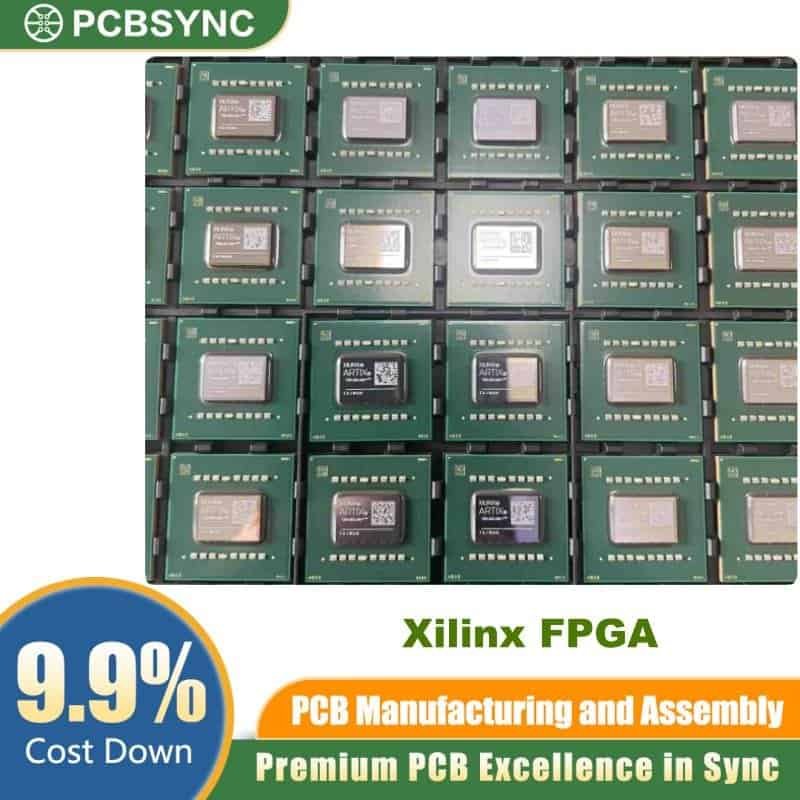
The XC7VX415T-2FFG1157C is a high-performance Xilinx FPGA from the Virtex-7 XT family, engineered for applications demanding maximum logic density, signal processing throughput, and I/O bandwidth. Built on AMD Xilinx’s 28 nm high-k metal gate (HKMG) process, this device delivers a powerful combination of programmable logic, embedded DSP, and high-speed transceivers in a compact 1157-pin FCBGA package.
What Is the XC7VX415T-2FFG1157C?
The XC7VX415T-2FFG1157C is a member of the Xilinx Virtex-7 XT FPGA series — a product line optimized for ultra-high bandwidth connectivity and processing performance. The device targets demanding applications in communications infrastructure, test and measurement, medical imaging, aerospace, and high-performance computing where both logic capacity and I/O speed are critical.
The part number breaks down as follows:
| Field |
Value |
Meaning |
| XC7V |
Virtex-7 |
Device family |
| X415T |
415T |
Logic density variant (XT subfamily) |
| -2 |
Speed Grade 2 |
Commercial speed, mid-range timing performance |
| FFG |
FCBGA |
Flip-Chip Ball Grid Array package |
| 1157 |
1157 pins |
Package pin count |
| C |
Commercial |
Temperature grade (0°C to +85°C) |
XC7VX415T-2FFG1157C Key Specifications
General Device Parameters
| Parameter |
Value |
| Manufacturer |
AMD (Xilinx) |
| Part Number |
XC7VX415T-2FFG1157C |
| Family |
Virtex-7 XT |
| Technology Node |
28 nm HKMG |
| Logic Cells |
412,160 |
| Logic Units |
257,600 |
| CLB Flip-Flops |
504,000 |
| CLB LUTs |
252,000 |
| Operating Voltage (VCCINT) |
1.0 V |
| Package |
1157-Pin FCBGA (FFG1157) |
| Operating Temperature |
0°C to +85°C (Commercial) |
| RoHS Compliance |
Compliant |
| Packaging |
Tray |
Memory & DSP Resources
| Resource |
Quantity |
| Block RAM (36 Kb blocks) |
685 |
| Total Block RAM |
24,660 Kb |
| DSP48E2 Slices |
2,160 |
| DSP Performance |
4.7 TMAC/s |
| I/O Bandwidth |
1.4 Tb/s |
I/O & Connectivity
| Feature |
Detail |
| User I/O Pins |
600 |
| Package Pin Count |
1,157 (FCBGA) |
| GTX Transceivers |
48 (up to 12.5 Gb/s each) |
| PCIe Interface |
Integrated PCIe Gen3 x8 block |
| GTP/GTX Transceiver Bandwidth |
Up to 600 Gb/s aggregate |
Clock & Timing Resources
| Feature |
Value |
| Clock Management Tiles (CMTs) |
24 |
| PLL per CMT |
1 |
| MMCM per CMT |
1 |
| Maximum Clock Frequency |
650.2 MHz |
XC7VX415T-2FFG1157C: Core Features Explained
#### High-Density Programmable Logic Fabric
With 412,160 logic cells organized into 6-input LUTs and dedicated flip-flops, the XC7VX415T-2FFG1157C supports complex control logic, state machines, and large data path designs. The Virtex-7 XT CLB architecture supports efficient routing and reduced timing closure iterations compared to previous generations.
#### High-Speed GTX Transceivers for Serial Connectivity
The device includes 48 GTX transceivers, each capable of operating up to 12.5 Gb/s. These are essential for protocol implementations such as 10GbE, CPRI, JESD204B, Aurora, and Interlaken. The aggregate bandwidth allows designers to build multi-channel systems with hundreds of gigabits per second of throughput.
#### Integrated PCIe Gen3 x8 Hard Block
An on-chip, hardened PCI Express Gen3 endpoint and root port block reduces the FPGA logic resources required for PCIe interfaces and simplifies board-level integration. This is ideal for FPGA-accelerated PCIe-attached compute cards and data acquisition systems.
#### DSP48E2 Slices for Signal Processing
With 2,160 DSP48E2 slices, the XC7VX415T-2FFG1157C delivers 4.7 TMAC/s of DSP performance. Each slice contains a 25×18 multiplier, a 48-bit accumulator, and a pre-adder optimized for FIR filters, FFT engines, and floating-point pipelines. This makes the device well-suited for radar signal processing, software-defined radio (SDR), and video analytics.
#### Configurable XADC Analog Interface
The XADC block provides dual 12-bit ADCs at 1 MSPS, with on-chip thermal and supply voltage sensors. This enables real-time system health monitoring without external measurement ICs.
#### AES-256 Configuration Security
The XC7VX415T-2FFG1157C supports 256-bit AES encryption with HMAC/SHA-256 authentication for bitstream protection, along with built-in Single Event Upset (SEU) detection and correction — critical for defense and aerospace design-in confidence.
#### Advanced Clock Management (CMT)
24 Clock Management Tiles, each combining a PLL and a Mixed-Mode Clock Manager (MMCM), provide precise, low-jitter clocking. This supports frequency synthesis, phase alignment, and spread-spectrum clocking across multiple clock domains.
XC7VX415T-2FFG1157C vs. Related Virtex-7 Devices
The table below compares the XC7VX415T-2FFG1157C against key variants within the Virtex-7 XT series:
| Part Number |
Logic Cells |
GTX Transceivers |
I/O Pins |
Speed Grade |
Temp Grade |
| XC7VX330T-2FFG1157C |
326,400 |
28 |
600 |
-2 |
Commercial |
| XC7VX415T-2FFG1157C |
412,160 |
48 |
600 |
-2 |
Commercial |
| XC7VX485T-2FFG1157C |
485,760 |
56 |
600 |
-2 |
Commercial |
| XC7VX690T-2FFG1157C |
693,120 |
80 |
600 |
-2 |
Commercial |
| XC7VX415T-1FFG1157C |
412,160 |
48 |
600 |
-1 |
Commercial |
| XC7VX415T-2FFG1157I |
412,160 |
48 |
600 |
-2 |
Industrial |
The -2FFG1157C variant occupies the mid-tier logic density position within the 1157-pin FFG package family — offering more transceivers and logic than the VX330T while remaining more cost-accessible than the VX485T and VX690T.
Typical Applications for the XC7VX415T-2FFG1157C
The combination of high transceiver count, DSP density, and large logic fabric makes this device well-matched for the following application areas:
| Application Domain |
Use Case |
| Wireline Networking |
100G line cards, Ethernet switching, CPRI/eCPRI fronthaul |
| Test & Measurement |
Protocol analyzers, pattern generators, high-speed data capture |
| Radar & EW Systems |
Pulse compression, beamforming, waveform generation |
| Medical Imaging |
CT, MRI, ultrasound signal acquisition and reconstruction |
| High-Performance Computing |
FPGA-accelerated PCIe cards, co-processing engines |
| Software-Defined Radio |
Multi-channel ADC/DAC interfaces, digital downconversion |
| Video Processing |
4K/8K video pipeline, multi-standard encoding |
Development Tools & Software Support
The XC7VX415T-2FFG1157C is fully supported by the AMD Vivado Design Suite, which provides:
- RTL synthesis and implementation with timing-driven placement and routing
- IP Integrator for block design-based development
- Integrated Logic Analyzer (ILA) and Virtual Input/Output (VIO) for in-system debug
- High-Level Synthesis (HLS) for C/C++ based design entry
- Partial Reconfiguration support
Designers targeting this device should use Vivado 2019.1 or later for full silicon support. The device is also compatible with third-party EDA tools including Synopsys Synplify and Mentor Precision RTL Plus.
Ordering Information
| Parameter |
Details |
| Manufacturer |
AMD (formerly Xilinx) |
| Manufacturer Part Number |
XC7VX415T-2FFG1157C |
| Package |
1157-Pin FCBGA |
| Packaging Type |
Tray |
| Temperature Grade |
Commercial (0°C to +85°C) |
| RoHS Status |
Compliant |
| DigiKey Part Number |
122-1734-ND |
Frequently Asked Questions
Q: What is the operating voltage of the XC7VX415T-2FFG1157C? The core VCCINT supply voltage is 1.0 V. I/O banks support multiple voltage standards including 1.2 V, 1.5 V, 1.8 V, 2.5 V, and 3.3 V via adjustable VCCO rails.
Q: What is the difference between the -1, -2, and -3 speed grades? Higher speed grades (e.g., -3) offer faster propagation delays and support higher clock frequencies. The -2 speed grade is the most common commercial variant, balancing performance and availability. The -1 grade is the slowest; -3 is the fastest but typically requires tighter power supply and thermal management.
Q: Is the XC7VX415T-2FFG1157C pin-compatible with other Virtex-7 FFG1157 devices? Yes. All Virtex-7 devices in the FFG1157 package share the same pin footprint, allowing board-level migration between the VX330T, VX415T, and VX485T variants without PCB redesign — enabling cost-down and capacity-up scaling.
Q: What configuration interfaces does this FPGA support? The device supports JTAG, Slave Serial, Master SPI (x1, x2, x4), Slave SelectMAP, Master BPI, and ICAP for partial reconfiguration. Configuration can be secured using 256-bit AES encryption.
Q: What bitstream file format is used with the Vivado Design Suite? Vivado generates .bit files for direct JTAG programming and .mcs or .bin files for flash memory programming.