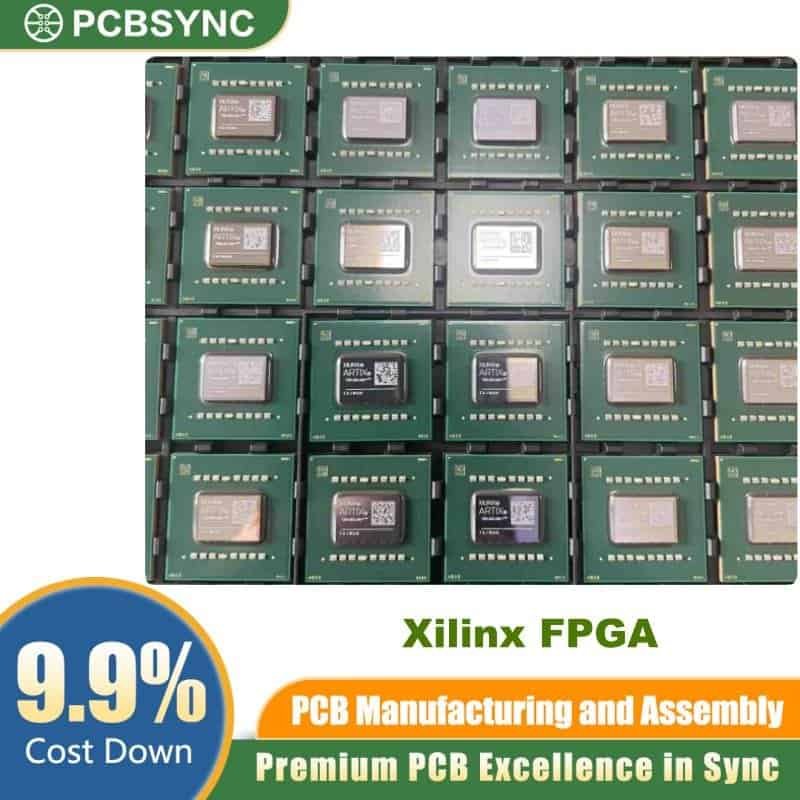
The XC7V2000T-1FLG1925C is a high-performance Field Programmable Gate Array (FPGA) from Xilinx (now AMD), belonging to the flagship Virtex-7 T family. Built on advanced 28nm High-K Metal Gate (HKMG) process technology, this device delivers an extraordinary combination of logic density, DSP throughput, I/O bandwidth, and power efficiency — making it one of the most capable FPGAs ever produced for demanding applications in networking, signal processing, and high-performance computing.
If you are looking for a high-density Xilinx FPGA with industry-leading logic capacity and serial bandwidth, the XC7V2000T-1FLG1925C is a top-tier choice for your next design.
What Is the XC7V2000T-1FLG1925C?
The XC7V2000T-1FLG1925C is a commercial-grade Virtex-7 FPGA IC featuring 1,954,560 logic cells, packaged in a 1925-pin FCBGA (Flip-Chip Ball Grid Array) format. Its part number breaks down as follows:
| Part Number Segment |
Meaning |
| XC |
Xilinx FPGA |
| 7V |
7 Series, Virtex family |
| 2000T |
2000K logic cell class, T = stacked silicon interconnect (SSI) |
| 1 |
Speed grade –1 (standard commercial speed) |
| FLG |
Package type: Flip-chip, Low-profile, G-variant |
| 1925 |
1925-pin package |
| C |
Commercial temperature grade (0°C to 85°C) |
XC7V2000T-1FLG1925C Key Specifications
Core Logic & Fabric Specifications
| Parameter |
Value |
| FPGA Family |
Virtex-7 |
| Logic Cells (Macrocells) |
1,954,560 |
| Logic Blocks (CLBs) |
305,400 |
| Process Node |
28nm HKMG |
| Configuration Memory Bits |
47,628,288 |
| Speed Grade |
–1 (Commercial) |
Memory Resources
| Memory Type |
Capacity |
| Total Block RAM |
46,512 Kbit (~5.66 MB) |
| Block RAM Tiles |
36 Kb dual-port with FIFO |
| Distributed RAM |
Available via 6-input LUT fabric |
I/O and Connectivity
| Parameter |
Value |
| User I/O Pins |
1,200 |
| Package Pins |
1,925 |
| Package Type |
1925-FCBGA (45×45 mm) |
| SelectIO Technology |
DDR3 support up to 1,866 Mb/s |
| Multi-Gigabit Transceivers |
600 Mb/s to 6.6 Gb/s (up to 11.3 Gb/s) |
Power and Operating Conditions
| Parameter |
Value |
| Core Supply Voltage (VCCINT) |
0.97V – 1.03V (nominal 1.0V) |
| Operating Temperature Range |
0°C to 85°C (TJ) |
| Mount Type |
Surface Mount |
| Moisture Sensitivity Level |
Tray packaging |
DSP and Clock Management
| Parameter |
Value |
| DSP Performance |
Up to 4.7 TMAC/s |
| Clock Management Tiles (CMT) |
Yes — PLL + MMCM |
| Maximum Clock Frequency |
625 MHz (fabric) |
| I/O Bandwidth |
Up to 1.4 Tb/s |
XC7V2000T-1FLG1925C Package and Physical Details
The XC7V2000T-1FLG1925C uses the FLG1925 package — a Flip-Chip Ball Grid Array measuring 45mm × 45mm. This package offers excellent electrical performance through direct die attach and provides the pin density required for a 1,200 user I/O design at commercial temperature ranges.
| Physical Attribute |
Detail |
| Package Code |
FLG1925 |
| Package Style |
1924-BBGA, FCBGA |
| Body Size |
45mm × 45mm |
| Ball Count |
1,925 |
| User I/O Count |
1,200 |
| Mounting Style |
SMD/SMT (Surface Mount) |
Virtex-7 SSI Technology: Why the XC7V2000T Uses Stacked Silicon Interconnect
The “T” suffix in XC7V2000T denotes Stacked Silicon Interconnect (SSI) technology, a proprietary Xilinx innovation used to achieve the 2M+ logic cell density that would be impossible to manufacture as a single monolithic die at 28nm. SSI technology stacks multiple FPGA dice on a passive silicon interposer, connected via tens of thousands of micro-bumps, delivering:
- Ultra-high bandwidth die-to-die connectivity with no performance penalty
- Improved yield compared to a single large die
- Scalable capacity for applications demanding the largest available logic footprint
This makes the XC7V2000T-1FLG1925C the largest logic density device in the Virtex-7 portfolio, well-suited for ASIC prototyping, large-scale signal processing, and high-port-count networking.
Key Features of the XC7V2000T-1FLG1925C
#### Advanced Logic Architecture
The Virtex-7 FPGA fabric is based on 6-input Look-Up Tables (6-LUTs) configurable as distributed memory or logic. Each CLB slice contains two 6-LUT elements with dedicated flip-flops, carry logic, and wide function multiplexers — enabling compact, high-performance implementations of arithmetic, control, and data path functions.
#### High-Speed Serial Connectivity
The XC7V2000T-1FLG1925C integrates built-in multi-gigabit transceivers (MGTs) supporting data rates from 600 Mb/s up to 11.3 Gb/s. A special low-power mode is optimized for chip-to-chip interfaces. This makes the device ideal for protocols such as PCIe, 10G/100G Ethernet, SATA, and custom high-speed serial links.
#### High-Performance SelectIO
The device supports DDR3 memory interfaces up to 1,866 Mb/s through its SelectIO technology, providing the bandwidth required for data-intensive workloads like image processing, real-time DSP, and large memory-mapped designs.
#### Powerful Clock Management
Clock Management Tiles (CMTs) combine Phase-Locked Loops (PLLs) and Mixed-Mode Clock Managers (MMCMs) to deliver high-precision, low-jitter clocking across the device. This is critical for timing closure in complex multi-clock-domain designs.
#### High-Capacity Block RAM
With 46,512 Kbit of on-chip Block RAM, organized as 36 Kb dual-port tiles with native FIFO support, the XC7V2000T-1FLG1925C enables large on-chip data buffers, lookup tables, and packet FIFOs — essential in networking and communications applications.
XC7V2000T-1FLG1925C Applications
The XC7V2000T-1FLG1925C is engineered for high-performance, high-complexity designs. Typical applications include:
| Application Area |
Use Case |
| Networking & Telecom |
10G/40G/100G Ethernet, OTN framing, packet processing |
| ASIC Prototyping |
Large SoC emulation, multi-die ASIC validation |
| High-Performance Computing |
Signal processing, matrix operations, real-time analytics |
| Defense & Aerospace |
Radar signal processing, electronic warfare, image processing |
| Scientific Instrumentation |
Data acquisition, waveform generation, physics experiments |
| Video & Broadcast |
4K/8K video processing, multi-channel SDI routing |
Ordering and Availability Information
| Attribute |
Detail |
| Manufacturer |
AMD (formerly Xilinx) |
| Part Number |
XC7V2000T-1FLG1925C |
| Manufacturer Series |
Virtex-7 |
| DigiKey Part Number |
122-1798-ND |
| Package Quantity |
Tray |
| RoHS Compliance |
Check with distributor |
| Export Control (ECCN) |
Subject to US export regulations |
Note: The XC7V2000T-1FLG1925C is an advanced, export-controlled component. Verify compliance requirements before ordering for certain international markets.
XC7V2000T-1FLG1925C vs. Other Virtex-7 Devices
| Model |
Logic Cells |
Package |
Speed Grade |
Temp Grade |
| XC7V2000T-1FLG1925C |
1,954,560 |
FCBGA-1925 |
–1 |
Commercial |
| XC7VX690T-2FFG1761C |
693,120 |
FCBGA-1761 |
–2 |
Commercial |
| XC7VX980T-1FFG1926C |
979,200 |
FCBGA-1926 |
–1 |
Commercial |
| XC7V585T-2FFG1761C |
583,680 |
FCBGA-1761 |
–2 |
Commercial |
The XC7V2000T-1FLG1925C offers more than 2× the logic cells of the next-largest standard Virtex-7 device, making it the undisputed choice for designs requiring maximum FPGA fabric capacity.
Design Tools and Support for XC7V2000T-1FLG1925C
Xilinx provides full design tool support for the XC7V2000T-1FLG1925C through the Vivado Design Suite, which offers:
- RTL synthesis and IP integration
- Advanced timing closure and static timing analysis (STA)
- Partial reconfiguration support
- In-system debugging with ChipScope / ILA cores
- Scripted flows via TCL for CI/CD integration
The device is also supported in legacy ISE Design Suite environments, though Vivado is the recommended tool for all new designs.
Frequently Asked Questions (FAQ)
Q: What does the “-1” speed grade mean in XC7V2000T-1FLG1925C?
A: The “-1” designates the standard commercial speed grade within the Virtex-7 family. Higher speed grades (e.g., -2, -3) offer faster timing, while -1 is the baseline commercial offering suitable for most system clock frequencies up to 625 MHz fabric.
Q: What is the operating temperature range of the XC7V2000T-1FLG1925C?
A: The “C” suffix indicates a commercial temperature grade: 0°C to 85°C junction temperature (TJ). For extended or industrial temperature variants, consider the “I”-grade devices.
Q: What package does the XC7V2000T-1FLG1925C use?
A: It uses the 1925-pin FCBGA (Flip-Chip Ball Grid Array) package, also described as 1924-BBGA in some datasheets. The body measures 45mm × 45mm.
Q: Is the XC7V2000T-1FLG1925C still in production?
A: As of 2026, AMD has extended support for Virtex-7 devices through 2040, ensuring long-term availability for existing designs and production programs.
Q: Can the XC7V2000T-1FLG1925C be used for ASIC prototyping?
A: Yes. With nearly 2 million logic cells and SSI-based architecture, it is one of the most capable FPGAs available for large SoC and ASIC prototyping workloads.
Summary
The XC7V2000T-1FLG1925C stands as one of the most powerful commercial FPGAs ever manufactured. With ~2M logic cells, 1,200 user I/Os, 46Mb of Block RAM, built-in high-speed transceivers, and advanced DSP resources — all packaged in a surface-mount 1925-ball FCBGA — it addresses the most demanding logic, processing, and connectivity requirements across industries. Whether for networking line cards, radar systems, ASIC prototyping, or high-performance computing, this Virtex-7 device delivers unmatched capacity and flexibility on a proven 28nm HKMG platform.