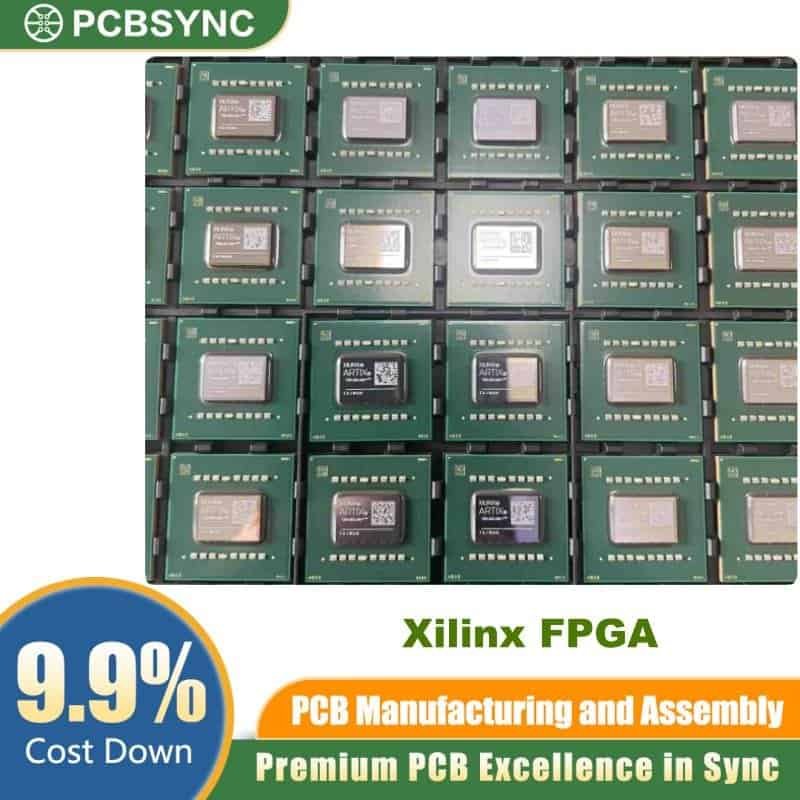
The XC4044XLA-09HQ240C is a high-performance, low-voltage field-programmable gate array (FPGA) from Xilinx’s XC4000XL family, now part of AMD’s semiconductor portfolio. Designed for logic-intensive applications, this device delivers robust programmability, a high gate count, and reliable operation in a 240-pin HQFP surface-mount package. Whether you are prototyping digital systems, implementing custom controllers, or developing signal processing solutions, the XC4044XLA-09HQ240C offers the flexibility and density required for demanding embedded designs.
If you are sourcing or evaluating Xilinx FPGA components for your next project, understanding the full technical profile of this part is essential for confident procurement and successful board design.
XC4044XLA-09HQ240C Overview and Key Features
The XC4044XLA-09HQ240C belongs to the XC4000XLA subfamily — an enhanced, low-voltage variant of the widely deployed XC4000XL series. It operates at 3.3 V core supply voltage and is fabricated using an advanced CMOS process, enabling lower power consumption compared to earlier 5 V FPGA generations.
Key Highlights
- Part Number: XC4044XLA-09HQ240C
- Manufacturer: Xilinx (AMD)
- Family: XC4000XL / XC4000XLA
- Package: 240-Pin HQFP (Heat-dissipating Quad Flat Package)
- Speed Grade: -09 (9 ns pin-to-pin logic delay)
- Operating Voltage: 3.3 V (core); 5 V tolerant I/O
- Temperature Range: Commercial (0°C to +85°C)
- RoHS Status: Non-RoHS (legacy component)
Detailed Technical Specifications
Logic and Programmable Resources
| Parameter |
Value |
| Logic Gates (Typical) |
~44,000 |
| Configurable Logic Blocks (CLBs) |
~1,024 |
| Flip-Flops |
~2,048 |
| Maximum User I/O Pins |
176 |
| On-Chip RAM (bits) |
~98,304 |
| Distributed RAM Cells |
Yes |
| Dedicated Carry Logic |
Yes |
| Global Clock Networks |
4 |
| Internal Oscillator |
No |
Electrical Characteristics
| Parameter |
Value |
| Core Supply Voltage (VCC) |
3.3 V |
| I/O Voltage Tolerance |
5 V Tolerant |
| Input Low Voltage (VIL) |
0.8 V (max) |
| Input High Voltage (VIH) |
2.0 V (min) |
| Standby Current (ICC Quiescent) |
Typically < 20 mA |
| Output Drive Strength |
2 mA – 24 mA (programmable) |
Timing Characteristics (Speed Grade -09)
| Parameter |
Value |
| Pin-to-Pin Logic Delay (tPD) |
9 ns (max) |
| CLB-to-CLB Delay |
~4 ns (typical) |
| Setup Time (tSU) |
~3.7 ns |
| Clock-to-Output (tCO) |
~5.5 ns |
| Maximum System Clock Frequency |
Up to ~80 MHz |
Package and Mechanical Information
HQFP-240 Package Details
| Parameter |
Value |
| Package Type |
HQFP (Heat-dissipating Quad Flat Package) |
| Pin Count |
240 |
| Body Size |
32 × 32 mm (nominal) |
| Pitch |
0.5 mm |
| Height (seated) |
~3.4 mm |
| Mounting Type |
Surface Mount (SMD/SMT) |
| Lead Finish |
SnPb (Tin-Lead, non-RoHS) |
The 240-pin HQFP package offers an excellent balance between I/O density and PCB real estate, making the XC4044XLA-09HQ240C well-suited for compact but I/O-intensive designs.
XC4000XLA Architecture Deep Dive
Configurable Logic Blocks (CLBs)
The core of the XC4000XLA architecture is its Configurable Logic Block (CLB). Each CLB contains:
- Two 4-input function generators (LUTs) capable of implementing any 4-input Boolean function
- One 3-input function generator sharing inputs with the two 4-input LUTs
- Two flip-flops for registered outputs
- Fast carry and arithmetic logic for efficient adder and counter implementation
- Multiplexers for flexible signal routing
This architecture allows each CLB to implement a wide variety of logic functions, RAM cells, or shift registers, giving designers maximum flexibility per unit area.
Interconnect Architecture
| Interconnect Type |
Description |
| Single-Length Lines |
Short routing lines for local CLB-to-CLB connections |
| Double-Length Lines |
Medium-range routing for reduced delay |
| Long Lines |
Dedicated low-skew routing spanning the entire device |
| Global Clock Buffers |
4 global buffers ensuring low-skew clock distribution |
| Tristate Buffers |
Available on long lines for bus-oriented designs |
I/O Blocks (IOBs)
Each I/O block provides:
- Programmable input/output standard (LVCMOS33, TTL compatible)
- Optional input flip-flop for registered capture
- Optional output flip-flop for registered drive
- Programmable output slew rate (fast/slow) for EMI control
- Optional pull-up or pull-down resistors
- 5 V input tolerance for interfacing with legacy logic
Configuration and Programming
Supported Configuration Modes
| Mode |
Description |
| Master Serial |
Device drives configuration clock; data from serial PROM |
| Slave Serial |
External logic drives clock and data (daisy-chaining) |
| Slave Parallel (SelectMAP) |
Fast parallel byte-wide configuration |
| Master Parallel |
Device drives clock; parallel PROM interface |
| Boundary Scan (JTAG) |
IEEE 1149.1 compliant in-system programming |
The XC4044XLA-09HQ240C supports JTAG-based in-system configuration, enabling programming via standard JTAG headers without removing the device from the board — a major advantage for production and field updates.
Recommended Configuration Devices
| Configuration Memory Type |
Compatible Xilinx PROM |
| Serial Configuration |
XC17S150 / XC17S300 |
| Parallel Configuration |
XC4062XL/M |
| Third-Party Serial Flash |
Compatible via Slave Serial mode |
Power Consumption
Typical Power Estimates
| Condition |
Estimated Power |
| Quiescent (unprogrammed) |
~200 mW |
| Static (programmed, no switching) |
~250–350 mW |
| Dynamic (50% toggle, 40 MHz) |
~500–800 mW (design-dependent) |
| Maximum (worst-case switching) |
Contact Xilinx Power Estimator |
For accurate power analysis, Xilinx’s XPower Estimator tool (or the modern AMD Power Advantage Tool) is recommended with your specific design’s toggle rates and net loading.
Application Areas
The XC4044XLA-09HQ240C is well-suited for a broad spectrum of applications:
| Application Domain |
Typical Use Cases |
| Embedded Systems |
Custom CPU cores, bus bridges, DMA controllers |
| Telecommunications |
FIFOs, serializers, protocol converters |
| Industrial Automation |
Motor control logic, PLC replacement, sensor interfaces |
| Test & Measurement |
Pattern generators, logic analyzers, ATE logic |
| Medical Devices |
Signal acquisition front-ends, timing controllers |
| Military / Aerospace |
Legacy system upgrades, ruggedized logic (with screening) |
| Prototyping |
ASIC prototyping, algorithm verification |
Ordering and Procurement Information
Part Number Breakdown
| Field |
Code |
Meaning |
| Family |
XC4044 |
XC4000 series, 44K gate density |
| Subfamily |
XL |
Low-voltage XL variant |
| Variant |
A |
Enhanced (XLA) version |
| Speed Grade |
-09 |
9 ns pin-to-pin delay |
| Package |
HQ |
Heat-dissipating Quad Flat Package |
| Pin Count |
240 |
240-pin package |
| Temp Grade |
C |
Commercial temperature (0°C to +85°C) |
Alternative and Related Part Numbers
| Part Number |
Difference |
| XC4044XL-09HQ240C |
Standard XL variant (without XLA enhancement) |
| XC4044XLA-08HQ240C |
Faster -08 speed grade |
| XC4044XLA-09HQ240I |
Industrial temperature (-40°C to +100°C) |
| XC4044XLA-09PQ240C |
Same speed/temp but PQFP package |
| XC4062XLA-09HQ240C |
Higher density (62K gates), same package |
Design Considerations and PCB Layout Guidelines
Power Supply Decoupling
Proper decoupling is critical for FPGA reliability and signal integrity:
- Place 100 nF ceramic capacitors (X7R, 0402 or 0603) on every VCC and VCCIO pin, as close as possible to the device
- Add 10 µF bulk capacitors (tantalum or electrolytic) at the power entry points
- Maintain a solid ground plane beneath the device for low-impedance return paths
PCB Layout Best Practices
| Guideline |
Recommendation |
| Via placement |
Keep decoupling capacitor vias short and direct to planes |
| Clock routing |
Route global clocks on GCLK pins; avoid passing through CLBs |
| I/O grouping |
Group I/Os by voltage standard; keep differential pairs together |
| Configuration pins |
Pull M0/M1/M2 with 4.7 kΩ resistors to set boot mode |
| DONE/PROG pins |
Connect DONE with pull-up; PROG with external control logic |
Design Tools
The XC4044XLA-09HQ240C is supported by the Xilinx ISE Design Suite (Foundation and Alliance versions). While newer Xilinx UltraScale and 7-Series devices use Vivado, ISE remains the appropriate toolchain for XC4000-family devices. Key tools include:
- XST – Xilinx Synthesis Technology
- NGDBUILD / MAP / PAR – Implementation flow
- BSIM / ModelSim – Functional and timing simulation
- iMPACT – Configuration and JTAG programming
Compliance and Certifications
| Specification |
Status |
| RoHS 2.0 (2011/65/EU) |
Non-compliant (legacy SnPb finish) |
| REACH |
Check current Xilinx/AMD documentation |
| JEDEC Package Standards |
HQFP-240 compliant |
| IEEE 1149.1 (JTAG) |
Supported |
| Moisture Sensitivity Level (MSL) |
MSL 3 (per JEDEC J-STD-020) |
Note: The XC4044XLA-09HQ240C is a legacy component. For new designs, Xilinx (AMD) recommends migration to the Artix-7, Kintex-7, or Spartan-7 families which offer superior performance, lower power, and RoHS compliance. However, this device remains widely available for repair, replacement, and maintenance of existing systems.
Frequently Asked Questions (FAQ)
Q: What is the difference between XC4044XL and XC4044XLA? The XLA variant is an enhanced version of the XL subfamily, featuring improved routing resources, better timing characteristics, and enhanced I/O flexibility. Both operate at 3.3 V core voltage with 5 V tolerant I/Os.
Q: Is the XC4044XLA-09HQ240C still in production? This is a legacy device. Xilinx (AMD) has moved production to newer families. The part is primarily available through authorized distributors, franchised brokers, and component exchanges as new old stock (NOS) or used/refurbished inventory.
Q: Can I replace the XC4044XLA-09HQ240C with a newer FPGA? Yes, but it requires redesign. Modern Xilinx Spartan-7 or Artix-7 devices are the closest functional successors. Pin-for-pin drop-in replacements do not exist due to architectural and package differences.
Q: What software do I need to program this FPGA? Use Xilinx ISE Design Suite (free WebPACK edition supports up to certain densities; Alliance/Foundation supports the full XC4000 family). Programming is performed via iMPACT with a JTAG cable (Xilinx Platform Cable USB or equivalent).
Q: What configuration PROM is compatible? Xilinx XC17Sxxx serial PROMs or XC18Vxxx in-system programmable PROMs are typically used. Check the Xilinx application notes (XAPP138, XAPP151) for configuration circuit examples.
Summary
The XC4044XLA-09HQ240C remains a capable and well-understood FPGA for engineers working with legacy systems, replacement sourcing, or retro-computing projects. Its 44,000-gate density, 240-pin HQFP package, -09 speed grade, and 3.3 V operation make it a versatile device with a proven track record across industrial, telecommunications, and embedded system applications. Understanding its full specifications — from CLB architecture to configuration modes, PCB layout guidelines, and ordering variants — ensures confident design-in and procurement decisions.