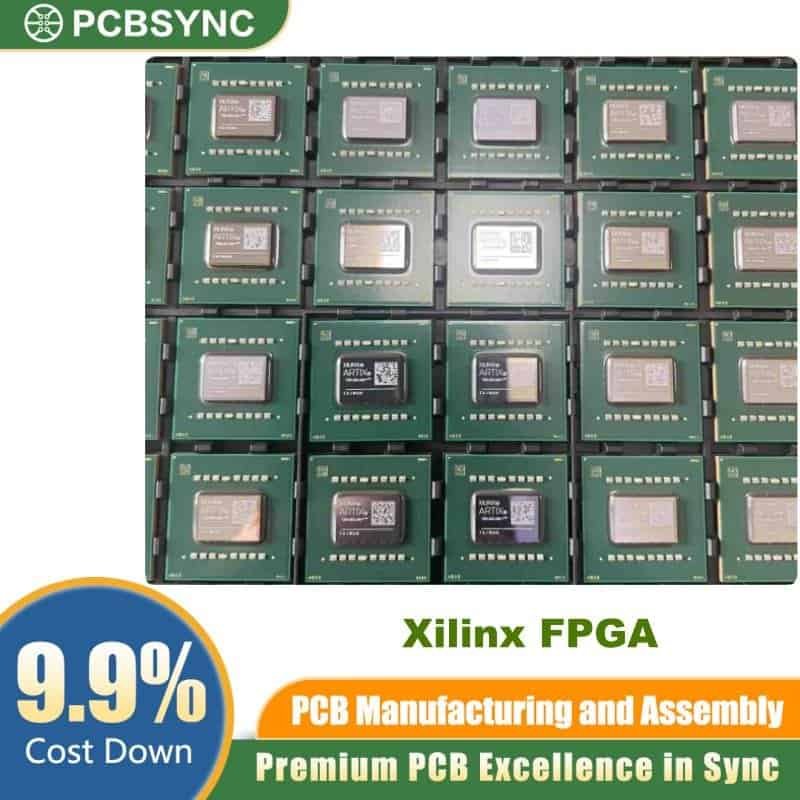
The XC3S50N-4TQG144C is a high-performance, cost-effective field-programmable gate array (FPGA) from Xilinx’s Spartan-3N family. Manufactured by AMD (formerly Xilinx), this device delivers 50,000 system gates, integrated on-chip non-volatile memory, and a compact 144-pin TQFP package — making it an ideal solution for embedded control, digital signal processing, and logic integration in commercial-grade applications.
Whether you are an engineer sourcing components for a new PCB design or an electronics buyer comparing FPGAs, this guide provides everything you need to know about the XC3S50N-4TQG144C, including full technical specifications, pin configuration, electrical parameters, and application use cases.
What Is the XC3S50N-4TQG144C?
The XC3S50N-4TQG144C is part of Xilinx’s Spartan-3N (XC3SN) product line — a generation of FPGAs optimized for high-volume, cost-sensitive designs. The “N” suffix designates the standard Spartan-3N variant (not the AN flash-based variant), making it a SRAM-based FPGA that requires external configuration memory or a host processor at power-up.
This part number breaks down as follows:
| Field |
Value |
Description |
| XC3S |
XC3S |
Spartan-3 product family |
| 50 |
50 |
50K system gates |
| N |
N |
Spartan-3N sub-family |
| -4 |
-4 |
Speed grade (fastest standard grade) |
| TQG |
TQG |
Thin Quad Flat Package (TQFP) |
| 144 |
144 |
144 total pins |
| C |
C |
Commercial temperature range (0°C to +85°C) |
If you are designing with Xilinx FPGA devices and need a compact, fast, and affordable logic device, the XC3S50N-4TQG144C is a compelling choice.
XC3S50N-4TQG144C Key Specifications
General Specifications
| Parameter |
Value |
| Manufacturer |
AMD / Xilinx |
| Series |
Spartan-3N |
| Part Number |
XC3S50N-4TQG144C |
| Package Type |
TQFP (Thin Quad Flat Pack) |
| Pin Count |
144 |
| Temperature Range |
0°C ~ +85°C (Commercial) |
| RoHS Compliance |
Yes |
| Mounting Type |
Surface Mount |
| Operating Voltage (VCC) |
1.2V |
| I/O Supply Voltage (VCCO) |
1.2V ~ 3.3V |
Logic Resources
| Resource |
Quantity |
| System Gates |
50,000 |
| Logic Cells (LUTs) |
1,408 |
| CLB Slices |
704 |
| CLB Flip-Flops |
1,408 |
| Maximum User I/Os |
97 |
| Distributed RAM |
11 Kb |
| Block RAM (BRAM) |
72 Kb |
| Multipliers (18×18) |
4 |
| Digital Clock Managers (DCMs) |
2 |
Speed and Performance
| Parameter |
Value |
| Speed Grade |
-4 (Fastest) |
| Maximum System Clock |
Up to ~200+ MHz (design dependent) |
| Internal Clock Distribution |
Global / Regional Clock Networks |
| DCM Features |
Clock multiplication, division, phase shifting |
Package Details: TQG144
The TQG144 (Thin Quad Flat Package, 144-pin) is a standard SMD package widely supported by PCB assembly processes. Key mechanical characteristics include:
| Parameter |
Value |
| Package Type |
TQFP |
| Total Pins |
144 |
| Body Size |
20mm × 20mm |
| Pin Pitch |
0.5mm |
| Height (max) |
1.2mm |
| Lead Type |
Gull-Wing SMT |
| Moisture Sensitivity Level |
MSL 3 |
The 0.5mm pitch allows for fine-line PCB routing while keeping the footprint relatively compact — suitable for medium-density designs.
Pin Configuration Overview
The 144 pins of the XC3S50N-4TQG144C are allocated as follows:
| Pin Type |
Count |
| User I/O Pins |
97 |
| Ground (GND) |
18 |
| VCC Core Power (1.2V) |
8 |
| VCCO I/O Power |
12 |
| VCCAUX Auxiliary Power (2.5V) |
4 |
| Configuration / Dedicated Pins |
5 |
The multi-voltage VCCO architecture allows different I/O banks to operate at different voltages (1.2V, 1.8V, 2.5V, or 3.3V), enabling seamless interfacing with a wide range of external components and buses.
I/O Standards Supported
The XC3S50N-4TQG144C supports a comprehensive set of single-ended and differential I/O standards:
| I/O Standard |
Type |
| LVCMOS 1.2V / 1.8V / 2.5V / 3.3V |
Single-Ended |
| LVTTL |
Single-Ended |
| LVDS |
Differential |
| LVPECL |
Differential |
| SSTL2 / SSTL3 |
Memory Interface |
| GTL / GTL+ |
Open Drain |
| PCI (3.3V) |
Bus Interface |
Electrical Characteristics
| Parameter |
Min |
Typical |
Max |
Unit |
| Core Supply Voltage (VCCINT) |
1.14 |
1.20 |
1.26 |
V |
| I/O Supply Voltage (VCCO) |
1.14 |
— |
3.465 |
V |
| Auxiliary Supply (VCCAUX) |
2.375 |
2.50 |
2.625 |
V |
| Input High Voltage (VIH) |
— |
— |
VCCO + 0.5 |
V |
| Input Low Voltage (VIL) |
−0.5 |
— |
— |
V |
| Operating Temperature |
0 |
— |
+85 |
°C |
| Junction Temperature (TJ max) |
— |
— |
+125 |
°C |
Configuration Modes
As an SRAM-based FPGA, the XC3S50N-4TQG144C must be configured at power-on. The device supports multiple configuration modes selected via the M[2:0] mode pins:
| Mode |
Description |
| Master Serial |
Uses external SPI Flash (most common) |
| Slave Serial |
Configuration driven by external controller |
| Master Parallel |
Fast configuration via parallel Flash |
| JTAG (Boundary Scan) |
IEEE 1149.1 standard, used for debug and in-system programming |
| Slave SelectMAP |
High-speed parallel configuration (8-bit) |
For production designs, Master Serial mode with an external Xilinx-compatible SPI Flash (e.g., Xilinx XCFxxS Platform Flash) is the most widely adopted approach.
Digital Clock Manager (DCM)
The XC3S50N-4TQG144C includes 2 Digital Clock Managers (DCMs), which provide:
- Clock frequency synthesis (multiplication and division)
- Phase and delay adjustment (0°, 90°, 180°, 270°)
- Clock deskewing to minimize clock distribution delay
- Input frequency range: 24 MHz to 280 MHz
DCMs are essential for generating precise on-chip clock domains and phase-aligning clocks for high-speed memory and communication interfaces.
Block RAM Architecture
The device integrates 72 Kb of on-chip block RAM, organized as two 18 Kb true dual-port BRAMs. Each block RAM can be configured as:
| Configuration |
Width × Depth |
| 16K × 1 |
16,384 bits (1-bit wide) |
| 8K × 2 |
— |
| 4K × 4 |
— |
| 2K × 9 |
Including parity |
| 1K × 18 |
Including parity |
| 512 × 36 |
Including parity |
This on-chip BRAM is ideal for FIFOs, lookup tables, small data buffers, and embedded memory arrays — reducing the need for external SRAM in many designs.
Typical Application Areas
The XC3S50N-4TQG144C is well-suited for a wide range of embedded and digital logic applications:
| Application |
Description |
| Embedded Control |
Soft-core processors (e.g., PicoBlaze) for simple control logic |
| Motor Control |
PWM generation, encoder interface, PID logic |
| Industrial Automation |
I/O expansion, protocol bridging (SPI, I2C, UART) |
| Communications |
UART, SPI, I2C, CAN interface controllers |
| Signal Processing |
FIR filters, FFT logic, data decimation |
| Prototyping |
Logic verification and hardware acceleration prototypes |
| Consumer Electronics |
Low-cost logic integration in mass-market products |
| Medical Devices |
Low-power embedded logic in portable equipment |
XC3S50N vs. XC3S50AN: What Is the Difference?
Buyers sometimes confuse the XC3S50N with the XC3S50AN. Here is a clear comparison:
| Feature |
XC3S50N-4TQG144C |
XC3S50AN-4TQG144C |
| Configuration Memory |
External (SRAM-based) |
On-chip Flash (non-volatile) |
| Power-Up Behavior |
Requires external config |
Self-configuring |
| BOM Complexity |
Higher (needs config Flash) |
Lower (standalone) |
| Reprogrammability |
Unlimited (SRAM) |
10,000+ cycles (Flash) |
| Typical Application |
General FPGA use |
Space/cost-constrained designs |
| Price |
Lower |
Slightly higher |
If your design requires a fully standalone FPGA with no external configuration memory, consider the XC3S50AN-4TQG144C instead.
Ordering Information
| Parameter |
Value |
| Manufacturer Part Number |
XC3S50N-4TQG144C |
| Manufacturer |
AMD / Xilinx |
| Package |
144-TQFP |
| Temperature Grade |
Commercial (0°C to +85°C) |
| Speed Grade |
-4 |
| ECCN (Export Control) |
EAR99 (verify before export) |
| RoHS Status |
RoHS Compliant |
| Moisture Sensitivity Level |
MSL 3 |
Note: Always verify stock availability, lead times, and pricing with your authorized distributor before placing orders. This device may be subject to allocation periods.
Design Support and Resources
Xilinx (AMD) provides comprehensive design support for the Spartan-3N family:
- ISE Design Suite — Legacy design tool supporting Spartan-3N devices (free download from AMD/Xilinx)
- XAPP and Reference Designs — Application notes for common use cases (SPI, DDR memory, PCI)
- JTAG Programming — In-system programming via Xilinx iMPACT or Vivado Lab Edition
- IP Cores — Xilinx LogiCORE IP for common communication, math, and memory functions
- Simulation Support — ModelSim, Vivado Simulator, Aldec Active-HDL compatible
Frequently Asked Questions (FAQs)
Q: What design software supports the XC3S50N-4TQG144C? A: The XC3S50N is supported by Xilinx ISE Design Suite (legacy). Since this is a Spartan-3N device, it is not supported in Vivado — ISE 14.7 is the recommended toolchain.
Q: Does the XC3S50N-4TQG144C have built-in Flash memory? A: No. The XC3S50N is SRAM-based and requires external configuration memory such as an SPI or parallel Flash device. If you need integrated Flash, choose the XC3S50AN variant.
Q: What is the -4 speed grade? A: The “-4” speed grade is the fastest speed grade in the Spartan-3N family for this gate count, offering the lowest propagation delays and highest achievable clock frequencies.
Q: What voltage does the core operate at? A: The XC3S50N-4TQG144C operates with a 1.2V core supply (VCCINT). I/O banks (VCCO) support 1.2V to 3.3V depending on the selected I/O standard.
Q: Is the XC3S50N-4TQG144C RoHS compliant? A: Yes, this part is RoHS compliant in its standard ordering configuration.
Summary
The XC3S50N-4TQG144C is a reliable, cost-effective FPGA from Xilinx’s proven Spartan-3N family. With 50,000 system gates, 97 user I/Os, 72 Kb block RAM, 2 DCMs, and support for multiple I/O standards — all in a compact 144-pin TQFP package — it provides strong logic density and flexibility for commercial-grade embedded designs. Its -4 speed grade ensures the best timing performance within the Spartan-3N lineup, and the commercial temperature rating (0°C to +85°C) makes it suitable for a wide range of end products.
For engineers evaluating FPGA options, the XC3S50N-4TQG144C offers an excellent balance of resources, speed, and affordability within the Spartan-3N portfolio.