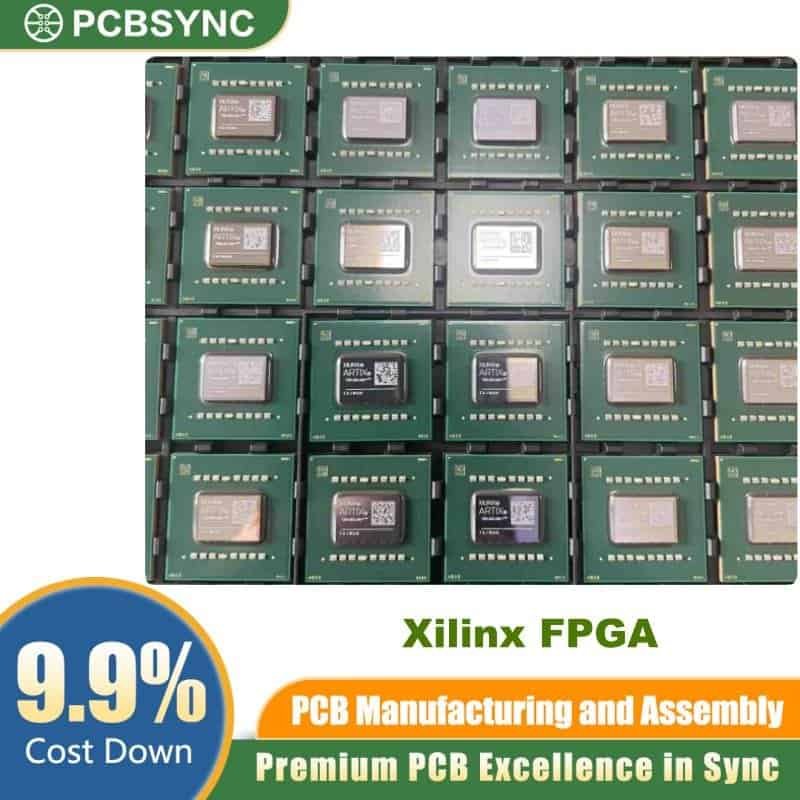
The XC3S5000-5FGG1156C is a high-performance, cost-effective Field-Programmable Gate Array (FPGA) from Xilinx’s renowned Spartan-3 family. Featuring 5 million system gates, 74,880 logic cells, and a 1156-pin Fine-pitch Ball Grid Array (FBGA) package, this FPGA delivers exceptional programmable logic density for high-volume embedded and consumer electronics applications. Whether you are designing broadband access systems, home networking hardware, or digital television equipment, the XC3S5000-5FGG1156C offers the performance, flexibility, and value that engineers rely on.
If you are sourcing Xilinx FPGA chips for your next project, the XC3S5000-5FGG1156C is one of the most capable devices in the Spartan-3 lineup.
What Is the XC3S5000-5FGG1156C?
The XC3S5000-5FGG1156C is the top-density member of the Xilinx Spartan-3 FPGA family, manufactured using 90nm process technology and operating at a core voltage of 1.2V. The “-5” speed grade denotes the fastest commercial variant, and the “FGG1156” suffix identifies the 1156-ball Fine-pitch BGA package. The trailing “C” indicates a commercial temperature range (0°C to +85°C).
This device combines the programmability of an FPGA with the logic density traditionally associated with custom ASICs — without the high NRE costs or inflexibility of mask-programmed solutions.
XC3S5000-5FGG1156C Key Specifications
General Overview Table
| Parameter |
Value |
| Part Number |
XC3S5000-5FGG1156C |
| Manufacturer |
Xilinx (AMD) |
| Family |
Spartan-3 |
| System Gates |
5,000,000 (5M) |
| Logic Cells |
74,880 |
| Equivalent Logic Cells |
74,880 |
| CLB Array |
104 × 80 |
| Total CLBs |
33,280 |
| CLB Flip-Flops |
66,560 |
| Process Technology |
90nm |
| Core Voltage (VCCINT) |
1.2V |
| Speed Grade |
-5 (Fastest Commercial) |
| Package |
1156-Pin FBGA (FGG1156) |
| Package Dimensions |
Fine-pitch BGA |
| Temperature Range |
Commercial (0°C to +85°C) |
| RoHS Compliance |
Not Compliant (standard version) |
Logic Resources
| Resource |
XC3S5000 |
| System Gates |
5,000,000 |
| CLBs (Configurable Logic Blocks) |
33,280 |
| Logic Cells |
74,880 |
| 4-Input LUTs |
66,560 |
| Flip-Flops |
66,560 |
| Maximum Distributed RAM |
520 Kb |
Memory & DSP Resources
| Resource |
Value |
| Block RAM (18 Kbit each) |
104 blocks |
| Total Block RAM |
1,872 Kb |
| Dedicated Multipliers (18×18) |
104 |
| Block RAM Columns |
4 |
| DCMs (Digital Clock Managers) |
4 |
I/O and Connectivity
| Parameter |
Value |
| Package |
FGG1156 (1156-pin FBGA) |
| Maximum User I/Os |
784 |
| Differential I/O Pairs |
Up to 326 |
| Supported Single-Ended I/O Standards |
18 |
| Supported Differential I/O Standards |
8 |
| SelectIO™ Technology |
Yes |
| DCI (Digitally Controlled Impedance) |
Yes |
| IEEE 1149.1 JTAG Boundary Scan |
Yes |
Clock and Timing
| Parameter |
Value |
| Speed Grade |
-5 |
| Maximum Internal Clock |
725 MHz |
| Digital Clock Managers (DCMs) |
4 |
| Clock Networks |
Distributed |
XC3S5000-5FGG1156C Ordering Information & Part Number Decoder
Understanding the Xilinx part number system helps you quickly identify the exact device for your BOM.
| Code Segment |
Meaning |
| XC |
Xilinx Commercial FPGA |
| 3S |
Spartan-3 Family |
| 5000 |
5,000,000 System Gates |
| -5 |
Speed Grade (fastest commercial) |
| FGG |
Fine-pitch Ball Grid Array (lead-free “G” variant) |
| 1156 |
1156 Total Ball Count |
| C |
Commercial Temperature (0°C to +85°C) |
Comparable Part Numbers in the XC3S5000 Series
| Part Number |
Package |
I/O Count |
Speed Grade |
Temperature |
| XC3S5000-4FG676C |
FG676 |
489 |
-4 |
Commercial |
| XC3S5000-4FGG676I |
FGG676 |
489 |
-4 |
Industrial |
| XC3S5000-5FG900C |
FG900 |
633 |
-5 |
Commercial |
| XC3S5000-5FGG1156C |
FGG1156 |
784 |
-5 |
Commercial |
| XC3S5000-5FGG1156I |
FGG1156 |
784 |
-5 |
Industrial |
Architecture and Functional Description
Configurable Logic Blocks (CLBs)
The XC3S5000-5FGG1156C is organized around a 104 × 80 array of Configurable Logic Blocks (CLBs). Each CLB contains four slices, and each slice includes two 4-input Look-Up Tables (LUTs) and two flip-flops with optional carry logic. This architecture provides:
- 33,280 total CLBs for maximum logic flexibility
- 66,560 LUTs for combinational and distributed memory functions
- 66,560 flip-flops for sequential logic and pipelining
- 520 Kb of distributed RAM using LUTs configured as memory
Block RAM
The XC3S5000 contains four columns of 18 Kbit dual-port block RAMs, giving a total of 104 block RAM tiles and 1,872 Kb of on-chip block memory. Each block RAM supports:
- Independent dual-port read/write access
- Configurable data widths
- Optional output registers for pipeline performance
- Use as dual-port FIFO or ROM
Dedicated 18×18 Multipliers
Every block RAM tile is paired with a dedicated 18×18-bit hardware multiplier, providing 104 multiplier resources. This makes the XC3S5000-5FGG1156C well-suited for DSP-intensive applications such as digital filtering, FFTs, and video signal processing — without consuming CLB resources.
Digital Clock Managers (DCMs)
Four on-chip DCMs provide advanced clocking capabilities including:
- Clock frequency synthesis and multiplication/division
- Phase shifting (coarse and fine)
- Clock deskew and alignment
- Spread-spectrum clock support
SelectIO™ Interface Technology
The 784 user I/Os on the FGG1156 package leverage Xilinx SelectIO™ technology to support 18 single-ended and 8 differential I/O standards. Supported standards include LVCMOS (1.2V–3.3V), LVTTL, SSTL18, HSTL, LVDS, LVPECL, and more. Digitally Controlled Impedance (DCI) enables on-chip matched terminations, reducing the need for external resistors.
Configuration Options
The XC3S5000-5FGG1156C supports five flexible configuration modes:
| Configuration Mode |
Description |
| Master Serial |
Reads configuration from a serial PROM |
| Slave Serial |
Receives bitstream from an external controller |
| Master Parallel |
Reads configuration from a parallel PROM |
| Slave Parallel (SelectMAP) |
Fast parallel configuration by a processor or CPLD |
| JTAG |
IEEE 1149.1 boundary-scan configuration and debugging |
Configuration data is stored in an external non-volatile memory (PROM, SPI flash, or BPI flash) and loaded into the FPGA’s static CMOS configuration latches (CCLs) at power-up.
Typical Applications
The XC3S5000-5FGG1156C is optimized for high-volume, cost-sensitive applications where programmable logic density is required:
- Broadband Access Equipment – DSL, cable modems, and optical networking line cards
- Home Networking – Routers, switches, and wireless access points
- Display & Projection Systems – Video scaling, format conversion, and timing control
- Digital Television – Set-top boxes, HDTV encoders/decoders
- Industrial Control – Motor drives, sensor fusion, and machine vision preprocessing
- Communications Infrastructure – Protocol bridging, FEC engines, and channel coding
- Medical Imaging – Signal acquisition, filtering, and data formatting
Why Choose the XC3S5000-5FGG1156C Over an ASIC?
The Spartan-3 FPGA platform is positioned as a cost-effective, flexible alternative to mask-programmed ASICs:
| Factor |
ASIC |
XC3S5000-5FGG1156C |
| NRE (Non-Recurring Engineering) Cost |
Very High ($500K–$5M+) |
None |
| Time to Market |
6–18 months |
Days to weeks |
| Design Changes |
Requires new mask set |
Reprogrammable in-field |
| Volume Flexibility |
Requires high minimum order |
Order as needed |
| Logic Density |
Fixed |
Up to 5M gates |
Development Tools for XC3S5000-5FGG1156C
Xilinx provides a complete software ecosystem for designing with the Spartan-3 family:
| Tool |
Description |
| ISE Design Suite |
Legacy Xilinx toolchain (primary for Spartan-3) |
| Vivado Design Suite |
Modern AMD/Xilinx toolchain (limited Spartan-3 support) |
| XST (Xilinx Synthesis Technology) |
HDL synthesis within ISE |
| ChipScope Pro |
In-system logic analysis and debugging |
| iMPACT |
Device programming and configuration |
| CORE Generator |
Pre-built IP cores for common functions |
For Spartan-3 devices, ISE Design Suite is the recommended primary toolchain. Designs are written in VHDL or Verilog and implemented using ISE’s synthesis, mapping, placement, and routing flows.
Physical & Packaging Details
| Parameter |
Value |
| Package Type |
FGG1156 (Fine-pitch Ball Grid Array) |
| Total Pins |
1156 |
| Ball Pitch |
1.0 mm |
| Package Marking |
XC3S5000-5FGG1156C |
| Mounting Type |
Surface Mount (SMT) |
| Operating Temperature |
0°C to +85°C (Commercial) |
| Storage Temperature |
-65°C to +150°C |
| Lead Finish |
SnPb (standard); Pb-free “G” suffix versions available |
Frequently Asked Questions (FAQ)
Q: What is the maximum number of I/Os available on the XC3S5000-5FGG1156C? A: The FGG1156 package provides up to 784 user I/Os, the highest of any XC3S5000 package option.
Q: What is the difference between XC3S5000-4FGG1156C and XC3S5000-5FGG1156C? A: The only difference is the speed grade. The “-5” device operates at a higher maximum internal clock frequency (725 MHz vs. 630 MHz for the “-4”) and meets tighter timing specifications across all paths.
Q: Is the XC3S5000-5FGG1156C RoHS compliant? A: The standard version (suffix “C”) uses SnPb solder balls and is not RoHS compliant. For RoHS-compliant (Pb-free) variants, look for part numbers with a “G” designation in the package suffix (e.g., FGG vs. FG).
Q: What external PROM is recommended for configuring the XC3S5000-5FGG1156C? A: Xilinx recommends the XCF16P Platform Flash PROM, which provides 16 Mb of configuration storage and direct interface to the XC3S5000 master serial configuration mode.
Q: Can the XC3S5000-5FGG1156C be used in new designs? A: Yes. As of the DS099 datasheet revision 3.1 (June 2013), this product is recommended for new designs. However, engineers starting new projects today may wish to evaluate more modern AMD Xilinx FPGA families such as Artix-7 or Kintex-7 for improved power efficiency and updated toolchain support.
Summary
The XC3S5000-5FGG1156C remains one of the most capable devices in the Xilinx Spartan-3 portfolio, offering 5 million system gates, 74,880 logic cells, 1,872 Kb of block RAM, 104 dedicated multipliers, 784 user I/Os, and a fast -5 speed grade — all in a 1156-pin FBGA package. It is a proven solution for complex, high-I/O embedded designs where FPGA flexibility is needed at competitive cost.