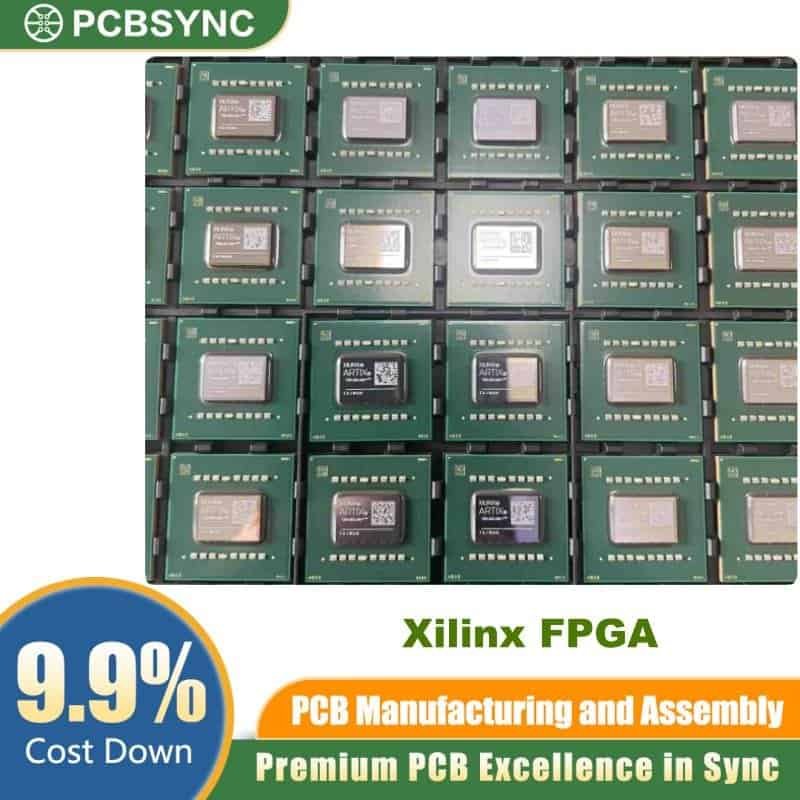
The XC3S5000-5FG676C is a high-density Field Programmable Gate Array (FPGA) from Xilinx’s Spartan-3 family, offering 5 million system gates and 74,880 logic cells in a compact 676-pin Fine-Pitch Ball Grid Array (FBGA) package. Built on 90nm process technology and operating at 1.2V, this device delivers outstanding performance-per-dollar for cost-sensitive, high-volume applications. If you’re looking for a proven Xilinx FPGA solution for consumer electronics, industrial systems, or communications designs, the XC3S5000-5FG676C remains a widely referenced part.
Key Features of the XC3S5000-5FG676C
The XC3S5000-5FG676C is engineered for demanding digital design environments. Its rich feature set makes it ideal for complex logic integration, memory interfacing, and high-speed I/O operations.
- 5,000,000 system gates for large-scale logic designs
- 74,880 logic cells with shift register capability
- 90nm CMOS process technology for power efficiency
- 1.2V core voltage with multi-standard I/O support
- 725 MHz maximum system clock frequency (speed grade -5)
- 676-pin FBGA package (FG676) for board-space efficiency
- Up to 489 user I/O pins for broad connectivity
- SelectIO™ interface supporting 18+ single-ended and 8 differential standards
- Four Digital Clock Managers (DCMs) for precise clock control
- 1,872 Kbits of block RAM plus 520 Kbits distributed RAM
- 104 dedicated 18×18-bit multipliers for DSP acceleration
- JTAG boundary scan compliant with IEEE 1149.1 and 1532
- DDR and DDR2 SDRAM support up to 333 Mb/s
- Fully supported by Xilinx ISE® and WebPACK™ design software
XC3S5000-5FG676C Technical Specifications
General Parameters
| Parameter |
Value |
| Manufacturer |
Xilinx (AMD) |
| Series |
Spartan®-3 |
| Part Number |
XC3S5000-5FG676C |
| Product Category |
FPGA – Field Programmable Gate Array |
| Status |
Obsolete (not currently manufactured) |
| RoHS Compliance |
Yes |
Logic Resources
| Resource |
Quantity |
| System Gates |
5,000,000 |
| Logic Cells |
74,880 |
| Configurable Logic Blocks (CLBs) |
33,280 (104 × 80 array) |
| Slices per CLB |
4 |
| Flip-Flops |
66,560 |
| 4-Input LUTs |
66,560 |
| Maximum Distributed RAM |
520 Kbits |
| Dedicated 18×18-bit Multipliers |
104 |
Memory Resources
| Memory Type |
Capacity |
| Total Block RAM |
1,872 Kbits |
| Number of Block RAM (18Kbit) |
104 |
| Total Distributed RAM |
520 Kbits |
Clock Management
| Parameter |
Value |
| Digital Clock Managers (DCMs) |
4 |
| Global Clock Lines |
8 |
| Clock Skew Elimination |
Yes |
| Frequency Synthesis |
Yes |
| High-Resolution Phase Shifting |
Yes |
I/O Specifications
| Parameter |
Value |
| User I/O Pins |
489 |
| Maximum I/O (all packages) |
784 |
| SelectIO™ Standards (Single-Ended) |
18 |
| Differential I/O Standards |
8 (incl. LVDS, RSDS) |
| Max Data Rate per I/O |
622+ Mb/s |
| Signal Swing Range |
1.14V – 3.465V |
| DDR Support |
DDR, DDR2 SDRAM (up to 333 Mb/s) |
| Digitally Controlled Impedance (DCI) |
Yes |
Electrical & Thermal
| Parameter |
Value |
| Core Supply Voltage (VCCINT) |
1.2V |
| I/O Supply Voltage (VCCO) |
1.14V – 3.465V |
| Process Technology |
90nm CMOS |
| Operating Temperature (Commercial) |
0°C to +85°C |
Package Information
| Parameter |
Value |
| Package Type |
FBGA (Fine-Pitch Ball Grid Array) |
| Package Code |
FG676 |
| Number of Pins |
676 |
| Package Dimensions |
Standard FBGA footprint |
| Pb-Free Option |
Available (FGG676 suffix) |
Speed Grade
| Speed Grade |
Max Frequency |
| -5 (this part) |
725 MHz |
| -4 |
630 MHz |
XC3S5000-5FG676C Part Number Decoder
Understanding the part numbering convention helps in selecting the right variant:
| Field |
Value |
Meaning |
| XC |
XC |
Xilinx Commercial IC |
| 3S |
3S |
Spartan-3 family |
| 5000 |
5000 |
5,000,000 system gates |
| -5 |
-5 |
Speed grade (fastest commercial) |
| FG |
FG |
Fine-Pitch Ball Grid Array (FBGA) |
| 676 |
676 |
Number of package pins |
| C |
C |
Commercial temperature (0°C to +85°C) |
Spartan-3 Family Density Comparison
The XC3S5000-5FG676C sits at the top of the Spartan-3 family in the FG676 package footprint. The table below shows how it compares to other members of the eight-device family:
| Device |
System Gates |
Logic Cells |
Block RAM |
Multipliers |
Max I/Os |
| XC3S50 |
50K |
1,728 |
72 Kbits |
4 |
124 |
| XC3S200 |
200K |
4,320 |
216 Kbits |
12 |
173 |
| XC3S400 |
400K |
8,064 |
288 Kbits |
16 |
264 |
| XC3S1000 |
1M |
17,280 |
432 Kbits |
24 |
391 |
| XC3S1500 |
1.5M |
29,952 |
576 Kbits |
32 |
487 |
| XC3S2000 |
2M |
46,080 |
720 Kbits |
40 |
565 |
| XC3S4000 |
4M |
62,208 |
1,728 Kbits |
96 |
712 |
| XC3S5000 |
5M |
74,880 |
1,872 Kbits |
104 |
784 |
Supported I/O Standards
The XC3S5000-5FG676C supports a wide range of I/O interface standards through its SelectIO™ technology, making it compatible with virtually every digital interface protocol used in modern system design.
Single-Ended Standards (18 Total)
| Standard |
Voltage |
| LVTTL |
3.3V |
| LVCMOS33 |
3.3V |
| LVCMOS25 |
2.5V |
| LVCMOS18 |
1.8V |
| LVCMOS15 |
1.5V |
| LVCMOS12 |
1.2V |
| PCI / PCI-X |
3.3V / 3.3V |
| SSTL2 Class I/II |
2.5V |
| SSTL18 Class I/II |
1.8V |
| HSTL Class I/II/III/IV |
1.5V |
| GTL / GTLP |
Terminated |
Differential Standards (8 Total)
| Standard |
Description |
| LVDS |
Low Voltage Differential Signaling |
| RSDS |
Reduced Swing Differential Signaling |
| Differential HSTL |
High-Speed Transceiver Logic |
| Differential SSTL2 |
Stub Series Terminated Logic 2.5V |
| Differential SSTL18 |
Stub Series Terminated Logic 1.8V |
| BLVDS |
Bus LVDS |
| ULVDS |
Ultra LVDS |
| LDT |
Lightning Data Transport |
On-Chip Architecture: What Makes the XC3S5000-5FG676C Powerful
Configurable Logic Blocks (CLBs)
The XC3S5000-5FG676C is organized around a 104×80 array of CLBs, each containing four slices. The left-hand slices in each CLB offer extended functionality: they can be configured as distributed RAM or as 16-bit shift registers (SRL16) in addition to standard LUT logic. This dual-use capability significantly increases design flexibility without consuming dedicated resources.
Block RAM and Multipliers
All 104 block RAM instances are 18-Kbit true dual-port RAMs, each paired with a dedicated 18×18-bit signed multiplier. This co-location allows highly efficient implementation of DSP-style algorithms such as FIR filters, correlation engines, and matrix operations. The device supports four RAM columns, with DCMs positioned at the ends of the outer RAM columns for optimal clock distribution.
Digital Clock Managers (DCMs)
The four on-chip DCMs provide clock skew elimination, frequency synthesis, and high-resolution phase shifting — removing the need for external clock conditioning circuits. Each DCM can generate multiple derived clocks at various phase offsets, making the XC3S5000-5FG676C suitable for multi-clock-domain designs.
Configuration and Security
The device supports multiple configuration modes including Master Serial, Slave Serial, Master Parallel (SelectMAP), Slave Parallel, and JTAG. It is compatible with the Xilinx XCF16P Platform Flash configuration device. Configuration data can be protected using the built-in bitstream encryption feature.
Typical Applications for the XC3S5000-5FG676C
The XC3S5000-5FG676C is well-suited for a broad range of applications that demand high logic density at a competitive price point:
| Application Sector |
Typical Use Cases |
| Consumer Electronics |
Digital TV, set-top boxes, display controllers |
| Broadband & Networking |
DSL/cable line cards, network switches, protocol processing |
| Home Networking |
Wireless routers, access points, media bridges |
| Industrial Control |
Motor controllers, PLC co-processors, sensor fusion |
| Test & Measurement |
Signal capture, pattern generation, data logging |
| Medical Electronics |
Imaging front-ends, patient monitoring, signal conditioning |
| Automotive |
ADAS prototype systems, CAN/LIN gateways |
| Video & Display |
Scaler engines, frame buffers, HDMI interface logic |
| Communications |
SONET/SDH framers, channel aggregation, forward error correction |
| Embedded Processing |
MicroBlaze™ soft-processor SoC implementations |
Development and Design Tools
Xilinx provides a complete toolchain for designing with the XC3S5000-5FG676C:
| Tool |
Description |
| Xilinx ISE® Design Suite |
Primary synthesis, implementation, and bitstream generation tool |
| WebPACK™ |
Free entry-level design environment for smaller Spartan-3 designs |
| iMPACT |
Device programming and boundary-scan testing |
| ChipScope Pro |
In-system logic analysis (ILA/VIO cores) |
| MicroBlaze™ Soft CPU |
32-bit embedded processor for SoC designs |
| PicoBlaze™ |
Lightweight 8-bit embedded controller |
Note: For new designs, AMD/Xilinx recommends migrating to the Spartan-6 or Artix-7 families. The ISE design tools (version 14.7) remain the supported toolchain for XC3S5000-5FG676C targeting.
Ordering Information and Variants
The XC3S5000 is available in multiple package options and speed grades. The table below lists the key variants in the FG676 footprint:
| Part Number |
Gates |
Speed Grade |
Package |
Temp Range |
| XC3S5000-4FG676C |
5M |
-4 (630 MHz) |
676-FBGA |
Commercial |
| XC3S5000-5FG676C |
5M |
-5 (725 MHz) |
676-FBGA |
Commercial |
| XC3S5000-4FGG676C |
5M |
-4 |
676-FBGA (Pb-free) |
Commercial |
| XC3S5000-5FGG676C |
5M |
-5 |
676-FBGA (Pb-free) |
Commercial |
Pb-Free Note: The “FGG” variant (double-G) indicates Pb-free (RoHS-compliant) packaging. The “FG” variant uses standard SnPb solder.
Compliance and Certifications
| Standard |
Status |
| RoHS (Pb-free option) |
Compliant (FGG676 variant) |
| IEEE 1149.1 JTAG Boundary Scan |
Supported |
| IEEE 1532 In-System Configuration |
Supported |
| HBM ESD Protection |
Yes |
Frequently Asked Questions (FAQ)
What is the XC3S5000-5FG676C?
The XC3S5000-5FG676C is a Xilinx Spartan-3 FPGA featuring 5 million system gates, 74,880 logic cells, 1,872 Kbits of block RAM, and 489 user I/O pins in a 676-ball FBGA package. It operates at 1.2V and is designed for commercial-temperature applications (0°C to +85°C).
What speed grade is the XC3S5000-5FG676C?
The “-5” suffix denotes the fastest commercial speed grade available for the XC3S5000, with a maximum system clock frequency of 725 MHz.
Is the XC3S5000-5FG676C still in production?
This device is listed as obsolete and is no longer actively manufactured by AMD (Xilinx). However, it remains available through authorized distributors and component brokers. For new designs, consider migrating to the Xilinx Spartan-6 (XC6SLX series) or Artix-7 families.
What is the difference between FG676 and FGG676?
The FGG676 is the Pb-free (RoHS-compliant) version of the same 676-ball FBGA package. Electrically and functionally, both are identical. The extra “G” in the package code (FGG) indicates lead-free solder balls.
What design tools support the XC3S5000-5FG676C?
The primary supported tool is Xilinx ISE Design Suite 14.7, which is the final and current release for legacy Spartan-3 devices. AMD’s Vivado Design Suite does not support Spartan-3. Free WebPACK editions of ISE are available for download from the AMD/Xilinx website.
Can I replace the XC3S5000-5FG676C with a newer device?
Functional migration is possible to the Spartan-6 XC6SLX75 or XC6SLX100 series, which offer higher logic density, lower power consumption, and continued toolchain support. Pin-for-pin drop-in replacement is not available due to different package footprints and architectures.
Summary
The XC3S5000-5FG676C is the highest-density, fastest-speed-grade member of the Spartan-3 family in the 676-pin FBGA package. With 5 million system gates, 74,880 logic cells, 1,872 Kbits of block RAM, 104 dedicated multipliers, and a rich I/O subsystem supporting 18 single-ended and 8 differential standards, it provides everything needed for complex FPGA designs in a compact, cost-effective package. While the part is now obsolete, it continues to be a staple in legacy system maintenance, repair, and production continuity scenarios.