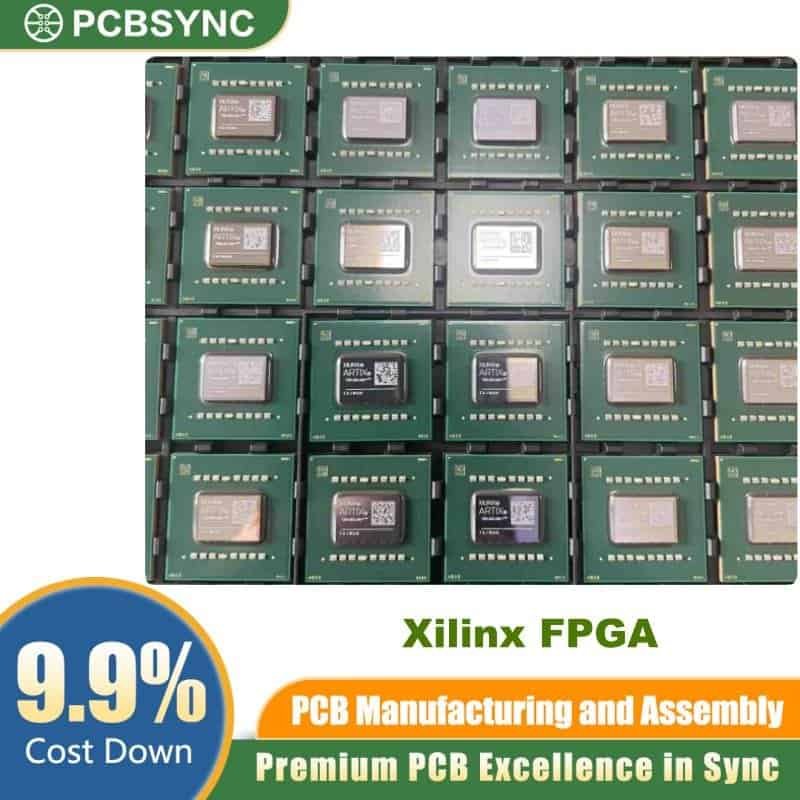
The XC3S5000-4FGG676I is a high-density, cost-optimized Field Programmable Gate Array (FPGA) from Xilinx’s Spartan-3 family, now part of the AMD portfolio. Designed for high-volume, cost-sensitive applications, this device delivers powerful logic density and flexible I/O in a robust industrial-grade package. Whether you are developing embedded systems, digital signal processing (DSP) applications, or telecommunications infrastructure, the XC3S5000-4FGG676I offers an excellent combination of performance, programmability, and value.
If you are looking for a proven, reliable Xilinx FPGA solution with strong community support and wide toolchain compatibility, this Spartan-3 device remains a compelling choice for production and legacy designs.
XC3S5000-4FGG676I Overview and Key Features
The XC3S5000-4FGG676I belongs to Xilinx’s Spartan-3 FPGA series — a family optimized to deliver the highest performance per dollar for high-volume designs. The “5000” in the part number refers to the device’s logic capacity of 5,000,000 system gates, making it the largest device in the Spartan-3 generation.
Core Highlights
- Logic Capacity: 5,000,000 system gates / 74,880 logic cells
- Speed Grade: -4 (commercial and industrial performance)
- Package: FGG676 – Fine-Pitch Ball Grid Array (FBGA), 676 balls
- Temperature Range: Industrial grade (-40°C to +100°C), denoted by the “I” suffix
- Process Technology: 90 nm CMOS
- Configuration: Supports master serial, slave serial, JTAG, and parallel configuration modes
Complete Technical Specifications
The table below summarizes the key technical parameters of the XC3S5000-4FGG676I.
| Parameter |
Value |
| Manufacturer |
AMD (Xilinx) |
| Part Number |
XC3S5000-4FGG676I |
| FPGA Family |
Spartan-3 |
| System Gates |
5,000,000 |
| Logic Cells |
74,880 |
| CLB Slices |
33,280 |
| CLB Flip-Flops |
66,560 |
| Maximum Distributed RAM |
520 Kb |
| Block RAM |
1,872 Kb (104 blocks × 18 Kb) |
| DSP/Multiplier Blocks |
104 dedicated 18×18 multipliers |
| DCM Blocks |
4 Digital Clock Managers |
| Maximum User I/O |
489 |
| Speed Grade |
-4 |
| Package |
FGG676 (FBGA, 676-ball) |
| Package Dimensions |
27 mm × 27 mm |
| Ball Pitch |
1.00 mm |
| Operating Voltage (VCCINT) |
1.2 V |
| I/O Voltage (VCCO) |
1.2 V – 3.3 V (bank selectable) |
| Temperature Range |
–40°C to +100°C (Industrial) |
| Process Node |
90 nm |
| Configuration Interfaces |
JTAG, Master/Slave Serial, SelectMAP |
| RoHS Compliance |
Yes |
Package and Pinout Information
FGG676 Package Details
The FGG676 is a Fine-Pitch Ball Grid Array package with 676 solder balls arranged in a 26×26 matrix on a 1.00 mm ball pitch. This compact form factor enables high-density PCB designs while providing excellent electrical performance.
| Package Attribute |
Detail |
| Package Type |
FBGA (Fine-Pitch BGA) |
| Ball Count |
676 |
| Ball Matrix |
26 × 26 |
| Ball Pitch |
1.00 mm |
| Body Size |
27 mm × 27 mm |
| Height (max) |
2.69 mm |
| User I/O Pins |
489 |
| I/O Banks |
8 |
I/O Bank Configuration
| I/O Bank |
Supported Standards |
| All Banks |
LVCMOS 3.3V, 2.5V, 1.8V, 1.5V, 1.2V |
| All Banks |
LVTTL, SSTL2, SSTL3, HSTL |
| Differential Pairs |
LVDS, LVPECL, RSDS, MINI-LVDS |
Logic Architecture Deep Dive
Configurable Logic Blocks (CLBs)
The Spartan-3 CLB architecture is the fundamental building block of the XC3S5000. Each CLB contains four slices, and each slice contains:
- Two 4-input Look-Up Tables (LUTs)
- Two storage elements (flip-flops or latches)
- Dedicated carry logic
- Wide-function multiplexers
This architecture provides exceptional flexibility for implementing arithmetic, counters, state machines, and custom logic functions.
Block RAM (BRAM) Specifications
| BRAM Feature |
Value |
| Total BRAM Blocks |
104 |
| Size per Block |
18 Kb (true dual-port) |
| Total Block RAM |
1,872 Kb |
| Aspect Ratio Options |
16K×1, 8K×2, 4K×4, 2K×9, 1K×18 |
| Operating Mode |
Simple Dual-Port or True Dual-Port |
Dedicated Multiplier Blocks
The XC3S5000-4FGG676I includes 104 dedicated 18×18-bit hardware multipliers, enabling high-throughput DSP operations without consuming CLB resources. These multipliers support cascading for larger multiply-accumulate (MAC) operations.
Digital Clock Manager (DCM)
Four on-chip DCMs provide precise clock management including:
- Frequency synthesis (multiply/divide)
- Phase shifting (0°, 90°, 180°, 270°, fine)
- Duty cycle correction
- Jitter filtering and clock deskewing
Power Consumption and Thermal Characteristics
Understanding the power requirements is essential for system-level design. The XC3S5000-4FGG676I operates at a core voltage of 1.2 V (VCCINT), which significantly reduces dynamic power compared to older FPGA generations.
| Power Parameter |
Value |
| Core Supply Voltage (VCCINT) |
1.2 V ± 5% |
| I/O Supply Voltage (VCCO) |
1.2 V – 3.3 V |
| Auxiliary Supply (VCCAUX) |
3.3 V ± 5% |
| Typical Quiescent Current (VCCINT) |
~100 mA (depends on configuration) |
| θJA (27 mm BGA, still air) |
~10°C/W |
| Maximum Junction Temperature |
125°C |
| Industrial Operating Range |
–40°C to +100°C |
Configuration and Programming
The XC3S5000-4FGG676I supports multiple configuration modes to suit a wide range of system architectures.
| Configuration Mode |
Description |
| Master Serial |
FPGA drives configuration clock; reads from external serial PROM |
| Slave Serial |
External controller drives configuration clock |
| Master SelectMAP (Parallel) |
FPGA reads an 8-bit parallel data stream |
| Slave SelectMAP |
External controller drives 8-bit parallel stream |
| JTAG (Boundary Scan) |
IEEE 1149.1 compliant; supports in-system programming |
Recommended configuration devices: Xilinx XCF family Platform Flash PROMs or standard SPI/parallel flash memory devices.
Supported I/O Standards
The XC3S5000-4FGG676I supports a broad range of single-ended and differential I/O standards, making it compatible with virtually any interface in a modern system design.
| I/O Standard Category |
Standards Supported |
| Single-Ended |
LVCMOS 3.3V / 2.5V / 1.8V / 1.5V / 1.2V, LVTTL |
| Memory Interface |
SSTL3 Class I/II, SSTL2 Class I/II, HSTL Class I/III/IV |
| Differential |
LVDS 25, LVPECL, RSDS, MINI-LVDS, BLVDS |
| GTL / PCI |
GTL, GTL+, PCI 3.3V/5V (input-tolerant) |
Typical Applications for XC3S5000-4FGG676I
The high gate count and rich feature set of this device make it suitable for a wide range of demanding applications:
- Industrial Control Systems – Motor drives, PLCs, factory automation
- Digital Signal Processing (DSP) – FIR/IIR filters, FFT engines, software-defined radio
- Telecommunications – Line cards, protocol processing, packet routing
- Embedded Computing – Soft processor implementations (MicroBlaze, PicoBlaze)
- Video & Image Processing – Real-time video scaling, format conversion
- Automotive Electronics – ADAS prototyping, diagnostics interfaces (industrial temp range)
- Military & Aerospace (prototype) – Pre-qualification testing requiring –40°C operation
- High-Speed Data Acquisition – ADC/DAC interfacing, FIFO buffering
- ASIC Prototyping – Large logic capacity for pre-silicon verification
Ordering Information
| Attribute |
Detail |
| Full Part Number |
XC3S5000-4FGG676I |
| Manufacturer |
AMD (Xilinx) |
| Series |
Spartan-3 |
| DigiKey Part # |
122-1483-ND (verify at time of order) |
| Packaging |
Tray |
| Moisture Sensitivity Level (MSL) |
MSL 3 – 168 hours |
| Lead-Free / RoHS |
Yes |
| ECCN |
EAR99 (verify with distributor for export) |
| HTSUS |
8542.39.0001 |
Part Number Decoder
Understanding Xilinx part numbering helps avoid ordering errors.
| Field |
Code |
Meaning |
| Family |
XC3S |
Spartan-3 family |
| Gate Count |
5000 |
5,000,000 system gates |
| Speed Grade |
-4 |
Faster performance tier (-4 > -5 in Spartan-3; lower number = faster) |
| Package |
FGG |
Fine-Pitch Ball Grid Array |
| Ball Count |
676 |
676-ball package |
| Temperature |
I |
Industrial: –40°C to +100°C |
Note: In Xilinx Spartan-3 speed grade notation, -4 is faster than -5. A -4 speed grade device meets tighter timing constraints than a -5 grade device.
Development Tools and Software Support
The XC3S5000-4FGG676I is fully supported by Xilinx ISE Design Suite (the primary design environment for Spartan-3 devices). Note that Vivado does not support Spartan-3; ISE 14.7 is the recommended tool.
| Tool |
Version |
Notes |
| Xilinx ISE Design Suite |
14.7 (final) |
Full synthesis, P&R, timing analysis |
| ChipScope Pro |
14.7 |
On-chip logic analyzer |
| EDK (Embedded Dev Kit) |
14.7 |
MicroBlaze soft processor |
| CORE Generator |
14.7 |
IP core generation |
| iMPACT |
14.7 |
Programming and configuration |
| Synplify Pro / Premier |
Current |
Third-party synthesis |
| ModelSim / Questa |
Current |
RTL and gate-level simulation |
Comparison: XC3S5000 vs Other Spartan-3 Devices
| Device |
System Gates |
Logic Cells |
Block RAM |
Multipliers |
Max I/O |
Package Options |
| XC3S50 |
50K |
1,728 |
72 Kb |
4 |
124 |
VQ100, CP132, TQ144 |
| XC3S400 |
400K |
8,064 |
288 Kb |
16 |
264 |
PQ208, FT256, FG456 |
| XC3S1500 |
1.5M |
29,952 |
1,080 Kb |
32 |
333 |
FG320, FG456, FG676 |
| XC3S2000 |
2.0M |
46,080 |
1,440 Kb |
40 |
489 |
FG456, FG676 |
| XC3S5000 |
5.0M |
74,880 |
1,872 Kb |
104 |
489 |
FG676, FG900 |
Frequently Asked Questions (FAQ)
Q: What is the difference between XC3S5000-4FGG676I and XC3S5000-4FGG676C? A: The only difference is the temperature grade. The “I” suffix indicates Industrial temperature range (–40°C to +100°C), while the “C” suffix indicates Commercial grade (0°C to +85°C). For harsh environments, always select the “I” variant.
Q: Is the XC3S5000-4FGG676I supported by Vivado? A: No. Spartan-3 devices are only supported in Xilinx ISE Design Suite 14.7. Vivado supports Spartan-6 and later families.
Q: Can I use this FPGA for new designs in 2024? A: The XC3S5000 is a mature product. For new designs, Xilinx recommends migrating to Spartan-7 or Artix-7 families. However, for existing production designs requiring long-term availability, the XC3S5000-4FGG676I remains widely available through authorized distributors.
Q: What configuration PROM should I use with this device? A: The Xilinx XCF32P (32 Mb Platform Flash) is commonly used. Third-party SPI Flash memories from manufacturers like Spansion/Cypress and Micron are also compatible.
Q: What is the maximum operating frequency? A: This depends on the design. The -4 speed grade supports internal clock frequencies exceeding 300 MHz for simple logic paths. Realistic system clock frequencies typically range from 100 MHz to 200 MHz for complex designs.
Where to Buy XC3S5000-4FGG676I
The XC3S5000-4FGG676I is available through authorized electronic component distributors. Always purchase from authorized sources to ensure authenticity and traceability.
| Distributor |
Type |
| DigiKey |
Authorized |
| Mouser Electronics |
Authorized |
| Arrow Electronics |
Authorized |
| Avnet |
Authorized |
| Future Electronics |
Authorized |
⚠️ Counterfeit Warning: Due to the age and popularity of this device, counterfeit XC3S5000 parts are common in the secondary market. Always source from authorized distributors or franchised dealers. Request a Certificate of Conformance (CoC) and lot traceability documentation for critical applications.
Summary
The XC3S5000-4FGG676I is a proven, high-density FPGA offering 5 million system gates, 104 block RAM tiles, 104 hardware multipliers, and up to 489 user I/Os in an industrial-temperature-rated 676-ball BGA package. Its mature silicon, extensive tool support under ISE 14.7, and wide distributor availability make it a dependable choice for production continuity and legacy system maintenance. For new designs requiring more performance or modern tool support, consider evaluating the Spartan-7 or Artix-7 families as an upgrade path.