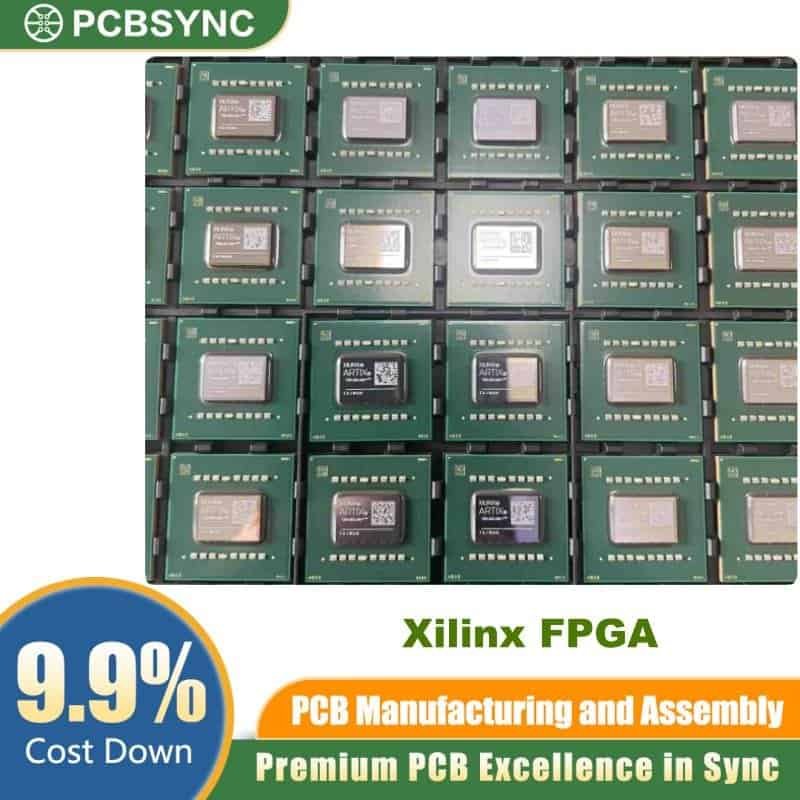
The XC3S5000-4FGG676C is a high-density, cost-optimized Field-Programmable Gate Array (FPGA) from Xilinx’s Spartan-3 family. Manufactured on a 90nm CMOS process node and housed in a compact 676-pin Fine-pitch Ball Grid Array (FBGA) package, this device delivers 5 million system gates alongside a rich set of embedded logic, memory, and clock management resources — making it one of the most capable members of the Spartan-3 generation for volume-driven digital design.
Whether you are building broadband access equipment, industrial control systems, display processors, or digital television hardware, the XC3S5000-4FGG676C offers the performance, flexibility, and competitive cost profile that engineers demand. For those exploring the full range of programmable logic solutions, Xilinx FPGA options span from entry-level to high-performance, covering virtually every application domain.
What Is the XC3S5000-4FGG676C? Decoding the Part Number
Understanding the part number helps engineers quickly identify the device variant:
| Code Segment |
Meaning |
| XC3S |
Xilinx Spartan-3 family |
| 5000 |
5,000,000 system gates (5M) |
| -4 |
Speed grade 4 (630 MHz internal performance) |
| FGG |
Fine-pitch Ball Grid Array, lead-free (Pb-free) package |
| 676 |
676 total package pins |
| C |
Commercial temperature range (0°C to +85°C junction) |
The “FGG” designation confirms this is the Pb-free (RoHS-compliant) variant of the 676-pin BGA package, distinguishing it from the standard “FG” package. The commercial “C” suffix indicates operation within 0°C to +85°C (TJ), suitable for the vast majority of industrial and consumer electronics environments.
XC3S5000-4FGG676C Key Specifications at a Glance
| Parameter |
Value |
| Manufacturer |
Xilinx (AMD) |
| Product Family |
Spartan-3 |
| Part Number |
XC3S5000-4FGG676C |
| System Gates |
5,000,000 |
| Logic Cells |
74,880 |
| Configurable Logic Blocks (CLBs) |
9,360 |
| Slices |
33,280 |
| Distributed RAM |
Up to 432 Kbits |
| Block RAM |
Up to 1,728 Kbits (96 × 18 Kbit blocks) |
| Dedicated Multipliers (18×18) |
104 |
| Digital Clock Managers (DCMs) |
4 |
| Maximum User I/O Pins |
489 |
| Package |
FBGA-676 (27mm × 27mm) |
| Process Technology |
90nm CMOS |
| Core Supply Voltage (VCCINT) |
1.2V (1.14V – 1.26V) |
| Speed Grade |
-4 (630 MHz) |
| Operating Temperature (TJ) |
0°C to +85°C (Commercial) |
| Mounting Style |
Surface Mount |
| RoHS / Pb-Free |
Yes (FGG variant) |
Architecture Deep Dive: What Makes the XC3S5000-4FGG676C Powerful
Configurable Logic Blocks (CLBs) and Logic Cells
The XC3S5000-4FGG676C contains 74,880 logic cells organized into 9,360 CLBs. Each CLB consists of four slices, and each slice contains two 4-input Look-Up Tables (LUTs), two storage elements (flip-flops or latches), fast carry logic, and wide multiplexers. The LUTs in left-hand slices can additionally be configured as 16-bit distributed RAM or shift registers (SRL16), greatly expanding flexible memory options without consuming block RAM resources.
Block RAM — Up to 1,728 Kbits of On-Chip Storage
The device integrates 96 true dual-port 18 Kbit block RAM modules, totaling 1,728 Kbits. Each block RAM can be independently configured as single-port or dual-port memory with widths from 1 to 36 bits. This hierarchical SelectRAM™ memory architecture supports efficient data buffering, FIFOs, lookup tables, and local storage for embedded processor designs.
Dedicated 18×18 Multipliers — 104 Blocks for DSP Acceleration
With 104 dedicated 18×18 hardware multipliers, the XC3S5000-4FGG676C provides hard-wired multiply capability for DSP operations such as filtering, correlation, and fast Fourier transforms. Each multiplier delivers pipelined multiplication without consuming CLB resources, significantly improving throughput for signal-processing workloads.
Digital Clock Managers (DCMs) — Precision Clock Control
Four on-chip DCMs provide:
- Clock skew elimination across the device
- Frequency synthesis (multiply and divide input clocks)
- High-resolution phase shifting (fine and coarse)
- Clock mirroring for board-level clock distribution
Eight global clock lines ensure low-skew clock delivery to every flip-flop and block RAM in the device.
SelectIO™ I/O Interface Standards
The 676-pin package exposes up to 489 user I/O pins with comprehensive multi-standard support:
| I/O Category |
Supported Standards |
| Single-Ended |
LVTTL, LVCMOS (3.3V/2.5V/1.8V/1.5V), PCI, GTL, HSTL, SSTL |
| Differential |
LVDS, RSDS, BLVDS, LVPECL, and more (8 standards) |
| Double Data Rate |
DDR input and output registers |
| Digitally Controlled Impedance (DCI) |
On-chip termination for signal integrity |
This broad I/O flexibility allows the XC3S5000-4FGG676C to interface directly with DDR/DDR2 memory, high-speed serial links, video interfaces, and a wide variety of processor buses.
Package Information: FBGA-676
| Package Attribute |
Detail |
| Package Type |
Fine-pitch Ball Grid Array (FBGA) |
| Total Pins |
676 |
| Ball Pitch |
1.0 mm |
| Package Dimensions |
27mm × 27mm × 1.75mm |
| Mounting |
Surface Mount (SMD) |
| Pb-Free / RoHS |
Yes (“FGG” suffix) |
The compact 27×27mm BGA footprint enables dense PCB placement, a key advantage for space-constrained designs. The 1.0mm ball pitch is manageable with standard PCB manufacturing processes, balancing high pin density with assembly yield.
Ordering Information and Variant Comparison
The XC3S5000 is available in multiple speed grades, temperature ranges, and package options. The table below outlines the most common variants:
| Part Number |
Speed Grade |
Package |
Pins |
Temp Range |
| XC3S5000-4FGG676C |
-4 (630 MHz) |
FBGA-676, Pb-free |
676 |
Commercial (0°C to 85°C) |
| XC3S5000-4FG676C |
-4 (630 MHz) |
FBGA-676, standard |
676 |
Commercial |
| XC3S5000-4FGG676I |
-4 (630 MHz) |
FBGA-676, Pb-free |
676 |
Industrial (-40°C to 100°C) |
| XC3S5000-4FGG900C |
-4 (630 MHz) |
FBGA-900, Pb-free |
900 |
Commercial |
| XC3S5000-5FGG676C |
-5 (fastest) |
FBGA-676, Pb-free |
676 |
Commercial |
For applications requiring extended temperature operation, the XC3S5000-4FGG676I (Industrial grade) covers –40°C to +100°C junction temperature and is a pin-compatible substitute.
Supported I/O Standards in Detail
Single-Ended Signal Standards (18 Supported)
The XC3S5000-4FGG676C supports 18 single-ended standards including LVTTL and LVCMOS at voltages from 1.5V to 3.3V, along with PCI, GTL, GTL+, HSTL Classes I–IV, and SSTL Classes I and II. This makes it straightforward to connect to legacy 3.3V logic, modern low-voltage interfaces, and memory buses in the same design.
Differential Signal Standards (8 Supported)
Eight differential standards include LVDS (Low Voltage Differential Signaling), RSDS (Reduced Swing Differential Signaling), BLVDS, LVPECL, LVDSEXT, RSDSEXT, and compatible variants. LVDS and RSDS are especially valuable for high-speed, noise-immune data links commonly used in display interfaces, backplane communications, and sensor front-ends.
XC3S5000-4FGG676C Applications
The XC3S5000-4FGG676C is well-suited to a broad spectrum of applications owing to its combination of high logic density, substantial on-chip memory, dedicated DSP multipliers, and versatile I/O:
| Application Domain |
Use Case Examples |
| Broadband & Networking |
DSL/cable line cards, Ethernet switches, routers |
| Display & Video |
Flat-panel display controllers, video scalers, projectors |
| Digital Television |
Set-top box processing, MPEG decode assist, OSD controllers |
| Industrial Automation |
PLCs, motor control, machine vision preprocessing |
| Embedded Processing |
MicroBlaze soft-core CPU, co-processing, custom peripherals |
| Communications Infrastructure |
Protocol conversion, framing, FEC logic |
| Test & Measurement |
Pattern generators, logic analyzers, data acquisition front-ends |
| Automotive Electronics |
Infotainment, ADAS sensor interfaces (commercial temp variants) |
Development Tools and Ecosystem
Xilinx ISE Design Suite
The XC3S5000-4FGG676C is supported by Xilinx ISE Design Suite (the appropriate toolchain for Spartan-3 generation devices). ISE provides synthesis, implementation, timing analysis, and device programming through iMPACT. Designers working with this device should use ISE 14.7, the final version of ISE and the recommended tool for all Spartan-3 targets.
Hardware Description Languages (HDL) Support
| HDL / Flow |
Support |
| VHDL |
Full |
| Verilog |
Full |
| SystemVerilog (subset) |
Partial (via XST) |
| Schematic Entry |
Supported via ISE |
| IP Core (LogiCORE) |
Extensive library available |
Configuration Methods
The XC3S5000-4FGG676C supports multiple configuration interfaces, including Master Serial, Slave Serial, Master SPI, Master BPI (parallel NOR flash), Slave Parallel (SelectMAP), and JTAG. The JTAG port is IEEE 1149.1/1532 compliant, enabling in-circuit programming and boundary-scan testing.
Absolute Maximum Ratings
| Parameter |
Limit |
| Storage Temperature |
–65°C to +150°C |
| Maximum Junction Temperature (TJ) |
+125°C |
| VCCINT Supply Voltage |
–0.5V to +1.5V |
| VCCO Supply Voltage |
–0.5V to +4.0V |
| Voltage on Any Pin |
–0.5V to VCCO + 0.5V |
Always refer to the official Xilinx DS099 datasheet for complete electrical specifications before design finalization.
Recommended Operating Conditions
| Parameter |
Minimum |
Typical |
Maximum |
| Core Voltage (VCCINT) |
1.14V |
1.20V |
1.26V |
| I/O Supply Voltage (VCCO) |
Depends on standard |
Varies |
3.465V max |
| Junction Temperature (TJ) |
0°C |
25°C |
+85°C |
| Speed Grade -4 Max Frequency |
— |
630 MHz |
— |
Frequently Asked Questions (FAQs)
What is the XC3S5000-4FGG676C?
The XC3S5000-4FGG676C is a 5-million gate FPGA from Xilinx’s Spartan-3 family. It features 74,880 logic cells, 1,728 Kbits of block RAM, 104 dedicated 18×18 multipliers, 4 DCMs, and up to 489 user I/O pins in a 676-pin Pb-free FBGA package. It operates on a 1.2V core supply and is rated for commercial temperatures (0°C to +85°C).
What is the difference between XC3S5000-4FGG676C and XC3S5000-4FG676C?
The only difference is the package finish. The FGG variant is Pb-free (lead-free) and RoHS-compliant, while the standard FG variant uses conventional tin-lead solder balls. Both are electrically and functionally identical and are pin-compatible.
What design software is used for XC3S5000-4FGG676C?
Xilinx ISE Design Suite 14.7 is the recommended toolchain. The Spartan-3 family is not supported by the newer Vivado Design Suite, which targets Xilinx 7-series and later devices.
Is the XC3S5000-4FGG676C still in production?
The Spartan-3 family has reached end-of-life for new designs, though inventory remains available through distribution channels. Engineers starting new designs should evaluate the Spartan-6 or Spartan-7 families for an upgrade path. Existing designs using this device continue to be supported in maintenance mode.
What are compatible alternative parts?
Pin-compatible and functionally similar alternatives include:
- XC3S5000-4FGG676I — same device, industrial temperature grade
- XC3S4000-4FGG676C — lower gate count (4M gates), same package
- XC6SLX75-3FGG676C — Spartan-6, higher performance upgrade path