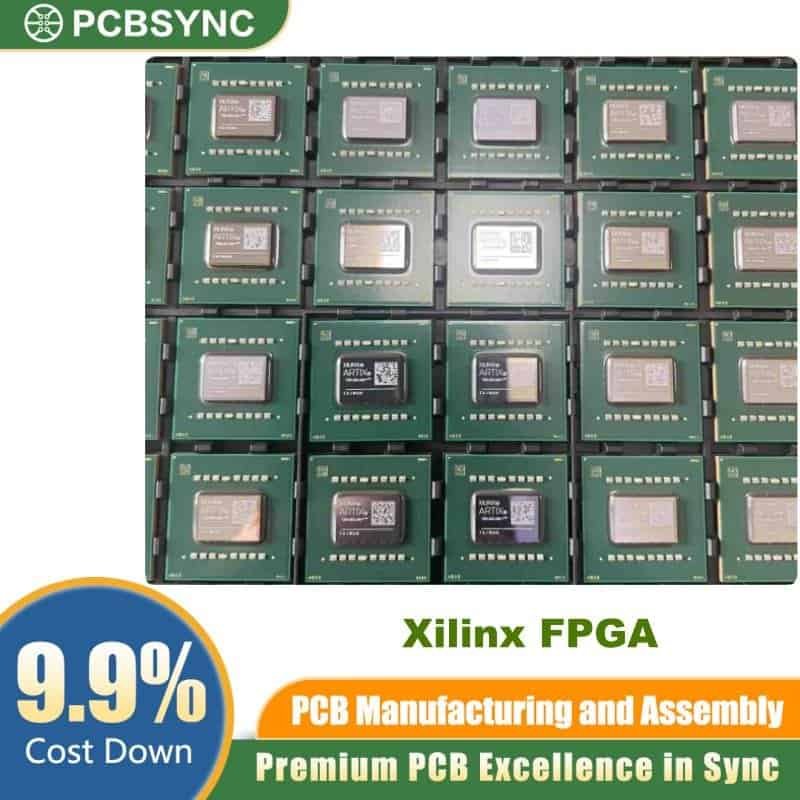
The XC3S5000-4FGG1156C is a high-density Field-Programmable Gate Array (FPGA) from Xilinx’s Spartan-3 family, offering 5 million system gates in a 1156-pin Fine-Pitch Ball Grid Array (FBGA) package. Manufactured using 90nm process technology and operating at a 1.2V core voltage, this device is engineered for high-volume, cost-sensitive applications that demand substantial logic density and flexible I/O capability. Whether you are working in telecommunications, industrial control, or embedded processing, the XC3S5000-4FGG1156C delivers reliable performance and broad compatibility with modern design toolchains.
What Is the XC3S5000-4FGG1156C?
The XC3S5000-4FGG1156C is the largest device in the Xilinx Spartan-3 family, combining 5,000,000 system gates with 74,880 logic cells across a 104 × 80 CLB array. As part of the Xilinx FPGA product line, it inherits the architecture of the Virtex-II platform while delivering a significant reduction in per-gate cost — making it one of the most capable cost-optimized FPGAs available for high-density designs.
The “4” in the part number denotes the -4 speed grade, which supports a maximum system clock frequency of 630 MHz (internal), while the “FGG1156” indicates the 1156-pin Flip Chip Ball Grid Array (FCBGA) package. This package provides the maximum number of user I/O pins available for the XC3S5000 silicon, making it the top choice when signal count is a design priority.
Key Features of the XC3S5000-4FGG1156C
- 5,000,000 system gates — the highest logic density in the Spartan-3 family
- 74,880 logic cells (equivalent to 66,560 flip-flops and 33,280 4-input LUTs)
- 1,872 Kbits of total distributed RAM
- 520 Kbits of dedicated block RAM across 104 dual-port 18-Kbit blocks
- 104 dedicated 18×18 multipliers for DSP-class arithmetic
- 4 Digital Clock Managers (DCMs) for clock synthesis, deskew, and phase shifting
- 784 user I/O pins in the FGG1156 package
- 90nm CMOS process technology, 1.2V core voltage
- Support for 18 single-ended and 8 differential SelectIO standards
- JTAG boundary-scan testing (IEEE 1149.1 compliant)
- Five configuration modes: Master Parallel, Slave Parallel, Master Serial, Slave Serial, JTAG
XC3S5000-4FGG1156C Full Technical Specifications
| Parameter |
Value |
| Manufacturer |
AMD / Xilinx |
| Part Number |
XC3S5000-4FGG1156C |
| Family |
Spartan-3 |
| System Gates |
5,000,000 |
| Logic Cells |
74,880 |
| CLB Array |
104 × 80 |
| Total CLBs |
8,320 |
| Flip-Flops |
66,560 |
| 4-Input LUTs |
33,280 |
| Distributed RAM |
1,872 Kbits |
| Block RAM |
520 Kbits (104 × 18 Kbit blocks) |
| Dedicated Multipliers |
104 (18×18-bit) |
| Digital Clock Managers |
4 |
| Max User I/Os |
784 |
| Package |
FGG1156 (1156-pin FCBGA) |
| Package Body Size |
35 × 35 mm |
| Speed Grade |
-4 |
| Max Internal Clock |
630 MHz |
| Process Node |
90nm |
| Core Voltage (VCCINT) |
1.2V |
| I/O Voltage (VCCO) |
1.2V – 3.3V (bank-configurable) |
| Operating Temperature |
0°C to +85°C (Commercial) |
| RoHS Compliance |
Not RoHS Compliant |
| Mounting Type |
Surface Mount |
| Configuration Storage |
External PROM or non-volatile medium |
XC3S5000-4FGG1156C Ordering Information & Part Number Breakdown
Understanding the part number helps confirm you are ordering the correct variant:
| Field |
Code |
Meaning |
| Device |
XC3S5000 |
Spartan-3, 5M gates |
| Speed Grade |
-4 |
Commercial speed grade (-4 = 630 MHz) |
| Package |
FGG |
Flip Chip Ball Grid Array (Pb-free suffix) |
| Pin Count |
1156 |
1156-pin BGA |
| Temperature |
C |
Commercial (0°C to +85°C) |
Note: The “FGG” designation indicates a Pb-free (lead-free) flip chip BGA package variant. The earlier “FG” variant is the standard Pb-containing package. Both occupy the same footprint and are pin-compatible.
XC3S5000-4FGG1156C vs. Other Speed Grades
| Part Number |
Speed Grade |
Max Clock |
Temperature |
| XC3S5000-4FGG1156C |
-4 |
630 MHz |
Commercial (0°C – 85°C) |
| XC3S5000-5FGG1156C |
-5 |
725 MHz |
Commercial (0°C – 85°C) |
| XC3S5000-4FG1156C |
-4 |
630 MHz |
Commercial (Standard Pb pkg) |
The -4 speed grade is the standard commercial option balancing performance and cost, while the -5 grade offers higher clock headroom for timing-critical designs.
XC3S5000-4FGG1156C Package & Pin Information
FGG1156 Package Details
| Package Attribute |
Value |
| Package Type |
Flip Chip BGA (FCBGA) |
| Total Pins |
1,156 |
| User I/O Pins |
784 |
| Differential I/O Pairs |
Up to 392 |
| Package Body |
35 × 35 mm |
| Ball Pitch |
1.0 mm |
| Pb-Free |
Yes (FGG designation) |
| SMT Compatible |
Yes |
The 1156-pin FGG package provides the maximum I/O count for the XC3S5000, making it the preferred choice for applications that require extensive external connectivity — such as memory interfaces, multi-channel communication buses, or high-pin-count ASIC replacement designs.
Architecture Overview: Five Functional Elements
The Spartan-3 architecture powering the XC3S5000-4FGG1156C is built around five tightly integrated programmable elements:
1. Configurable Logic Blocks (CLBs)
Each CLB contains four slices, and each slice contains two 4-input Look-Up Tables (LUTs), two storage elements (flip-flops or latches), and dedicated carry logic. The XC3S5000 has 8,320 CLBs arranged in a 104 × 80 array, yielding 33,280 LUTs and 66,560 flip-flops.
2. Block RAM
The XC3S5000 includes four columns of block RAM, each column consisting of multiple 18-Kbit dual-port RAM blocks. Every block RAM can be configured as a true dual-port SRAM with independent clocking on each port. Total block RAM capacity is 520 Kbits (104 blocks × 18 Kbits each).
3. Dedicated Multipliers
Each 18-Kbit block RAM is paired with a dedicated 18×18-bit hardware multiplier, providing 104 multipliers in total. These enable high-throughput DSP functions — including FIR filters, FFTs, and correlation engines — without consuming CLB resources.
4. Digital Clock Managers (DCMs)
Four DCMs provide advanced clocking capabilities:
- Clock deskew — eliminates clock distribution delays
- Frequency synthesis — generates derived clocks using DLL multiplication/division
- Phase shifting — continuous or fixed phase adjustment
- Clock mirroring — provides clean, low-jitter internal clock domains
5. Input/Output Blocks (IOBs)
The SelectIO feature supports 18 single-ended standards (including LVCMOS, LVTTL, HSTL, SSTL, GTL, GTLP, PCI) and 8 differential standards (LVDS, LVPECL, BLVDS, ULVDS, RSDS). Digitally Controlled Impedance (DCI) is supported on most banks, enabling integrated on-chip termination without external resistors. Each IOB includes programmable slew rate control (FAST/SLOW) and drive strength selection (2, 4, 6, 8, 12, 16, 24 mA).
Supported I/O Standards
| Standard Type |
Supported Standards |
| Single-Ended |
LVCMOS 3.3V/2.5V/1.8V/1.5V, LVTTL, HSTL I/II/III/IV, SSTL 3/2/18 I/II, GTL, GTLP, PCI, PCI-X |
| Differential |
LVDS, LVPECL, BLVDS, ULVDS, RSDS, HSTL Differential, SSTL Differential |
| DCI Supported |
Most banks (except Bank 5 in VQ100/CP132/TQ144 packages) |
Configuration Modes
The XC3S5000-4FGG1156C supports five configuration modes, providing flexibility for different system architectures:
| Mode |
Description |
| Master Serial |
FPGA reads from a serial PROM (e.g., XCF16P) automatically on power-up |
| Slave Serial |
Configuration data clocked in by external controller |
| Master Parallel (SelectMAP) |
FPGA reads from a parallel PROM |
| Slave Parallel (SelectMAP) |
Data driven by external processor or CPLD |
| JTAG |
Configuration via standard IEEE 1149.1 test access port |
Configuration data is stored in static CMOS configuration latches (CCLs), which are reprogrammable and retain state as long as power is applied.
Typical Applications for the XC3S5000-4FGG1156C
The XC3S5000-4FGG1156C is well-suited for a wide range of high-density embedded and digital applications:
| Application Area |
Use Case Examples |
| Broadband Access |
DSL modems, cable modems, optical line terminals |
| Home Networking |
Gigabit Ethernet switches, wireless access points |
| Digital Video |
HDTV processing, video scaling, format conversion |
| Industrial Control |
Motor control, PLC replacement, sensor fusion |
| Embedded Processing |
Soft-core CPU systems (MicroBlaze), co-processing |
| ASIC Prototyping |
Pre-silicon validation, logic emulation |
| Communications |
Protocol bridging, line-card logic, FEC engines |
| Test & Measurement |
Stimulus generation, data capture, signal analysis |
XC3S5000-4FGG1156C vs. Comparable Devices
| Feature |
XC3S5000-4FGG1156C |
XC3S4000-4FGG676C |
XC3S2000-4FGG456C |
| System Gates |
5,000,000 |
4,000,000 |
2,000,000 |
| Logic Cells |
74,880 |
62,208 |
33,792 |
| Block RAM (Kbits) |
520 |
432 |
216 |
| Multipliers |
104 |
96 |
40 |
| DCMs |
4 |
4 |
4 |
| Max User I/Os |
784 |
489 |
489 |
| Package Pins |
1156 |
676 |
456 |
The XC3S5000-4FGG1156C stands out as the top-of-range Spartan-3 device, offering roughly 25% more gates and 20% more block RAM than the XC3S4000, with significantly more I/O pins.
Design Tools & Software Support
The XC3S5000-4FGG1156C is fully supported by Xilinx design tools:
| Tool |
Description |
| ISE Design Suite |
Primary synthesis, implementation, and bitstream generation tool for Spartan-3 |
| Vivado Design Suite |
Available for migration planning; not natively targeted for Spartan-3 |
| ChipScope Pro |
In-system logic analyzer for post-synthesis debugging |
| iMPACT |
Configuration and JTAG programming tool |
| PlanAhead |
Floorplanning and constraint management |
| CORE Generator |
IP core generation (FIFOs, memory controllers, DSP blocks) |
Xilinx’s ISE Design Suite (versions 10.1 through 14.7) provides full support for place-and-route, timing analysis, and bitstream generation targeting the XC3S5000 device family.
Frequently Asked Questions (FAQ)
What does the “-4” speed grade mean for the XC3S5000-4FGG1156C?
The -4 speed grade indicates the device’s timing performance class. For the XC3S5000, the -4 grade supports a maximum internal system clock of 630 MHz, which is the standard commercial speed grade. The faster -5 grade (725 MHz) is also available but at a higher cost.
Is the XC3S5000-4FGG1156C RoHS compliant?
No. The XC3S5000-4FGG1156C is not RoHS compliant. The “FGG” package designation indicates a Pb-free package body, but the component as distributed through legacy channels (e.g., Rochester Electronics) may not carry full RoHS certification. For RoHS-compliant designs, verify the specific lot compliance documentation with your distributor.
What external PROM is recommended for configuring the XC3S5000-4FGG1156C?
Xilinx recommends the XCF16P Platform Flash PROM (16 Mbit), which is specifically listed in the Spartan-3 selection matrix for the XC3S5000 device. This PROM holds the full 13.3 Mbit configuration bitstream required for the XC3S5000.
Is the XC3S5000-4FGG1156C still recommended for new designs?
Yes. As of the last official Xilinx datasheet revision (DS099 v3.1, June 2013), the XC3S5000 is listed as recommended for new designs. However, engineers starting new projects should also evaluate more recent families such as Spartan-6 or Artix-7 for improved performance-per-watt and updated IP ecosystem support.
What is the difference between FG1156 and FGG1156 packages?
The FG1156 is the original standard leaded (Pb-containing) 1156-pin BGA package. The FGG1156 is the Pb-free (lead-free) equivalent, identifiable by the “G” suffix added after the package code. Both variants are pin-compatible and electrically equivalent.
Summary
The XC3S5000-4FGG1156C is the flagship device of the Xilinx Spartan-3 FPGA family — combining 5 million system gates, 74,880 logic cells, 520 Kbits of block RAM, 104 hardware multipliers, and up to 784 user I/Os in a single 1156-pin FCBGA package. Operating at a -4 speed grade (630 MHz) with a 1.2V core voltage on 90nm process technology, it is the optimal choice for cost-sensitive, high-density designs in communications, video, industrial, and embedded processing applications. Backed by Xilinx’s mature ISE toolchain and a robust IP ecosystem, the XC3S5000-4FGG1156C continues to deliver proven, reliable performance for both new designs and legacy system support.