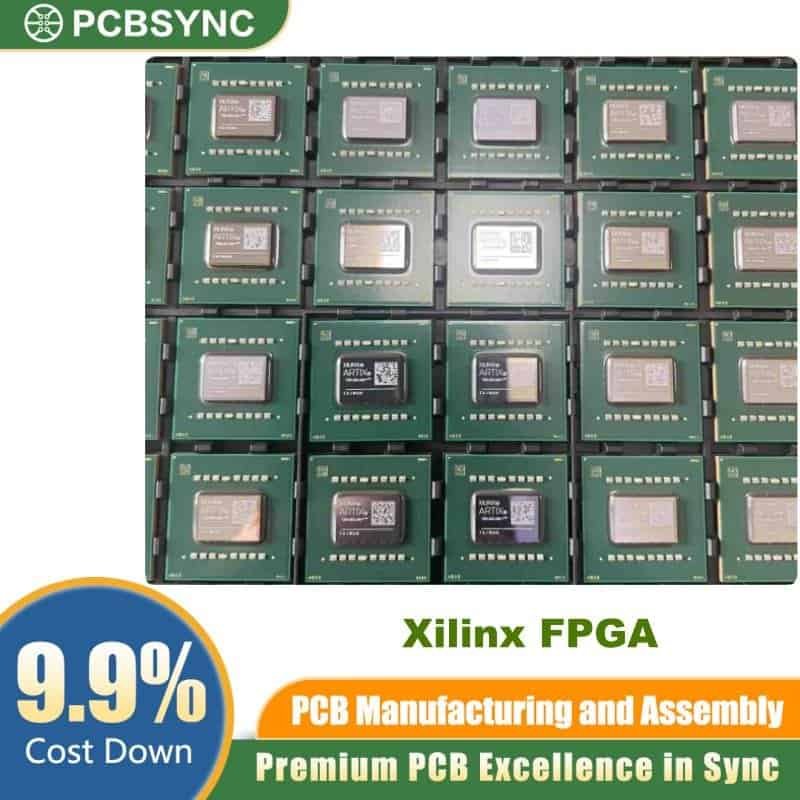
The XC3S5000-4FGG676C is a high-density, cost-optimized Field-Programmable Gate Array (FPGA) from Xilinx (now AMD), part of the industry-proven Spartan-3 family. Designed for high-volume consumer and industrial electronics, this device delivers 5 million system gates, 74,880 logic cells, and up to 784 user I/Os — all in a compact 676-pin Fine-Pitch Ball Grid Array (FBGA) package. Whether you are building broadband access equipment, digital television systems, or embedded control platforms, the XC3S5000-4FGG676C offers exceptional performance-per-dollar on a mature 90nm process node.
What Is the XC3S5000-4FGG676C?
The XC3S5000-4FGG676C is a member of the Xilinx FPGA Spartan-3 product line — a family specifically engineered to serve the needs of cost-sensitive, high-volume applications. The part number decodes as follows:
| Part Number Segment |
Meaning |
| XC3S |
Xilinx Spartan-3 family |
| 5000 |
5,000,000 system gates |
| 4 |
Speed grade -4 (standard) |
| FGG |
Fine-pitch Ball Grid Array (FBGA), Pb-free |
| 676 |
676-pin package |
| C |
Commercial temperature range (0°C to +85°C) |
This device is also sometimes referenced without the extra “G” in the package code as XC3S5000-4FG676C, which refers to the same physical device with a legacy non-Pb-free marking convention. The FGG suffix confirms RoHS-compliant, Pb-free construction.
XC3S5000-4FGG676C Key Specifications
Core Logic Resources
| Parameter |
Value |
| System Gates |
5,000,000 |
| Logic Cells |
74,880 |
| CLB Array |
104 × 80 |
| Total CLBs |
8,320 |
| Flip-Flops |
66,560 |
| 4-Input LUTs |
66,560 |
| Distributed RAM |
520 Kbits |
Memory Resources
| Parameter |
Value |
| Block RAM Columns |
4 |
| Total Block RAM |
1,872 Kbits |
| Block RAM Blocks |
104 × 18 Kbits each |
| Dedicated Multipliers |
104 (18×18-bit) |
I/O and Connectivity
| Parameter |
Value |
| Maximum User I/Os |
784 (FGG676 package: 344 usable) |
| I/O Banks |
8 |
| Differential I/O Pairs |
Up to 172 |
| Digital Clock Managers (DCMs) |
4 |
Package and Electrical
| Parameter |
Value |
| Package Type |
676-Pin FBGA (Fine-Pitch BGA) |
| Package Body Size |
27 × 27 mm |
| Core Voltage (VCCINT) |
1.2V |
| I/O Voltage (VCCO) |
1.2V – 3.3V |
| Speed Grade |
-4 |
| Max System Clock |
630 MHz |
| Process Technology |
90nm CMOS |
| Temperature Range |
0°C to +85°C (Commercial) |
| RoHS Compliance |
Yes (Pb-Free, FGG suffix) |
XC3S5000-4FGG676C Speed Grade and Performance
The -4 speed grade is the standard commercial offering for the XC3S5000 in the FGG676 package. Xilinx also offered a -5 speed grade for higher clock frequency requirements. Below is a comparison:
| Speed Grade |
Max System Clock |
Typical Application |
| -4 |
630 MHz |
Standard consumer & industrial designs |
| -5 |
725 MHz |
High-performance signal processing |
For most embedded control, communications, and video processing designs, the -4 grade provides ample headroom while offering the best price-to-performance ratio.
Supported I/O Standards
The XC3S5000-4FGG676C supports a broad range of single-ended and differential I/O standards, making it compatible with virtually all modern digital interfaces:
Single-Ended I/O Standards
| Standard |
Description |
| LVCMOS 3.3V / 2.5V / 1.8V / 1.5V / 1.2V |
Low-voltage CMOS logic |
| LVTTL |
3.3V TTL-compatible |
| PCI / PCI-X |
Peripheral Component Interconnect |
| GTL / GTLP |
Gunning Transceiver Logic |
| HSTL Class I/II/III/IV |
High-Speed Transceiver Logic |
| SSTL 2 / SSTL 18 |
Stub Series Terminated Logic |
Differential I/O Standards
| Standard |
Description |
| LVDS |
Low-Voltage Differential Signaling |
| LVPECL |
Low-Voltage Positive ECL |
| BLVDS |
Bus LVDS |
| Differential HSTL |
High-speed differential |
| Differential SSTL |
Differential stub-terminated |
Block RAM Architecture
The XC3S5000-4FGG676C contains 104 block RAM tiles, each consisting of an 18 Kbit dual-port synchronous SRAM. Key architectural features include:
- True dual-port access: Port A and Port B operate independently with separate clocks, addresses, and data paths
- Configurable data widths from 1 to 18 bits per port
- Built-in optional output registers for improved pipeline performance
- Each block RAM tile is paired with a dedicated 18×18-bit multiplier, enabling efficient DSP datapath construction
Total on-chip block RAM: 1,872 Kbits (~234 KB), suitable for storing FIFOs, frame buffers, lookup tables, and instruction memory for embedded soft processor cores.
Digital Clock Manager (DCM)
The device integrates 4 Digital Clock Managers, providing robust on-chip clock control:
- Frequency synthesis: multiply or divide input clock frequencies
- Phase shifting: precise control over clock phase (0°, 90°, 180°, 270°, and fine-grained)
- Deskew: eliminates clock distribution delay within the FPGA fabric
- Status outputs: LOCKED signal confirms DCM lock for safe system initialization
- Supported input frequency range: approximately 24 MHz to 326 MHz
Configuration Modes
The XC3S5000-4FGG676C supports five industry-standard configuration modes, enabling flexible board-level integration:
| Configuration Mode |
Description |
| Master Serial |
Device reads bitstream from SPI or serial PROM |
| Slave Serial |
External controller clocks in configuration bits |
| Master Parallel |
Device reads from parallel NOR Flash |
| Slave Parallel (SelectMAP) |
Fast parallel configuration by host processor |
| JTAG (Boundary-Scan) |
IEEE 1149.1 compliant; used for debugging and in-system programming |
Configuration data is held in robust reprogrammable static CMOS configuration latches (CCLs). The device stores its configuration externally between power cycles, typically in a Xilinx Platform Flash PROM (such as the XCF16P).
Typical Applications for the XC3S5000-4FGG676C
Thanks to its combination of logic density, on-chip memory, dedicated multipliers, and flexible I/O, the XC3S5000-4FGG676C is well-suited for a wide range of applications:
| Application Area |
Use Cases |
| Consumer Electronics |
Digital TV processing, set-top box control, display drivers |
| Broadband & Networking |
Protocol bridging, packet inspection, network interface cards |
| Industrial Control |
Motor control, PLC replacement, sensor fusion |
| Video & Image Processing |
Frame buffering, scaling, format conversion |
| Embedded Computing |
Soft processor (MicroBlaze/PicoBlaze), co-processing |
| Communications |
UART, SPI, I2C, Ethernet MAC, custom serial protocols |
| Prototyping / Evaluation |
ASIC emulation, design verification, rapid prototyping |
XC3S5000-4FGG676C vs. Other Spartan-3 Devices
The table below shows where the XC3S5000 sits within the full Spartan-3 family lineup:
| Device |
System Gates |
Logic Cells |
Block RAM |
Multipliers |
Max I/O |
| XC3S50 |
50K |
1,728 |
72 Kbits |
4 |
124 |
| XC3S200 |
200K |
4,320 |
216 Kbits |
12 |
173 |
| XC3S400 |
400K |
8,064 |
288 Kbits |
16 |
264 |
| XC3S1000 |
1M |
17,280 |
432 Kbits |
24 |
391 |
| XC3S1500 |
1.5M |
29,952 |
648 Kbits |
32 |
487 |
| XC3S2000 |
2M |
46,080 |
864 Kbits |
40 |
565 |
| XC3S4000 |
4M |
62,208 |
1,728 Kbits |
96 |
712 |
| XC3S5000 |
5M |
74,880 |
1,872 Kbits |
104 |
784 |
The XC3S5000 is the largest and most capable device in the standard Spartan-3 family, making it the right choice when logic density or memory capacity is the primary design driver.
Ordering Information and Part Number Variants
The XC3S5000 is available in multiple package and temperature variants. The table below covers the most common FGG676 options:
| Part Number |
Speed Grade |
Package |
Temperature |
Pb-Free |
| XC3S5000-4FG676C |
-4 |
FG676 |
Commercial (0°C to +85°C) |
No |
| XC3S5000-4FGG676C |
-4 |
FGG676 |
Commercial (0°C to +85°C) |
Yes |
| XC3S5000-4FGG676I |
-4 |
FGG676 |
Industrial (-40°C to +100°C) |
Yes |
| XC3S5000-5FGG676C |
-5 |
FGG676 |
Commercial (0°C to +85°C) |
Yes |
| XC3S5000-4FGG900C |
-4 |
FGG900 |
Commercial (0°C to +85°C) |
Yes |
Note: The “I” suffix denotes the Industrial temperature grade, suitable for designs exposed to extreme environmental conditions. Always verify your application’s temperature requirements before selecting a part.
Development Tools and Software Support
The XC3S5000-4FGG676C is fully supported by Xilinx (AMD) legacy design tools:
- Xilinx ISE Design Suite – The primary design environment for all Spartan-3 devices. Includes synthesis, implementation, simulation, and bitstream generation.
- XST (Xilinx Synthesis Technology) – Integrated RTL synthesis engine within ISE
- ChipScope Pro – In-system logic analyzer for real-time debugging via JTAG
- EDK (Embedded Development Kit) – For MicroBlaze soft processor designs
- ISIM / ModelSim – Simulation environments for behavioral and timing verification
- iMPACT – Programming and configuration tool for device programming via JTAG or PROM
Note: The Spartan-3 family is not supported in Vivado. ISE 14.7 is the final and recommended design tool version for this device.
Recommended Companion Devices
For a complete system design around the XC3S5000-4FGG676C, consider pairing it with the following:
| Component Type |
Recommended Device |
Purpose |
| Configuration PROM |
XCF16P (Xilinx Platform Flash) |
Stores FPGA bitstream |
| Power Regulator |
LTC3406 or similar |
Generate stable 1.2V VCCINT rail |
| Clock Source |
Oscillator or LVDS clock buffer |
Clean reference for DCM input |
| JTAG Debug Cable |
Xilinx Platform Cable USB II |
ISE programming and debugging |
Frequently Asked Questions
What is the difference between XC3S5000-4FG676C and XC3S5000-4FGG676C?
The double “G” in FGG indicates a Pb-free (RoHS-compliant) package. The XC3S5000-4FGG676C uses lead-free solder balls, making it suitable for modern manufacturing environments compliant with EU RoHS directives. Functionally and electrically, both parts are identical.
Is the XC3S5000-4FGG676C recommended for new designs?
Yes. As of the June 2013 datasheet revision (DS099 v3.1), Xilinx confirmed this product is recommended for new designs. While it is a mature-node device (90nm), it remains in production and is widely available through authorized distributors.
How many I/Os are available in the FGG676 package?
The 676-pin FGG package provides 344 maximum user I/Os for the XC3S5000. While the device supports up to 784 I/Os in larger packages, the FGG676 is a practical middle ground balancing pin count and PCB routing complexity.
What configuration PROM should I use with the XC3S5000-4FGG676C?
Xilinx recommends the XCF16P Platform Flash PROM (16 Mbit capacity), which provides sufficient storage for the XC3S5000 bitstream (~13.3 Mbits).
Can this device run a soft processor?
Yes. The XC3S5000-4FGG676C has ample resources to implement Xilinx MicroBlaze or PicoBlaze soft processor cores, along with peripherals, using the Xilinx EDK toolchain within ISE.
Summary
The XC3S5000-4FGG676C delivers the highest logic density in the standard Spartan-3 family with 5 million system gates, 74,880 logic cells, 104 dedicated 18×18 multipliers, and 1,872 Kbits of block RAM — all in a compact Pb-free 676-pin FBGA package. Its support for a wide array of I/O standards, four onboard DCMs, and five configuration modes makes it a versatile and production-proven choice for cost-sensitive consumer electronics, industrial control, communications, and embedded computing applications.
For engineers requiring a mature, well-supported, and readily available FPGA with strong logic density, the XC3S5000-4FGG676C remains a compelling option backed by decades of proven deployment in the field.