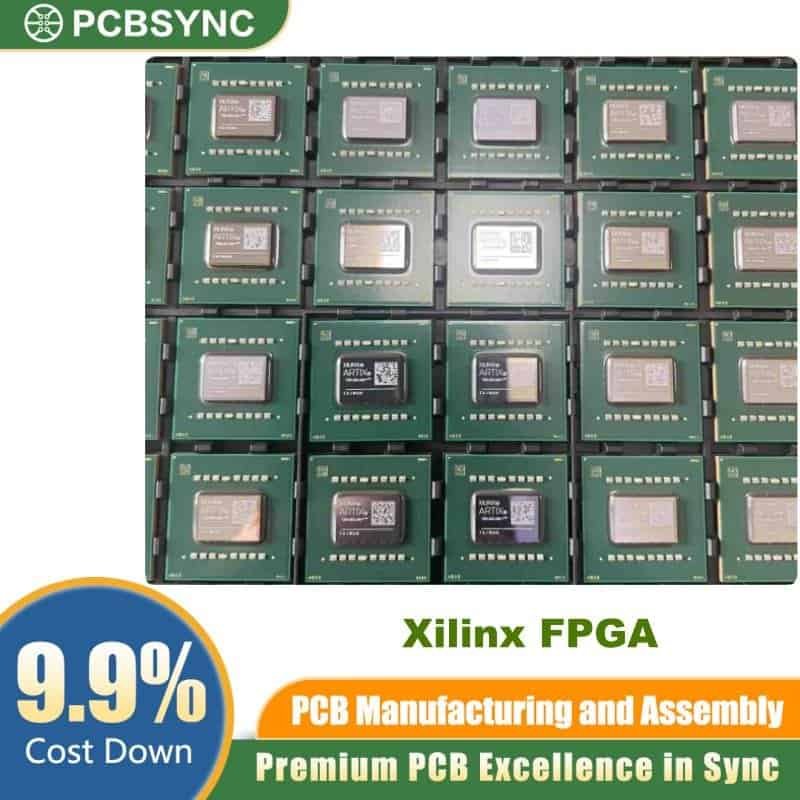
The XC3S50-5TQG144C is a high-performance, cost-efficient Field-Programmable Gate Array (FPGA) from Xilinx’s Spartan-3 family. Designed for high-volume, I/O-intensive applications, this device delivers 50,000 system gates in a compact 144-pin TQFP package. Whether you are developing embedded systems, consumer electronics, or industrial control applications, the XC3S50-5TQG144C offers a proven, flexible, and affordable programmable logic solution.
As part of the broader Xilinx FPGA product portfolio, the Spartan-3 series stands out for its mature 90nm process technology, low power consumption, and extensive I/O flexibility — making the XC3S50-5TQG144C an excellent choice for both new designs and legacy system support.
What Is the XC3S50-5TQG144C?
The XC3S50-5TQG144C is a member of the Xilinx Spartan-3 FPGA family, a family that spans densities from 50K to 5 million system gates. The “XC3S50” designates the 50K-gate device in the family, “-5” indicates the high-performance speed grade, “TQG” refers to the Pb-free 144-pin Thin Quad Flat Pack (TQFP) package, and “C” indicates the commercial temperature range (0°C to +85°C).
This FPGA is manufactured on a 90nm CMOS process and operates at a core voltage of 1.2V, making it suitable for modern low-power digital designs.
XC3S50-5TQG144C Key Specifications
The table below summarizes the primary technical specifications of the XC3S50-5TQG144C:
| Parameter |
Value |
| Manufacturer |
Xilinx (now AMD) |
| Part Number |
XC3S50-5TQG144C |
| FPGA Family |
Spartan-3 |
| System Gates |
50,000 |
| Logic Cells |
1,728 |
| CLB Array |
16 × 12 |
| CLBs (Total) |
192 |
| Flip-Flops |
1,536 |
| Distributed RAM |
12 Kbits |
| Block RAM |
72 Kbits |
| Multipliers (18×18) |
4 |
| DCMs (Digital Clock Managers) |
2 |
| Max User I/O Pins |
97 |
| Speed Grade |
-5 (High Performance) |
| Package Type |
TQG144 (Pb-free 144-pin TQFP) |
| Process Technology |
90nm |
| Core Supply Voltage (VCCINT) |
1.2V |
| Auxiliary Supply (VCCAUX) |
2.5V |
| Operating Temperature |
0°C to +85°C (Commercial) |
| Maximum Clock Frequency |
725 MHz |
XC3S50-5TQG144C Pin Configuration & Package Details
The TQG144 package is a 144-pin Thin Quad Flat Pack (TQFP) with lead-free (Pb-free) construction, denoted by the “G” in the package code. This package is widely used in space-constrained PCB designs where a fine-pitch SMD component is required.
| Package Attribute |
Detail |
| Package Type |
TQFP (Thin Quad Flat Pack) |
| Pin Count |
144 |
| Pb-Free / RoHS Compliant |
Yes (indicated by “G” suffix) |
| Mounting Type |
Surface Mount |
| Max User I/O |
97 |
| I/O Banks |
4 |
| Configuration Pins |
Dedicated (not included in user I/O count) |
Spartan-3 Internal Architecture Overview
Understanding the internal architecture of the XC3S50-5TQG144C helps engineers make full use of its capabilities. The Spartan-3 architecture consists of five main programmable functional elements:
Configurable Logic Blocks (CLBs)
The XC3S50-5TQG144C contains 192 CLBs arranged in a 16×12 array. Each CLB contains four slices, and each slice contains two 4-input Look-Up Tables (LUTs), two storage elements (flip-flops or latches), and carry/control logic. CLBs are the primary resource for implementing custom combinational and sequential logic.
Block RAM
The device includes 72 Kbits of block RAM organized as a single column of 18-Kbit dual-port RAM blocks. Each RAM block supports independent read and write operations on two ports simultaneously, enabling efficient data buffering and FIFO implementations.
Dedicated Multipliers
Four 18×18-bit dedicated multipliers are embedded directly in the FPGA fabric. These hardware multipliers enable high-speed arithmetic operations for DSP-adjacent applications without consuming CLB resources.
Digital Clock Managers (DCMs)
Two Digital Clock Managers provide advanced clock control features including frequency synthesis, phase shifting, and clock deskewing. DCMs support a wide range of clocking topologies and are essential for timing closure in complex designs.
Input/Output Blocks (IOBs)
The 97 user-configurable IOBs support a wide variety of single-ended and differential I/O standards, enabling the XC3S50-5TQG144C to interface with a broad range of external devices and buses.
Supported I/O Standards
The XC3S50-5TQG144C supports an extensive set of I/O standards, enabling seamless integration into mixed-voltage and high-speed system designs.
| I/O Standard Category |
Standards Supported |
| Single-Ended |
LVCMOS33, LVCMOS25, LVCMOS18, LVCMOS15, LVTTL, PCI, GTLP |
| Differential |
LVDS, RSDS, BLVDS, DIFF_HSTL, DIFF_SSTL |
| High-Speed |
HSTL Class I/III, SSTL18 Class I/II, SSTL2 Class I/II |
Note: DCI (Digitally Controlled Impedance) signal standards are not supported in Bank 5 of any Spartan-3 FPGA in the TQ144 package.
XC3S50-5TQG144C Ordering Information Decoded
The part number encodes critical product information. Here is a breakdown:
| Code Segment |
Meaning |
| XC |
Xilinx product prefix |
| 3S |
Spartan-3 family |
| 50 |
50K system gates density |
| -5 |
High-performance speed grade (fastest in family) |
| TQG |
Pb-free 144-pin Thin Quad Flat Pack (TQFP) |
| 144 |
144 total pin count |
| C |
Commercial temperature range (0°C to +85°C) |
For industrial temperature applications (-40°C to +100°C), the equivalent part number uses the suffix “I” instead of “C.”
Applications & Use Cases
The XC3S50-5TQG144C is well-suited for a wide range of applications where a balance of cost, I/O flexibility, and programmable logic density is required:
| Application Segment |
Example Use Cases |
| Consumer Electronics |
Set-top boxes, digital cameras, home networking devices |
| Industrial Automation |
Motor control, sensor interfaces, PLC co-processors |
| Communications |
Protocol bridges, serial interface controllers, UART/SPI/I2C logic |
| Embedded Systems |
Glue logic, bus arbitration, custom peripheral interfaces |
| Prototyping & Education |
FPGA development boards, academic research, logic experimentation |
| Automotive |
Low-risk legacy interface adaptation (commercial grade) |
Design Tools & Development Support
Xilinx (now AMD) provides comprehensive tooling for designing with the XC3S50-5TQG144C:
- ISE Design Suite – The legacy Xilinx Integrated Synthesis Environment (ISE) provides full support for Spartan-3 design, including synthesis, implementation, simulation, and bitstream generation. ISE is the primary recommended tool for this device family.
- VHDL / Verilog / SystemVerilog – All standard HDL languages are supported for design entry.
- ModelSim / ISim – Functional and timing simulation can be performed to validate designs before programming.
- JTAG Configuration – The device is programmed via a standard JTAG interface (IEEE 1149.1), enabling in-circuit programming and debugging.
The newer Vivado Design Suite does not support Spartan-3 devices. Use ISE 14.7 for all XC3S50-based designs.
Configuration Modes
The XC3S50-5TQG144C supports multiple configuration modes, providing flexibility for different system architectures:
| Configuration Mode |
Description |
| Master Serial |
FPGA drives a serial Flash to load configuration data |
| Slave Serial |
An external processor drives configuration data serially |
| Master SPI |
Uses SPI Flash memory for configuration |
| Master BPI (Parallel) |
Uses parallel NOR Flash for faster configuration |
| JTAG |
IEEE 1149.1 boundary scan for programming and debug |
XC3S50-5TQG144C vs. Related Part Numbers
Engineers often compare this part against similar variants. The table below highlights key differences:
| Part Number |
Speed Grade |
Temp Range |
Package |
Gates |
Notes |
| XC3S50-5TQG144C |
-5 (High) |
Commercial (0–85°C) |
144 TQFP Pb-free |
50K |
This product |
| XC3S50-4TQG144C |
-4 (Standard) |
Commercial (0–85°C) |
144 TQFP Pb-free |
50K |
Lower speed grade |
| XC3S50-5TQG144I |
-5 (High) |
Industrial (–40–100°C) |
144 TQFP Pb-free |
50K |
Industrial temp range |
| XC3S50-5VQG100C |
-5 (High) |
Commercial (0–85°C) |
100 VQFP Pb-free |
50K |
Smaller package, fewer I/Os |
| XC3S50A-5TQG144C |
-5 (High) |
Commercial (0–85°C) |
144 TQFP Pb-free |
50K |
Spartan-3A family (enhanced) |
Electrical Characteristics Summary
| Parameter |
Min |
Typical |
Max |
Unit |
| VCCINT (Core Voltage) |
1.14 |
1.20 |
1.26 |
V |
| VCCAUX (Auxiliary Voltage) |
2.375 |
2.5 |
2.625 |
V |
| VCCO (I/O Bank Voltage) |
1.14 |
— |
3.465 |
V |
| Operating Temp (Commercial) |
0 |
— |
+85 |
°C |
| Junction Temp (Tj max) |
— |
— |
125 |
°C |
Why Choose the XC3S50-5TQG144C?
The XC3S50-5TQG144C offers several compelling advantages for engineers and procurement teams:
Cost Efficiency – The Spartan-3 family was architected for high-volume, cost-sensitive markets. The 50K-gate density provides significant programmable logic capability at a competitive price point compared to ASICs or larger FPGA families.
Mature, Stable Platform – Based on proven 90nm technology with years of production history, this device offers supply chain stability and well-understood electrical behavior for long-lifecycle programs.
High-Performance Speed Grade – The -5 speed grade is the fastest offered in the Spartan-3 family, supporting system clock frequencies up to 725 MHz and minimizing timing closure challenges.
Pb-Free Compliance – The “G” in the package code confirms RoHS-compliant, lead-free construction, meeting global environmental regulations for electronics manufacturing.
Broad I/O Standard Support – With 97 user I/Os and support for both single-ended and differential standards across multiple voltage levels, the XC3S50-5TQG144C adapts to diverse system interface requirements.
Frequently Asked Questions (FAQ)
Q: Is the XC3S50-5TQG144C still in production? A: Xilinx (AMD) has indicated Spartan-3 as recommended for new designs in some documentation; however, this is a mature product family. Always verify current production and last-time-buy status with your distributor before committing to large volume orders.
Q: What design tool should I use for the XC3S50-5TQG144C? A: Use Xilinx ISE Design Suite 14.7, the final version of ISE. Vivado does not support Spartan-3 devices.
Q: What is the difference between XC3S50-5TQG144C and XC3S50A-5TQG144C? A: The XC3S50A is from the enhanced Spartan-3A sub-family, which offers additional features such as dual VCCAUX supply support, configuration improvements, and slightly different cell counts (1,584 cells vs. 1,728). The core XC3S50 (non-A) and Spartan-3A are not pin-compatible, so they cannot be used as drop-in replacements.
Q: How is the XC3S50-5TQG144C configured? A: The device is configured via JTAG or from an external non-volatile memory source (SPI Flash, BPI Flash, or serial PROM) at power-up. Configuration is stored in SRAM-based configuration latches, so the bitstream must be reloaded at every power cycle unless an external configuration memory is used.
Q: What is the maximum I/O count for the TQ144 package? A: The TQ144 package supports up to 97 user I/O pins for the XC3S50 device density.
Summary
The XC3S50-5TQG144C is a mature, reliable, and cost-effective FPGA from the Xilinx Spartan-3 family. With 50K system gates, 1,728 logic cells, 72 Kbits of block RAM, four 18×18 multipliers, and two DCMs — all in a compact 144-pin Pb-free TQFP package — it remains a strong solution for high-volume embedded and interface applications. Its -5 high-performance speed grade and broad I/O standard support make it equally suitable for performance-critical glue logic and I/O expansion roles.
For engineers seeking a proven programmable logic device with a well-established ecosystem of tools and documentation, the XC3S50-5TQG144C delivers reliable results.