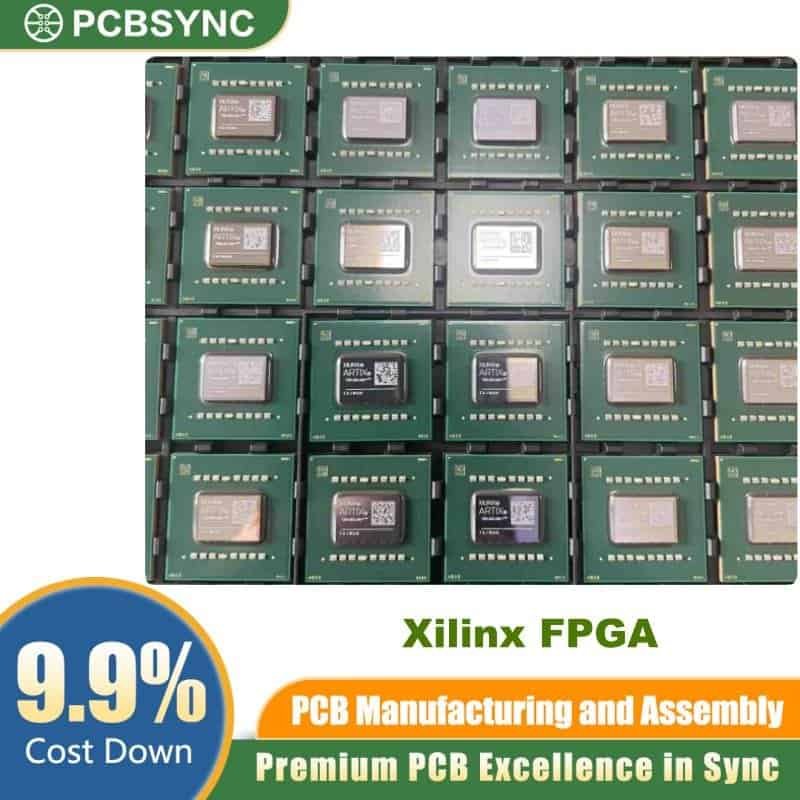
The XC3S50-5PQ208C is a field-programmable gate array (FPGA) from Xilinx’s Spartan-3 family, now under AMD ownership. Designed for high-volume, cost-sensitive applications, it combines 50,000 system gates with a 208-pin Plastic Quad Flat Pack (PQFP) package and a commercial temperature rating. The “-5” speed grade makes it one of the fastest options in this family, ideal for demanding digital logic designs.
Whether you are building embedded systems, digital signal processing circuits, or custom logic controllers, the XC3S50-5PQ208C offers a compelling balance of density, speed, and affordability. As part of the broader Xilinx FPGA ecosystem, it benefits from mature toolchain support and a vast community knowledge base.
XC3S50-5PQ208C Key Specifications at a Glance
| Parameter |
Value |
| Part Number |
XC3S50-5PQ208C |
| Manufacturer |
Xilinx (AMD) |
| FPGA Family |
Spartan-3 |
| Logic Cells |
1,728 |
| System Gates |
50,000 |
| CLB Slices |
768 |
| Distributed RAM |
12 Kb |
| Block RAM |
72 Kb |
| Multipliers (18×18) |
4 |
| DCM Blocks |
2 |
| Max User I/O |
124 |
| Package |
PQ208 (PQFP) |
| Package Pins |
208 |
| Speed Grade |
-5 (Fastest) |
| Operating Voltage (VCCINT) |
1.2 V |
| I/O Voltage |
1.2 V – 3.3 V |
| Temperature Range |
0°C to +85°C (Commercial) |
| RoHS Compliant |
Yes |
What Is the XC3S50-5PQ208C? Overview and Family Background
Spartan-3 FPGA Family
The Spartan-3 series was introduced by Xilinx to address the growing demand for low-cost, programmable logic in consumer electronics, industrial controls, and communications infrastructure. It was the first FPGA family built on a 90 nm process node, which allowed Xilinx to deliver significantly more logic at a lower price point compared to its predecessors.
The XC3S50-5PQ208C sits at the entry level of the Spartan-3 family in terms of gate count, but its -5 speed grade designation places it at the top of the performance tier within this device size. The “C” suffix confirms the commercial temperature range (0°C to +85°C), which covers the vast majority of non-military and non-automotive applications.
PQ208 Package Explained
The PQ208 (208-pin Plastic Quad Flat Pack) is a through-hole-compatible surface-mount package with leads on all four sides. It offers a practical board footprint for prototyping and production alike. With 124 user-configurable I/O pins available in this package, designers have substantial flexibility to interface with external memory, sensors, communication buses, and other peripherals.
XC3S50-5PQ208C Detailed Electrical Specifications
Power Supply Requirements
| Supply Rail |
Voltage |
Purpose |
| VCCINT |
1.2 V |
Core logic power |
| VCCO |
1.2 V – 3.3 V |
I/O bank power |
| VCCAUX |
2.5 V |
Auxiliary circuits (DLL, DCM) |
The VCCINT rail at 1.2 V reflects the 90 nm process and contributes to the device’s low static and dynamic power consumption, which is advantageous in battery-powered or thermally constrained designs.
I/O Standards Supported
| I/O Standard |
Description |
| LVTTL |
Low-voltage TTL, 3.3 V |
| LVCMOS 3.3 / 2.5 / 1.8 / 1.5 / 1.2 |
Multi-voltage CMOS |
| SSTL2 / SSTL3 |
Stub Series Terminated Logic |
| HSTL |
High-Speed Transceiver Logic |
| GTL / GTL+ |
Gunning Transceiver Logic |
| PCI (3.3 V) |
Peripheral Component Interconnect |
| LVDS |
Low Voltage Differential Signaling |
| BLVDS |
Bus LVDS |
The support for LVDS and differential I/O makes the XC3S50-5PQ208C well suited to noise-sensitive or high-speed serial interface applications.
Internal Architecture: Logic Resources Deep Dive
Configurable Logic Blocks (CLBs)
The XC3S50-5PQ208C contains 768 CLB slices, each consisting of two slices. Every slice includes:
- Two 4-input look-up tables (LUTs)
- Two storage elements (flip-flops or latches)
- Fast carry and arithmetic logic
- Wide function multiplexers
This architecture enables efficient implementation of counters, state machines, data paths, and arithmetic operations.
Block RAM (BRAM)
| Resource |
Amount |
| Block RAM Total |
72 Kb |
| Individual BRAM Size |
18 Kb (true dual-port) |
| Number of BRAM Blocks |
4 |
Each BRAM block supports true dual-port operation with independent read/write clocks, configurable data widths from 1 to 18 bits, and optional built-in error correction. These features make BRAM ideal for FIFOs, lookup tables, and small embedded memories.
Distributed RAM
In addition to block RAM, the CLB LUTs can be configured as 12 Kb of distributed RAM, useful for small, fast storage close to logic elements — minimizing routing delay.
Hardware Multipliers
The device includes four dedicated 18×18-bit hardware multipliers, each capable of computing a 36-bit product in a single clock cycle. These multipliers are essential for DSP operations such as digital filters, correlation, and signal processing pipelines.
Digital Clock Manager (DCM)
| Resource |
Count |
| DCM Blocks |
2 |
| Clock Outputs per DCM |
Up to 8 |
| Frequency Synthesis |
Yes |
| Phase Shifting |
Yes (fine/coarse) |
The two DCMs enable precise clock management including frequency synthesis, phase alignment, duty-cycle correction, and clock deskewing — all without external PLL ICs.
Speed Grade -5: Performance Characteristics
The “-5” speed grade is the fastest available for the XC3S50 device. Higher negative numbers indicate faster propagation times across Xilinx Spartan-3 devices.
| Parameter |
XC3S50-5 Typical Value |
| Maximum Logic Frequency |
~200 MHz (internal registers) |
| LUT Propagation Delay |
~0.7 ns |
| Clock-to-Output (Tco) |
~3.5 ns |
| Setup Time (Tsu) |
~0.9 ns |
| Input/Output Delay |
Varies by I/O standard |
Exact timing values are defined in the official Xilinx Spartan-3 data sheet and must be verified using Xilinx ISE or Vivado timing analysis tools.
Configuration Modes
The XC3S50-5PQ208C supports multiple configuration methods to suit different production and prototyping workflows:
| Mode |
Description |
Typical Use Case |
| Master Serial |
FPGA drives clock; reads bitstream from serial Flash |
Low pin count, simple designs |
| Slave Serial |
External device drives the configuration clock |
Multi-device chains |
| Master SPI |
Reads from SPI Flash memory |
Cost-effective production |
| Master BPI |
Parallel NOR Flash interface |
Faster configuration |
| JTAG |
IEEE 1149.1 boundary scan |
Debug, in-system programming |
| Slave Parallel |
External parallel data source |
Custom loaders |
The JTAG interface is available on all modes simultaneously, allowing in-circuit debugging without interrupting normal operation.
Development Tools and Software Support
Xilinx ISE Design Suite
The XC3S50-5PQ208C is fully supported by Xilinx ISE Design Suite (versions up to 14.7, the final release). ISE provides:
- VHDL and Verilog synthesis (via XST)
- Place-and-route (PAR)
- Static timing analysis
- iMPACT for device programming
ISE 14.7 is available free of charge from the AMD/Xilinx website and runs on Windows and Linux.
IP Cores and Reference Designs
Xilinx provides a rich library of pre-verified IP cores compatible with the Spartan-3 family, including UART, SPI, I2C, FIFO generators, memory controllers, and soft-core processors such as the MicroBlaze and PicoBlaze.
Typical Applications for XC3S50-5PQ208C
The XC3S50-5PQ208C is widely used across industries due to its combination of speed, I/O flexibility, and price efficiency:
| Application Area |
Example Use Cases |
| Industrial Automation |
Motor control, sensor interfacing, PLC logic |
| Communications |
Protocol bridging, UART/SPI/I2C controllers |
| Consumer Electronics |
Display controllers, LED matrix drivers |
| Test & Measurement |
Signal capture, logic analysis, pattern generation |
| Embedded Systems |
Custom processor peripherals, glue logic |
| Education |
FPGA learning kits, digital design courses |
| Medical Devices |
Low-power signal processing, timing circuits |
XC3S50-5PQ208C vs. Related Part Numbers
Understanding the part number structure helps when comparing alternatives within the Spartan-3 family:
| Part Number |
Gates |
Package |
Speed Grade |
Temp Range |
| XC3S50-4PQ208C |
50K |
PQ208 |
-4 |
Commercial |
| XC3S50-5PQ208C |
50K |
PQ208 |
-5 |
Commercial |
| XC3S50-5PQ208I |
50K |
PQ208 |
-5 |
Industrial |
| XC3S200-5PQ208C |
200K |
PQ208 |
-5 |
Commercial |
| XC3S400-5PQ208C |
400K |
PQ208 |
-5 |
Commercial |
If your design requires a wider temperature range (−40°C to +85°C), consider the XC3S50-5PQ208I industrial variant. For more logic resources in the same PQ208 footprint, the XC3S200 and XC3S400 are pin-compatible upgrade paths.
PCB Design Considerations
Decoupling Capacitors
Proper decoupling is critical for reliable FPGA operation. Recommended practice:
- Place 100 nF ceramic capacitors (X7R or C0G) at each VCCINT and VCCO pin
- Add a 10 µF bulk capacitor per power rail on the PCB
- Keep decoupling traces as short as possible with ground vias adjacent to each capacitor
PCB Layer Requirements
| Consideration |
Recommendation |
| Minimum PCB Layers |
4 (2 signal + power + ground) |
| Signal Integrity |
Route high-speed I/O with controlled impedance |
| Ground Plane |
Continuous ground plane beneath the device |
| JTAG Access |
Expose TCK, TMS, TDI, TDO, GND for debug header |
Thermal Management
The XC3S50-5PQ208C in commercial grade operates at an ambient range of 0°C to +85°C. The device has low power consumption, so passive cooling (no heatsink) is typically sufficient at moderate utilization. For high utilization or enclosed environments, verify junction temperature using the power estimator tool from AMD/Xilinx.
Ordering Information
| Field |
Detail |
| Full Part Number |
XC3S50-5PQ208C |
| Manufacturer |
AMD (formerly Xilinx) |
| Package |
208-PQFP |
| Temperature Grade |
Commercial (0°C to +85°C) |
| Lead Finish |
Matte Tin (RoHS compliant) |
| Status |
Mature / Production |
Note: The XC3S50-5PQ208C is a mature product. Confirm availability and lead times with your distributor before placing large production orders.
Frequently Asked Questions (FAQ)
Q: What is the difference between XC3S50-4PQ208C and XC3S50-5PQ208C?
The only difference is the speed grade. The “-5” version is faster, with lower propagation delays and higher maximum operating frequencies. If timing closure is critical, the -5 grade provides more margin.
Q: Can I use Vivado to program the XC3S50-5PQ208C?
No. Vivado does not support Spartan-3 devices. You must use Xilinx ISE 14.7, which is the final and free version available from the AMD/Xilinx download center.
Q: Is the XC3S50-5PQ208C suitable for PCI bus interfaces?
Yes, the device supports 3.3 V PCI I/O standards and can be used to implement PCI logic, though you should verify timing requirements against the PCI specification using ISE timing analysis.
Q: What configuration memory should I use with this FPGA?
Xilinx recommends its XCF series Platform Flash for SPI and BPI mode configuration. Third-party SPI Flash memories compatible with the Serial Peripheral Interface standard also work in Master SPI mode.
Q: Is the XC3S50-5PQ208C pin-compatible with larger Spartan-3 devices?
Yes. The Spartan-3 family is designed with migration paths. Devices in the PQ208 package (XC3S50, XC3S200, XC3S400) are functionally pin-compatible, allowing design upgrades with minimal PCB changes.
Summary
The XC3S50-5PQ208C remains a practical choice for designers needing a fast, low-cost, and well-supported FPGA in a standard PQFP footprint. With 50,000 system gates, 124 user I/Os, dual DCMs, dedicated hardware multipliers, and the fastest “-5” speed grade in its class, it covers a broad range of digital logic and embedded applications. Its maturity in the market means extensive documentation, community support, and proven design patterns are readily available — reducing development risk for new and experienced designers alike.