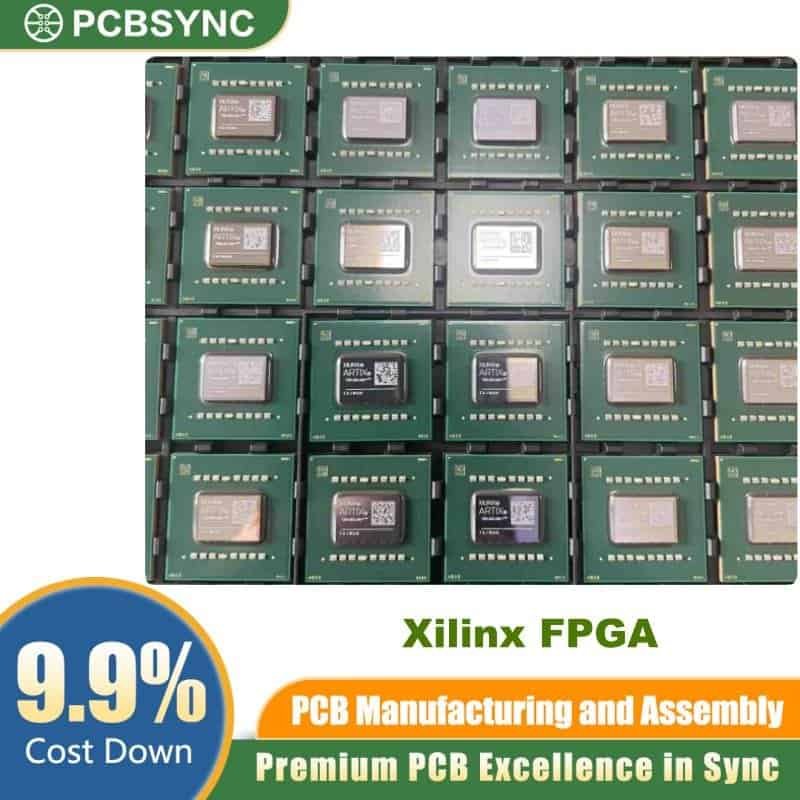
The XC3S50-5CPG132C is a high-performance, cost-optimized Field-Programmable Gate Array (FPGA) from Xilinx’s Spartan-3 family, now under AMD. This compact 132-pin chip-scale package device delivers 50,000 system gates and operates at speeds up to 630 MHz — making it an excellent choice for embedded systems, consumer electronics, and industrial control applications that demand reliable programmable logic in a small footprint.
As part of the Xilinx FPGA Spartan-3 series, the XC3S50-5CPG132C combines advanced 90nm process technology with a rich feature set at a competitive price point. Whether you are designing a new prototype or sourcing components for production, understanding this device’s full specifications and capabilities is essential to making an informed decision.
XC3S50-5CPG132C Key Specifications at a Glance
The table below summarizes the most critical technical parameters of the XC3S50-5CPG132C:
| Parameter |
Value |
| Manufacturer |
Xilinx (AMD) |
| Part Number |
XC3S50-5CPG132C |
| FPGA Family |
Spartan-3 |
| System Gates |
50,000 |
| Equivalent Logic Cells |
1,728 |
| Maximum User I/O |
124 |
| Block RAM |
72 Kbits (4 × 18K blocks) |
| DCMs (Digital Clock Managers) |
2 |
| Dedicated Multipliers |
4 × 18×18-bit |
| Core Supply Voltage |
1.2V |
| Speed Grade |
-5 (High Performance) |
| Maximum Frequency |
Up to 630 MHz |
| Process Technology |
90nm CMOS |
| Package Type |
CSBGA (Chip-Scale Ball Grid Array) |
| Pin Count |
132 |
| Package Code |
CPG132 (Pb-free) |
| Operating Temperature |
0°C to 85°C (Commercial) |
| Temperature Grade |
C (Commercial) |
| RoHS Compliance |
Yes (Pb-free, “G” designation) |
What Does the XC3S50-5CPG132C Part Number Mean?
Understanding the Xilinx part number decode helps you confirm you have exactly the right component:
| Code Segment |
Meaning |
| XC |
Xilinx FPGA |
| 3S |
Spartan-3 Family |
| 50 |
50,000 System Gates |
| -5 |
Speed Grade -5 (Highest Performance in Spartan-3) |
| CPG |
Chip-Scale Package, Pb-free (G = Lead-free) |
| 132 |
132 Pin Count |
| C |
Commercial Temperature Range (0°C to +85°C) |
XC3S50-5CPG132C Detailed Technical Description
Programmable Logic Architecture
The XC3S50-5CPG132C is built on Xilinx’s proven Spartan-3 architecture, which organizes its programmable resources into five key functional elements:
- Configurable Logic Blocks (CLBs): The device contains 1,728 equivalent logic cells arranged in a regular array. Each CLB contains look-up tables (LUTs), flip-flops, and carry logic, enabling efficient implementation of both combinational and sequential logic.
- Input/Output Blocks (IOBs): Up to 124 user-configurable I/O pins support a wide range of single-ended and differential I/O standards, providing flexible interfacing to external components and system busses.
- Block RAM: Four 18-Kbit dual-port synchronous SRAM blocks (totaling 72 Kbits) offer fast on-chip data storage with independent read and write ports, ideal for FIFOs, look-up tables, and data buffering.
- Dedicated Multipliers: Four hardwired 18×18-bit multipliers dramatically accelerate DSP operations, signal processing pipelines, and math-intensive functions without consuming CLB resources.
- Digital Clock Managers (DCMs): Two fully digital DCMs provide precise clock synthesis, deskewing, phase shifting, and frequency multiplication/division, essential for high-speed synchronous designs.
Speed Grade -5: High-Performance Variant
The -5 speed grade is the fastest variant in the Spartan-3 XC3S50 lineup, supporting system clock frequencies approaching 630 MHz for internal logic paths. This makes the XC3S50-5CPG132C the preferred choice in performance-critical applications where -4 speed grade variants may not meet timing closure requirements.
CPG132 Package: Compact Chip-Scale Form Factor
The CPG132 package is a 132-pin Chip-Scale Ball Grid Array (CSBGA) in a Pb-free (RoHS-compliant) configuration. The “G” in CPG132 specifically indicates lead-free solder balls, satisfying modern environmental compliance requirements including the EU RoHS directive. This ultra-compact package is well-suited for space-constrained PCB designs.
Important Note: Xilinx has officially announced that the CP132 and CPG132 packages are being discontinued. The XC3S50-5CPG132C is not recommended for new designs. Engineers designing new products should evaluate alternative packages such as the TQG144 or VQG100. For existing production or legacy repair, stock availability should be confirmed with authorized distributors.
Supported I/O Standards
The XC3S50-5CPG132C supports a broad range of programmable I/O standards, enabling compatibility with many external interfaces:
| I/O Standard Category |
Supported Standards |
| Single-Ended |
LVTTL, LVCMOS 3.3V / 2.5V / 1.8V / 1.5V |
| Differential |
LVDS, RSDS, BLVDS, MINI_LVDS |
| High-Speed Memory |
HSTL, SSTL2, SSTL18 |
| PCI |
PCI 3.3V (33/66 MHz) |
Note: DCI (Digitally Controlled Impedance) signal standards are not supported in Bank 5 for CPG132 or VQ100 packages. Design accordingly when targeting high-speed differential interfaces.
Configuration Options for XC3S50-5CPG132C
Spartan-3 FPGAs including the XC3S50-5CPG132C support multiple configuration modes:
| Configuration Mode |
Description |
| Master Serial |
Uses a Xilinx serial PROM (e.g., XCF01S) for single-chip configuration |
| Slave Serial |
Controlled by an external master device (microcontroller or FPGA) |
| Master SPI |
Uses standard SPI flash memory |
| Master SelectMAP (Parallel) |
High-speed 8-bit parallel configuration bus |
| JTAG |
IEEE 1149.1 boundary-scan for debug and in-system programming |
Configuration data is stored in static CMOS configuration latches (CCLs), which are reprogrammable — a fundamental advantage over one-time-programmable ASICs.
XC3S50-5CPG132C vs. Other XC3S50 Variants
The XC3S50 is available in multiple speed grades and packages. The table below compares the most common variants:
| Part Number |
Speed Grade |
Package |
Pins |
Temp Grade |
Lead-Free |
| XC3S50-4CPG132C |
-4 Standard |
CSBGA |
132 |
Commercial |
Yes |
| XC3S50-5CPG132C |
-5 High Perf. |
CSBGA |
132 |
Commercial |
Yes |
| XC3S50-4TQ144C |
-4 Standard |
TQFP |
144 |
Commercial |
No |
| XC3S50-4TQG144C |
-4 Standard |
TQFP |
144 |
Commercial |
Yes |
| XC3S50-4VQ100C |
-4 Standard |
VQFP |
100 |
Commercial |
No |
| XC3S50-4CPG132I |
-4 Standard |
CSBGA |
132 |
Industrial |
Yes |
The -5 speed grade in the XC3S50-5CPG132C represents the highest available performance bin within the XC3S50 device. If timing margins are critical, this is the correct variant to specify.
Typical Applications for XC3S50-5CPG132C
The XC3S50-5CPG132C is well-suited for a broad range of embedded and digital design applications:
| Application Area |
Use Case |
| Industrial Automation |
Motor control, sensor interface, PLC I/O expansion |
| Consumer Electronics |
Set-top boxes, digital cameras, home automation |
| Communications |
Protocol bridging, UART/SPI/I2C controllers, line interfaces |
| Embedded Systems |
Soft-core processor (MicroBlaze), custom peripheral controllers |
| Signal Processing |
FIR/IIR filters, FFT pipelines leveraging dedicated multipliers |
| Test & Measurement |
Logic analyzers, pattern generators, data acquisition front-ends |
| Prototyping & Development |
ASIC prototyping, algorithm verification, glue logic replacement |
Why Choose the XC3S50-5CPG132C Over a Custom ASIC?
The XC3S50-5CPG132C offers several compelling advantages versus mask-programmed ASICs:
- No NRE Cost: Eliminates the high Non-Recurring Engineering (NRE) cost associated with ASIC tape-out.
- Fast Time-to-Market: FPGA-based designs can be verified and deployed in days rather than months.
- In-Field Reconfigurability: Configuration can be updated in the field via JTAG or configuration memory replacement — impossible with a traditional ASIC.
- Risk Reduction: Design changes can be made without fabricating new silicon, reducing project risk significantly.
- Small Volume Viability: Ideal for low-to-medium production volumes where ASIC economics are unfavorable.
Design Tool Support
The XC3S50-5CPG132C is fully supported by Xilinx design tools:
| Tool |
Description |
| Xilinx ISE Design Suite |
Legacy design flow — supported for Spartan-3 series |
| XST (Xilinx Synthesis Technology) |
HDL synthesis for Verilog and VHDL |
| iMPACT / iCable |
JTAG-based configuration and programming |
| ChipScope Pro |
In-system logic analyzer and debug |
| EDK (Embedded Development Kit) |
MicroBlaze soft-core processor integration |
The Spartan-3 family is not supported in Xilinx Vivado. Use the ISE 14.7 toolchain for all XC3S50-5CPG132C designs.
Ordering Information
| Field |
Details |
| Full Part Number |
XC3S50-5CPG132C |
| Manufacturer |
Xilinx / AMD |
| DigiKey Part Number |
122-1449-ND |
| Package |
132-CSBGA (CPG132) |
| Lifecycle Status |
Not Recommended for New Designs (NRND) |
| RoHS Status |
RoHS Compliant (Pb-free) |
| Moisture Sensitivity Level |
MSL 3 |
Frequently Asked Questions (FAQ)
Q: Is the XC3S50-5CPG132C still in production? The XC3S50 in the CPG132 package is classified as Not Recommended for New Designs (NRND). Stock may be available through distributors and authorized resellers for legacy repair and maintenance purposes.
Q: What is the difference between XC3S50-5CPG132C and XC3S50-4CPG132C? The only difference is the speed grade. The -5 variant is the higher-performance bin, capable of achieving faster internal clock speeds and tighter timing margins than the -4 variant.
Q: What configuration memory is compatible with XC3S50-5CPG132C? Xilinx Platform Flash PROMs such as the XCF01S (1 Mbit) are compatible and commonly used with this device in master serial configuration mode.
Q: Can I use Vivado to program the XC3S50-5CPG132C? No. The Spartan-3 family is only supported under the legacy Xilinx ISE 14.7 design suite. Vivado does not support Spartan-3 devices.
Q: What is the core voltage for XC3S50-5CPG132C? The device requires a 1.2V core supply (VCCINT). I/O bank voltages (VCCO) are configurable from 1.2V to 3.3V depending on the I/O standard in use.
Summary
The XC3S50-5CPG132C is a proven, high-performance entry in Xilinx’s Spartan-3 FPGA family — delivering 50K system gates, 1,728 logic cells, 72 Kbits of block RAM, four dedicated multipliers, and two DCMs in a compact 132-pin chip-scale package. With the fastest available speed grade (-5) in the XC3S50 family and full RoHS compliance, it remains a reliable choice for legacy production and board repair.
For engineers evaluating programmable logic solutions and sourcing components, thorough review of the official Xilinx Spartan-3 datasheet (DS099) and lifecycle notices is recommended before committing to this part in new designs.