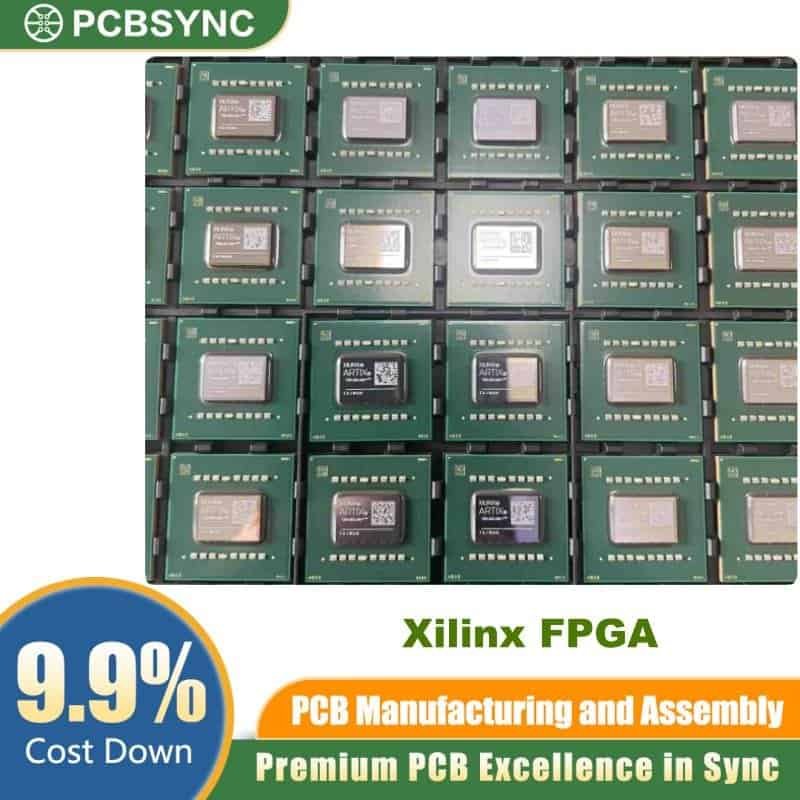
The XC3S50-4VQG100I is a powerful, cost-optimized field-programmable gate array (FPGA) from AMD Xilinx’s industry-renowned Spartan-3 family. Designed for high-volume, price-sensitive applications, this device combines proven programmable logic density with robust I/O capabilities in a compact 100-pin VQFP package. Whether you are developing embedded systems, industrial control, consumer electronics, or communications hardware, the XC3S50-4VQG100I delivers reliable performance at an attractive price point.
If you are sourcing Xilinx FPGA components for your next design, the XC3S50-4VQG100I is a proven choice for low-to-mid complexity programmable logic requirements.
What Is the XC3S50-4VQG100I?
The XC3S50-4VQG100I belongs to AMD Xilinx’s Spartan-3 series, one of the most widely adopted FPGA families in the embedded and industrial markets. The part number breaks down as follows:
| Code Segment |
Meaning |
| XC3S |
Spartan-3 Family |
| 50 |
50,000 system gates |
| 4 |
Speed Grade –4 (slowest/most cost-optimized) |
| VQG |
VQFP plastic package |
| 100 |
100 total pins |
| I |
Industrial temperature range (–40°C to +85°C) |
This device is manufactured on a 90 nm process technology, enabling a favorable balance of logic density, power consumption, and cost efficiency.
Key Features of the XC3S50-4VQG100I
- 50,000 System Gates — sufficient for moderate-complexity state machines, bus interfaces, and glue logic designs
- 1,728 Logic Cells organized into configurable logic blocks (CLBs)
- 72 Kbits of Distributed RAM for flexible in-fabric data storage
- 72 Kbits of Block RAM (2 × 18 Kbit RAMB16 blocks) for buffered data handling
- 2 Digital Clock Managers (DCMs) for clock multiplication, division, deskewing, and phase shifting
- 4 Multipliers (18×18-bit) for signal processing and arithmetic acceleration
- 63 User I/O Pins across 4 I/O banks
- Industrial temperature range: –40°C to +85°C
- VQ100 VQFP package — compact 14 × 14 mm footprint, suitable for space-constrained PCB designs
- Low static power consumption, ideal for battery-powered and always-on applications
XC3S50-4VQG100I Full Technical Specifications
General Specifications
| Parameter |
Value |
| Manufacturer |
AMD (Xilinx) |
| Part Number |
XC3S50-4VQG100I |
| Family |
Spartan-3 |
| Series |
Spartan-3 |
| Package |
100-VQFP (14×14 mm body) |
| Mounting Type |
Surface Mount |
| Operating Temperature |
–40°C to +85°C (Industrial) |
| Core Supply Voltage (VCCINT) |
1.2 V |
| I/O Supply Voltage (VCCO) |
1.2 V – 3.3 V |
Logic Resources
| Resource |
Quantity |
| System Gates |
50,000 |
| Logic Cells |
1,728 |
| CLBs (Configurable Logic Blocks) |
192 |
| Slices per CLB |
4 |
| Total Slices |
768 |
| Flip-Flops |
1,536 |
| 4-input LUTs |
1,536 |
| Distributed RAM |
72 Kbits |
Memory Resources
| Resource |
Quantity |
| Block RAM (RAMB16) |
2 blocks |
| Total Block RAM |
72 Kbits (36 Kbytes) |
| Distributed RAM |
18 Kbytes (in LUTs) |
Clock and Timing Resources
| Resource |
Quantity |
| Digital Clock Managers (DCMs) |
2 |
| Global Clock Networks |
8 |
| Maximum Frequency (Fmax) |
~200 MHz (speed grade –4, typical design) |
I/O Resources
| Resource |
Quantity |
| Total Package Pins |
100 |
| User I/O Pins |
63 |
| I/O Banks |
4 |
| Differential I/O Pairs |
Up to 24 |
| Supported I/O Standards |
LVTTL, LVCMOS 3.3/2.5/1.8/1.5/1.2, SSTL, HSTL, LVDS, LVPECL, and more |
DSP / Arithmetic Resources
| Resource |
Quantity |
| 18×18 Multiplier Blocks |
4 |
| Dedicated Carry Logic |
Yes (in slices) |
Package Drawing and Pin Assignment
The XC3S50-4VQG100I uses a 100-pin VQFP (Very Thin Quad Flat Package). Its 14 × 14 mm body with 0.5 mm pin pitch makes it well suited to high-density PCB layouts.
VQG100 Package Summary
| Package Attribute |
Value |
| Package Type |
VQFP |
| Total Pins |
100 |
| Body Size |
14 mm × 14 mm |
| Pin Pitch |
0.5 mm |
| Mounting |
Surface Mount (SMD) |
| Lead Finish |
Matte Tin (RoHS Compliant) |
Power Requirements
The XC3S50-4VQG100I requires two primary supply voltages:
| Supply Rail |
Voltage |
Purpose |
| VCCINT |
1.2 V |
Core logic power |
| VCCO |
1.2 V – 3.3 V |
I/O bank supply (per bank) |
| VCCAUX |
2.5 V |
Auxiliary circuits (DCM, config) |
Proper power sequencing and decoupling capacitor placement (100 nF ceramic per supply pin, plus bulk capacitance) are recommended for stable operation. Refer to Xilinx UG331 (Spartan-3 User Guide) for detailed power guidelines.
Supported I/O Standards
One of the strengths of the Spartan-3 family is its broad I/O standard support, enabling easy interfacing with a wide range of external devices and buses.
| I/O Standard |
Drive Strength Support |
Notes |
| LVTTL |
2–24 mA |
General-purpose TTL levels |
| LVCMOS 3.3 V |
2–24 mA |
Compatible with 3.3 V logic |
| LVCMOS 2.5 V |
2–16 mA |
— |
| LVCMOS 1.8 V |
2–16 mA |
— |
| LVCMOS 1.5 V |
2–8 mA |
— |
| LVCMOS 1.2 V |
2–6 mA |
— |
| SSTL 2 & 3 |
— |
DDR memory interfaces |
| HSTL |
— |
High-speed transceiver logic |
| LVDS |
— |
Differential signaling |
| LVPECL |
— |
Differential clock input |
Digital Clock Manager (DCM) Capabilities
The two on-chip DCMs provide flexible clock management without requiring external PLLs or clock buffers:
- Clock frequency multiplication and division (rational ratios)
- Phase shifting (0°, 90°, 180°, 270°, or fine-grained)
- Clock deskewing — eliminates clock distribution delays
- Duty cycle correction
- Inputs up to ~200 MHz with the –4 speed grade
DCMs are instrumental in designs that must interface with external clocks of differing frequencies or require precise phase alignment.
Configuration Options
The XC3S50-4VQG100I supports multiple configuration modes for flexible system integration:
| Configuration Mode |
Description |
| Master Serial |
Reads bitstream from serial SPI flash |
| Slave Serial |
Receives bitstream from external controller |
| Master Parallel (SelectMAP) |
High-speed byte-wide configuration |
| Slave Parallel (SelectMAP) |
Byte-wide input from processor |
| JTAG |
IEEE 1149.1 boundary scan and configuration |
| Master SPI (using XCFxxS PROM) |
Standard SPI flash compatible |
For most embedded applications, Master Serial or SPI mode using an Xilinx Platform Flash (XCF series) or third-party SPI NOR flash is the most common choice.
Ordering Information
| Parameter |
Detail |
| Full Part Number |
XC3S50-4VQG100I |
| Manufacturer |
AMD (formerly Xilinx) |
| Manufacturer Part Number |
XC3S50-4VQG100I |
| Digikey Part Number |
122-1448-ND |
| Package |
100-VQFP |
| Temperature Grade |
Industrial (–40°C to +85°C) |
| RoHS Compliant |
Yes |
| Lead-Free |
Yes |
| ECCN |
3A991.a.2 |
| HTS Code |
8542.39.00.01 |
Typical Applications for the XC3S50-4VQG100I
The XC3S50-4VQG100I is widely used in applications that require cost-effective programmable logic with moderate I/O requirements:
Embedded & Industrial Systems
- Glue logic replacement — consolidating multiple discrete logic ICs into a single FPGA
- Custom bus bridges — bridging SPI, I²C, UART, and parallel interfaces
- Industrial control panels — state machine controllers for automation hardware
- Motor control interfaces — PWM generation and encoder decoding
Communications & Networking
- Protocol converters — translating between RS-232, RS-485, SPI, and I²C
- Line card controllers for telecom equipment
- Ethernet PHY interface logic
Consumer Electronics
- Display controllers — driving segment or matrix displays
- Audio processing — simple DSP pipelines using built-in multipliers
- Remote control decoding and generation
Development & Prototyping
- FPGA learning boards — ideal for students and engineers learning Xilinx ISE/Vivado design flows
- Rapid hardware prototyping before migrating to larger devices
Development Tools & Design Flow
AMD Xilinx provides full design support for the Spartan-3 family through its legacy toolchain:
| Tool |
Description |
| ISE Design Suite |
Primary HDL synthesis, implementation, and bitstream generation for Spartan-3 |
| iMPACT |
Device configuration and JTAG programming utility |
| ChipScope Pro |
On-chip logic analyzer for debug without adding external test equipment |
| CORE Generator |
IP core generation for common functions (FIFOs, memories, arithmetic) |
| ModelSim / Xilinx Simulator |
HDL simulation (VHDL and Verilog) |
Note: Xilinx Vivado does not support Spartan-3 devices. Use ISE Design Suite 14.7 (the final ISE release) for XC3S50-4VQG100I development.
Comparison: XC3S50 vs Related Spartan-3 Devices
| Device |
System Gates |
Logic Cells |
Block RAM |
Multipliers |
I/O Pins (VQG100) |
| XC3S50 |
50,000 |
1,728 |
72 Kbits |
4 |
63 |
| XC3S200 |
200,000 |
4,320 |
216 Kbits |
12 |
N/A (not in VQG100) |
| XC3S400 |
400,000 |
8,064 |
288 Kbits |
16 |
N/A |
| XC3S1000 |
1,000,000 |
17,280 |
432 Kbits |
24 |
N/A |
The XC3S50 occupies the entry-level position in the Spartan-3 range, making it the lowest-cost option when your design fits within its resource budget.
XC3S50-4VQG100I vs XC3S50-4VQG100C: Industrial vs Commercial Grade
| Attribute |
XC3S50-4VQG100I |
XC3S50-4VQG100C |
| Temperature Grade |
Industrial |
Commercial |
| Operating Range |
–40°C to +85°C |
0°C to +85°C |
| Typical Use Case |
Industrial, outdoor, embedded |
Lab, consumer, office equipment |
| Price |
Slightly higher |
Lower |
For designs that may experience ambient temperature extremes — such as outdoor enclosures, factory floors, or automotive-adjacent applications — the I (Industrial) grade is strongly recommended.
PCB Design Considerations
When designing a PCB around the XC3S50-4VQG100I, keep these best practices in mind:
Power Decoupling Place 100 nF ceramic capacitors (X5R or X7R, 0402) at every VCCINT, VCCO, and VCCAUX pin. Add 10 µF bulk capacitors near each power domain.
Ground Plane Use a solid, unbroken ground plane beneath the FPGA to minimize noise and impedance.
Configuration Interface Route SPI/JTAG configuration signals as short as possible. Use 33 Ω series termination resistors on CCLK and high-speed config lines.
Differential I/O Pairs Route LVDS or other differential pairs with matched lengths and 100 Ω differential impedance (50 Ω per trace to ground).
Thermal Management The XC3S50 dissipates relatively low power (typically under 100 mW in most designs). Standard PCB copper pours and natural convection cooling are generally sufficient.
Frequently Asked Questions (FAQ)
Q: Is the XC3S50-4VQG100I obsolete? A: The Spartan-3 family has been in production for many years and remains available through authorized distributors. However, for new designs starting from scratch, AMD Xilinx recommends migrating to the newer Spartan-7 or Artix-7 families for long-term availability.
Q: What programming software do I need for XC3S50-4VQG100I? A: Use Xilinx ISE Design Suite 14.7. It is available as a free download from the AMD Xilinx website (WebPACK edition supports Spartan-3 devices at no charge).
Q: Can I use Vivado for the XC3S50-4VQG100I? A: No. Vivado does not support the Spartan-3 family. You must use ISE 14.7.
Q: What JTAG programmer is compatible? A: The Xilinx Platform Cable USB II (DLC10) is the official programmer. Many third-party JTAG adapters compatible with the Xilinx SVF format also work.
Q: What is the difference between speed grades –4, –5, and –6? A: The –4 is the slowest speed grade (highest propagation delay, lowest cost). The –5 and –6 offer progressively higher maximum clock frequencies. For many low-to-medium frequency designs, the –4 grade is completely adequate.
Q: Is this device RoHS compliant? A: Yes. The XC3S50-4VQG100I is supplied in a RoHS-compliant, lead-free package with matte tin lead finish.
Summary
The XC3S50-4VQG100I is a compact, industrial-grade FPGA that delivers a capable combination of logic resources, block RAM, multipliers, and DCMs in a small, surface-mount 100-pin VQFP package. Its industrial temperature rating makes it suitable for demanding environments, while its broad I/O standard support ensures compatibility with virtually any system bus or interface. Backed by Xilinx’s mature ISE toolchain and an extensive ecosystem of IP cores and reference designs, this device remains a solid choice for cost-conscious embedded and industrial designs.