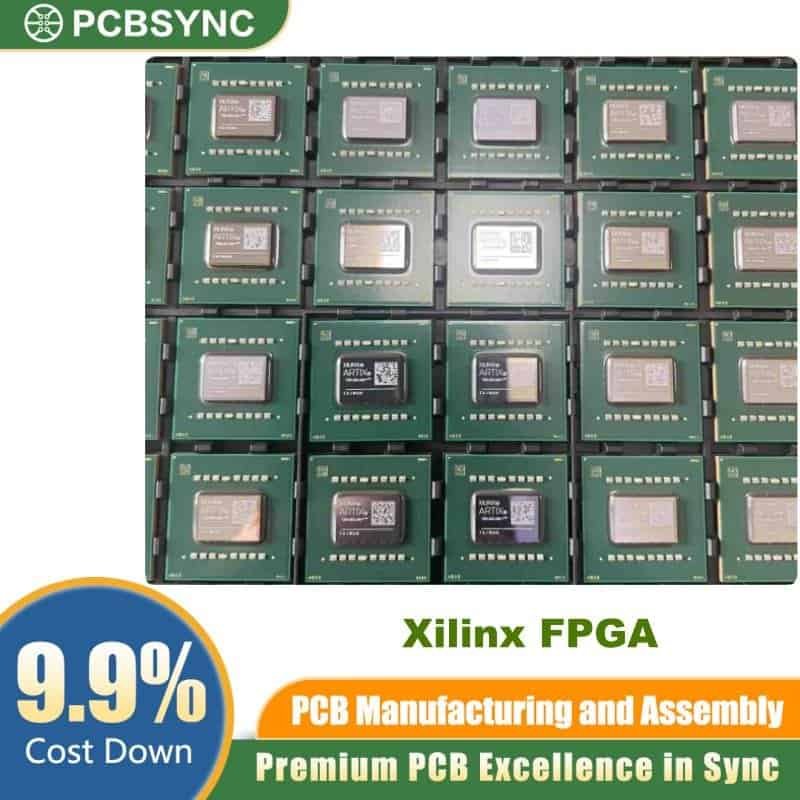
The XC3S50-4VQG100C is a low-cost, high-performance field-programmable gate array (FPGA) from the Xilinx Spartan-3 family, now part of AMD’s portfolio. Designed for cost-sensitive, high-volume applications, this device delivers 50,000 system gates in a compact 100-pin VQFP package, making it an ideal choice for embedded control, digital signal processing, and I/O expansion tasks. Whether you’re a design engineer sourcing components or a procurement specialist comparing FPGA options, this guide covers everything you need to know about the XC3S50-4VQG100C.
What Is the XC3S50-4VQG100C?
The XC3S50-4VQG100C belongs to Xilinx’s Spartan-3 FPGA series — a family engineered to offer programmable logic at the lowest possible system cost. The part number breaks down as follows:
- XC3S50 — Spartan-3 series, 50K system gate density
- -4 — Speed grade (faster timing performance)
- VQG100 — 100-pin Plastic Very-Thin Quad Flat Pack (VQFP) package
- C — Commercial temperature range (0°C to +85°C)
As a Xilinx FPGA, the XC3S50 leverages proven 90nm process technology to combine abundant logic resources, dedicated multipliers, and block RAM into a single, reprogrammable device.
XC3S50-4VQG100C Key Specifications
General Device Parameters
| Parameter |
Value |
| Manufacturer |
AMD (Xilinx) |
| Series |
Spartan-3 |
| Part Number |
XC3S50-4VQG100C |
| System Gates |
50,000 |
| Logic Cells |
1,728 |
| CLB (Configurable Logic Blocks) |
192 |
| CLB Slices |
768 |
| Distributed RAM |
12 Kb |
| Block RAM |
72 Kb |
| Dedicated Multipliers (18×18) |
4 |
| DCM (Digital Clock Manager) |
2 |
Package & Mechanical Specifications
| Parameter |
Value |
| Package Type |
VQFP (Very-Thin Quad Flat Pack) |
| Package Code |
VQG100 |
| Pin Count |
100 |
| Maximum User I/O Pins |
63 |
| I/O Standards Supported |
LVTTL, LVCMOS 1.2V–3.3V, SSTL, HSTL, PCI, GTL+ |
| Mounting Type |
Surface Mount |
| Operating Temperature |
0°C to +85°C (Commercial) |
Electrical Characteristics
| Parameter |
Value |
| Core Voltage (VCCINT) |
1.2 V |
| I/O Voltage (VCCAUX) |
3.3 V |
| Speed Grade |
-4 |
| Maximum System Clock (fMAX) |
Up to ~200+ MHz (design-dependent) |
| Configuration Interfaces |
JTAG, Master/Slave Serial, SelectMAP |
XC3S50-4VQG100C Logic Resources Breakdown
Understanding the internal architecture helps you evaluate whether this FPGA is right for your design.
Configurable Logic Blocks (CLBs)
The Spartan-3 CLB contains four slices, and each slice contains two 4-input LUTs (Look-Up Tables), two flip-flops, carry logic, and multiplexers. This structure gives the XC3S50 the following distributed logic resources:
| Resource |
Count |
| CLBs |
192 |
| Slices |
768 |
| 4-Input LUTs |
1,536 |
| Flip-Flops |
1,536 |
| Max Distributed RAM |
12 Kb |
Block RAM (BRAM)
The device includes two 18 Kb block RAM primitives that can be used as single-port or true dual-port memory, FIFOs, or shift registers — giving designers 36 Kb total of on-chip storage.
| BRAM Parameter |
Value |
| Number of BRAMs |
2 |
| BRAM Size (each) |
18 Kb |
| Total Block RAM |
36 Kb (72 Kb with parity bits) |
| FIFO Support |
Yes |
Digital Clock Managers (DCMs)
The two on-chip DCMs provide clock synthesis, phase shifting, frequency multiplication, and deskew capabilities — simplifying multi-clock domain designs without external PLLs.
XC3S50-4VQG100C I/O Capabilities
With 63 user I/O pins available on the 100-pin package, the XC3S50-4VQG100C supports a broad range of single-ended and differential I/O standards.
Supported I/O Standards
| Standard |
Voltage |
| LVTTL |
3.3 V |
| LVCMOS |
1.2 V, 1.5 V, 1.8 V, 2.5 V, 3.3 V |
| SSTL2 / SSTL3 |
2.5 V / 3.3 V |
| HSTL |
1.5 V |
| PCI |
3.3 V |
| GTL / GTL+ |
— |
Each I/O block includes individually programmable drive strength, slew rate control, pull-up/pull-down resistors, and optional keeper circuits.
Configuration Options for XC3S50-4VQG100C
The XC3S50-4VQG100C is a volatile FPGA that requires configuration on every power-up. It supports several industry-standard configuration modes:
| Mode |
Description |
| Master Serial |
Loads bitstream from external SPI Flash |
| Slave Serial |
Driven by an external controller |
| Master SelectMAP |
Byte-wide parallel configuration |
| Slave SelectMAP |
Parallel config driven externally |
| JTAG (Boundary Scan) |
For debugging and direct programming |
A companion PROM (such as the XCF01S or XCF02S) is commonly used to store the configuration bitstream for automatic loading on power-up.
Ordering Information & Product Variants
The XC3S50 is available in multiple speed grades, package types, and temperature ranges. The table below shows common ordering variants to help you select the right part.
| Part Number |
Speed Grade |
Package |
Pins |
Temp Range |
User I/O |
| XC3S50-4VQG100C |
-4 |
VQFP |
100 |
Commercial (0–85°C) |
63 |
| XC3S50-5VQG100C |
-5 |
VQFP |
100 |
Commercial (0–85°C) |
63 |
| XC3S50-4PQG208C |
-4 |
PQFP |
208 |
Commercial (0–85°C) |
124 |
| XC3S50-4TQG144C |
-4 |
TQFP |
144 |
Commercial (0–85°C) |
97 |
| XC3S50-4VQG100I |
-4 |
VQFP |
100 |
Industrial (−40–100°C) |
63 |
Note: The -4 speed grade in the XC3S50-4VQG100C denotes a mid-range timing performance tier within the Spartan-3 family. The higher the speed grade number, the faster the device.
Typical Applications of the XC3S50-4VQG100C
The Spartan-3 XC3S50’s combination of low cost, sufficient logic density, and rich I/O makes it well-suited for:
#### Embedded Control Systems
Replace fixed-function ASICs or MCUs with a reconfigurable logic block that can implement custom state machines, PWM controllers, and peripheral interfaces.
#### Industrial I/O Expansion
Act as a glue logic device to bridge multiple bus protocols (SPI, I²C, UART, parallel buses) in industrial automation and instrumentation designs.
#### Digital Signal Processing (DSP)
Leverage the four 18×18 dedicated multipliers and block RAM to implement FIR filters, FFT stages, or correlators in radar, sonar, or audio processing systems.
#### Prototyping & Academic Projects
The affordable price point and compact VQFP package make the XC3S50-4VQG100C a popular choice for university lab boards and rapid design prototyping.
#### Communication Interface Bridging
Implement custom protocol converters and bus translators between incompatible interfaces in telecom line cards, network appliances, and test equipment.
Design Tools & Development Support
Xilinx (AMD) provides comprehensive EDA tool support for the XC3S50-4VQG100C:
| Tool |
Description |
| ISE Design Suite |
Legacy Xilinx toolchain for Spartan-3 synthesis, P&R, and timing analysis |
| ChipScope Pro |
On-chip logic analyzer for real-time debugging |
| CORE Generator |
IP core generator for standard functions (FIFOs, memory controllers, etc.) |
| XST |
Xilinx Synthesis Technology for HDL synthesis |
| iMPACT |
Bitstream programming and JTAG configuration tool |
HDL support includes both VHDL and Verilog, and third-party synthesis tools such as Synopsys Synplify and Mentor Precision are also compatible.
XC3S50-4VQG100C vs. Other Spartan-3 Devices
Choosing the right Spartan-3 variant depends on your logic and I/O requirements. Here’s how the XC3S50 compares to neighboring members of the family:
| Device |
System Gates |
Logic Cells |
Block RAM |
Multipliers |
Max User I/O |
| XC3S50 |
50,000 |
1,728 |
72 Kb |
4 |
124 (208-pin) |
| XC3S200 |
200,000 |
4,320 |
216 Kb |
12 |
173 (208-pin) |
| XC3S400 |
400,000 |
8,064 |
288 Kb |
16 |
264 (320-pin) |
| XC3S1000 |
1,000,000 |
17,280 |
432 Kb |
24 |
391 (456-pin) |
For the most resource-constrained designs where board area and cost are the primary drivers, the XC3S50-4VQG100C in the 100-pin VQFP package remains one of the most compact and economical FPGA solutions available.
Compliance & Regulatory Information
| Attribute |
Status |
| RoHS Compliance |
RoHS Compliant |
| Moisture Sensitivity Level (MSL) |
3 (Per IPC/JEDEC J-STD-020) |
| REACH Compliance |
Yes |
| Export Control (ECCN) |
3A001.a.7.b |
Frequently Asked Questions (FAQ)
Q: Is the XC3S50-4VQG100C still in production?
The Spartan-3 family has reached end-of-life status with Xilinx/AMD. However, authorized distributors and component suppliers continue to stock the XC3S50-4VQG100C from existing inventory. Always verify availability and date codes with your distributor.
Q: What is the difference between the -4 and -5 speed grades?
The -5 speed grade offers faster propagation delays and higher maximum clock frequencies compared to -4. Choose -5 if your design has tight timing margins; -4 is sufficient for most standard designs.
Q: Can I use Vivado to design for the XC3S50-4VQG100C?
No. Vivado only supports 7-Series and newer Xilinx devices. The Spartan-3 family requires the ISE Design Suite (version 14.7 recommended).
Q: What PROM should I use to configure the XC3S50-4VQG100C?
The XCF01S (1Mb) or XCF02S (2Mb) Platform Flash PROMs from Xilinx are the standard companion configuration devices for the XC3S50, providing non-volatile bitstream storage.
Q: Is the XC3S50-4VQG100C suitable for automotive applications?
The “C” suffix denotes a Commercial temperature range (0°C to +85°C). For automotive or extended environments, consider the “I” industrial grade variant (XC3S50-4VQG100I, rated to −40°C to +100°C), or evaluate the Spartan-3A or newer Spartan-7 families.
Summary
The XC3S50-4VQG100C is a proven, cost-effective FPGA solution that delivers 50K system gates, 63 user I/O pins, 36 Kb block RAM, four 18×18 hardware multipliers, and two digital clock managers in a compact 100-pin VQFP surface-mount package. Backed by robust Xilinx tooling and a wide range of supported I/O standards, it remains a reliable choice for embedded control, protocol bridging, and DSP applications where form factor and economics are critical design constraints.