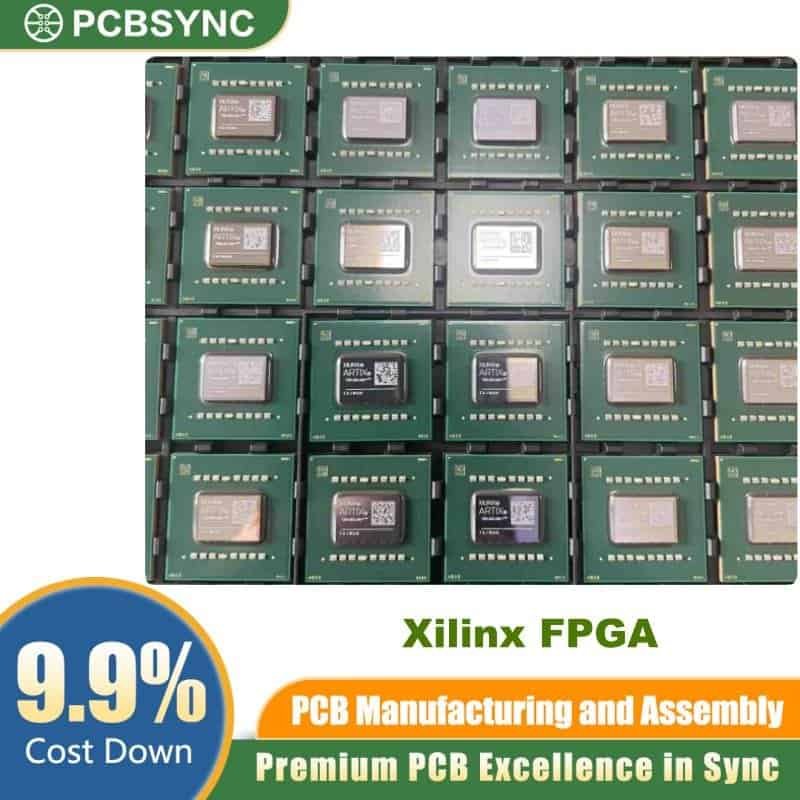
The XC3S50-4TQ144C is a field-programmable gate array from the Xilinx (now AMD) Spartan-3 family, designed to deliver cost-effective, high-performance programmable logic for a wide range of commercial and industrial applications. Whether you are building embedded controllers, communication interfaces, or signal-processing pipelines, the XC3S50-4TQ144C offers a compact and flexible solution housed in a surface-mount 144-pin TQFP package.
As part of the broader Xilinx FPGA ecosystem, the XC3S50-4TQ144C balances logic density, memory resources, and I/O flexibility — making it an ideal entry point for designs that have outgrown simple microcontrollers but do not require the overhead of higher-density devices.
What Is the XC3S50-4TQ144C?
The XC3S50-4TQ144C is a 50,000-gate Spartan-3 FPGA manufactured using 90nm CMOS process technology. The device integrates 1,728 logic cells arranged in configurable logic blocks (CLBs), dual Digital Clock Managers (DCMs), block RAM, and distributed memory — all accessible through up to 97 user I/O pins. Operating at a core voltage of 1.2V and supporting junction temperatures from 0°C to 85°C, it is rated for standard commercial-grade environments.
The part number breaks down as follows:
| Segment |
Meaning |
| XC3S |
Spartan-3 FPGA family |
| 50 |
~50,000 system gate equivalent |
| -4 |
Speed grade (fastest commercial grade in this family) |
| TQ144 |
144-pin Thin Quad Flat Pack (TQFP) package |
| C |
Commercial temperature range (0°C to +85°C junction) |
XC3S50-4TQ144C Key Specifications
Core Logic Resources
| Parameter |
Value |
| System Gates |
50,000 |
| Logic Cells |
1,728 |
| Configurable Logic Blocks (CLBs) |
192 |
| Slices per CLB |
4 |
| Total Slices |
768 |
| Flip-Flops |
1,536 |
| 4-Input LUTs |
1,536 |
Memory Resources
| Parameter |
Value |
| Block RAM |
72 Kbits (one column) |
| Distributed RAM |
~12 Kbits |
| Total On-Chip Memory |
~73,728 bits |
Block RAM uses a dual-port structure with independent A and B data ports, supporting simultaneous read/write operations across both ports. This enables efficient FIFO, ping-pong buffer, and lookup-table implementations.
Clock Management
| Parameter |
Value |
| Digital Clock Managers (DCMs) |
2 |
| Max Clock Frequency |
630 MHz |
The two on-chip DCMs support clock multiplication, division, phase shifting, and deskewing — essential for synchronous system designs. DCMs are located at the ends of the block RAM column.
I/O and Package
| Parameter |
Value |
| Package |
144-Pin TQFP (TQ144) |
| Maximum User I/O Pins |
97 |
| I/O Banks |
8 (independent) |
| Package Body Size |
20mm × 20mm |
| Package Type |
Surface Mount |
Power and Electrical
| Parameter |
Value |
| Core Supply Voltage (VCCINT) |
1.2V (1.14V – 1.26V range) |
| Auxiliary Supply (VCCAUX) |
3.3V or 2.5V (dual-range) |
| Process Technology |
90nm CMOS |
| Temperature Range (Junction) |
0°C to +85°C (Commercial) |
| RoHS Compliance |
Non-compliant (standard Pb package) |
Configuration
| Parameter |
Value |
| Configuration Interfaces |
Master Serial, Slave Serial, Slave Parallel, JTAG |
| JTAG Boundary Scan |
IEEE 1149.1 compliant |
| Configuration Memory |
External SPI or parallel flash supported |
XC3S50-4TQ144C I/O Bank Architecture
The device divides its I/O pins into 8 independent banks, with two banks per side of the package. Each bank has its own:
- Reference voltage (VREF) lines for differential or SSTL/HSTL signaling
- Output driver supply (VCCO) for independent voltage-level support per bank
This arrangement allows the XC3S50-4TQ144C to interface simultaneously with 3.3V, 2.5V, 1.8V, and 1.5V logic families on different banks — greatly simplifying mixed-voltage board designs.
Supported I/O Standards
| Standard |
Type |
| LVTTL / LVCMOS 3.3V / 2.5V / 1.8V / 1.5V |
Single-ended |
| PCI (3.3V) |
Single-ended |
| SSTL2 Class I & II |
Single-ended / Differential |
| SSTL18 Class I |
Single-ended |
| HSTL Class I, III |
Single-ended |
| LVDS, LVPECL |
Differential |
| GTL, GTL+ |
Open-drain |
Note: DCI (Digitally Controlled Impedance) is not supported in Bank 5 for the TQ144 package.
Spartan-3 Family Context: Where Does XC3S50 Fit?
The Spartan-3 family spans eight density options, from 50K to 5M system gates. The XC3S50 sits at the entry level of the family, making it ideal for simpler control tasks, glue logic, and protocol bridging.
| Device |
System Gates |
Logic Cells |
Block RAM (Kbits) |
Max User I/O |
| XC3S50 |
50,000 |
1,728 |
72 |
124 |
| XC3S200 |
200,000 |
4,320 |
216 |
173 |
| XC3S400 |
400,000 |
8,064 |
288 |
264 |
| XC3S1000 |
1,000,000 |
17,280 |
432 |
391 |
| XC3S1500 |
1,500,000 |
29,952 |
648 |
487 |
| XC3S2000 |
2,000,000 |
46,080 |
864 |
565 |
The XC3S50-4TQ144C in particular is limited to 97 user I/O in the TQ144 package (compared to 124 in larger packages), reflecting the pin constraints of the compact form factor.
Architecture Deep Dive
Configurable Logic Blocks (CLBs)
Each CLB contains four slices, and each slice contains:
- Two 4-input look-up tables (LUTs) — configurable as logic or 16-bit distributed RAM
- Two storage elements (flip-flops or latches)
- Carry and arithmetic logic
- Wide-function multiplexers
The CLB array spans the central area of the device, interconnected by a rich fabric of routing resources including local, long, and global lines.
Hardware Multipliers
The XC3S50 includes two dedicated 18×18-bit multiplier blocks (MULT18X18S primitives). These hardware multipliers accelerate DSP operations such as filtering, FIR algorithms, and matrix math, offloading computation from general logic slices.
Digital Clock Managers (DCMs)
Both DCMs in the XC3S50-4TQ144C support:
- Clock multiplication and division — generate frequencies that are rational multiples of the input clock
- Phase adjustment — shift clock edges by fixed or variable amounts
- Clock deskewing — eliminate board-level clock distribution delays
- Status outputs — lock detection for stable operation
DCMs are placed at the ends of the block RAM column for optimal clock routing.
Configuration Modes
The XC3S50-4TQ144C supports four configuration modes selectable via the M0/M1/M2 mode pins:
| Mode |
Description |
| Master Serial |
FPGA drives a serial PROM (e.g., XCF series) |
| Slave Serial |
An external controller loads bitstream serially |
| Slave Parallel (SelectMAP) |
Byte-wide parallel loading for faster configuration |
| JTAG |
IEEE 1149.1 boundary scan and debug access |
The bitstream is stored externally (typically in SPI or BPI flash) and loaded into the FPGA’s SRAM-based configuration cells at power-up. Because the configuration is SRAM-based, the device must be reconfigured every time power is applied.
Typical Applications of the XC3S50-4TQ144C
The compact gate count and small footprint make the XC3S50-4TQ144C a strong fit for:
| Application Area |
Typical Use Case |
| Embedded Control |
Custom state machines, motor control logic |
| Protocol Bridging |
UART, SPI, I²C, and parallel bus interfacing |
| Communication Systems |
Encoding, framing, and CRC generation |
| Consumer Electronics |
Low-cost I/O expansion and glue logic |
| Test & Measurement |
Data capture, triggering, and pattern generation |
| Education & Prototyping |
FPGA learning boards, design verification |
Its small TQ144 package is well-suited for space-constrained PCB designs where larger BGA packages would not be practical.
Design Tool Support
The XC3S50-4TQ144C is supported by:
- Xilinx ISE Design Suite — the primary legacy toolchain for Spartan-3 development (synthesis, place and route, bitstream generation)
- VHDL and Verilog — both hardware description languages are fully supported
- ModelSim / ISIM — for behavioral and post-synthesis simulation
- iMPACT — for JTAG-based programming and device configuration
Newer Xilinx tools such as Vivado do not support Spartan-3 devices. ISE 14.7 is the last and final version to support the XC3S50-4TQ144C and the wider Spartan-3 family.
Ordering Information and Variants
XC3S50 Package Options
| Part Number |
Package |
User I/O |
Speed Grade |
Temp Range |
| XC3S50-4TQ144C |
144-Pin TQFP |
97 |
-4 |
Commercial |
| XC3S50-4TQ144I |
144-Pin TQFP |
97 |
-4 |
Industrial |
| XC3S50-4PQ208C |
208-Pin PQFP |
124 |
-4 |
Commercial |
| XC3S50-4VQ100C |
100-Pin VQFP |
63 |
-4 |
Commercial |
Speed Grades
| Speed Grade |
Description |
| -4 |
Fastest (highest performance, highest power) |
| -5 |
Standard (balanced performance) |
The -4 speed grade in the XC3S50-4TQ144C indicates the fastest timing performance available for this device family, with a maximum system clock frequency of 630 MHz.
Pb-Free (RoHS) Note
The standard XC3S50-4TQ144C uses conventional tin-lead (Pb) solder and is not RoHS compliant. For RoHS-compliant designs, the equivalent Pb-free variant carries the part number XC3S50-4TQG144C (note the added “G” designator). Both variants are electrically and functionally identical.
Summary: Why Choose the XC3S50-4TQ144C?
The XC3S50-4TQ144C remains a widely used, proven FPGA for cost-sensitive designs that need programmable logic flexibility. Key reasons engineers continue to select this device include:
- Low cost relative to more modern FPGA families
- Compact TQ144 surface-mount package for space-constrained boards
- 90nm proven process with well-established reliability data
- Extensive legacy ecosystem with ISE toolchain, reference designs, and community support
- Flexible I/O banking for multi-voltage board designs
- Dual DCMs for robust clock management in synchronous systems
For engineers working on cost-sensitive or legacy-compatible projects, the XC3S50-4TQ144C continues to deliver reliable programmable logic in a compact, well-supported form factor.
Frequently Asked Questions (FAQ)
What is the XC3S50-4TQ144C used for?
The XC3S50-4TQ144C is used for custom digital logic design, including embedded control, protocol interfacing, signal processing, and glue logic applications in commercial-grade environments.
What software is used to program the XC3S50-4TQ144C?
The primary design tool is Xilinx ISE Design Suite 14.7, which supports synthesis, simulation, place and route, and bitstream generation for Spartan-3 devices. JTAG programming is handled via the iMPACT programmer.
What is the difference between XC3S50-4TQ144C and XC3S50-4TQG144C?
The only difference is the solder finish. The XC3S50-4TQG144C uses Pb-free (RoHS-compliant) solder, while the XC3S50-4TQ144C uses standard tin-lead solder. Both are electrically identical.
What is the maximum clock speed of the XC3S50-4TQ144C?
The device supports a maximum clock frequency of 630 MHz at the -4 speed grade.
Is the XC3S50-4TQ144C suitable for industrial temperature applications?
No. The C suffix indicates a commercial temperature range of 0°C to +85°C junction temperature. For industrial use, the XC3S50-4TQ144I variant is rated for -40°C to +100°C junction temperature.