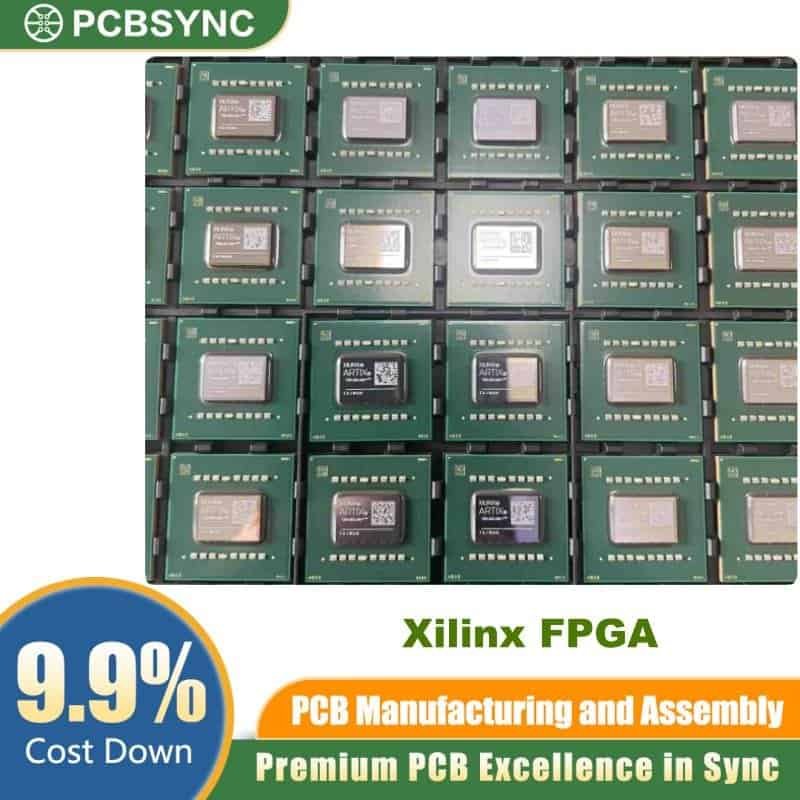
The XC3S50-4PQ208C is a cost-optimized Field-Programmable Gate Array (FPGA) from the Xilinx Spartan-3 family, now under AMD. Designed for high-volume, cost-sensitive applications, this device delivers 50,000 system gates, 1,728 logic cells, and runs at up to 630 MHz — all in a compact 208-pin PQFP package. Whether you are building embedded control systems, consumer electronics, or digital signal processing platforms, the XC3S50-4PQ208C offers a powerful combination of programmable logic, on-chip memory, and flexible I/O in a production-ready commercial-grade package.
For engineers seeking a proven, readily available Xilinx FPGA for embedded and digital design, this device remains one of the most widely used entry-level programmable logic solutions on the market.
What Is the XC3S50-4PQ208C?
The XC3S50-4PQ208C belongs to the Spartan-3 FPGA family — a product line engineered specifically to serve high-volume, cost-sensitive consumer and industrial electronic applications. It uses 90nm CMOS process technology and operates on a 1.2V core supply voltage. The “-4” in the part number denotes its speed grade, while “PQ208” refers to the 208-pin Plastic Quad Flat Package (PQFP), and “C” specifies the commercial temperature range (0°C to +85°C).
XC3S50-4PQ208C Key Specifications
General Product Identification
| Parameter |
Value |
| Manufacturer |
AMD / Xilinx |
| Part Number |
XC3S50-4PQ208C |
| Product Family |
Spartan-3 |
| Product Category |
FPGA (Field-Programmable Gate Array) |
| RoHS Status |
Not Compliant (Standard Pb package) |
Core Logic Specifications
| Specification |
Value |
| System Gates |
50,000 |
| Logic Cells |
1,728 |
| CLB Slices |
768 |
| CLB Flip-Flops |
1,536 |
| 4-Input LUTs |
1,536 |
| Distributed RAM |
24 Kbits |
| Block RAM |
72 Kbits (4 × 18Kbit blocks) |
| Dedicated Multipliers |
4 × 18×18 multipliers |
| Digital Clock Managers (DCM) |
2 |
Electrical & Performance Specifications
| Specification |
Value |
| Core Supply Voltage |
1.2V (1.14V – 1.26V) |
| I/O Supply Voltage |
3.3V, 2.5V, 1.8V, 1.5V, 1.2V |
| Maximum Clock Speed |
630 MHz |
| Speed Grade |
-4 |
| Process Technology |
90nm CMOS |
| Configuration Logic |
Static CMOS CCLs |
Package & Thermal Specifications
| Specification |
Value |
| Package Type |
PQFP (Plastic Quad Flat Pack) |
| Package Code |
PQ208 |
| Pin Count |
208 |
| Terminal Form |
Gull Wing (SMD) |
| Temperature Grade |
Commercial (C) |
| Operating Temperature |
0°C to +85°C |
| Mounting Type |
Surface Mount |
I/O Specifications
| Specification |
Value |
| User I/O Pins |
124 (single-ended) |
| Differential I/O Pairs |
56 |
| I/O Standards Supported |
26 signal standards |
| Digitally Controlled Impedance (DCI) |
Supported |
| Double Data Rate (DDR) Registers |
Supported |
| High-Performance Differential Standards |
8 standards |
XC3S50-4PQ208C Part Number Decoder
Understanding the part number helps engineers quickly identify the right variant for their design:
| Code Segment |
Meaning |
| XC |
Xilinx (AMD) FPGA |
| 3S |
Spartan-3 family |
| 50 |
50,000 system gates |
| -4 |
Speed grade 4 |
| PQ |
Plastic Quad Flat Package (PQFP) |
| 208 |
208-pin count |
| C |
Commercial temperature (0°C–85°C) |
Architecture Overview: Five Key Functional Elements
The Spartan-3 architecture — and by extension the XC3S50-4PQ208C — is built around five tightly integrated functional elements:
1. Configurable Logic Blocks (CLBs)
CLBs are the primary logic resource. Each CLB contains RAM-based Look-Up Tables (LUTs) that implement combinational logic, plus storage elements that can operate as flip-flops or latches. CLBs are organized in a regular array surrounded by a ring of I/O blocks.
2. Input/Output Blocks (IOBs)
IOBs control data flow between external pins and internal logic. Each IOB supports bidirectional data flow and three-state operation, and is compatible with 26 different signal standards — including eight high-performance differential standards such as LVDS and RSDS.
3. Block RAM
The XC3S50-4PQ208C features a single column of block RAM, totaling 72 Kbits. The block RAM uses a dual-port structure, enabling independent, simultaneous access from two separate data ports (Port A and Port B), making it ideal for FIFOs, lookup tables, and embedded memory applications.
4. Dedicated Multiplier Blocks
Four 18×18 hardware multiplier blocks are embedded in the device. Each multiplier is associated with a block RAM column and is optimized for digital signal processing tasks such as filtering, FFT computation, and arithmetic-intensive operations.
5. Digital Clock Managers (DCMs)
The XC3S50-4PQ208C includes two DCMs. These are used for clock skew elimination, frequency synthesis, and phase shifting, enabling clean, reliable clocking across the device at speeds up to 630 MHz.
Supported I/O Standards
The XC3S50-4PQ208C supports a broad range of I/O signaling standards, making it compatible with most modern interface protocols:
| Standard Category |
Examples |
| Single-Ended Standards |
LVTTL, LVCMOS 3.3V/2.5V/1.8V/1.5V/1.2V |
| High-Speed Differential |
LVDS, RSDS, mini-LVDS, PPDS |
| Memory Interface Standards |
SSTL2 (Class I/II), SSTL18 (Class I/II) |
| High-Speed Logic |
HSTL (Class I/III/IV) |
| Terminated Standards |
GTL, GTL+ |
Configuration Modes
The XC3S50-4PQ208C supports five configuration modes, providing flexible system integration options:
| Configuration Mode |
Description |
| Master Serial |
FPGA drives SCK; reads from serial PROM |
| Slave Serial |
External controller drives SCK |
| Master Parallel |
FPGA reads from parallel NOR Flash or PROM |
| Slave Parallel |
External processor writes configuration data |
| JTAG (Boundary Scan) |
In-system configuration and debugging via JTAG |
Configuration data is stored in reprogrammable static CMOS Configuration Latches (CCLs), which collectively control all functional elements and routing resources.
Typical Application Areas
The XC3S50-4PQ208C is well-suited for the following application domains:
| Application Domain |
Use Cases |
| Consumer Electronics |
Set-top boxes, digital cameras, home appliances |
| Industrial Control |
Motor drives, PLCs, sensor interfaces |
| Communications Equipment |
Protocol bridging, UART/SPI/I2C controllers |
| Embedded Systems |
Co-processors, custom logic accelerators |
| Signal Processing |
FIR/IIR filters, FFT, data acquisition systems |
| Prototyping & Development |
ASIC prototyping, educational boards, eval kits |
XC3S50-4PQ208C vs. Other Spartan-3 Variants
The Spartan-3 family spans eight density levels. Here is how the XC3S50 compares to other family members:
| Device |
System Gates |
Logic Cells |
Block RAM (Kbits) |
Multipliers |
DCMs |
| XC3S50 |
50,000 |
1,728 |
72 |
4 |
2 |
| XC3S200 |
200,000 |
4,320 |
216 |
12 |
4 |
| XC3S400 |
400,000 |
8,064 |
288 |
16 |
4 |
| XC3S1000 |
1,000,000 |
17,280 |
432 |
24 |
4 |
| XC3S2000 |
2,000,000 |
33,280 |
720 |
40 |
4 |
The XC3S50-4PQ208C is the entry-level device in this family, making it ideal for applications that require modest logic density at the lowest possible cost and power.
XC3S50 Available Packages
The XC3S50 device is available in multiple package options to support different board space constraints:
| Package |
Pins |
User I/O (Single-Ended) |
Differential Pairs |
| CP132 |
132 |
63 |
29 |
| TQ144 |
144 |
97 |
46 |
| PQ208 |
208 |
124 |
56 |
| FT256 |
256 |
173 |
76 |
The PQ208 package used in the XC3S50-4PQ208C provides the highest I/O count available for this device, with 124 user-selectable single-ended I/O pins and 56 differential pairs.
Design Tools & Programming
The XC3S50-4PQ208C is supported by Xilinx/AMD design toolchains:
- Xilinx ISE Design Suite — legacy support tool for Spartan-3 devices, supporting VHDL, Verilog, and schematic entry
- Vivado Design Suite — newer generation tool; some Spartan-3 support available for certain flows
- iMPACT — Xilinx configuration and programming tool for JTAG and configuration PROM workflows
- ChipScope Pro — in-system logic analysis and debugging
HDL languages supported include VHDL, Verilog, and SystemVerilog for higher-level synthesis flows.
Ordering Information
| Field |
Detail |
| Full Part Number |
XC3S50-4PQ208C |
| Manufacturer |
AMD / Xilinx |
| Pb-Free Equivalent |
XC3S50-4PQG208C |
| DigiKey Part # |
6131752 |
| Package |
208-Pin PQFP (Gull Wing SMD) |
| Temperature Grade |
Commercial (0°C to +85°C) |
| Compliance |
Standard (Non-Pb-Free) |
Note: If your design requires RoHS-compliant components, consider the XC3S50-4PQG208C, which is the Pb-free version of this device (indicated by the “G” in the package code).
Frequently Asked Questions (FAQ)
Q: What is the XC3S50-4PQ208C used for? The XC3S50-4PQ208C is used in embedded systems, consumer electronics, industrial control, communications, and digital signal processing applications that require a low-cost, programmable logic solution with moderate gate density.
Q: What is the difference between XC3S50-4PQ208C and XC3S50-4PQG208C? The only difference is the package material. The “G” variant (XC3S50-4PQG208C) uses a Pb-free (lead-free) package for RoHS compliance. Electrically and functionally, both devices are identical.
Q: What speed grade is the XC3S50-4PQ208C? This device carries a speed grade of -4, which corresponds to a maximum system clock frequency of 630 MHz.
Q: Is the XC3S50-4PQ208C still recommended for new designs? As of the last official Xilinx datasheet revision (June 2013), the Spartan-3 family is confirmed as recommended for new designs. However, for new projects with longer design horizons, engineers may also consider newer families such as Spartan-6 or Artix-7 for improved performance, lower power, and longer-term supply chain support.
Q: What configuration modes does the XC3S50-4PQ208C support? It supports Master Serial, Slave Serial, Master Parallel, Slave Parallel, and JTAG (Boundary Scan) configuration modes.
Q: How many I/O pins does the XC3S50-4PQ208C have? In the PQ208 package, this device provides 124 single-ended user I/O pins and 56 differential I/O pairs.
Summary
The XC3S50-4PQ208C is a reliable, cost-effective FPGA from the Xilinx Spartan-3 family that combines programmable logic, on-chip block RAM, hardware multipliers, and flexible I/O into a 208-pin PQFP package. With 50,000 system gates, 630 MHz performance, 90nm process technology, and support for 26 I/O standards, it is well-positioned for a wide variety of embedded, consumer, and industrial applications where cost and time-to-market are critical factors.
Its mature ecosystem of design tools, broad support for standard interfaces, and dual DCM architecture make it a dependable choice for both new designs and legacy system maintenance.