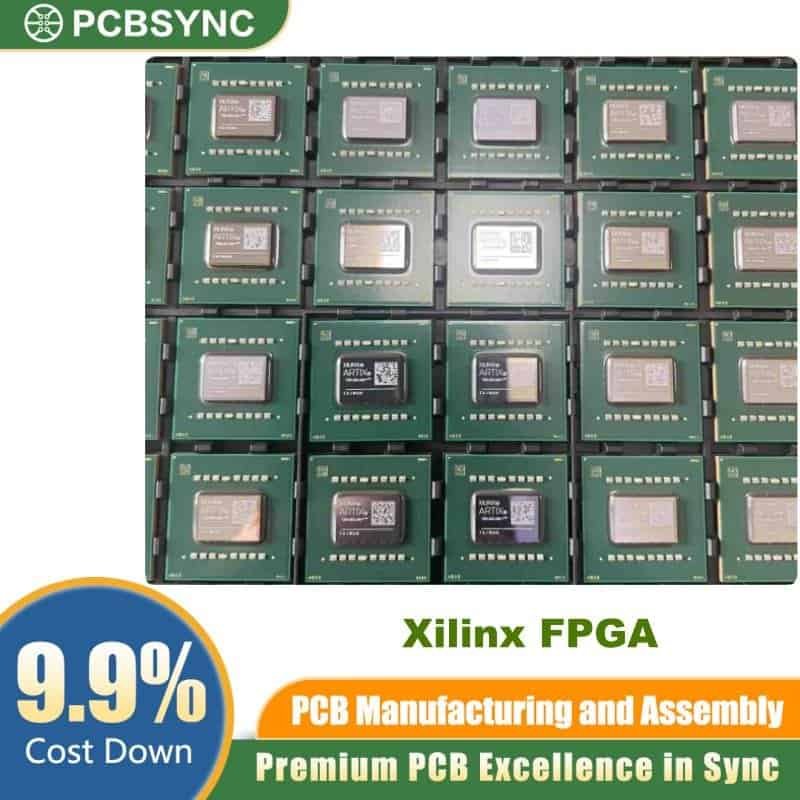
The XC3S50-4CPG132C is a field-programmable gate array (FPGA) from the Xilinx Spartan-3 family, now maintained under AMD. Designed for cost-sensitive, high-volume consumer and embedded applications, this device delivers a compelling balance of logic density, on-chip memory, and clock management capability — all packaged in a compact 132-pin Chip-Scale Ball Grid Array (CSBGA). Whether you are designing a communications interface, an industrial controller, or a digital signal processing pipeline, the XC3S50-4CPG132C offers a proven, flexible, and affordable programmable logic solution.
What Is the XC3S50-4CPG132C?
The XC3S50-4CPG132C is a member of the Xilinx FPGA Spartan-3 family — a series of eight devices spanning 50,000 to 5,000,000 system gates. The “XC3S50” designates the Spartan-3 device with 50K system gates. The “-4” suffix identifies the standard speed grade, “CPG132” denotes the 132-pin Chip-Scale Package with lead-free (Pb-free) ball finish, and the trailing “C” confirms the commercial temperature range (0°C to 85°C).
Built on a 90 nm process technology from Xilinx, this device inherits architectural enhancements from the Virtex-II platform, making it one of the most capable low-cost FPGAs of its generation.
XC3S50-4CPG132C Key Specifications at a Glance
| Parameter |
Value |
| Part Number |
XC3S50-4CPG132C |
| Manufacturer |
AMD (Xilinx) |
| FPGA Family |
Spartan-3 |
| System Gates |
50,000 |
| Logic Cells |
1,728 |
| CLB Slices |
768 |
| CLB Array |
16 × 12 |
| CLB Flip-Flops |
1,536 |
| Max. Distributed RAM |
12K bits |
| Block RAM |
4 blocks / 72 Kbits total |
| Dedicated Multipliers |
4 × 18×18-bit |
| Digital Clock Managers (DCMs) |
2 |
| Max. User I/O |
89 |
| Differential I/O Pairs |
44 |
| Process Technology |
90 nm |
| Core Supply Voltage |
1.2V |
| Package |
132-pin CSBGA (CPG132) |
| Package Type |
Chip-Scale Ball Grid Array |
| Temperature Range |
0°C to +85°C (Commercial) |
| Speed Grade |
-4 (Standard Performance) |
| Max. Clock Frequency |
630 MHz (internal routing) |
| DCM Frequency Range |
25 MHz – 326 MHz |
| Lead-Free (Pb-Free) |
Yes (G suffix in package code) |
| RoHS Compliant |
Yes |
| DigiKey Part Number |
1951715 |
XC3S50-4CPG132C Detailed Technical Description
Configurable Logic Blocks (CLBs) and Slices
The XC3S50-4CPG132C contains 768 slices arranged in a 16×12 CLB array. Each CLB contains two slices, and each slice includes two 4-input lookup tables (LUTs), two storage elements (flip-flops or latches), and dedicated carry and control logic. This architecture supports up to 12K bits of distributed RAM, making the device well-suited for small data buffering tasks, shift registers, and ROM implementations entirely within the CLB fabric.
Block RAM Architecture
The XC3S50 integrates 4 block RAM modules, totaling 72 Kbits of true dual-port synchronous memory. Each block RAM is organized with a dual-port structure, where both ports (A and B) offer independent read and write access. Port width is configurable up to 18 bits (including parity), and address depth scales accordingly. This on-chip memory is ideal for FIFOs, lookup tables, and local data storage without external memory.
Dedicated Multipliers
Four 18×18-bit dedicated hardware multipliers are embedded in the XC3S50-4CPG132C. These multipliers support both combinatorial (MULT18X18) and registered (MULT18X18S) operation modes. By offloading multiply operations from the CLB fabric, these dedicated blocks significantly improve DSP throughput and free up logic resources for other functions.
Digital Clock Manager (DCM)
The XC3S50-4CPG132C features two Digital Clock Managers, located at the ends of the block RAM column. The DCM supports:
- Frequency synthesis — multiply and divide input clock frequencies
- Phase shifting — fine-grained phase control for timing adjustment
- Clock deskewing — eliminates clock distribution delay
The DCM operates across a frequency range of 25 MHz to 326 MHz, enabling a wide variety of clocking scenarios from slow control loops to high-speed data paths.
I/O Bank and Supported Standards
With 89 maximum user I/Os (44 differential pairs), the XC3S50-4CPG132C supports a rich set of both single-ended and differential I/O standards:
| I/O Standard Type |
Supported Standards |
| Single-Ended |
LVTTL, LVCMOS 3.3V / 2.5V / 1.8V / 1.5V / 1.2V, PCI 3.3V (32/64-bit @ 33 MHz), SSTL2 Class I & II, SSTL18 Class I, HSTL Class I & III |
| Differential |
LVDS, LVPECL, BLVDS, ULVDS, LDT, RSDS |
| Digitally Controlled Impedance (DCI) |
Yes (selected banks) |
Note: DCI signal standards are not supported in Bank 5 when using VQ100, CP132, or TQ144 packages.
Package Details: CPG132 (132-Pin CSBGA)
The “CPG132” package is a 132-ball Chip-Scale Ball Grid Array (CSBGA) with a Pb-free ball finish. The compact package dimensions make it suitable for space-constrained PCB designs. The “G” in CPG132 confirms RoHS-compliant lead-free solder balls.
| Package Attribute |
Detail |
| Package Style |
CSBGA (Chip-Scale Ball Grid Array) |
| Total Ball Count |
132 |
| User I/O Available |
89 |
| Lead-Free |
Yes |
| Ball Pitch |
Fine-pitch CSP |
| Mounting |
Surface Mount Technology (SMT) |
Part Number Decoder: XC3S50-4CPG132C
Understanding the part number helps confirm the exact device variant for your design:
| Field |
Code |
Meaning |
| Family |
XC3S |
Spartan-3 |
| Gates |
50 |
50,000 system gates |
| Speed Grade |
-4 |
Standard performance |
| Package |
CPG |
Chip-Scale BGA, Pb-free |
| Pin Count |
132 |
132 total balls |
| Temperature |
C |
Commercial (0°C to +85°C) |
XC3S50-4CPG132C vs. Other Spartan-3 Variants
The following table compares the XC3S50 against larger Spartan-3 family members, helping engineers select the right device for their logic density requirements:
| Device |
System Gates |
Slices |
Block RAM (Kbits) |
Multipliers |
Max I/O |
| XC3S50 |
50K |
768 |
72 |
4 |
124 |
| XC3S200 |
200K |
1,920 |
216 |
12 |
173 |
| XC3S400 |
400K |
3,584 |
288 |
16 |
264 |
| XC3S1000 |
1M |
7,680 |
432 |
24 |
391 |
| XC3S1500 |
1.5M |
10,752 |
576 |
32 |
487 |
| XC3S2000 |
2M |
14,336 |
720 |
40 |
565 |
The XC3S50-4CPG132C in the CPG132 package provides 89 user I/Os, which is lower than the 124 maximum available in larger packages (e.g., TQ144), due to package pin constraints.
Typical Applications for XC3S50-4CPG132C
The XC3S50-4CPG132C is a strong fit for the following application domains:
- Consumer Electronics — Digital control logic, display drivers, interface bridging
- Industrial Automation — Sensor interfacing, PWM generation, motor control logic
- Communications — Serial-to-parallel conversion, protocol bridging (UART, SPI, I2C, etc.)
- Embedded Systems — Soft-core processor integration (e.g., MicroBlaze or PicoBlaze)
- Education & Prototyping — FPGA development boards, academic research, proof-of-concept designs
- Test & Measurement — Signal generation, pattern matching, event capture logic
Programming and Design Tools
The XC3S50-4CPG132C is compatible with the following Xilinx/AMD development environments:
| Tool |
Description |
| Xilinx ISE Design Suite |
Legacy design tool; fully supports Spartan-3 synthesis, implementation, and bitstream generation |
| Vivado Design Suite |
AMD’s current generation tool; partial compatibility via ISE migration |
| ChipScope Pro |
On-chip debug and signal capture for Spartan-3 designs |
| XAPP427 |
Pb-free solder reflow guidelines for lead-free packages |
The device is programmed by loading configuration data into static CMOS configuration latches (CCLs) via the JTAG boundary scan interface or a dedicated configuration port.
Ordering Information
| Attribute |
Detail |
| Full Part Number |
XC3S50-4CPG132C |
| Manufacturer |
AMD (formerly Xilinx) |
| DigiKey Part Number |
1951715 |
| Package |
132-CSBGA (CPG132) |
| Temperature Grade |
Commercial (0°C to 85°C) |
| RoHS Status |
RoHS Compliant |
| Lead-Free |
Yes |
| Availability |
Check distributor stock |
⚠️ Important Notice: The CPG132 package has been designated as not recommended for new designs by Xilinx/AMD. Engineers starting new projects should consult Xilinx’s product lifecycle documentation and consider alternative packages or family members where long-term availability is a priority.
Frequently Asked Questions (FAQ)
Q: What is the core voltage of the XC3S50-4CPG132C?
A: The XC3S50-4CPG132C operates at a core supply voltage of 1.2V, while I/O banks support multiple voltages depending on the selected I/O standard (1.2V to 3.3V).
Q: What is the difference between XC3S50-4CPG132C and XC3S50-4CP132I?
A: The primary difference is the temperature range. The “C” suffix indicates the commercial grade (0°C to +85°C), while the “I” suffix indicates the industrial grade (−40°C to +100°C).
Q: Is the XC3S50-4CPG132C RoHS compliant?
A: Yes. The “G” in the CPG132 package code confirms that this variant uses Pb-free (lead-free) solder balls, making it RoHS compliant.
Q: How many user I/Os are available on the XC3S50-4CPG132C?
A: The CPG132 package exposes 89 user I/O pins, including 44 differential pairs. The theoretical maximum for the XC3S50 die is 124 I/Os in larger packages.
Q: What design tools are compatible with this FPGA?
A: The primary tool is Xilinx ISE Design Suite, which provides full support for Spartan-3 devices. The AMD Vivado Design Suite does not natively support Spartan-3 but can be used alongside ISE for partial workflows.