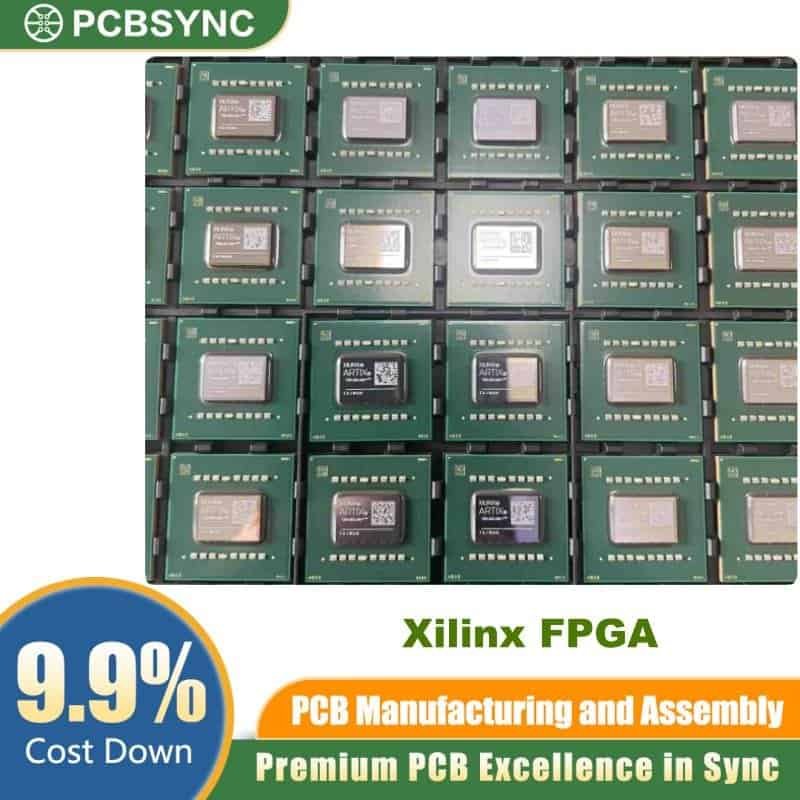
The XC3S4000-5FGG676I is a high-capacity, industrial-grade Field Programmable Gate Array (FPGA) from the AMD Xilinx Spartan-3 family. Featuring 4 million system gate equivalents, 62,208 logic cells, and a robust 676-ball Fine-pitch Ball Grid Array (FBGA) package, this device is engineered for demanding embedded, communications, and signal-processing applications. With its industrial temperature rating (-40°C to +100°C), the XC3S4000-5FGG676I delivers reliable long-term operation in harsh environments.
Whether you are designing a high-speed data acquisition system, an embedded processor platform, or a custom DSP pipeline, the XC3S4000-5FGG676I offers the programmable logic density and I/O flexibility to meet your requirements. As part of the broader portfolio of Xilinx FPGA solutions, this device represents a cost-effective path to high-density programmable logic.
What Is the XC3S4000-5FGG676I?
The XC3S4000-5FGG676I belongs to AMD Xilinx’s Spartan-3 platform — a generation of FPGAs built on a 90 nm process technology and optimized for high volume, cost-sensitive applications. The part number decodes as follows:
| Part Number Segment |
Meaning |
| XC |
Xilinx FPGA |
| 3S |
Spartan-3 family |
| 4000 |
~4 million system gate equivalents |
| -5 |
Speed grade (-5 = standard; lower number = faster) |
| FGG676 |
Fine-pitch Ball Grid Array, 676 balls |
| I |
Industrial temperature range (-40°C to +100°C) |
XC3S4000-5FGG676I Key Specifications
Core Logic Resources
| Parameter |
Value |
| System Gates |
4,000,000 (4M) |
| Logic Cells |
62,208 |
| Configurable Logic Blocks (CLBs) |
3,840 |
| CLB Flip-Flops |
49,152 |
| Max Distributed RAM |
720 Kb |
| DCM (Digital Clock Manager) |
4 |
Memory Resources
| Memory Type |
Capacity |
| Block RAM Blocks (18 Kb each) |
54 blocks |
| Total Block RAM |
1,728 Kb |
| Distributed (LUT-based) RAM |
720 Kb |
DSP & Multiplier Resources
| Parameter |
Value |
| 18×18-bit Hardware Multipliers |
96 |
| DCM Instances |
4 |
Package & I/O
| Parameter |
Value |
| Package Type |
FBGA (Fine-pitch Ball Grid Array) |
| Package Code |
FGG676 |
| Total Balls |
676 |
| Maximum User I/O Pins |
616 |
| Differential I/O Pairs |
Up to 264 |
| I/O Standards Supported |
LVTTL, LVCMOS, SSTL, HSTL, LVDS, BLVDS, ULVDS, RSDS |
Electrical & Environmental
| Parameter |
Value |
| Core Supply Voltage (VCCINT) |
1.2 V |
| I/O Supply Voltage (VCCO) |
1.2 V – 3.3 V (bank selectable) |
| Temperature Grade |
Industrial |
| Operating Temperature Range |
-40°C to +100°C |
| Process Technology |
90 nm |
XC3S4000-5FGG676I vs. Related Variants
The Spartan-3 XC3S4000 is available in multiple speed grades and packages. The table below compares the most common variants to help you select the right part.
| Part Number |
Speed Grade |
Package |
Temp Grade |
Key Difference |
| XC3S4000-5FGG676I |
-5 (standard) |
FGG676 |
Industrial |
Standard speed, industrial temp |
| XC3S4000-4FGG676I |
-4 (faster) |
FGG676 |
Industrial |
Faster speed grade, industrial temp |
| XC3S4000-4FGG676C |
-4 (faster) |
FGG676 |
Commercial |
Faster speed, commercial (0°C to 85°C) |
| XC3S4000-5FG676I |
-5 (standard) |
FG676 |
Industrial |
Alternative ball pitch variant |
Note: A lower speed grade number (e.g., -4) means faster timing performance. Choose -4 when maximum clock frequency is critical; choose -5 for cost-optimized or less timing-sensitive designs.
XC3S4000-5FGG676I Architecture Deep Dive
Configurable Logic Blocks (CLBs)
The Spartan-3 CLB architecture is built around 4-input Look-Up Tables (LUTs). Each CLB contains four Slices, and each Slice contains two LUTs and two flip-flops. With 62,208 logic cells, designers can implement complex state machines, arithmetic circuits, and custom processor cores. Each LUT can also function as a 16-bit distributed RAM element, contributing to the total 720 Kb of distributed memory.
Block RAM (BRAM)
The XC3S4000-5FGG676I integrates 1,728 Kb of true dual-port block RAM, organized into 54 blocks of 18 Kb each. Each BRAM block supports independent read and write port widths (1, 2, 4, 9, 18, or 36 bits), true dual-port operation with simultaneous read/write, and an optional output register for pipelined read operations. This makes the device well-suited for FIFO buffers, frame buffers, and on-chip data storage in embedded processor designs.
Hardware Multipliers
The 96 dedicated 18×18-bit multipliers enable high-throughput DSP functions without consuming LUT resources. These multipliers are used in FIR/IIR filters, FFT engines, matrix multipliers, and software-defined radio (SDR) front-ends. Cascading multipliers with BRAM delivers pipelined multiply-accumulate (MAC) architectures at high clock rates.
Digital Clock Manager (DCM)
Four Digital Clock Managers provide on-chip clock synthesis, deskewing, phase shifting, and frequency multiplication/division. DCM capabilities include clock multiplication and division ratios, fine-increment phase adjustment, and clock deskew to eliminate board-level propagation delay offsets.
I/O Architecture
The FGG676 package exposes up to 616 user I/O pins, each assignable to a wide range of single-ended and differential signaling standards. I/O banks allow per-bank VCCO voltage selection, enabling seamless interfacing with 1.8 V, 2.5 V, and 3.3 V peripherals on a single device.
Supported I/O Standards
| Standard |
Type |
Typical VCCO |
| LVTTL |
Single-ended |
3.3 V |
| LVCMOS33 / 25 / 18 / 15 / 12 |
Single-ended |
3.3 V – 1.2 V |
| SSTL2 / SSTL3 |
Single-ended (memory bus) |
2.5 V / 3.3 V |
| HSTL Class I / II |
Single-ended (high-speed) |
1.5 V / 1.8 V |
| LVDS |
Differential |
2.5 V |
| BLVDS (Bus LVDS) |
Differential |
2.5 V |
| ULVDS |
Differential |
1.8 V |
| RSDS |
Differential |
2.5 V |
Typical Applications for the XC3S4000-5FGG676I
The XC3S4000-5FGG676I is a versatile device used across a wide range of industries and application domains.
Embedded Processing
The device supports soft-processor cores such as MicroBlaze (32-bit RISC) and PicoBlaze (8-bit). Combined with on-chip BRAM and peripheral IP cores, it can implement a complete SoC (System-on-Chip) without external components.
Digital Signal Processing (DSP)
With 96 hardware multipliers and deep LUT resources, the FPGA handles real-time DSP workloads including audio and video processing, radar signal analysis, spectrum analyzers, and software-defined radio (SDR) platforms.
Communications & Networking
The device supports high-speed serial and parallel interface protocols including UART, SPI, I²C, Ethernet (via soft MAC cores), and PCI companion logic. It is widely used in network line cards, protocol converters, and data concentrators.
Industrial Control & Automation
The industrial temperature grade (-40°C to +100°C) makes the XC3S4000-5FGG676I ideal for motor drive controllers, industrial Ethernet bridges, robotic controllers, and programmable automation controllers (PACs) in factory environments.
Test & Measurement Equipment
High I/O count, differential signaling support, and flexible clocking make this device a popular choice in oscilloscopes, logic analyzers, pattern generators, and automated test equipment (ATE).
Image Processing & Machine Vision
With enough logic resources to implement pipelined image filters, histogram engines, and edge-detection algorithms, the device is used in camera interface boards, medical imaging systems, and industrial inspection equipment.
Configuration Modes
| Configuration Mode |
Description |
| Master Serial |
FPGA drives the configuration clock; uses SPI/NOR flash |
| Slave Serial |
External clock source drives configuration |
| Master SelectMAP |
Parallel 8-bit bus; FPGA as master |
| Slave SelectMAP |
Parallel 8-bit bus; processor as master |
| JTAG |
IEEE 1149.1 boundary scan and configuration |
| Master SPI |
Direct interface to standard SPI NOR flash |
Development Tools & IP Support
Design Software
The XC3S4000-5FGG676I is fully supported by Xilinx ISE Design Suite 14.7 — the final and recommended ISE release. Key tools include:
| Tool |
Purpose |
| ISE Project Navigator |
RTL-to-bitstream implementation flow |
| PlanAhead |
Floorplanning and placement analysis |
| iSim / ModelSim |
Functional and timing simulation |
| ChipScope Pro |
On-chip logic analyzer and hardware debugging |
| CORE Generator |
IP core customization and instantiation |
Important: The Spartan-3 family is not supported in Vivado. Always use ISE Design Suite 14.7 for XC3S4000 projects.
Available IP Cores
| IP Core |
Function |
| MicroBlaze |
Soft 32-bit RISC processor |
| PicoBlaze |
Lightweight 8-bit processor |
| Tri-Mode Ethernet MAC |
10/100/1000 Mbps Ethernet |
| DDR / DDR2 Memory Controller |
External SDRAM interface |
| PCI / PCI-X Interface |
Legacy bus connectivity |
| FIR Compiler |
High-performance digital filter generation |
| FFT Core |
Fast Fourier Transform engine |
Ordering Information
| Parameter |
Detail |
| Manufacturer |
AMD (Xilinx) |
| Part Number |
XC3S4000-5FGG676I |
| Product Family |
Spartan-3 |
| Package |
FBGA-676 (FGG676) |
| Speed Grade |
-5 (standard) |
| Temperature Grade |
Industrial (-40°C to +100°C) |
| Lifecycle Status |
Mature / Long-term supply available |
Frequently Asked Questions (FAQ)
What is the difference between the XC3S4000-5FGG676I and the XC3S4000-4FGG676I?
The only difference is the speed grade. The -4 variant has faster internal propagation delays and supports higher clock frequencies, making it preferable for timing-critical designs. The -5 is the standard speed grade and suits less timing-constrained or cost-optimized designs.
Is the XC3S4000-5FGG676I pin-compatible with other Spartan-3 devices in the FGG676 package?
Yes. Spartan-3 devices in the FGG676 package share the same ball assignment for common signals, enabling PCB-level migration across density options (XC3S1500, XC3S2000, XC3S4000). Always verify against the official Xilinx package pinout files before finalizing your layout.
What flash memory devices can I use to configure this FPGA?
Compatible options include the Xilinx XCF04S, XCF08P, and XCF16P serial PROMs, as well as standard SPI NOR flash devices from Micron, Winbond, and Macronix that support the Master SPI configuration mode.
Can I use Vivado with the XC3S4000-5FGG676I?
No. Vivado does not support the Spartan-3 family. You must use Xilinx ISE Design Suite 14.7 for all design, synthesis, implementation, and bitstream generation work targeting this device.
What is the core voltage for the XC3S4000-5FGG676I?
The VCCINT (core) supply is 1.2 V. The VCCO I/O bank voltages are independently selectable per bank from 1.2 V to 3.3 V, depending on the I/O standard required.
Why Choose the XC3S4000-5FGG676I?
The XC3S4000-5FGG676I strikes an excellent balance between logic density, on-chip memory, DSP performance, and I/O flexibility. Its industrial temperature rating and mature supply chain make it a dependable choice for long-lifecycle embedded designs. Standout advantages include:
- High logic density – 62,208 logic cells support complex designs without device partitioning
- Rich on-chip memory – 1,728 Kb BRAM reduces reliance on external memory devices
- Dedicated DSP resources – 96 hardware multipliers accelerate signal processing algorithms
- Wide I/O flexibility – Up to 616 user I/Os with multi-standard support simplify PCB interfacing
- Industrial temperature range – Reliable operation from -40°C to +100°C
- Mature ecosystem – Extensive reference designs, IP cores, and community knowledge base
For engineers and procurement teams seeking a proven, high-density programmable logic solution, the XC3S4000-5FGG676I remains a compelling choice within the full range of Xilinx FPGA devices.