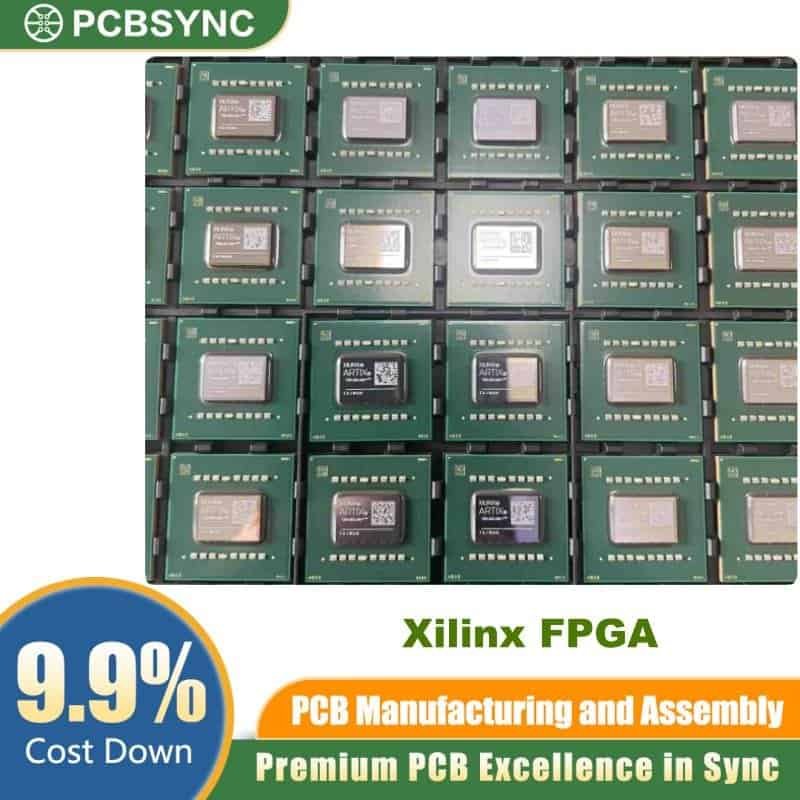
The XC3S4000-4FGG676C is a high-density, cost-optimized Field Programmable Gate Array (FPGA) from Xilinx’s (now AMD) Spartan-3 family. Built on advanced 90nm process technology, this device delivers 4 million system gates, 62,208 logic cells, and a maximum operating frequency of 630 MHz — making it a powerful and versatile choice for high-volume embedded applications. Whether you’re designing consumer electronics, industrial control systems, or communications hardware, the XC3S4000-4FGG676C offers an exceptional balance of performance, I/O density, and programmable flexibility.
As part of the broader Xilinx FPGA product portfolio, the Spartan-3 series remains a proven platform for engineers who need reliable, field-upgradeable logic in a compact package.
What Is the XC3S4000-4FGG676C?
The XC3S4000-4FGG676C is a member of Xilinx’s Spartan-3 FPGA family, which was specifically designed to address cost-sensitive, high-volume applications. The part number breaks down as follows:
- XC3S4000 – Spartan-3 family, 4,000,000 system gates
- -4 – Speed grade 4 (commercial temperature range)
- FGG676 – Fine-pitch Ball Grid Array (FBGA), 676-pin package
- C – Commercial temperature grade (0°C to +85°C)
This FPGA is an ideal alternative to mask-programmed ASICs, eliminating the high NRE costs and long development cycles associated with custom silicon. Its in-field reprogrammability gives engineers the flexibility to update designs without hardware replacement.
Key Features of the XC3S4000-4FGG676C
- 4,000,000 system gates with 62,208 equivalent logic cells
- 6,912 Configurable Logic Blocks (CLBs) for dense logic implementation
- Up to 633 user I/O pins for maximum connectivity
- 90nm CMOS process technology for efficient power consumption
- 1.2V core supply voltage (1.14V–1.26V range)
- Maximum clock frequency of 630 MHz
- 676-pin Fine-Pitch BGA (FBGA) package
- RoHS compliant (lead-free packaging)
- Commercial temperature grade: 0°C to +85°C
- Compatible with Xilinx ISE Design Suite and Vivado toolchain
XC3S4000-4FGG676C Technical Specifications
General Specifications
| Parameter |
Value |
| Manufacturer |
Xilinx / AMD |
| Part Number |
XC3S4000-4FGG676C |
| FPGA Family |
Spartan-3 |
| System Gates |
4,000,000 |
| Equivalent Logic Cells |
62,208 |
| Configurable Logic Blocks (CLBs) |
6,912 |
| Logic Slices |
27,648 |
| Max User I/O Pins |
633 |
| Max Frequency |
630 MHz |
Process & Electrical Specifications
| Parameter |
Value |
| Process Technology |
90nm CMOS |
| Core Supply Voltage (Vcc) |
1.2V |
| Supply Voltage Min |
1.14V |
| Supply Voltage Max |
1.26V |
| I/O Output Drive |
12 mA |
| Operating Temperature |
0°C to +85°C |
| RoHS Compliance |
Yes |
Package & Mechanical Specifications
| Parameter |
Value |
| Package Type |
FBGA (Fine-Pitch BGA) |
| Package Code |
FGG676 |
| Total Pin Count |
676 |
| Mounting Type |
Surface Mount (SMD) |
| Package Dimensions |
27mm × 27mm |
Memory & DSP Resources
| Resource |
Quantity |
| Block RAM (18Kb blocks) |
96 |
| Total Block RAM |
1,728 Kbits |
| Dedicated Multipliers (18×18) |
96 |
| Digital Clock Managers (DCMs) |
4 |
XC3S4000-4FGG676C Ordering Information
| Field |
Detail |
| Manufacturer Part Number |
XC3S4000-4FGG676C |
| DigiKey Part Number |
122-1381-ND |
| Manufacturer |
AMD / Xilinx |
| Series |
Spartan-3 |
| Status |
Active / Last Time Buy |
| Package |
676-FBGA |
| RoHS |
Yes |
Spartan-3 Family: Logic Density Comparison
The XC3S4000-4FGG676C sits near the top of the Spartan-3 family in terms of gate density. The table below shows how it compares to other members of the family:
| Device |
System Gates |
Logic Cells |
Max I/Os |
Block RAM (Kbits) |
| XC3S50 |
50,000 |
1,728 |
124 |
72 |
| XC3S200 |
200,000 |
4,320 |
173 |
216 |
| XC3S400 |
400,000 |
8,064 |
264 |
288 |
| XC3S1000 |
1,000,000 |
17,280 |
391 |
432 |
| XC3S1500 |
1,500,000 |
29,952 |
487 |
648 |
| XC3S2000 |
2,000,000 |
46,080 |
565 |
864 |
| XC3S4000 |
4,000,000 |
62,208 |
633 |
1,728 |
| XC3S5000 |
5,000,000 |
74,880 |
633 |
1,872 |
Architecture Overview: What’s Inside the XC3S4000-4FGG676C?
Configurable Logic Blocks (CLBs)
The XC3S4000-4FGG676C contains 6,912 CLBs, each consisting of four slices. Every slice includes two 4-input Look-Up Tables (LUTs), two storage elements (flip-flops or latches), and dedicated carry logic — enabling efficient implementation of both combinational and sequential logic.
Block RAM
With 96 block RAM tiles totaling 1,728 Kbits of on-chip memory, the device supports dual-port operation at up to 18Kbits per tile. This is well-suited for FIFO buffers, lookup tables, and embedded data storage without consuming CLB resources.
Dedicated Multiplier Blocks
The device features 96 dedicated 18×18-bit hardware multipliers, providing high-throughput arithmetic capability without using general-purpose logic fabric. This makes the XC3S4000-4FGG676C an attractive choice for DSP, filtering, and mathematical processing pipelines.
Digital Clock Managers (DCMs)
Four Digital Clock Managers enable clock synthesis, multiplication, division, phase shifting, and deskew operations — giving designers precise control over timing across multiple clock domains.
I/O Blocks (IOBs)
The 633 user-accessible I/Os support a wide range of single-ended and differential signaling standards, including LVCMOS, LVTTL, SSTL, HSTL, and LVDS. The I/O banks feature Digitally Controlled Impedance (DCI) for on-chip termination, eliminating the need for external resistors in high-speed interfaces.
Supported I/O Standards
| Standard Type |
Supported Standards |
| Single-Ended |
LVCMOS 3.3V / 2.5V / 1.8V / 1.5V, LVTTL, PCI |
| Differential |
LVDS, BLVDS, LVPECL, RSDS |
| Memory Interface |
SSTL2 Class I/II, SSTL18 Class I, HSTL Class I/II/III/IV |
| High-Speed |
GTL, GTLP |
Programming & Design Tools
ISE Design Suite (Legacy)
The XC3S4000-4FGG676C is natively supported by Xilinx ISE Design Suite 14.7, which includes the ISE Project Navigator, XST synthesis engine, and iMPACT programming tool. ISE supports VHDL, Verilog, and ABEL design entry languages.
Vivado Design Suite
While Vivado’s primary focus is on 7-Series and newer families, many designers use it for simulation and verification when targeting Spartan-3 via ISE for implementation. The Vivado simulator is compatible with Spartan-3 device primitives for testbench-driven verification.
Configuration Methods
| Configuration Mode |
Interface |
| Master Serial |
SPI Flash |
| Slave Serial |
External controller |
| Master SelectMAP |
Parallel byte-wide |
| Slave SelectMAP |
Parallel byte-wide |
| JTAG |
Boundary scan / in-system programming |
Typical Applications for the XC3S4000-4FGG676C
The XC3S4000-4FGG676C is widely used across multiple industries due to its high gate density, rich I/O support, and cost-effective pricing at volume. Common use cases include:
Consumer Electronics
- Digital television signal processing
- Home networking and broadband access equipment
- Display and projection controllers
Industrial & Embedded Systems
- Motor control and drive systems
- Industrial automation and PLC interfaces
- Real-time data acquisition systems
Communications
- Line-rate protocol processing
- Serial interface bridging (UART, SPI, I2C, CAN)
- Multi-channel data aggregation
Prototyping & ASIC Emulation
- ASIC prototype validation before tape-out
- Algorithm acceleration and hardware co-simulation
- Rapid hardware prototyping and design iteration
XC3S4000-4FGG676C vs. XC3S4000-4FGG900I: Key Differences
Engineers often compare the 4FGG676C with the 4FGG900I variant. Here’s a quick comparison:
| Feature |
XC3S4000-4FGG676C |
XC3S4000-4FGG900I |
| Package |
676-FBGA |
900-FBGA |
| Temperature Grade |
Commercial (0°C to +85°C) |
Industrial (–40°C to +100°C) |
| Max User I/Os |
633 |
633 |
| Speed Grade |
-4 (630 MHz) |
-4 (630 MHz) |
| RoHS |
Yes |
Yes |
Choose the XC3S4000-4FGG676C for cost-sensitive commercial applications, and the I-grade variant when operating in harsh industrial or extended-temperature environments.
Why Choose the XC3S4000-4FGG676C?
- High density in a compact footprint – 4M gates in a 676-ball BGA means more logic with fewer board resources
- Proven platform – The Spartan-3 family has shipped hundreds of millions of units worldwide
- Rich on-chip resources – Block RAM, dedicated multipliers, and DCMs reduce external component count
- Broad I/O standard support – Interfaces directly with DDR, LVDS, and standard logic families
- In-field reprogrammability – No need to replace hardware for design updates
- RoHS compliant – Meets environmental and regulatory standards for global distribution
Frequently Asked Questions
Q: What is the core voltage for the XC3S4000-4FGG676C?
A: The core supply voltage (VCCINT) is nominally 1.2V, with a valid operating range of 1.14V to 1.26V.
Q: What speed grade does the “-4” suffix indicate?
A: Speed grade -4 indicates a maximum internal operating frequency of 630 MHz. A faster variant, the XC3S4000-5FGG676C, reaches 725 MHz.
Q: Is the XC3S4000-4FGG676C RoHS compliant?
A: Yes. The “C” suffix denotes a commercial-grade, lead-free RoHS compliant part.
Q: What design software should I use with this FPGA?
A: Xilinx ISE Design Suite 14.7 is the primary supported toolchain. Vivado can be used for simulation, while ISE handles synthesis and implementation targeting the Spartan-3 device.
Q: Can this FPGA be used in automotive applications?
A: The XC3S4000-4FGG676C is rated for commercial temperatures only (0°C to +85°C). For automotive-grade use, consider the Xilinx Spartan-3 XA (Automotive) product variants.