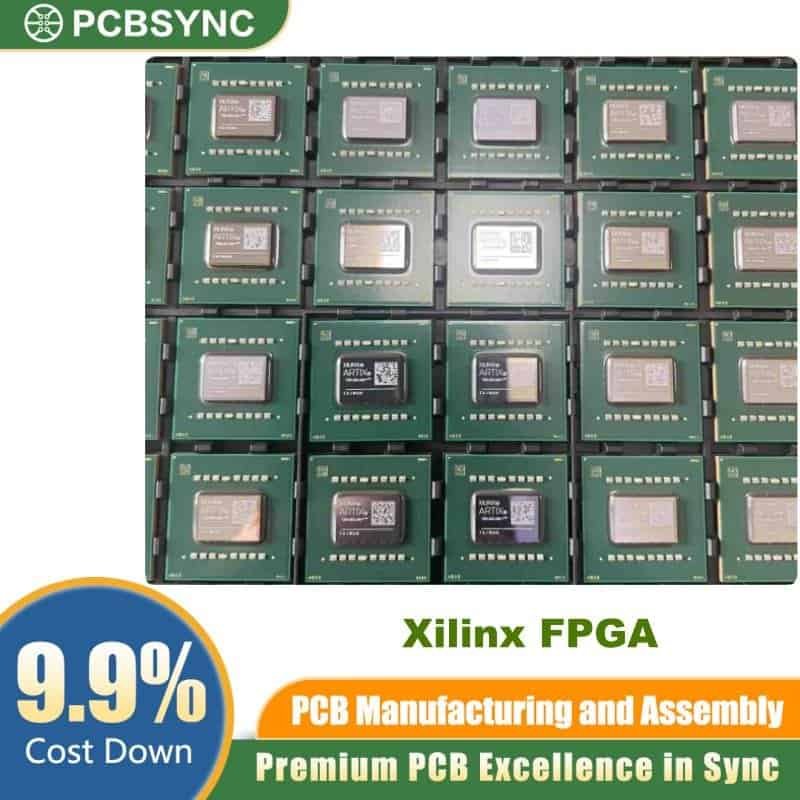
The XC3S4000-4FG900C is a high-density, commercial-grade Field Programmable Gate Array (FPGA) from AMD Xilinx’s Spartan-3 family. Designed for cost-sensitive, high-volume applications, this device delivers 4 million system gates in a fine-pitch 900-ball BGA package, making it an ideal solution for engineers who need powerful logic density without the premium cost of higher-end FPGA families. Whether you are developing embedded systems, digital signal processing pipelines, or communications hardware, the XC3S4000-4FG900C offers the performance and flexibility demanded by modern designs.
What Is the XC3S4000-4FG900C?
The XC3S4000-4FG900C belongs to the Xilinx FPGA Spartan-3 generation — one of the most widely deployed FPGA families in history. The part number breaks down as follows:
- XC3S4000 – Spartan-3 series with 4,000K system gates
- -4 – Commercial speed grade (slower propagation delay ceiling; suitable for most non-speed-critical designs)
- FG900 – Fine-pitch Ball Grid Array (FBGA), 900 balls
- C – Commercial temperature range (0°C to +85°C)
Key Features of the XC3S4000-4FG900C FPGA
- 4,000,000 system gates — substantial logic capacity for complex control and data path designs
- 84,672 logic cells organized in a regular array of Configurable Logic Blocks (CLBs)
- 96 dedicated 18Kb block RAMs providing 1,728 Kbits of on-chip memory
- 96 dedicated multipliers (18×18-bit) for high-throughput DSP applications
- 4 Digital Clock Managers (DCMs) for precise clock synthesis, deskewing, and phase shifting
- Up to 622 user I/Os supporting a wide range of I/O standards
- FG900 package — 900-ball FBGA, 31×31 mm body with 1.0 mm pitch
- 1.2V core voltage with 3.3V, 2.5V, 1.8V, and 1.5V I/O bank support
- Commercial temperature range: 0°C to +85°C
- Manufactured on 90nm process technology
XC3S4000-4FG900C Technical Specifications
General Parameters
| Parameter |
Value |
| Manufacturer |
AMD (Xilinx) |
| Series |
Spartan-3 |
| Part Number |
XC3S4000-4FG900C |
| Package |
FBGA-900 (Fine-Pitch Ball Grid Array) |
| Package Body Size |
31 × 31 mm |
| Ball Pitch |
1.0 mm |
| Mounting Type |
Surface Mount |
| Operating Temperature |
0°C to +85°C (Commercial) |
| Speed Grade |
-4 |
| Core Supply Voltage (VCCINT) |
1.2V |
| I/O Supply Voltage (VCCO) |
1.2V / 1.5V / 1.8V / 2.5V / 3.3V |
Logic Resources
| Resource |
Quantity |
| System Gates |
4,000,000 |
| Logic Cells |
84,672 |
| CLB Slices |
42,336 |
| CLB Array |
192 × 220 |
| Flip-Flops |
84,672 |
| 4-input LUTs |
84,672 |
| Block RAM (18Kbit each) |
96 |
| Total Block RAM |
1,728 Kbits |
| Dedicated Multipliers (18×18-bit) |
96 |
| Digital Clock Managers (DCMs) |
4 |
I/O Characteristics
| Parameter |
Value |
| Maximum User I/Os |
622 |
| I/O Banks |
8 |
| Differential I/O Pairs |
311 |
| LVDS Pairs |
311 |
| Max Single-Ended LVCMOS Drive |
24 mA |
Supported I/O Standards
| Standard |
Supported |
| LVCMOS 3.3V / 2.5V / 1.8V / 1.5V |
✓ |
| LVTTL |
✓ |
| SSTL 2 / SSTL 18 |
✓ |
| HSTL Class I / II |
✓ |
| LVDS, LVDS_25 |
✓ |
| RSDS |
✓ |
| BLVDS |
✓ |
| GTL, GTL+ |
✓ |
| PCI 3.3V (33 MHz / 66 MHz) |
✓ |
XC3S4000-4FG900C Ordering Information
| Attribute |
Detail |
| Manufacturer Part Number |
XC3S4000-4FG900C |
| DigiKey Part Number |
122-1698-ND |
| Manufacturer |
AMD / Xilinx |
| RoHS Compliance |
Compliant (Lead-free available) |
| ECCN (Export Classification) |
3E001 |
| HTSUS |
8542.39.00.01 |
Spartan-3 Family Comparison: XC3S4000 vs Similar Devices
| Device |
System Gates |
Logic Cells |
Block RAMs |
Multipliers |
Max I/Os |
| XC3S1000 |
1,000,000 |
17,280 |
24 |
24 |
391 |
| XC3S1500 |
1,500,000 |
29,952 |
32 |
32 |
487 |
| XC3S2000 |
2,000,000 |
46,080 |
40 |
40 |
565 |
| XC3S4000 |
4,000,000 |
84,672 |
96 |
96 |
622 |
| XC3S5000 |
5,000,000 |
104,832 |
104 |
104 |
784 |
The XC3S4000 sits near the top of the Spartan-3 family, offering the second-highest gate count while remaining significantly more affordable than Virtex-series devices.
Package Information: FG900 (FBGA-900)
The FG900 package is a Fine-Pitch Ball Grid Array with 900 solder balls arranged in a 30×30 grid matrix. Key physical characteristics are listed below.
| Parameter |
Value |
| Package Type |
FBGA (Fine Pitch BGA) |
| Total Balls |
900 |
| Ball Array |
30 × 30 |
| Package Body |
31 mm × 31 mm |
| Ball Pitch |
1.0 mm |
| Package Height |
2.55 mm (max) |
| Thermal Resistance θJA |
~12°C/W (still air) |
Designers working with this package should follow Xilinx BGA PCB design guidelines, including appropriate via-in-pad or dog-bone fanout strategies, controlled impedance power and ground planes, and careful decoupling capacitor placement to maintain signal integrity.
Digital Clock Manager (DCM) Capabilities
The XC3S4000-4FG900C includes 4 Digital Clock Managers, which provide:
- Clock deskewing to eliminate board and distribution delays
- Frequency synthesis with selectable multiplication (M) and division (D) factors
- Phase shifting in fixed or variable (fine-grain) increments
- Clock mirroring for 0°, 90°, 180°, and 270° outputs simultaneously
- DLL (Delay-Locked Loop) based clocking without VCO jitter
This makes the device well suited for multi-clock-domain designs, DDR memory interfaces, and high-speed serial applications.
Block RAM Architecture
Each of the 96 block RAMs in the XC3S4000-4FG900C is a true dual-port 18 Kbit SRAM, configurable as:
| Configuration |
Depth × Width |
| 16K × 1 |
Single bit deep |
| 8K × 2 |
Byte-wide shallow |
| 4K × 4 |
– |
| 2K × 9 |
Byte + parity |
| 1K × 18 |
Half-word + parity |
| 512 × 36 |
Word + parity |
Two adjacent 18Kb BRAMs can be combined to form a single 36Kb true dual-port RAM, offering up to 512 × 72-bit configurations. The total available block RAM of 1,728 Kbits (216 KB) supports demanding on-chip buffer, FIFO, and lookup table requirements.
Typical Applications for the XC3S4000-4FG900C
The XC3S4000-4FG900C is well suited for a broad range of applications across multiple industries:
Embedded Processing & Control
- Soft-processor implementations (MicroBlaze, PicoBlaze)
- Motor control and industrial automation controllers
- Custom SoC (System-on-Chip) designs
Communications & Networking
- Ethernet MAC/PHY bridging
- UART, SPI, I²C, and custom serial protocol engines
- Packet processing and header parsing
Digital Signal Processing
- FIR and IIR filter banks
- FFT/IFFT engines leveraging on-chip multipliers
- Image and video processing pipelines
Test & Measurement
- High-speed data acquisition front ends
- Protocol analysis and debugging
- Pattern generation and logic analysis
Consumer & Industrial Electronics
- Display controllers (LCD, LVDS)
- RAID and storage controllers
- Automotive and industrial sensor interfaces
Design Tools & Development Resources
AMD Xilinx provides a comprehensive toolchain and IP library for the Spartan-3 family:
| Tool / Resource |
Description |
| Vivado Design Suite (Legacy) / ISE Design Suite |
Full RTL-to-bitstream synthesis and implementation |
| IP Integrator / CORE Generator |
Pre-built IP cores (FIFO, memory controllers, DSP) |
| ChipScope Pro |
On-chip logic analyzer for debugging |
| MicroBlaze Soft Processor |
32-bit embedded RISC core for XC3S4000 |
| JTAG Configuration |
Via Xilinx Platform Cable USB II |
| Configuration Modes |
Master Serial, Slave Serial, Master Parallel, JTAG |
Configuration can be stored in an external SPI flash, BPI parallel NOR flash, or EEPROM. The device re-configures from non-volatile memory at power-on in milliseconds.
Power Consumption Guidelines
The XC3S4000-4FG900C operates from a 1.2V core supply. Actual power varies significantly based on toggle rate, utilization, and I/O switching activity. Xilinx’s XPower Estimator tool provides accurate pre-layout power estimates.
| Supply Rail |
Typical Voltage |
Current (Typical Utilization) |
| VCCINT (Core) |
1.2V |
~500–800 mA (depends on activity) |
| VCCO (I/O Banks) |
1.5V–3.3V |
Varies per bank |
| VCCAUX (Auxiliary) |
2.5V |
~20–50 mA |
Proper decoupling with low-ESR capacitors (100nF ceramic per power pin, bulk 10–47µF) is essential for stable operation at high frequencies.
PCB Design Considerations for XC3S4000-4FG900C
When designing a PCB for the XC3S4000-4FG900C in the FG900 package, engineers should consider:
- Minimum 6-layer PCB to accommodate power planes, signal routing, and BGA fanout
- Via-in-pad or dog-bone escape routing for the 1.0mm pitch BGA
- Ground pour beneath the package connected through vias for thermal dissipation
- Separate VCCINT and VCCO power planes to prevent noise coupling
- 100nF decoupling capacitors placed as close as possible to each power ball
- Consult Xilinx UG112 – PCB Design Guide for Spartan-3 FPGAs for detailed layout rules
Frequently Asked Questions (FAQ)
Q: What is the difference between XC3S4000-4FG900C and XC3S4000-4FG900I? A: The suffix “C” denotes the Commercial temperature grade (0°C to +85°C), while “I” denotes the Industrial grade (–40°C to +100°C). All logic and I/O resources are identical; only the guaranteed operating temperature range differs.
Q: Is the XC3S4000-4FG900C still in production? A: The Spartan-3 family has reached end-of-life status with Xilinx/AMD. However, authorized distributors and component brokers continue to carry existing inventory. For new designs, AMD recommends migrating to the Spartan-7 or Artix-7 families.
Q: Can the XC3S4000-4FG900C be used with Vivado? A: No. The Spartan-3 family is supported only by the legacy Xilinx ISE Design Suite 14.7. Vivado does not support devices older than the 7-Series.
Q: What configuration PROM is compatible with the XC3S4000-4FG900C? A: Common choices include the Xilinx XCF32P (Platform Flash PROM) or compatible SPI serial flash devices. The XC3S4000 requires approximately 12 Mbits of configuration storage.
Q: What is the maximum I/O frequency for LVDS pairs? A: LVDS data rates up to approximately 622 Mbps are achievable with the XC3S4000 using source-synchronous clocking techniques and proper PCB impedance matching.
Summary
The XC3S4000-4FG900C remains a capable and widely understood FPGA for engineers maintaining or extending existing Spartan-3 based designs. Its combination of 4 million system gates, 1,728 Kbits of block RAM, 96 hardware multipliers, and 622 user I/Os in a manageable 900-ball BGA form factor makes it a versatile platform. While new projects should consider the more modern Spartan-7 or Artix-7 families for longevity, the XC3S4000-4FG900C continues to serve reliably in deployed systems worldwide.