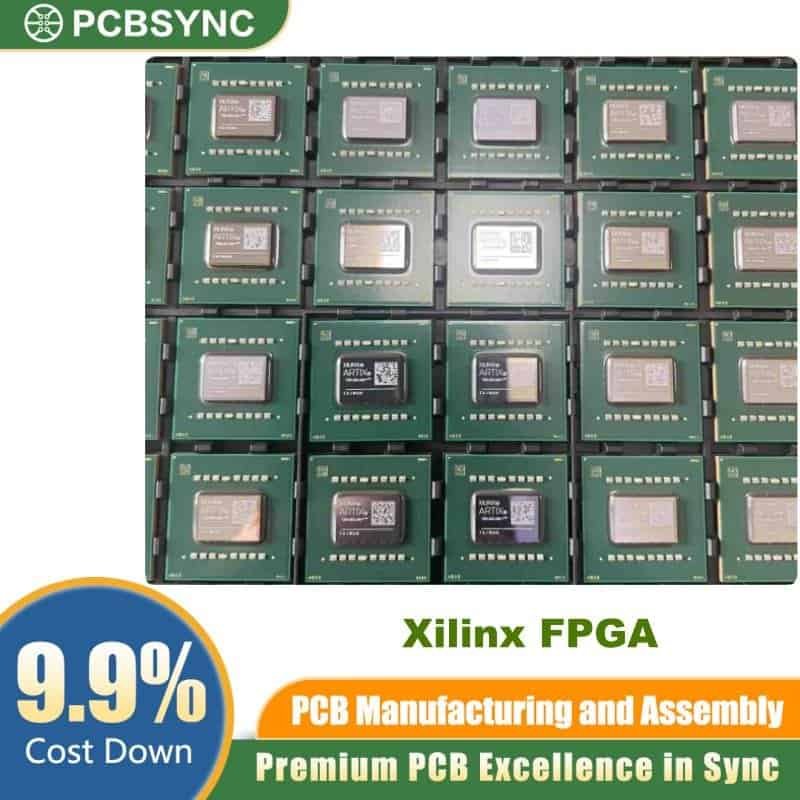
The XC3S4000-4FG676I is a high-capacity, industrial-grade Field Programmable Gate Array (FPGA) from the Xilinx Spartan-3 family, manufactured by AMD Xilinx. Designed for high-volume, cost-sensitive applications, this IC delivers 4 million gates, 489 I/O lines, and a robust 676-pin FBGA package — making it one of the most versatile and capable devices in the Spartan-3 lineup. Whether you are developing broadband access equipment, home networking hardware, digital television systems, or industrial control solutions, the XC3S4000-4FG676I offers an outstanding balance of performance, programmability, and value.
If you’re looking for a reliable source for Xilinx FPGA products, understanding the full specifications and capabilities of the XC3S4000-4FG676I is essential before purchasing.
What Is the XC3S4000-4FG676I?
The XC3S4000-4FG676I belongs to AMD Xilinx’s Spartan-3 FPGA family, a product line built on 90nm process technology and engineered to replace mask-programmed ASICs at a fraction of the cost and development time. Unlike traditional ASICs, this FPGA is fully reprogrammable, enabling hardware engineers to update and iterate on their designs in the field without replacing physical components.
The “4” speed grade in the part number indicates a maximum system clock frequency of up to 630 MHz, while the “I” suffix denotes the industrial temperature range, qualifying it for environments from −40°C to +100°C (TJ). This makes the XC3S4000-4FG676I an excellent fit not just for consumer electronics, but also for harsh industrial and telecommunications environments.
XC3S4000-4FG676I Key Specifications
| Parameter |
Value |
| Part Number |
XC3S4000-4FG676I |
| Manufacturer |
AMD Xilinx (formerly Xilinx Inc.) |
| Series |
Spartan®-3 |
| Device Type |
FPGA (Field Programmable Gate Array) |
| Number of Gates |
4,000,000 |
| Logic Cells (CLBs) |
62,208 |
| Number of LABs/CLBs |
6,912 |
| Total RAM Bits |
1,769,472 |
| Number of I/O |
489 |
| Maximum Frequency |
630 MHz |
| Process Technology |
90nm |
| Supply Voltage |
1.14V – 1.26V (nominal 1.2V) |
| I/O Voltage Standards |
3.3V, 2.5V, 1.8V, 1.5V, 1.2V |
| Package / Case |
676-FCBGA (Fine-Pitch Ball Grid Array) |
| Mounting Type |
Surface Mount (SMD) |
| Operating Temperature |
−40°C to +100°C (TJ) |
| Product Status |
Active |
| RoHS Compliance |
Non-Compliant (legacy product) |
XC3S4000-4FG676I Package and Pin Configuration
| Package Detail |
Description |
| Package Type |
676-Pin FCBGA (Fine-Pitch Ball Grid Array) |
| Package Code |
FG676 |
| Total Pin Count |
676 |
| User I/O Pins |
489 |
| Mounting Style |
Surface Mount |
| PCB Footprint |
Standard FBGA-676 |
The 676-FCBGA package offers a high pin density in a compact footprint, making it suitable for space-constrained PCB designs. Its surface-mount construction simplifies automated assembly processes in high-volume manufacturing environments.
XC3S4000-4FG676I Logic and Memory Resources
Understanding the internal architecture is critical for evaluating whether this FPGA meets your design requirements.
| Resource |
Quantity |
| Configurable Logic Blocks (CLBs) |
6,912 |
| Logic Cells |
62,208 |
| Equivalent Gates |
4,000,000 |
| Block RAM Bits |
1,769,472 |
| Distributed RAM |
Included in CLB slices |
| Dedicated Multipliers |
Available (DSP slices) |
| Digital Clock Managers (DCMs) |
4 |
The large pool of 62,208 logic cells enables highly parallel architectures, making the XC3S4000-4FG676I ideal for signal processing pipelines, state machines, and custom processor implementations. The 1,769,472 bits of block RAM (approximately 1.69 Mb) supports applications that require fast on-chip data buffering, FIFO queues, or embedded lookup tables.
XC3S4000-4FG676I Electrical Characteristics
| Parameter |
Minimum |
Typical |
Maximum |
| Core Supply Voltage (VCCINT) |
1.14V |
1.2V |
1.26V |
| I/O Supply Voltage (VCCO) |
— |
1.2V to 3.3V |
— |
| Maximum System Frequency |
— |
— |
630 MHz |
| Operating Junction Temp |
−40°C |
— |
+100°C |
| ESD Protection |
Per JEDEC JESD22-A114 |
— |
— |
The device’s core voltage of 1.2V is consistent with modern low-power FPGA designs, reducing heat dissipation and extending component reliability. The wide range of supported I/O voltages (1.2V to 3.3V) allows seamless interfacing with a variety of peripheral ICs without the need for external level-shifters in many use cases.
XC3S4000-4FG676I: Industrial Temperature Grade Explained
The “I” suffix in the XC3S4000-4FG676I designates the industrial temperature grade, guaranteeing reliable operation across a junction temperature range of −40°C to +100°C. This distinguishes it from commercial-grade variants (typically rated 0°C to 85°C).
| Grade |
Suffix |
Temperature Range (TJ) |
| Commercial |
C |
0°C to +85°C |
| Industrial |
I |
−40°C to +100°C |
Industrial-grade FPGAs like the XC3S4000-4FG676I are required in applications such as factory automation, military/defense electronics, telecommunications infrastructure, and outdoor industrial equipment where ambient temperatures can fluctuate dramatically.
XC3S4000-4FG676I Speed Grade: What “-4” Means
The -4 speed grade refers to the performance tier of the FPGA. In Xilinx’s Spartan-3 naming convention, a lower number denotes a faster device.
| Speed Grade |
Performance |
Typical Use |
| -4 |
Fastest (630 MHz) |
High-performance DSP, fast interfaces |
| -5 |
Medium |
Balanced performance and power |
The -4 grade makes the XC3S4000-4FG676I the highest-performance variant in this series, ideal for demanding applications with strict timing budgets, including high-speed data acquisition, video processing, and communications protocol handling.
XC3S4000-4FG676I Applications and Use Cases
#### Digital Signal Processing (DSP)
The XC3S4000-4FG676I is a powerful platform for implementing complex DSP algorithms. Designers can leverage the device’s parallel logic resources and dedicated multipliers for real-time audio and video signal manipulation, including Fourier transforms, FIR/IIR filtering, and modulation/demodulation schemes.
#### Broadband Access and Networking
The chip’s large I/O count (489 pins) and high-speed clock support make it well-suited for broadband modems, network switches, and home networking equipment. Its reprogrammability enables vendors to update communication protocols post-deployment.
#### Display and Projection Systems
The XC3S4000-4FG676I is widely used in display controllers, projection systems, and digital television equipment, where it manages video timing, scaling, and interface conversion between different display standards.
#### Industrial Automation and Control
With its industrial temperature rating and robust I/O options, this FPGA is deployed in PLC controllers, motor drives, robotics, and sensor fusion systems within factory automation environments.
#### Embedded Custom Processors
The device can host soft-core processors (such as Xilinx’s MicroBlaze or PicoBlaze) along with custom accelerators, enabling single-chip embedded systems with flexible hardware/software partitioning.
#### Communications and Protocol Bridging
Its support for multiple I/O voltage standards (1.2V to 3.3V) and the large number of configurable I/O lines make it ideal for bridging heterogeneous communication buses, including SPI, I2C, UART, Ethernet MAC, and custom serial protocols.
XC3S4000-4FG676I vs. Other Spartan-3 Devices
| Part Number |
Gates |
Logic Cells |
I/O Pins |
Package |
Temp Grade |
| XC3S400-4FG456I |
400K |
8,064 |
264 |
456-FBGA |
Industrial |
| XC3S1000-4FG676I |
1M |
17,280 |
391 |
676-FBGA |
Industrial |
| XC3S4000-4FG676I |
4M |
62,208 |
489 |
676-FBGA |
Industrial |
| XC3S5000-4FG900I |
5M |
74,880 |
633 |
900-FBGA |
Industrial |
The XC3S4000-4FG676I sits in the upper tier of the Spartan-3 family, offering significantly more logic capacity than the XC3S1000 while remaining in the same 676-pin package footprint — an important advantage for designs that may need to scale without PCB re-layout.
XC3S4000-4FG676I Design Tools and Programming
The XC3S4000-4FG676I is supported by AMD Xilinx’s industry-standard development toolchains:
| Tool |
Version |
Purpose |
| Xilinx ISE Design Suite |
14.x (final) |
Legacy synthesis, simulation, and implementation |
| Vivado Design Suite |
Not supported (Spartan-3 only in ISE) |
Newer devices only |
| ModelSim / ISIM |
Compatible |
RTL and gate-level simulation |
| JTAG Programming Cable |
Platform Cable USB II |
On-board configuration |
| Configuration Memory |
SPI Flash / JTAG |
Non-volatile bitstream storage |
Note: Spartan-3 family devices are programmed using Xilinx ISE Design Suite 14.x. Vivado does not support the Spartan-3 architecture. Engineers migrating to newer platforms should consider Spartan-7 or Artix-7 devices.
XC3S4000-4FG676I Ordering Information
| Field |
Detail |
| Full Part Number |
XC3S4000-4FG676I |
| Manufacturer |
AMD Xilinx |
| DigiKey Part Number |
122-1514-ND |
| ECAD Model |
Available from major libraries |
| Packaging |
Tray (bulk anti-static) |
| Product Lifecycle |
Active |
| Recommended Replacement |
Spartan-7 XC7S50 or Artix-7 (for new designs) |
Why Choose the XC3S4000-4FG676I Over an ASIC?
The XC3S4000-4FG676I is positioned as a superior alternative to mask-programmed ASICs for many applications:
- No Non-Recurring Engineering (NRE) Costs – Eliminates the expensive mask set required for custom ASICs, reducing time-to-market and upfront investment.
- In-Field Reprogrammability – Firmware and logic updates can be deployed without hardware changes, a capability impossible with fixed ASICs.
- Shorter Development Cycles – RTL designs can be tested and validated on real hardware in hours rather than months.
- Design Flexibility – Adapt to changing standards, customer requirements, or bug fixes post-production.
- Scalable Parallel Architecture – Exploits hardware parallelism for latency-sensitive tasks that software processors cannot match.
XC3S4000-4FG676I PCB Design Considerations
When integrating the XC3S4000-4FG676I into a PCB design, engineers should follow these best practices:
- Decoupling Capacitors: Place 100nF and 10µF decoupling capacitors close to each power pin (VCCINT and VCCO banks) to minimize power supply noise.
- Signal Integrity: Route high-speed I/O signals with controlled impedance (typically 50Ω) and minimize via stubs on critical signal paths.
- Thermal Management: The 676-BGA package requires adequate thermal relief. Monitor junction temperature under full logic utilization; consider heatspreaders for sustained high-throughput applications.
- JTAG Chain: Plan the JTAG boundary-scan chain layout early to simplify in-circuit programming and debug.
- Power Sequencing: Ensure VCCINT (1.2V) powers up before VCCO rails to prevent latch-up conditions.
Frequently Asked Questions (FAQ)
Q: What is the XC3S4000-4FG676I used for? The XC3S4000-4FG676I is used in digital signal processing, broadband access equipment, home networking, display and projection systems, digital television, and industrial control applications.
Q: What is the operating temperature of the XC3S4000-4FG676I? The device is rated for an industrial temperature range of −40°C to +100°C (junction temperature), making it suitable for harsh environments.
Q: Is the XC3S4000-4FG676I RoHS compliant? No. The XC3S4000-4FG676I is listed as RoHS non-compliant as a legacy product. Designers with RoHS requirements should verify with their distributor or consider newer Xilinx families.
Q: What software is needed to program the XC3S4000-4FG676I? Xilinx ISE Design Suite 14.x is the recommended toolchain for Spartan-3 FPGA development. Vivado is not compatible with this device family.
Q: What is the difference between XC3S4000-4FG676I and XC3S4000-4FGG676I? These part numbers refer to the same device. “FGG” is sometimes used as an alternate designator for the fine-pitch ball grid array package in distributor databases.
Q: Can the XC3S4000-4FG676I replace an existing ASIC design? Yes. The Spartan-3 family was specifically architected as an ASIC replacement platform, eliminating NRE costs and enabling post-deployment field updates that fixed ASICs cannot support.
Summary
The XC3S4000-4FG676I is a proven, high-density industrial FPGA delivering 4 million gates, 62,208 logic cells, 489 configurable I/O pins, and 1.76 Mb of block RAM in a 676-pin FCBGA package. Its industrial temperature grade, -4 speed performance, and broad I/O voltage compatibility make it a reliable choice for engineers designing telecommunications infrastructure, industrial automation systems, video processing pipelines, and high-speed data acquisition platforms. As a fully programmable alternative to ASICs, it offers unmatched flexibility and a dramatically lower barrier to entry for both prototyping and volume production.