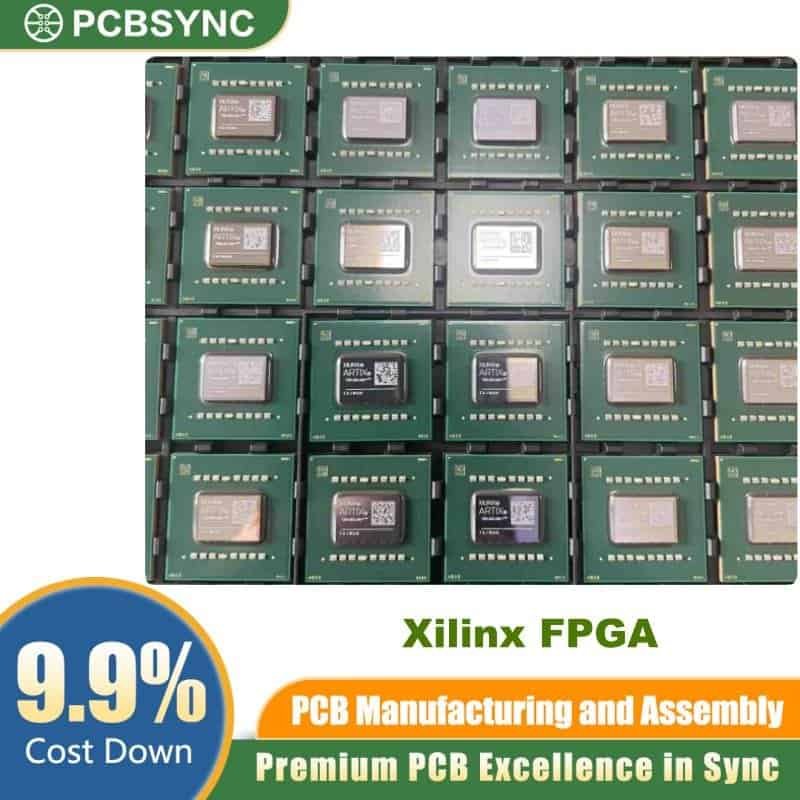
The XC3S4000-4FG676C is a high-performance, cost-effective Field-Programmable Gate Array (FPGA) from Xilinx’s Spartan®-3 family. Manufactured on advanced 90nm process technology, this device delivers 4 million system gates and 62,208 logic cells in a compact 676-pin Fine-pitch Ball Grid Array (FBGA) package. Whether you are designing for broadband access, digital television, home networking, or industrial control systems, the XC3S4000-4FG676C offers the logic density, I/O flexibility, and performance that demanding applications require.
As part of the broader Xilinx FPGA product line, the XC3S4000-4FG676C combines proven programmable logic technology with exceptional value — making it a preferred choice for engineers worldwide.
XC3S4000-4FG676C Key Specifications at a Glance
| Parameter |
Value |
| Part Number |
XC3S4000-4FG676C |
| Manufacturer |
AMD Xilinx |
| Family |
Spartan®-3 |
| System Gates |
4,000,000 |
| Logic Cells |
62,208 |
| Configurable Logic Blocks (CLBs) |
6,912 |
| Maximum Frequency |
630 MHz |
| Process Technology |
90nm CMOS |
| Core Supply Voltage |
1.2V (1.14V – 1.26V) |
| I/O Pins |
489 user I/Os |
| Total Package Pins |
676 |
| Package Type |
676-FBGA (27mm × 27mm) |
| Mount Type |
Surface Mount |
| Operating Temperature |
0°C to +85°C (Commercial) |
| Speed Grade |
-4 |
| RoHS Status |
Not Compliant (Standard) |
What Is the XC3S4000-4FG676C? Overview of the Spartan-3 FPGA
The XC3S4000-4FG676C belongs to Xilinx’s eight-member Spartan-3 FPGA family, which spans logic densities from 50,000 to 5,000,000 system gates. This family was purpose-built to serve high-volume, cost-sensitive consumer and industrial electronics applications, bridging the gap between low-cost programmable logic and high-performance ASIC-class designs.
The Spartan-3 platform builds directly on the Virtex®-II architecture, inheriting several advanced features while optimizing for price-per-logic-unit. The result is a device that delivers substantially more functionality and I/O bandwidth per dollar compared to its predecessors.
Part Number Decoding: Understanding XC3S4000-4FG676C
Understanding the part number helps engineers confirm they have the right device:
| Segment |
Meaning |
| XC |
Xilinx Commercial Product |
| 3S |
Spartan-3 Family |
| 4000 |
4,000,000 System Gates |
| 4 |
Speed Grade (-4, standard commercial) |
| FG |
Fine-pitch Ball Grid Array (FBGA) Package |
| 676 |
676 Total Package Pins |
| C |
Commercial Temperature Range (0°C to +85°C) |
XC3S4000-4FG676C Logic Resources and Architecture
The internal architecture of the XC3S4000-4FG676C is designed around five fundamental programmable functional elements that work together to deliver flexible, high-density logic.
Configurable Logic Blocks (CLBs)
The device contains 6,912 CLBs, each composed of four slices. Each slice provides two 4-input Look-Up Tables (LUTs), two storage elements (flip-flops or latches), and carry/arithmetic logic — giving designers fine-grained control over both combinational and sequential logic implementation.
Block RAM (BRAM)
| Resource |
Quantity |
| Block RAM tiles |
96 |
| Total Block RAM capacity |
1,728 Kbits |
| Max distributed RAM |
520 Kbits |
The on-chip Block RAM enables efficient storage of lookup tables, FIFO buffers, packet buffers, and embedded data arrays — reducing external memory requirements and improving system performance.
Dedicated Multipliers
The XC3S4000-4FG676C includes 96 dedicated 18×18-bit hardware multipliers. These multipliers accelerate DSP functions such as digital filtering, FFT computation, and signal processing without consuming CLB resources.
Digital Clock Managers (DCMs)
| DCM Feature |
Detail |
| Number of DCMs |
4 |
| Clock multiplication/division |
Supported |
| Phase shifting |
Fine and coarse adjustment |
| Clock deskew |
Supported |
| Spread-spectrum clocking |
Not natively supported |
The four integrated DCMs provide clean, phase-aligned clocking across the device. Engineers can multiply, divide, and phase-shift clock signals — essential for multi-clock-domain designs and high-speed serial interfaces.
I/O Capabilities and Supported Standards
With 489 user I/O pins in the 676-pin FBGA package, the XC3S4000-4FG676C supports a broad range of single-ended and differential I/O standards.
Supported I/O Standards
| I/O Standard |
Type |
| LVCMOS (1.2V, 1.5V, 1.8V, 2.5V, 3.3V) |
Single-Ended |
| LVTTL |
Single-Ended |
| SSTL2 Class I & II |
Single-Ended / Differential |
| SSTL3 Class I & II |
Single-Ended / Differential |
| HSTL Class I, II, III, IV |
Single-Ended / Differential |
| LVDS |
Differential |
| RSDS |
Differential |
| BLVDS |
Differential |
| GTL / GTL+ |
Single-Ended |
| PCI (3.3V, 33/66 MHz) |
Single-Ended |
The maximum I/O output drive strength is 12 mA, with configurable slew rates for both fast and slow edge-rate control — important for managing signal integrity and EMI in high-density PCB designs.
Power Supply Requirements
Proper power delivery is critical for reliable FPGA operation. The XC3S4000-4FG676C requires two primary supply rails:
| Supply Rail |
Voltage |
Purpose |
| VCCINT |
1.2V (1.14V – 1.26V) |
Core logic power |
| VCCO |
1.2V – 3.3V (bank-dependent) |
I/O output power |
| VCCAUX |
2.5V |
Auxiliary circuits, DCMs |
The multi-voltage I/O architecture allows each I/O bank to be powered independently, making it straightforward to interface with 1.8V, 2.5V, or 3.3V peripherals within the same design.
Package and Physical Characteristics
676-Pin FBGA Package Details
| Characteristic |
Value |
| Package |
676-FBGA (Fine-pitch Ball Grid Array) |
| Body Size |
27mm × 27mm |
| Ball Pitch |
1.0mm |
| Mount Type |
Surface Mount (SMT) |
| Lead Finish |
Pb-Free options available |
| PCB Footprint |
Standard FBGA 676 |
The FBGA package is well-suited for automated SMT assembly and reflow soldering processes. The 1.0mm ball pitch is compatible with standard PCB design rules for via-in-pad and escape routing techniques.
Programming and Configuration
Configuration Modes
The XC3S4000-4FG676C supports multiple configuration modes to suit different system architectures:
| Configuration Mode |
Description |
| Master Serial |
FPGA drives configuration from serial Flash |
| Slave Serial |
External host controls configuration |
| Master SPI |
Configuration via SPI Flash memory |
| Master BPI (Parallel NOR Flash) |
Parallel configuration for fast startup |
| JTAG |
Boundary scan and in-system programming |
| Slave SelectMAP |
High-speed parallel configuration by processor |
Configuration data is stored externally and loaded into the FPGA at power-up or on demand. The JTAG interface supports both configuration and in-system debugging through Xilinx’s ChipScope Pro logic analyzer tool.
Development Tools
The XC3S4000-4FG676C is supported by the following Xilinx design tools:
- ISE Design Suite — The primary design environment for Spartan-3-era FPGAs, supporting VHDL, Verilog, and schematic entry
- XST (Xilinx Synthesis Technology) — Integrated synthesis engine
- ChipScope Pro — In-system logic analysis and debugging
- iMPACT — Device programming and configuration utility
Applications: Where the XC3S4000-4FG676C Excels
The XC3S4000-4FG676C is optimized for applications that demand high logic density, broad I/O compatibility, and cost efficiency. Typical use cases include:
Consumer Electronics
- Digital Television (DTV) signal processing
- DVD and Blu-ray player controllers
- Set-top box logic and interface management
- Home networking equipment (routers, switches)
Communications and Networking
- Broadband access infrastructure (DSL, cable)
- Line card and framer logic
- Protocol bridging and conversion (PCI, USB, Ethernet)
- Wireless baseband processing
Industrial and Embedded Systems
- Motor control and motion control systems
- Industrial Ethernet interfaces
- Data acquisition front-ends
- Test and measurement instrumentation
Imaging and Display
- Display controller and scaler logic
- Projection system signal management
- Machine vision pre-processing pipelines
XC3S4000-4FG676C vs. Other Spartan-3 Variants
The Spartan-3 family offers multiple density options. Here is how the XC3S4000-4FG676C compares to closely related parts:
| Part Number |
System Gates |
Logic Cells |
Block RAM (Kbits) |
Multipliers |
Package |
Speed Grade |
| XC3S2000-4FG676C |
2,000,000 |
46,080 |
864 |
48 |
676-FBGA |
-4 |
| XC3S4000-4FG676C |
4,000,000 |
62,208 |
1,728 |
96 |
676-FBGA |
-4 |
| XC3S4000-5FG676C |
4,000,000 |
62,208 |
1,728 |
96 |
676-FBGA |
-5 (faster) |
| XC3S5000-4FG1156C |
5,000,000 |
74,880 |
2,304 |
104 |
1156-FBGA |
-4 |
The -4 speed grade in the XC3S4000-4FG676C denotes a standard commercial speed bin with a maximum operating frequency of 630 MHz, which suits the majority of design requirements. For timing-critical paths requiring higher clock speeds, the -5 grade variant offers up to 725 MHz.
Advantages Over Traditional ASICs
One of the defining strengths of the XC3S4000-4FG676C — and all Spartan-3 FPGAs — is their programmability advantage over mask-programmed ASICs:
- No NRE (Non-Recurring Engineering) costs — Eliminates expensive mask tooling charges
- Faster time-to-market — Design iterations in hours, not months
- In-field reconfigurability — Update firmware and logic without PCB rework or hardware replacement
- Lower risk — Bugs and design changes are correctable post-deployment
- Scalable production — No minimum order quantities tied to ASIC economics
These advantages make the XC3S4000-4FG676C an excellent choice for products with evolving firmware requirements, short product cycles, or low-to-mid production volumes.
Ordering Information
| Attribute |
Detail |
| Part Number |
XC3S4000-4FG676C |
| Manufacturer |
AMD Xilinx |
| DigiKey Part Number |
122-1496-ND |
| Series |
Spartan®-3 |
| Package |
676-FBGA |
| Temperature Grade |
Commercial (0°C to +85°C) |
| RoHS Status |
Contact distributor for RoHS-compliant variant |
| Minimum Order |
1 unit (check distributor for tray/reel quantities) |
For volume pricing, lead time inquiries, or RoHS-compliant alternatives, contact your authorized Xilinx distributor or AMD’s official sales channel.
Frequently Asked Questions (FAQ)
Q: What is the XC3S4000-4FG676C? The XC3S4000-4FG676C is a Xilinx Spartan-3 FPGA with 4 million system gates, 62,208 logic cells, and a 676-pin FBGA package. It operates at up to 630 MHz on a 1.2V core supply.
Q: What design tools support the XC3S4000-4FG676C? The XC3S4000-4FG676C is fully supported by Xilinx ISE Design Suite, including XST synthesis, ISim simulation, and ChipScope Pro for in-system debug. Xilinx Vivado does not support Spartan-3; ISE 14.7 is the recommended tool.
Q: What is the difference between XC3S4000-4FG676C and XC3S4000-5FG676C? The only difference is the speed grade. The -4 variant runs at up to 630 MHz while the -5 variant achieves up to 725 MHz. Both share identical logic resources, package, and pinout.
Q: Is the XC3S4000-4FG676C RoHS compliant? The standard XC3S4000-4FG676C is not RoHS compliant. Engineers requiring lead-free, RoHS-compliant parts should inquire with distributors about the appropriate Pb-free variant.
Q: What package does the XC3S4000-4FG676C use? It uses a 676-pin Fine-pitch Ball Grid Array (FBGA) measuring 27mm × 27mm with 1.0mm ball pitch, suitable for standard SMT assembly and reflow soldering.