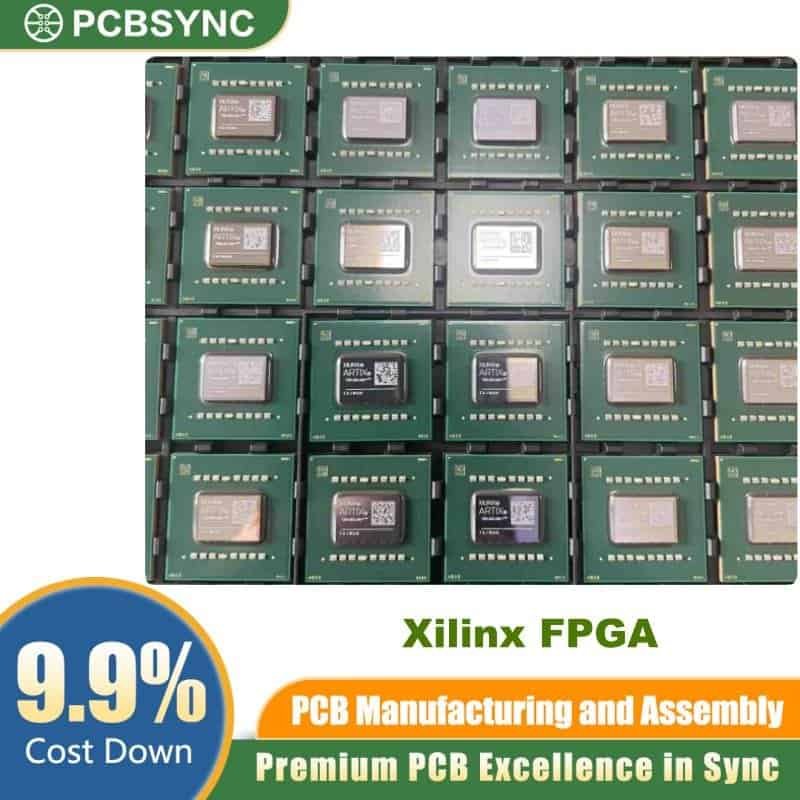
The XC3S400-4TQG144C is a high-performance, cost-optimized Field Programmable Gate Array (FPGA) from the Xilinx Spartan-3 family, now part of the AMD portfolio. Designed for high-volume production and cost-sensitive applications, this device delivers 400,000 system gates in a compact 144-pin Thin Quad Flat Package (TQFP). Whether you are developing embedded control systems, digital signal processing pipelines, or interface bridging solutions, the XC3S400-4TQG144C offers the logic density, I/O flexibility, and speed performance to meet demanding design requirements.
If you are looking for a broad range of programmable logic solutions, explore our full catalog of Xilinx FPGA devices.
What Is the XC3S400-4TQG144C?
The XC3S400-4TQG144C belongs to Xilinx’s Spartan-3 series, a family engineered to bring FPGA technology to high-volume, cost-sensitive markets without sacrificing programmable logic capability. The “400” in the part number denotes 400,000 equivalent system gates. The “-4” suffix indicates the speed grade — a standard commercial speed grade within the Spartan-3 family. The “TQG144” designates the 144-pin TQFP package, and the “C” suffix specifies the commercial temperature range (0°C to +85°C).
This device is manufactured on a 90nm process technology and features Xilinx’s fifth-generation FPGA architecture, which includes dedicated multipliers, distributed and block RAM, and digital clock management (DCM) blocks — all in a single, affordable package.
XC3S400-4TQG144C Key Specifications
| Parameter |
Value |
| Manufacturer |
AMD (Xilinx) |
| Part Number |
XC3S400-4TQG144C |
| Series |
Spartan-3 |
| System Gates |
400,000 |
| Logic Cells |
8,064 |
| CLB Slices |
3,584 |
| Distributed RAM |
56 Kb |
| Block RAM |
288 Kb |
| Dedicated Multipliers (18×18) |
16 |
| Digital Clock Managers (DCM) |
4 |
| Maximum User I/O |
97 |
| Package Type |
TQFP (Thin Quad Flat Package) |
| Pin Count |
144 |
| Speed Grade |
-4 |
| Operating Voltage (VCCINT) |
1.2V |
| I/O Voltage Support |
1.2V, 1.5V, 1.8V, 2.5V, 3.3V |
| Temperature Range |
0°C to +85°C (Commercial) |
| Process Technology |
90nm |
| Configuration Interface |
Master Serial, Slave Serial, JTAG, SelectMAP |
XC3S400-4TQG144C Architecture Overview
CLB and Logic Resources
The heart of the XC3S400-4TQG144C is its array of Configurable Logic Blocks (CLBs). Each CLB contains four slices, and each slice includes two 4-input Look-Up Tables (LUTs), two flip-flops, carry logic, and wide-function multiplexers. The 3,584 slices provide substantial combinatorial and sequential logic capacity for complex digital designs.
Dedicated Block RAM
The device integrates 288 Kb of dual-port block RAM organized in 18 Kb blocks. This dedicated memory supports true dual-port operation, allowing simultaneous read and write from two independent ports. Block RAM is ideal for FIFOs, lookup tables, packet buffers, and embedded processor memory in designs using MicroBlaze or PicoBlaze soft processors.
Distributed RAM
In addition to block RAM, the XC3S400-4TQG144C provides 56 Kb of distributed RAM implemented within the CLB LUTs. Distributed RAM is useful for small, fast memories closely coupled to logic, minimizing routing delays.
Dedicated Multipliers
Sixteen 18×18-bit dedicated hardware multipliers enable efficient implementation of DSP functions such as digital filters, FFTs, and control loop algorithms. Using dedicated multipliers instead of LUT-based multipliers frees up logic resources and improves timing closure.
Digital Clock Management (DCM)
Four on-chip DCM blocks provide flexible clock synthesis, phase shifting, and frequency multiplication/division. DCMs allow designers to generate multiple clock domains from a single reference clock, eliminate clock skew, and implement phase-aligned clocking for high-speed interfaces.
XC3S400-4TQG144C I/O and Package Details
I/O Bank Architecture
| Feature |
Details |
| Total Package Pins |
144 |
| Maximum User I/O |
97 |
| I/O Banks |
4 |
| Differential I/O Pairs |
Up to 24 LVDS pairs |
| Supported I/O Standards |
LVTTL, LVCMOS (1.2V–3.3V), LVDS, SSTL, HSTL, PCI |
Package Dimensions
| Parameter |
Value |
| Package Body Size |
20mm × 20mm |
| Pitch |
0.5mm |
| Package Height |
1.0mm (max) |
| Mounting Style |
Surface Mount (SMD/SMT) |
The 144-pin TQFP package is well-suited for designs requiring a balance between pin count and PCB footprint. The 0.5mm pitch is compatible with standard fine-pitch SMT assembly processes.
Speed Grade and Timing Performance
The “-4” speed grade is the standard commercial offering in the Spartan-3 family. Key timing characteristics include:
| Timing Parameter |
Typical Value |
| Maximum System Clock (Fmax) |
~200 MHz (design-dependent) |
| DCM Input Frequency Range |
24 MHz – 280 MHz |
| CLB-to-CLB Routing Delay |
Sub-nanosecond (typical) |
| Setup Time (Tsu) |
<1 ns (flip-flop) |
| Clock-to-Output (Tco) |
<5 ns (I/O register) |
Faster speed grades (-5) are available in other variants; the -4 grade is appropriate for most standard embedded and control applications.
Configuration Options for XC3S400-4TQG144C
The Spartan-3 FPGA supports multiple configuration modes, giving designers flexibility in production programming:
| Configuration Mode |
Description |
| Master Serial |
FPGA reads bitstream from external SPI Flash |
| Slave Serial |
External controller streams bitstream |
| JTAG (IEEE 1149.1) |
In-circuit, boundary scan, and debug configuration |
| SelectMAP (Parallel) |
8-bit parallel configuration for fast load times |
| Master SPI |
Direct connection to SPI Flash memory |
| Master BPI |
Parallel NOR Flash configuration |
The JTAG interface also supports Xilinx’s ChipScope Pro for in-system debugging without external logic analyzers.
Supported I/O Standards
The XC3S400-4TQG144C supports a wide range of I/O voltage standards, enabling seamless interfacing with diverse system components:
| I/O Standard |
Voltage Level |
Common Use Case |
| LVCMOS33 |
3.3V |
General-purpose logic, microcontrollers |
| LVCMOS25 |
2.5V |
Memory interfaces, mixed-voltage systems |
| LVCMOS18 |
1.8V |
Low-power memory, sensors |
| LVCMOS15 |
1.5V |
DDR memory interfaces |
| LVTTL |
3.3V |
Legacy TTL-compatible interfaces |
| LVDS |
2.5V/3.3V |
High-speed differential signaling |
| SSTL2 / SSTL3 |
2.5V / 3.3V |
DDR SDRAM interfaces |
| HSTL |
1.5V |
SRAM, network processors |
| PCI / PCI-X |
3.3V |
PCI bus interfaces |
Power Supply Requirements
The XC3S400-4TQG144C operates from two primary supply voltages:
| Supply |
Voltage |
Description |
| VCCINT |
1.2V |
Core logic power supply |
| VCCO |
1.2V – 3.3V |
I/O bank supply voltage (per bank) |
| VCCAUX |
2.5V |
Auxiliary power for DCMs, DCI, config |
Proper power sequencing is recommended: VCCINT should be powered before or simultaneous with VCCO. Xilinx application note XAPP682 provides detailed power management guidelines for Spartan-3 devices.
Typical Applications for XC3S400-4TQG144C
The XC3S400-4TQG144C is a versatile device used across a wide range of industries and application domains:
Embedded Systems and Control
- Motor control with PWM generation and encoder interfaces
- Servo drive feedback processing
- Industrial automation and PLC replacement
- Safety-critical control with redundant logic
Communications and Networking
- UART, SPI, I2C, and CAN bus protocol bridging
- Ethernet MAC and PHY interface logic
- LVDS serial data links for backplane applications
- Multi-channel data aggregation
Signal Processing (DSP)
- FIR and IIR digital filters using dedicated multipliers
- FFT computation for audio and sensor data
- Radar and LIDAR signal conditioning
- Software-defined radio (SDR) baseband processing
Video and Imaging
- Frame buffering and pixel pipeline processing
- LVDS-based camera interface (LVDS deserializer)
- Timing controller for LCD displays
- Image pre-processing in machine vision systems
Test and Measurement
- Waveform generation and capture
- High-speed data logging with FIFO buffering
- Boundary scan and JTAG chain management
- BERT (Bit Error Rate Testing) logic
XC3S400-4TQG144C vs. Other Spartan-3 Variants
| Part Number |
Gates |
Slices |
Block RAM |
Multipliers |
Max I/O |
Package Options |
| XC3S50-4TQG144C |
50K |
768 |
72 Kb |
4 |
97 |
TQ144, PQ208 |
| XC3S200-4TQG144C |
200K |
1,920 |
216 Kb |
12 |
97 |
TQ144, PQ208 |
| XC3S400-4TQG144C |
400K |
3,584 |
288 Kb |
16 |
97 |
TQ144, PQ208 |
| XC3S1000-4FTG256C |
1M |
7,680 |
432 Kb |
24 |
173 |
FT256, FG320 |
| XC3S1500-4FG320C |
1.5M |
13,312 |
504 Kb |
32 |
221 |
FG320, FG456 |
The XC3S400 strikes an excellent balance between resource density and package size, making it the preferred mid-range Spartan-3 device for designs that have outgrown the XC3S200 but do not require the larger XC3S1000.
XC3S400-4TQG144C vs. Competing FPGAs
| Feature |
XC3S400-4TQG144C |
Altera Cyclone II EP2C5 |
Lattice MachXO2-4000 |
| Logic Elements / Cells |
8,064 LCs |
4,608 LEs |
4,320 LUTs |
| Block RAM |
288 Kb |
119 Kb |
128 Kb |
| Dedicated Multipliers |
16 |
13 |
0 (soft) |
| DCM / PLL |
4 DCMs |
2 PLLs |
2 PLLs |
| Process Node |
90nm |
90nm |
40nm |
| Package |
TQFP-144 |
TQFP-144 |
TQFP-144 |
| I/O Standards |
12+ |
10+ |
8+ |
| Configuration |
Flash + JTAG |
EPCS Flash + JTAG |
Embedded Flash |
The XC3S400-4TQG144C offers more block RAM and dedicated multipliers than comparable Cyclone II and Lattice devices in the same package, making it particularly strong for DSP and memory-intensive applications.
Design Tool Support
The XC3S400-4TQG144C is fully supported by Xilinx ISE Design Suite (the primary tool for Spartan-3 development):
| Tool |
Description |
| Xilinx ISE Design Suite 14.7 |
Primary synthesis, implementation, and bitfile generation |
| XST (Xilinx Synthesis Technology) |
Integrated HDL synthesizer for Verilog and VHDL |
| ISIM / ModelSim |
Functional and timing simulation |
| ChipScope Pro |
In-system logic analysis via JTAG |
| PlanAhead |
Floorplanning and design analysis |
| iMPACT |
JTAG programming and configuration file management |
Note: Xilinx ISE 14.7 is the final version supporting Spartan-3 devices and is available as a free WebPACK edition with full support for the XC3S400. Vivado does not support the Spartan-3 family.
HDL designers can implement designs using VHDL, Verilog, or ABEL, and Xilinx provides a rich library of IP cores via the CORE Generator tool including MicroBlaze soft processor, FIFOs, memory controllers, and communication peripherals.
Ordering Information
| Parameter |
Details |
| Full Part Number |
XC3S400-4TQG144C |
| Manufacturer |
AMD (Xilinx) |
| Package |
144-Pin TQFP |
| Temperature Grade |
Commercial (0°C to +85°C) |
| Speed Grade |
-4 |
| RoHS Compliance |
Yes |
| Lead Finish |
Matte Tin (SnPb-free) |
| DigiKey Part Number |
122-1441-ND |
| Manufacturer Stock Code |
XC3S400-4TQG144C |
Related Part Numbers:
| Part Number |
Difference |
| XC3S400-5TQG144C |
Faster speed grade (-5) |
| XC3S400-4PQG208C |
Same device, 208-pin PQFP package |
| XC3S400-4TQG144I |
Industrial temperature (-40°C to +100°C) |
| XC3S400-4FTG256C |
Same device, 256-pin FBGA package, more I/O |
PCB Design Guidelines for XC3S400-4TQG144C
Decoupling Capacitor Recommendations
| Supply Rail |
Capacitor Type |
Value |
Placement |
| VCCINT (1.2V) |
MLCC X5R/X7R |
100nF per pin |
As close as possible to VCCINT pins |
| VCCO (per bank) |
MLCC X5R/X7R |
100nF per bank pin |
Adjacent to each VCCO pin |
| VCCAUX (2.5V) |
MLCC X5R/X7R |
100nF |
Near VCCAUX pins |
| Bulk Decoupling |
Tantalum/Electrolytic |
10µF–47µF |
Per power domain, 1–2 per board area |
Layout Best Practices
Good PCB layout is essential for reliable operation of the XC3S400-4TQG144C at high clock speeds:
- Place decoupling capacitors on the same side as the FPGA, directly adjacent to each power pin.
- Use a solid ground plane beneath the FPGA for low-impedance return paths.
- Route high-speed differential pairs (LVDS) as tightly coupled, matched-length pairs.
- Avoid routing clock signals under the FPGA die area where possible.
- Keep JTAG signal traces short and away from high-frequency switching signals.
- Implement proper thermal management; the TQFP-144 package has adequate thermal dissipation for typical commercial applications without heatsinking.
Frequently Asked Questions (FAQ)
Q: Is the XC3S400-4TQG144C still in production? The Xilinx Spartan-3 series has reached end-of-life for new production orders from Xilinx/AMD. However, the XC3S400-4TQG144C remains widely available from authorized distributors and franchise distributors for maintenance, repair, and ongoing production of legacy systems.
Q: Can I use Vivado to design for the XC3S400-4TQG144C? No. Vivado supports Spartan-6 and newer families only. You must use Xilinx ISE Design Suite 14.7 (final version) for all Spartan-3 designs. ISE 14.7 WebPACK is free and fully functional for this device.
Q: What is the difference between the -4 and -5 speed grades? The -5 speed grade offers improved propagation delay and higher achievable system clock frequencies compared to -4. For most applications running below 150 MHz, -4 provides ample performance. Designs with tight timing margins or operating above 175 MHz should consider -5 variants.
Q: What configuration PROM is compatible with the XC3S400-4TQG144C? The XC3S400 requires a bitstream of approximately 1.7 Mb. Compatible configuration PROMs include the Xilinx XCF02S (2 Mb SPI Flash) and XCF04S (4 Mb SPI Flash). Third-party SPI Flash devices such as the Winbond W25Q16 and AT25DF series are also widely used.
Q: Does the XC3S400-4TQG144C support partial reconfiguration? Partial reconfiguration is not supported on the Spartan-3 family. Full device reconfiguration is required for design updates. If partial reconfiguration is needed, consider migrating to the Spartan-6 or Artix-7 families.
Q: What is the maximum operating frequency? Maximum system frequency depends heavily on the design. Simple register-based designs can exceed 200 MHz, while complex logic paths may be limited to 100–150 MHz. ISE’s timing analyzer (Timing Analyzer / TRCE) provides accurate post-place-and-route timing reports for each specific design.
Summary
The XC3S400-4TQG144C remains one of the most practical and widely used mid-range FPGAs in the Spartan-3 family. Its combination of 8,064 logic cells, 288 Kb block RAM, 16 dedicated multipliers, four DCMs, and broad I/O voltage support — all in a compact 144-pin TQFP — makes it a reliable choice for embedded control, DSP, communications, and interface bridging designs. Its long availability from distributors and mature toolchain support in Xilinx ISE 14.7 make it an excellent choice for both new designs and long-term production sustainability.
For designers evaluating the full range of programmable logic solutions from Xilinx and AMD, including Spartan, Artix, Kintex, and Virtex families, our Xilinx FPGA page provides a comprehensive overview and sourcing guide.