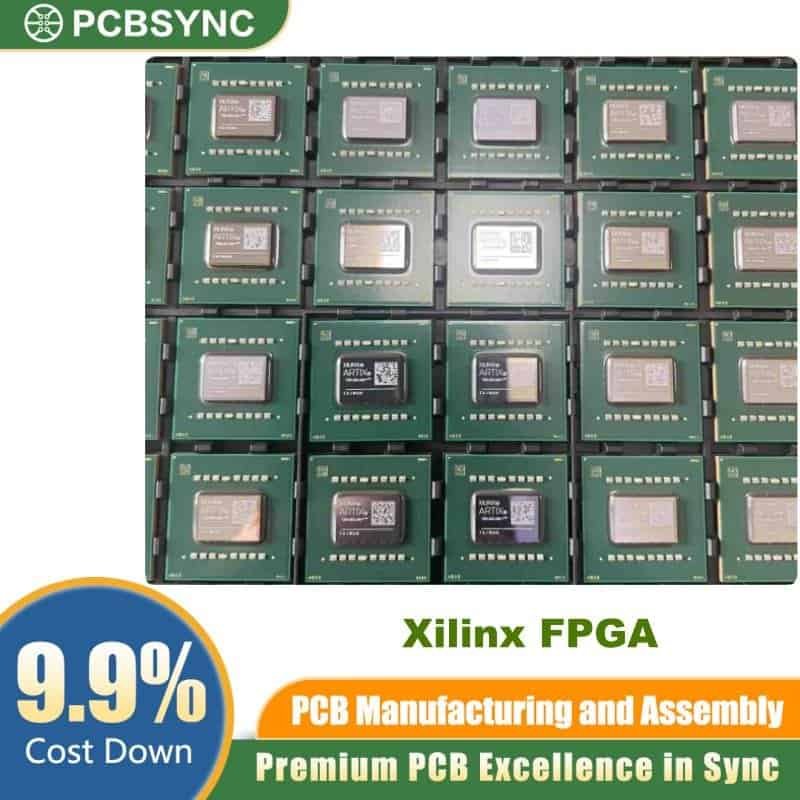
The XC3S400-4FT256CES is a high-performance, cost-optimized field-programmable gate array (FPGA) from Xilinx’s Spartan-3 family, now part of AMD’s portfolio. Designed for high-volume, cost-sensitive applications, this device offers 400,000 system gates in a compact 256-ball Fine-pitch Ball Grid Array (FTBGA) package. Whether you are developing embedded systems, digital signal processing pipelines, or communications hardware, the XC3S400-4FT256CES delivers proven Spartan-3 reliability with efficient resource utilization.
As a leading Xilinx FPGA solution, the XC3S400-4FT256CES is widely used in industrial, consumer, and telecommunications designs requiring flexible, reprogrammable logic at an accessible price point.
XC3S400-4FT256CES Key Specifications at a Glance
| Parameter |
Value |
| Manufacturer |
AMD (Xilinx) |
| Part Number |
XC3S400-4FT256CES |
| FPGA Family |
Spartan-3 |
| System Gates |
400,000 |
| Logic Cells |
8,064 |
| CLB Slices |
3,584 |
| Distributed RAM |
56 Kb |
| Block RAM |
288 Kb |
| Multipliers (18×18) |
16 |
| DCMs (Digital Clock Managers) |
4 |
| Maximum User I/O Pins |
173 |
| Package |
FT256 (FTBGA) |
| Package Pins |
256 |
| Speed Grade |
-4 |
| Operating Voltage (VCCINT) |
1.2 V |
| Operating Temperature |
0°C to +85°C (Commercial) |
| RoHS Compliant |
Yes |
What Is the XC3S400-4FT256CES?
The XC3S400-4FT256CES belongs to Xilinx’s Spartan-3 generation, a family specifically engineered to drive down the cost of programmable logic. Spartan-3 devices are built on a 90 nm process technology, enabling high integration density and low static power consumption relative to earlier FPGA generations.
The “4” in the part number denotes the speed grade, where lower numbers indicate faster devices. The “FT256” refers to the 256-ball Fine-pitch Ball Grid Array package, and “CES” designates the commercial temperature range extended screening grade.
XC3S400-4FT256CES Architecture Overview
Configurable Logic Blocks (CLBs)
The XC3S400 contains 3,584 CLB slices, each consisting of two slices with four-input look-up tables (LUTs), flip-flops, and carry logic. This architecture supports both combinational and sequential logic functions and allows efficient mapping of complex digital designs.
Block RAM
The device provides 288 Kb of dual-port block RAM, organized as 16 × 18 Kb RAMB16 primitives. Block RAMs support synchronous read and write operations and can be configured as simple dual-port or true dual-port memories, making them ideal for FIFOs, line buffers, and lookup tables in signal processing.
Dedicated Multipliers
Sixteen 18×18-bit dedicated hardware multipliers are embedded in the fabric. These multipliers can be cascaded or combined with block RAM for efficient implementation of DSP operations such as FIR filters, correlators, and arithmetic pipelines without consuming CLB resources.
Digital Clock Managers (DCMs)
Four Digital Clock Managers provide on-chip clock synthesis, phase shifting, and frequency multiplication/division. DCMs help eliminate clock skew across the device and allow designers to derive multiple clock domains from a single input reference.
I/O Architecture
The XC3S400-4FT256CES supports 173 user I/O pins through SelectIO technology, accommodating a wide range of single-ended and differential signaling standards.
Supported I/O Standards
| Standard Type |
Supported Standards |
| Single-Ended |
LVTTL, LVCMOS 3.3V / 2.5V / 1.8V / 1.5V, PCI, GTL, GTLP |
| Differential |
LVDS, LVPECL, BLVDS, DIFF_HSTL, DIFF_SSTL |
| Memory Interfaces |
SSTL 2 / SSTL 3, HSTL |
Package and Ordering Information
Package Details
| Parameter |
Detail |
| Package Type |
Fine-pitch Ball Grid Array (FTBGA) |
| Package Code |
FT256 |
| Ball Count |
256 |
| Ball Pitch |
1.0 mm |
| Body Size |
17 mm × 17 mm |
| Height |
1.55 mm (max) |
| Lead Finish |
SnAgCu (Lead-Free) |
Part Number Decoder
| Field |
Code |
Meaning |
| Family |
XC3S |
Spartan-3 |
| Gate Count |
400 |
400K system gates |
| Speed Grade |
-4 |
Speed grade 4 (fastest in family) |
| Package |
FT256 |
256-ball FTBGA, 1.0 mm pitch |
| Temperature / Screening |
CES |
Commercial, extended screening |
XC3S400-4FT256CES vs. Related Spartan-3 Devices
| Part Number |
Gates |
CLB Slices |
Block RAM |
Multipliers |
Max I/O |
Package |
| XC3S200-4FT256C |
200K |
1,920 |
216 Kb |
12 |
173 |
FT256 |
| XC3S400-4FT256CES |
400K |
3,584 |
288 Kb |
16 |
173 |
FT256 |
| XC3S1000-4FT256C |
1,000K |
7,680 |
432 Kb |
24 |
173 |
FT256 |
| XC3S400-4PQ208C |
400K |
3,584 |
288 Kb |
16 |
141 |
PQ208 |
The XC3S400-4FT256CES strikes an ideal balance between logic capacity and pin count within the FT256 footprint, offering more gates than the XC3S200 without requiring a larger package.
Electrical Characteristics
| Parameter |
Min |
Typical |
Max |
Unit |
| Core Supply Voltage (VCCINT) |
1.14 |
1.20 |
1.26 |
V |
| Auxiliary Supply (VCCAUX) |
2.375 |
2.50 |
2.625 |
V |
| I/O Supply (VCCO) |
1.14 |
— |
3.465 |
V |
| Operating Temperature |
0 |
— |
+85 |
°C |
| Static Current (ICC) |
— |
~15 |
— |
mA |
Configuration Options
The XC3S400-4FT256CES supports multiple configuration modes to suit different system architectures:
| Mode |
Description |
Typical Use Case |
| Master Serial |
SPI Flash via MOSI/MISO |
Single-chip standalone systems |
| Slave Serial |
Externally clocked bit-stream |
Multi-FPGA daisy-chain |
| Master SelectMAP (Parallel) |
8-bit parallel configuration |
Fast boot applications |
| Slave SelectMAP |
Processor-driven configuration |
Microprocessor-based systems |
| JTAG (Boundary Scan) |
IEEE 1149.1-compliant |
In-system programming, debug |
Typical Applications of the XC3S400-4FT256CES
The XC3S400-4FT256CES FPGA is well-suited for a broad range of applications across industries:
- Embedded Processing – Soft-core processor implementations (MicroBlaze, PicoBlaze) for microcontroller replacement
- Digital Signal Processing (DSP) – FIR/IIR filters, FFT engines, and decimation/interpolation chains
- Industrial Control – Motor control, servo interfaces, real-time sensor fusion, and safety-critical I/O
- Communications – Protocol bridging (UART, SPI, I²C, CAN), line encoding, and media access controllers
- Consumer Electronics – Video scalar, image processing pipelines, and display controllers
- Automotive – ADAS sensor interfaces, LIN/CAN bus bridging (with appropriate qualification)
- Test & Measurement – Pattern generators, logic analyzers, and high-speed data capture
Design Tools and IP Support
Xilinx (AMD) provides a comprehensive design ecosystem for the XC3S400-4FT256CES:
| Tool / Resource |
Description |
| Xilinx ISE Design Suite |
Primary synthesis and implementation tool for Spartan-3 |
| CORE Generator |
IP core generation including memory controllers, DSP blocks, and bus interfaces |
| ChipScope Pro |
On-chip logic analyzer for real-time debugging |
| iMPACT |
JTAG programming and configuration utility |
| PlanAhead |
Floorplanning and physical constraint management |
| Xilinx LogiCORE IP |
Certified IP cores for Ethernet MAC, PCIe (lite), and more |
Note: The Spartan-3 family is supported in ISE 14.7, the final version of the ISE Design Suite. New designs targeting Xilinx FPGAs are encouraged to migrate to Spartan-6, 7-Series, or UltraScale+ families using Vivado Design Suite for long-term support.
Compliance and Certifications
| Certification |
Status |
| RoHS 2 (EU Directive 2011/65/EU) |
Compliant |
| REACH SVHC |
Compliant |
| Pb-Free Process Compatibility |
Yes (SnAgCu ball finish) |
| MSL (Moisture Sensitivity Level) |
MSL 3 per J-STD-020 |
| JTAG Boundary Scan |
IEEE 1149.1 compliant |
PCB Design and Soldering Guidelines
Recommended PCB Stack-Up
The 1.0 mm ball pitch of the FT256 package requires careful PCB design. Key recommendations include:
- Minimum 4-layer PCB with dedicated power and ground planes
- Via-in-pad or dog-bone routing for inner ball rows depending on via technology
- 0.45 mm pad diameter on PCB for 1.0 mm pitch BGA (NSMD recommended)
- Controlled impedance routing for high-speed differential I/O pairs
Decoupling Capacitor Guidelines
| Supply Rail |
Recommended Capacitance |
Placement |
| VCCINT (1.2 V) |
100 nF per pair |
Under package, close to balls |
| VCCAUX (2.5 V) |
100 nF per bank |
Adjacent to I/O bank pins |
| VCCO |
100 nF per I/O bank |
Distributed across bank supply pins |
| Bulk Decoupling |
10–47 µF |
Board-level, near power entry |
Frequently Asked Questions (FAQ)
Q: What is the difference between XC3S400-4FT256C and XC3S400-4FT256CES? The “CES” suffix indicates extended screening — the device undergoes additional test procedures beyond standard commercial screening, improving confidence in parametric performance. Both share the same silicon die, speed grade, and package.
Q: Is the XC3S400-4FT256CES still in production? Xilinx (AMD) has placed the Spartan-3 family on a longevity program but recommends new designs adopt Spartan-6 or newer families. The XC3S400-4FT256CES remains available through authorized distributors for production and aftermarket needs.
Q: Can I use Vivado with the XC3S400-4FT256CES? No. Vivado does not support Spartan-3 devices. ISE Design Suite 14.7 is required for synthesis and implementation of this device.
Q: What configuration memory is compatible? Xilinx Platform Flash (XCF series) and standard SPI NOR Flash devices (e.g., Micron M25P series) are compatible for master serial configuration mode.
Summary
The XC3S400-4FT256CES delivers a proven combination of logic density, embedded memory, hardware multipliers, and flexible I/O in a compact 256-ball BGA package. Its -4 speed grade ensures the fastest performance within the Spartan-3 FT256 lineup, and the CES screening adds an extra layer of production reliability. With 400K system gates, 288 Kb of block RAM, and 16 dedicated multipliers, this device is a cost-effective choice for mid-complexity digital designs across industrial, communications, and embedded applications.
For a full range of programmable logic solutions, explore our selection of Xilinx FPGA products.