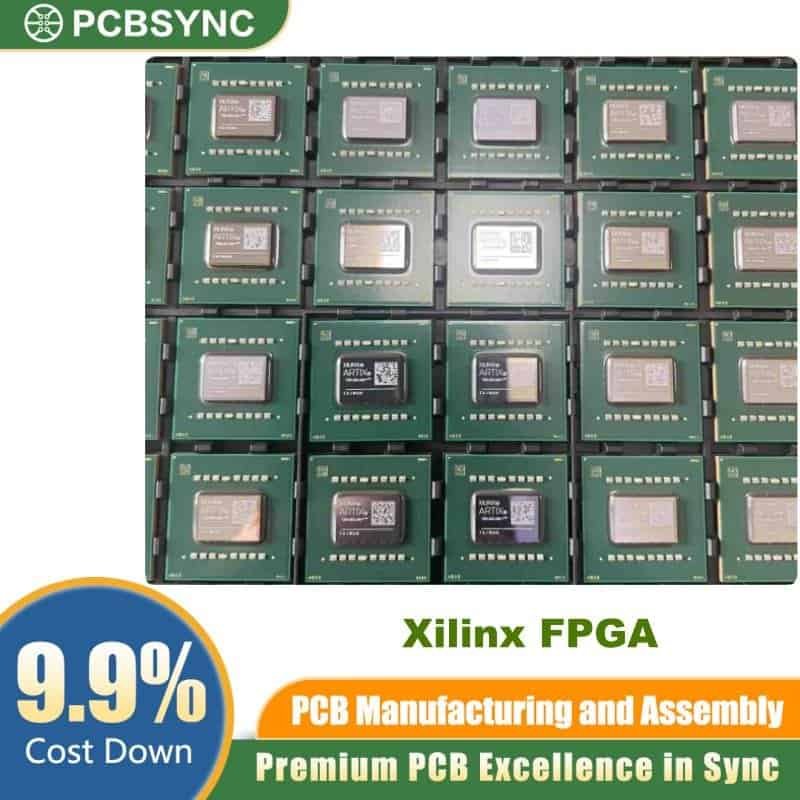
The XC3S400-4FT256C is a high-performance, cost-optimized Xilinx FPGA from the Spartan-3 family, manufactured by AMD (formerly Xilinx). Designed for high-volume, cost-sensitive applications, this device delivers 400,000 system gates in a compact 256-ball Fine-pitch Thin Ball Grid Array (FTBGA) package. Whether you are developing consumer electronics, industrial control systems, or embedded processing solutions, the XC3S400-4FT256C offers the logic density, I/O flexibility, and speed performance your design demands.
XC3S400-4FT256C Key Specifications at a Glance
| Parameter |
Value |
| Manufacturer |
AMD (Xilinx) |
| Part Number |
XC3S400-4FT256C |
| Series |
Spartan-3 |
| Logic Gates |
400,000 |
| Logic Cells |
8,064 |
| CLB Slices |
3,584 |
| Distributed RAM |
56 Kb |
| Block RAM |
288 Kb |
| Multipliers (18×18) |
16 |
| DCM (Digital Clock Mgmt) |
4 |
| Maximum User I/Os |
141 |
| Package |
256-Ball FTBGA (FT256) |
| Package Size |
17 mm × 17 mm |
| Ball Pitch |
1.00 mm |
| Speed Grade |
-4 |
| Operating Voltage (VCCINT) |
1.2 V |
| Temperature Range |
0°C to +85°C (Commercial) |
| RoHS Status |
RoHS Compliant |
What Is the XC3S400-4FT256C?
The XC3S400-4FT256C belongs to Xilinx’s Spartan-3 FPGA family — one of the most widely adopted FPGA platforms in the industry for cost-optimized designs. The “400” in the part number denotes approximately 400,000 equivalent system gates, while “4” indicates the speed grade (faster than -5, slower than -3). The “FT256” suffix identifies the 256-ball Fine-pitch Thin BGA package, and “C” designates the commercial temperature range (0°C to +85°C).
This device is ideal for engineers who need substantial programmable logic, embedded memory, and high-speed DSP capabilities without the cost premium of larger FPGA families.
XC3S400-4FT256C Logic Resources and Architecture
CLB and Slice Architecture
The Spartan-3 architecture uses Configurable Logic Blocks (CLBs) as its fundamental building unit. Each CLB contains four slices, and each slice includes two 4-input Look-Up Tables (LUTs), two flip-flops, and dedicated carry logic. The XC3S400-4FT256C provides:
| Resource |
Quantity |
| CLBs |
896 |
| Slices |
3,584 |
| 4-Input LUTs |
7,168 |
| Flip-Flops |
7,168 |
| Maximum Distributed RAM |
56 Kb |
Block RAM (BRAM)
The XC3S400-4FT256C includes dedicated Block RAM organized as 18 Kb dual-port RAM blocks. These are ideal for FIFOs, lookup tables, and large data buffers.
| BRAM Feature |
Detail |
| Total Block RAM |
288 Kb |
| Number of RAM Blocks |
16 × 18 Kb |
| Port Configuration |
True Dual-Port |
| Supported Widths |
×1, ×2, ×4, ×9, ×18 |
Dedicated Multipliers
For DSP and signal processing applications, the device includes 16 dedicated 18×18 hardware multipliers. These deliver high-throughput multiply-accumulate (MAC) operations without consuming CLB resources.
I/O Banks and Pin Configuration
Maximum I/O Count and Bank Structure
| I/O Feature |
Detail |
| Maximum User I/Os |
141 |
| Number of I/O Banks |
4 |
| Package |
FT256 (256-ball FTBGA) |
| Differential I/O Pairs |
Up to 70 |
Supported I/O Standards
The XC3S400-4FT256C supports a wide range of single-ended and differential I/O standards, enabling seamless integration with diverse system interfaces:
| I/O Standard Category |
Supported Standards |
| Single-Ended |
LVTTL, LVCMOS 3.3V / 2.5V / 1.8V / 1.5V |
| Differential |
LVDS, RSDS, PPDS, BLVDS, LVPECL |
| High-Speed Memory |
SSTL 2 / 3 (Class I & II), HSTL (Class I & III) |
| PCI |
PCI 3.3V (33/66 MHz) |
Clock Management: Digital Clock Manager (DCM)
The XC3S400-4FT256C features 4 Digital Clock Managers (DCMs), which are powerful clock synthesis and management blocks offering:
- Clock multiplication and division
- Phase shifting (fine-grain and coarse)
- Clock deskew and jitter reduction
- Frequency synthesis using DLL and DFS
This makes the XC3S400-4FT256C well-suited for applications requiring precise, multi-domain clock management, such as communications, video processing, and high-speed data acquisition.
Package Information: FT256 (Fine-Pitch Thin BGA)
| Package Attribute |
Detail |
| Package Type |
Fine-Pitch Thin Ball Grid Array (FTBGA) |
| Package Code |
FT256 |
| Ball Count |
256 |
| Ball Pitch |
1.00 mm |
| Body Size |
17 mm × 17 mm |
| Height (max) |
1.20 mm |
| Mounting Type |
Surface Mount (SMT) |
The compact 17×17 mm BGA package makes the XC3S400-4FT256C suitable for space-constrained PCB designs while still providing 141 user I/Os.
Electrical and Operating Characteristics
| Parameter |
Min |
Typical |
Max |
Unit |
| Core Supply Voltage (VCCINT) |
1.14 |
1.20 |
1.26 |
V |
| I/O Supply Voltage (VCCO) |
1.4 |
— |
3.6 |
V |
| Auxiliary Supply (VCCAUX) |
2.375 |
2.5 |
2.625 |
V |
| Operating Temperature |
0 |
— |
+85 |
°C |
| Static ICC (Typical) |
— |
~10 |
— |
mA |
Speed Grade -4 Performance
The “-4” speed grade indicates the device’s timing performance tier within the Spartan-3 family. A lower speed grade number means faster propagation delays in Xilinx’s convention (e.g., -4 is faster than -5).
| Timing Parameter |
-4 Grade (Typical) |
| Maximum CLK-to-Q (flip-flop) |
~1.0 ns |
| Maximum LUT propagation delay |
~0.5 ns |
| Maximum System Frequency |
Up to ~200 MHz |
| Setup Time (Tsu) |
~0.4 ns |
Note: Actual performance depends on design implementation, placement, and routing.
XC3S400-4FT256C vs. Other Spartan-3 Variants
Engineers frequently compare devices within the Spartan-3 family. Here is how the XC3S400-4FT256C compares to nearby devices:
| Part Number |
Gates |
Slices |
Block RAM |
Multipliers |
Package |
Temp Grade |
| XC3S200-4FT256C |
200K |
1,920 |
216 Kb |
12 |
FT256 |
Commercial |
| XC3S400-4FT256C |
400K |
3,584 |
288 Kb |
16 |
FT256 |
Commercial |
| XC3S400-4FG456C |
400K |
3,584 |
288 Kb |
16 |
FG456 |
Commercial |
| XC3S1000-4FT256C |
1M |
7,680 |
432 Kb |
24 |
FT256 |
Commercial |
| XC3S400-4FT256I |
400K |
3,584 |
288 Kb |
16 |
FT256 |
Industrial |
Common Applications for XC3S400-4FT256C
The XC3S400-4FT256C is used across a broad range of industries and applications due to its balance of capacity, performance, and low cost:
Industrial and Embedded Applications
- Industrial motor control and automation
- Embedded processor implementations (MicroBlaze soft-core)
- Machine vision and image pre-processing
- Serial communication bridges (UART, SPI, I2C, CAN)
Consumer Electronics
- Set-top box logic and glue logic
- Display control and timing generation
- Remote I/O expansion
Communications and Networking
- Protocol conversion (RS-232 to LVDS, etc.)
- Data framing and packetization
- FIFOs and elasticity buffers for clock domain crossing
Test and Measurement
- Signal capture and pattern generation
- Logic analyzer front-end
- Programmable stimulus/response
Configuration and Programming
The XC3S400-4FT256C supports multiple configuration modes, giving designers flexibility in production programming workflows:
| Configuration Mode |
Description |
| Master Serial |
External serial Flash (e.g., Xilinx Platform Flash) |
| Slave Serial |
Driven by external host processor |
| Master Parallel (SelectMAP) |
High-speed 8-bit parallel configuration |
| Slave Parallel (SelectMAP) |
Parallel configuration from processor |
| JTAG (IEEE 1149.1) |
Boundary scan and in-circuit programming |
| Master SPI |
Direct connection to SPI Flash memory |
Configuration bitstream size for XC3S400 is approximately 1.69 Mb.
Design Tools and Ecosystem
Xilinx (AMD) provides a comprehensive toolchain for designing with the XC3S400-4FT256C:
| Tool |
Purpose |
| Vivado Design Suite |
RTL synthesis, implementation, and bitstream generation |
| ISE Design Suite |
Legacy toolchain (fully supported for Spartan-3) |
| ChipScope Pro |
In-system logic analysis and debug |
| PlanAhead |
Floorplanning and analysis |
| CORE Generator |
IP core instantiation (FIFOs, DCMs, etc.) |
| IMPACT |
Device programming and configuration |
The XC3S400-4FT256C is fully supported in Xilinx ISE 14.7, which remains the recommended tool for Spartan-3 family devices.
Ordering Information
| Attribute |
Detail |
| Manufacturer Part Number |
XC3S400-4FT256C |
| Manufacturer |
AMD (Xilinx) |
| DigiKey Part Number |
122-1411-ND |
| Package / Case |
256-FTBGA |
| RoHS |
Compliant |
| Export Control |
EAR99 |
| ECCN |
3A992.a |
| Lead-Free |
Yes |
| Halogen-Free |
No (standard) |
Why Choose the XC3S400-4FT256C?
The XC3S400-4FT256C remains a popular choice for both new designs and legacy board replacements because of several compelling advantages:
- Proven silicon reliability — Mature Spartan-3 process technology with extensive field deployment
- Low cost per logic gate — Optimized for cost-sensitive, high-volume production
- Compact BGA package — 17×17 mm FT256 fits easily on space-constrained boards
- Rich IP ecosystem — Thousands of Xilinx and third-party IP cores available
- Flexible I/O standards — Supports 3.3V, 2.5V, 1.8V, and 1.5V I/O with differential pair support
- Excellent software support — ISE 14.7 is stable and well-documented
- Strong community — Extensive reference designs, application notes, and forum support
Frequently Asked Questions (FAQ)
Q: What is the difference between XC3S400-4FT256C and XC3S400-4FT256I? A: The “C” suffix denotes a commercial temperature range (0°C to +85°C), while the “I” suffix is for industrial grade (-40°C to +100°C). All other specifications are identical.
Q: Is the XC3S400-4FT256C RoHS compliant? A: Yes, this part is RoHS compliant and lead-free.
Q: What configuration Flash memory is recommended for XC3S400-4FT256C? A: Xilinx recommends the XCF04S or XCF08P Platform Flash devices for Master Serial configuration. SPI Flash devices such as the Micron N25Q or Winbond W25Q series are also commonly used with the SPI Master configuration mode.
Q: Can I use Vivado to program the XC3S400-4FT256C? A: Vivado does not support Spartan-3 devices for implementation. You must use Xilinx ISE 14.7 for synthesis, implementation, and bitstream generation. However, Vivado Lab Tools can be used for programming via JTAG.
Q: What soft-core processors can run on XC3S400-4FT256C? A: The device supports Xilinx MicroBlaze (32-bit RISC soft-core) and PicoBlaze (8-bit embedded controller). MicroBlaze can be configured with optional FPU, memory controllers, and bus interfaces such as AXI and PLB.