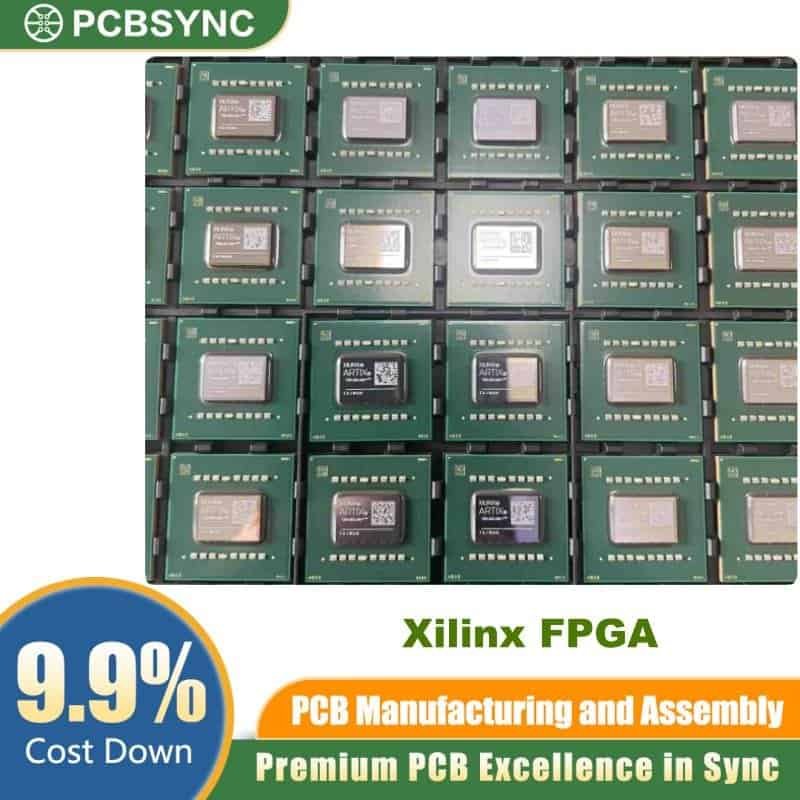
The XC3S400-4FGG320C is a high-performance, cost-optimized field-programmable gate array (FPGA) from AMD Xilinx’s Spartan-3 family. Designed for high-volume, cost-sensitive applications, this device offers a compelling combination of logic density, I/O flexibility, and integrated memory — packaged in a compact 320-ball Fine-Pitch Ball Grid Array (FBGA) package. Whether you are developing embedded control systems, digital signal processing pipelines, or communications interfaces, the XC3S400-4FGG320C delivers reliable and proven programmable logic performance.
What Is the XC3S400-4FGG320C?
The XC3S400-4FGG320C is part of Xilinx’s Spartan-3 generation — a family engineered to bring FPGA technology into mainstream, price-competitive product segments. The “400” in the part number denotes approximately 400,000 system gates, while the “4” speed grade indicates a moderately fast propagation delay suitable for many real-world designs. The “FGG320” suffix identifies the 320-ball FBGA package with a 1.0 mm ball pitch, and the trailing “C” indicates the commercial temperature range (0°C to +85°C).
As a member of the broader Xilinx FPGA product portfolio, this device benefits from decades of Xilinx architecture refinement and ecosystem tooling, including the ISE Design Suite.
XC3S400-4FGG320C Key Specifications
| Parameter |
Value |
| Manufacturer |
AMD (Xilinx) |
| Part Number |
XC3S400-4FGG320C |
| Family |
Spartan-3 |
| System Gates |
~400,000 |
| Logic Cells |
8,064 |
| CLB Array |
56 × 72 |
| Flip-Flops |
8,064 |
| Distributed RAM |
56 Kb |
| Block RAM |
288 Kb |
| Multipliers (18×18) |
16 |
| DCM Blocks |
4 |
| Maximum User I/O |
264 |
| Package |
FGG320 (FBGA, 320 balls) |
| Ball Pitch |
1.0 mm |
| Speed Grade |
-4 |
| Operating Voltage (VCC) |
1.2 V |
| I/O Voltage |
1.2 V – 3.3 V |
| Temperature Range |
0°C to +85°C (Commercial) |
| Configuration Interface |
JTAG, Master/Slave Serial, SelectMAP |
XC3S400-4FGG320C Logic Resources
Configurable Logic Blocks (CLBs)
The XC3S400-4FGG320C contains 8,064 logic cells arranged within a 56×72 CLB array. Each CLB consists of two slices, and each slice includes two 4-input Look-Up Tables (LUTs) plus two flip-flops. This architecture provides fine-grained logic granularity ideal for control logic, state machines, and custom datapath implementations.
Distributed and Block RAM
| Memory Type |
Capacity |
| Distributed RAM |
56 Kb |
| Block RAM (BRAM) |
288 Kb (16 × 18 Kb blocks) |
| Total On-Chip Memory |
344 Kb |
The dual-port block RAMs support independent read/write ports and can be configured as FIFOs, ROM, or general-purpose RAM — making them well-suited for data buffering, lookup tables, and co-processor memory in embedded designs.
Digital Clock Managers (DCMs)
Four on-chip DCM blocks provide clock synthesis, deskewing, phase shifting, and frequency multiplication/division. This allows designers to generate multiple derived clocks from a single source without external PLLs, reducing board complexity and cost.
Hardware Multipliers
Sixteen dedicated 18×18-bit hardware multipliers accelerate DSP operations such as FIR filters, FFTs, and PID controllers — functions that would otherwise consume substantial LUT resources if implemented in fabric.
Package and Pinout: FGG320
Package Overview
| Attribute |
Detail |
| Package Type |
Fine-Pitch Ball Grid Array (FBGA) |
| Package Code |
FGG320 |
| Total Balls |
320 |
| Ball Pitch |
1.0 mm |
| Package Body Size |
19 mm × 19 mm |
| Maximum User I/O |
264 |
The FGG320 package offers a compact, high-density footprint well-suited for space-constrained PCB designs. The 1.0 mm pitch requires careful PCB layout with controlled impedance traces and adequate bypass capacitors close to VCC/GND balls.
I/O Bank Structure
The XC3S400-4FGG320C organizes its user I/O into banks, each supporting a range of I/O standards. This multi-voltage I/O architecture enables the device to interface seamlessly with 1.8 V, 2.5 V, and 3.3 V logic families simultaneously.
| Supported I/O Standard |
Voltage |
| LVCMOS33 |
3.3 V |
| LVCMOS25 |
2.5 V |
| LVCMOS18 |
1.8 V |
| LVCMOS15 |
1.5 V |
| LVTTL |
3.3 V |
| SSTL2, SSTL3 |
2.5 V / 3.3 V |
| HSTL |
1.5 V |
| DIFF_HSTL / DIFF_SSTL |
Differential |
| LVDS (via external resistors) |
Differential |
Electrical Characteristics
| Parameter |
Min |
Typical |
Max |
Unit |
| Core Supply Voltage (VCCINT) |
1.14 |
1.20 |
1.26 |
V |
| I/O Supply Voltage (VCCO) |
1.14 |
— |
3.465 |
V |
| Operating Temperature |
0 |
25 |
85 |
°C |
| Input Voltage (3.3V I/O) |
–0.5 |
— |
3.465 |
V |
| Maximum Toggle Frequency |
— |
— |
~200+ |
MHz |
| Static Current (ICC standby) |
— |
~6 |
— |
mA |
XC3S400-4FGG320C Configuration Modes
The device supports multiple configuration methods, providing flexibility for production and development:
| Configuration Mode |
Interface |
Notes |
| Master Serial |
SPI Flash |
Boot from external serial flash |
| Slave Serial |
External Host |
Driven by processor or CPLD |
| Master Parallel (SelectMAP) |
8-bit parallel |
Fast configuration |
| Slave Parallel (SelectMAP) |
8-bit parallel |
Host-controlled |
| JTAG (Boundary Scan) |
IEEE 1149.1 |
Debug and in-circuit programming |
The JTAG interface is also used for in-system debugging with Xilinx’s ChipScope Pro logic analyzer, enabling real-time signal capture without adding external test equipment.
Typical Applications for XC3S400-4FGG320C
The XC3S400-4FGG320C is widely deployed across multiple industries due to its balance of resources, I/O count, and cost:
| Application Area |
Use Case |
| Industrial Automation |
Motor control, PLC expansion, encoder interfaces |
| Communications |
UART, SPI, I2C bridges; protocol converters |
| Embedded Systems |
Co-processor acceleration, glue logic replacement |
| Test & Measurement |
Data acquisition front-ends, pattern generators |
| Medical Devices |
Signal conditioning, parallel data routing |
| Consumer Electronics |
Set-top box glue logic, display interfaces |
| Automotive (Non-Rated) |
Prototype development, infotainment peripherals |
XC3S400-4FGG320C vs. Other Spartan-3 Devices
| Part Number |
System Gates |
Logic Cells |
Block RAM |
Multipliers |
Max I/O |
Package Options |
| XC3S50-4FTG256C |
50,000 |
1,728 |
72 Kb |
4 |
124 |
FTG256 |
| XC3S200-4FTG256C |
200,000 |
4,320 |
216 Kb |
12 |
173 |
FTG256, VQG100 |
| XC3S400-4FGG320C |
400,000 |
8,064 |
288 Kb |
16 |
264 |
FGG320 |
| XC3S1000-4FTG256C |
1,000,000 |
17,280 |
432 Kb |
24 |
391 |
FTG256, FG456 |
| XC3S1500-4FG320C |
1,500,000 |
29,952 |
576 Kb |
32 |
487 |
FG320, FG456 |
The XC3S400-4FGG320C occupies a mid-range position in the Spartan-3 lineup, providing more resources than entry-level variants while maintaining the cost efficiency that defines the Spartan-3 family.
Design Tools and Software Support
Xilinx ISE Design Suite
The XC3S400-4FGG320C is fully supported by Xilinx ISE Design Suite (version 14.x and earlier), which includes:
- XST – Xilinx Synthesis Technology for HDL synthesis
- NGDBUILD / MAP / PAR – Implementation tools for place-and-route
- TRCE – Timing analysis and constraint verification
- iMPACT – Programming and configuration tool
- ChipScope Pro – On-chip logic analyzer for debugging
Third-Party Tool Support
| Tool |
Vendor |
Function |
| Synplify Pro |
Synopsys |
HDL Synthesis |
| Precision RTL |
Mentor Graphics |
Synthesis |
| ModelSim |
Mentor Graphics |
HDL Simulation |
| Active-HDL |
Aldec |
Simulation |
| SpeedEasy |
Aldec |
Timing Simulation |
PCB Design Considerations
Power Supply Decoupling
Proper decoupling is critical for reliable FPGA operation. Recommended practice for the FGG320 package:
| Supply Rail |
Recommended Decoupling |
| VCCINT (1.2V) |
100 nF + 10 µF per supply group |
| VCCO Banks (I/O) |
100 nF per bank, 10 µF per pair of banks |
| VCCAUX (2.5V) |
100 nF + 10 µF |
BGA Routing Guidelines
- Use a minimum 6-layer PCB for FGG320 to properly escape BGA signals.
- Place via-in-pad or dogleg routing for outer rows; inner balls may require blind vias.
- Observe Xilinx-recommended controlled impedance of 50 Ω for single-ended and 100 Ω differential traces.
- Keep configuration pins (CCLK, DIN, DONE, PROG_B, INIT_B) routed away from high-frequency signal lines.
Ordering Information
| Attribute |
Detail |
| Manufacturer Part Number |
XC3S400-4FGG320C |
| Manufacturer |
AMD (formerly Xilinx) |
| DigiKey Part Number |
122-1453-ND |
| Product Status |
Active (check distributor for availability) |
| RoHS Compliance |
Yes |
| Moisture Sensitivity Level |
MSL 3 |
| Minimum Order Quantity |
1 |
| Packaging |
Tray |
Note: Always verify current stock and pricing with authorized distributors, as component availability can change. The XC3S400-4FGG320C is produced in limited quantities as the Spartan-3 family matures; consider Spartan-6 (XC6SLx) as a migration path for new designs.
Frequently Asked Questions (FAQ)
Q: What is the difference between XC3S400-4FGG320C and XC3S400-4FTG256C? A: Both are Spartan-3 400K gate devices but differ in package. The FGG320 has 320 balls (264 user I/O), while the FTG256 has 256 balls (173 user I/O). Choose FGG320 when your design requires more than 173 I/O pins.
Q: Is the XC3S400-4FGG320C lead-free (RoHS compliant)? A: Yes. The “C” commercial grade version is RoHS compliant. Ensure your solder process is compatible with the SnAgCu (SAC) ball composition.
Q: What programming file format does XC3S400-4FGG320C use? A: The standard configuration bitstream format is .bit (for JTAG/iMPACT) or .mcs/.bin for external flash programming.
Q: Can I migrate a Spartan-3 design to Spartan-6? A: Xilinx provides a migration guide. The architectures are different (Spartan-6 uses 6-input LUTs vs. 4-input in Spartan-3), so RTL migration is possible but requires re-synthesis and re-implementation.
Q: What is the configuration time for this FPGA? A: At 66 MHz SelectMAP, the ~1.7 Mbit bitstream configures in approximately 26 ms. JTAG configuration is slower, typically 100–500 ms depending on clock rate.
Summary
The XC3S400-4FGG320C is a reliable, proven, and well-supported mid-range FPGA well suited for a wide variety of embedded, industrial, and communications applications. With 8,064 logic cells, 344 Kb of on-chip memory, 16 hardware multipliers, 4 DCMs, and 264 user I/O pins in a manageable 19×19 mm BGA package, it provides the resources most mid-complexity designs require at an economical price point. Its mature toolchain, extensive community documentation, and broad distributor availability make it a dependable choice for both new designs and legacy system maintenance.
For engineers evaluating a broader range of programmable logic solutions, exploring the full Xilinx FPGA portfolio can help identify the optimal device for your performance, power, and cost requirements.