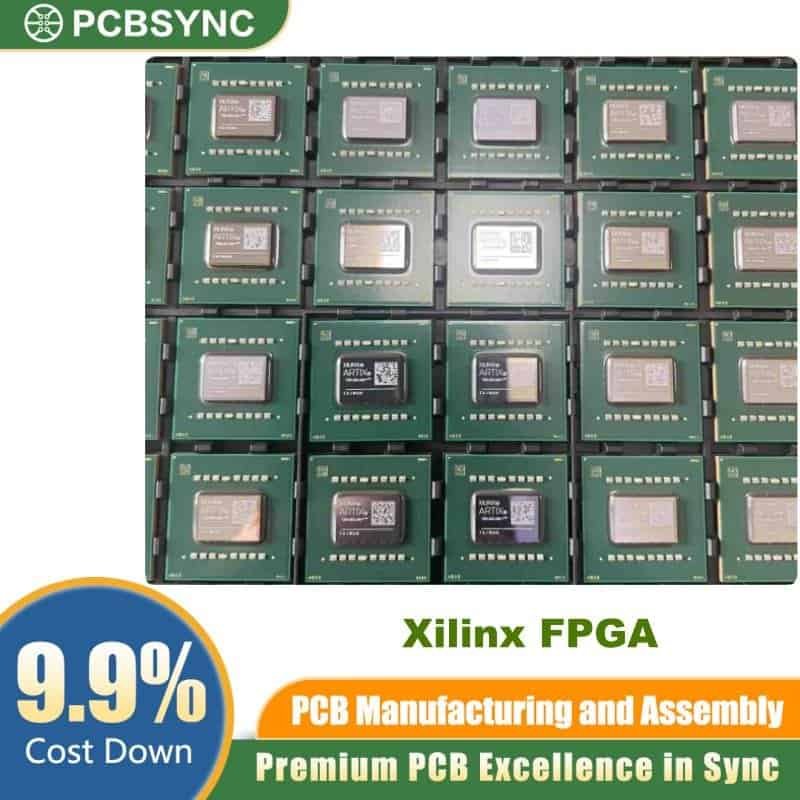
The XC3S2000-4FGG900C is a high-density, commercially-graded Xilinx FPGA from AMD’s Spartan-3 family. Designed for cost-sensitive, high-volume applications, this device delivers 2,000,000 system gates in a compact Fine-Pitch Ball Grid Array (FBGA) package. Whether you are designing signal processing hardware, embedded systems, or communications infrastructure, the XC3S2000-4FGG900C offers the logic density, I/O flexibility, and proven reliability engineers demand.
What Is the XC3S2000-4FGG900C?
The XC3S2000-4FGG900C is part of Xilinx’s Spartan-3 FPGA series — a family engineered to bring high performance at the lowest possible cost per logic cell. The “4” in the part number designates a speed grade of -4 (the standard commercial speed grade for this family), “FGG900” refers to the 900-ball Fine-Pitch BGA package, and “C” denotes the commercial temperature range (0°C to +85°C).
This FPGA is widely used across telecommunications, industrial automation, consumer electronics, and embedded computing platforms.
XC3S2000-4FGG900C Key Specifications
General Device Overview
| Parameter |
Value |
| Manufacturer |
AMD (formerly Xilinx) |
| Part Number |
XC3S2000-4FGG900C |
| Series |
Spartan-3 |
| Logic Cells |
46,080 |
| System Gates |
2,000,000 |
| CLB Array |
96 × 64 |
| CLB Flip-Flops |
46,080 |
| Maximum Distributed RAM |
720 Kb |
| Block RAM |
720 Kb |
| Dedicated Multipliers |
96 |
| DCMs (Digital Clock Managers) |
4 |
Package and Physical Characteristics
| Parameter |
Value |
| Package Type |
FBGA (Fine-Pitch Ball Grid Array) |
| Package Designator |
FGG900 |
| Ball Count |
900 |
| Body Size |
31 mm × 31 mm |
| Ball Pitch |
1.00 mm |
| Mounting Type |
Surface Mount |
| Height (Seated) |
2.60 mm |
Electrical and Timing Specifications
| Parameter |
Value |
| Supply Voltage (VCCINT) |
1.20 V |
| Supply Voltage (VCCO) |
1.2 V – 3.3 V |
| Speed Grade |
-4 (Commercial) |
| Maximum I/O Pins |
565 |
| Maximum User I/O |
565 |
| Operating Temperature (Commercial) |
0°C to +85°C |
| I/O Standards Supported |
LVCMOS, LVTTL, SSTL, HSTL, LVDS, and more |
XC3S2000-4FGG900C Functional Block Diagram Overview
Configurable Logic Blocks (CLBs)
The XC3S2000 contains 46,080 CLBs arranged in a 96 × 64 array. Each CLB contains four slices, and each slice includes two 4-input Look-Up Tables (LUTs), two flip-flops, and dedicated carry/arithmetic logic. This architecture enables efficient implementation of both combinational and registered logic.
Block RAM
The device provides 720 Kb of dedicated block RAM organized as 40 individual 18 Kb dual-port RAM blocks. These can be configured as 18 Kb or 36 Kb (two combined) memories, supporting various width/depth configurations from 16K×1 to 512×36 bits. Block RAM is ideal for FIFOs, lookup tables, and data buffering in pipeline designs.
Digital Clock Managers (DCMs)
Four fully digital DCMs eliminate clock skew, multiply or divide clock frequencies, and shift clock phase. DCMs support de-skewing, synthesis, and mirroring — making them indispensable for high-speed synchronous designs.
Dedicated Multipliers
Ninety-six 18×18-bit dedicated hardware multipliers accelerate DSP operations without consuming CLB logic. These multipliers support both signed and unsigned multiplication and can be cascaded for higher-precision arithmetic.
I/O Bank Organization and Supported Standards
I/O Bank Summary
| Bank Number |
Approximate I/O Count |
Configurable VCCO |
| Bank 0 |
~70 |
Yes |
| Bank 1 |
~72 |
Yes |
| Bank 2 |
~72 |
Yes |
| Bank 3 |
~72 |
Yes |
| Bank 4 |
~70 |
Yes |
| Bank 5 |
~72 |
Yes |
| Bank 6 |
~72 |
Yes |
| Bank 7 |
~72 |
Yes |
Each bank supports independent VCCO voltage, enabling multi-voltage system designs within a single device.
Supported I/O Standards
| Category |
Standards |
| Single-Ended |
LVCMOS33, LVCMOS25, LVCMOS18, LVCMOS15, LVCMOS12, LVTTL |
| Stub-Series Terminated Logic |
SSTL2 Class I & II, SSTL3 Class I & II |
| High-Speed Transceiver Logic |
HSTL Class I, II, III, IV |
| Differential |
LVDS, LVPECL, BLVDS, ULVDS |
XC3S2000-4FGG900C Configuration Modes
The XC3S2000-4FGG900C supports five primary configuration modes, providing flexibility for production and prototyping scenarios:
| Configuration Mode |
Description |
| Master Serial |
Uses external serial Flash or PROM |
| Slave Serial |
Driven by an external microprocessor |
| Master Parallel (SelectMAP) |
High-speed byte-wide parallel loading |
| Slave Parallel (SelectMAP) |
External controller loads configuration data |
| JTAG (Boundary Scan) |
IEEE 1149.1 compatible for in-circuit testing |
Configuration memory is SRAM-based and must be reloaded at power-on. Common companion devices include Xilinx Platform Flash PROMs (XCFxxS, XCFxxP series).
Ordering Information and Variants
Part Number Breakdown
| Field |
Value |
Meaning |
| XC3S2000 |
Device |
Spartan-3, 2M gate density |
| -4 |
Speed Grade |
Commercial speed (-4 is fastest in class) |
| FGG |
Package |
Fine-Pitch Ball Grid Array |
| 900 |
Pin Count |
900 balls |
| C |
Temperature Grade |
Commercial: 0°C to +85°C |
Related Part Numbers
| Part Number |
Package |
Speed Grade |
Temp Grade |
| XC3S2000-4FGG900C |
FGG900 |
-4 |
Commercial |
| XC3S2000-5FGG900C |
FGG900 |
-5 |
Commercial |
| XC3S2000-4FGG900I |
FGG900 |
-4 |
Industrial |
| XC3S2000-4FT256C |
FT256 |
-4 |
Commercial |
| XC3S2000-5FT256C |
FT256 |
-5 |
Commercial |
XC3S2000-4FGG900C Applications
The high I/O count and large logic density of the XC3S2000-4FGG900C make it well-suited for a broad range of application domains:
Communications and Networking
- Line card interfaces and protocol bridging
- Wireless basestation digital front-end processing
- Gigabit Ethernet and serial backplane logic
Industrial and Embedded Systems
- Motor drive control and encoder interfaces
- Machine vision preprocessing pipelines
- Industrial fieldbus gateways (CAN, Profibus, EtherCAT)
Consumer Electronics and AV
- Video scaling and frame-rate conversion
- Multi-channel audio processing
- Set-top box and display timing controllers
Medical and Test Equipment
- ADC/DAC interfacing for signal acquisition
- Multi-channel data aggregation
- High-speed memory bus arbitration
PCB Design Considerations for the FGG900 Package
Power Delivery and Decoupling
The XC3S2000-4FGG900C requires a 1.2 V core supply (VCCINT) and variable I/O supplies (VCCO) between 1.2 V and 3.3 V per bank. Best practices include:
- Place 100 nF ceramic decoupling capacitors within 2 mm of each VCCINT ball
- Use 10 µF bulk capacitors at each power plane entry point
- Separate VCCINT and VCCO planes to reduce noise coupling
- Add ferrite beads between analog and digital supply domains where DCMs share power
BGA Routing Guidelines
| Parameter |
Recommendation |
| Ball Pitch |
1.00 mm |
| Via Type |
Micro-vias or dog-bone fanout for outer rings |
| Escape Routing |
Route signal layers 1–4 from outer rings, route inner rows through via-in-pad or staggered vias |
| PCB Layer Count |
Minimum 6 layers recommended; 8–10 layers for complex designs |
| Controlled Impedance |
50 Ω single-ended, 100 Ω differential |
Thermal Management
| Parameter |
Value |
| θJA (Junction to Ambient) |
~10°C/W (with airflow) |
| θJC (Junction to Case) |
~2°C/W |
| Maximum Junction Temperature |
85°C (commercial grade) |
| Recommended Heatsink |
Low-profile BGA heatsink with thermal interface material |
Development Tools and Ecosystem
Xilinx/AMD Software Support
| Tool |
Purpose |
| Xilinx ISE Design Suite |
Full RTL-to-bitstream implementation flow |
| Vivado (legacy import) |
Constraints and simulation reuse |
| ModelSim / Questa |
RTL simulation and functional verification |
| ChipScope Pro |
On-chip logic analysis and debug |
| iMPACT |
Device programming via JTAG or cable |
Development Boards
Several third-party and Xilinx-branded development platforms support the XC3S2000 or compatible Spartan-3 FPGAs, including boards from Digilent (Spartan-3E Starter Board) and Avnet. These platforms allow rapid prototyping with onboard memory, connectors, and clock sources.
XC3S2000-4FGG900C vs. Competing Devices
Spartan-3 Family Comparison
| Device |
Logic Cells |
Block RAM |
Multipliers |
Max User I/O |
Package Options |
| XC3S200 |
4,320 |
72 Kb |
12 |
141 |
TQ144, FT256 |
| XC3S400 |
8,064 |
288 Kb |
16 |
264 |
TQ144, FT256, PQ208 |
| XC3S1000 |
17,280 |
432 Kb |
24 |
391 |
FT256, FG320, FG456 |
| XC3S2000 |
46,080 |
720 Kb |
96 |
565 |
FG456, FGG900 |
| XC3S4000 |
62,208 |
1,728 Kb |
96 |
633 |
FG676, FG900 |
| XC3S5000 |
74,880 |
1,872 Kb |
104 |
633 |
FG900 |
The XC3S2000-4FGG900C occupies a sweet spot in the family — offering near-maximum I/O count in the 900-ball package while keeping bill-of-materials cost lower than the XC3S4000 and XC3S5000.
Compliance and Certifications
| Specification |
Status |
| RoHS Compliance |
Compliant (lead-free) |
| REACH |
Compliant |
| Moisture Sensitivity Level (MSL) |
MSL 3 per IPC/JEDEC J-STD-020 |
| ESD Sensitivity |
Class 2 per JESD22-A114 |
| Flammability |
UL 94V-0 |
Frequently Asked Questions (FAQ)
Q: What is the difference between XC3S2000-4FGG900C and XC3S2000-4FGG900I? The “C” suffix denotes the commercial temperature grade (0°C to +85°C), while the “I” suffix denotes the industrial temperature grade (–40°C to +100°C). All other electrical and functional specifications remain the same.
Q: Can the XC3S2000-4FGG900C be reprogrammed in-circuit? Yes. Via the JTAG port and SelectMAP interfaces, the device can be reconfigured in-circuit without removal from the PCB. Configuration is volatile (SRAM-based), so a configuration source device is required at every power-up.
Q: Is the XC3S2000 still in production? The Spartan-3 family is in a mature lifecycle phase. While AMD/Xilinx has transitioned newer designs to Spartan-6, 7-Series, and Artix-7, the XC3S2000-4FGG900C remains available through authorized distributors such as DigiKey, Mouser, and Arrow for existing designs and long-term production runs.
Q: What configuration PROM is compatible with the XC3S2000? The XCF08P (8 Mb) or XCF16P (16 Mb) Platform Flash PROMs are commonly used. The XC3S2000 requires approximately 7.1 Mb of configuration data, making the XCF08P the minimum-capacity solution.
Summary
The XC3S2000-4FGG900C is a mature, production-proven FPGA delivering 2 million system gates, 565 user I/Os, 720 Kb of block RAM, and 96 dedicated multipliers — all in an 900-ball FBGA package at commercial temperature grade. It remains a strong choice for logic-intensive designs where I/O density, proven reliability, and cost efficiency are primary requirements. With broad support from Xilinx ISE tooling and an extensive ecosystem of IP cores and reference designs, the XC3S2000-4FGG900C continues to serve demanding applications across industrial, communications, and embedded markets.