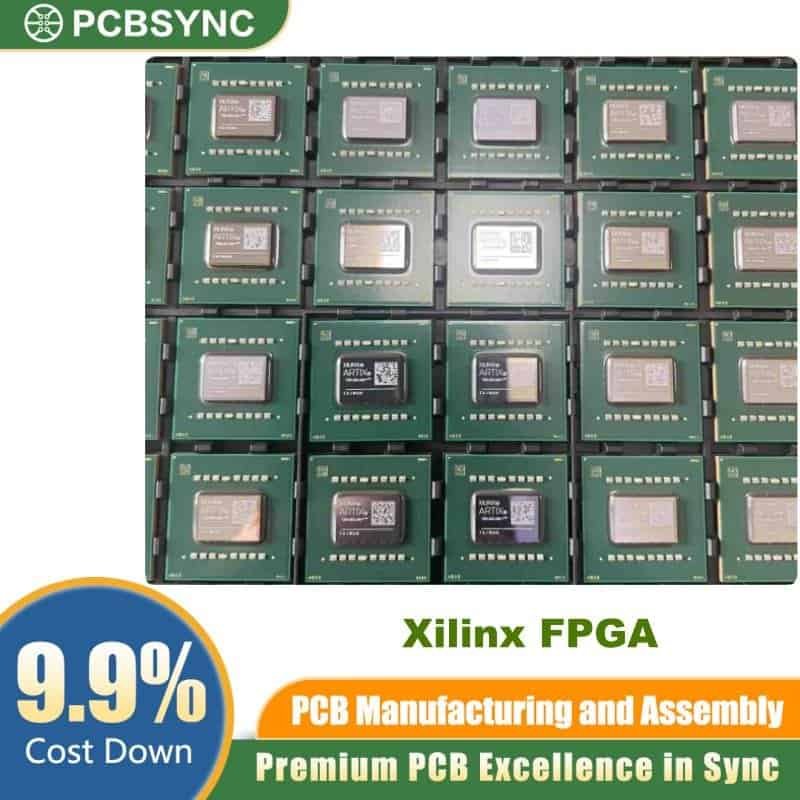
The XC3S2000-4FGG676C is a high-performance field-programmable gate array (FPGA) from AMD Xilinx, part of the trusted Spartan-3 family. Designed for cost-sensitive, high-volume applications, this device delivers robust logic density, flexible I/O, and a proven architecture that engineers worldwide rely on for embedded, communications, and industrial designs. Whether you are building a new product or sourcing a replacement component, this guide covers everything you need to know about the XC3S2000-4FGG676C.
What Is the XC3S2000-4FGG676C?
The XC3S2000-4FGG676C is a member of the Xilinx FPGA Spartan-3 series. The part number breaks down as follows:
| Part Number Segment |
Meaning |
| XC3S |
Spartan-3 Family |
| 2000 |
2,000,000 system gates |
| -4 |
Speed grade –4 (commercial speed) |
| FGG |
Fine-pitch Ball Grid Array (FBGA) package |
| 676 |
676-ball package |
| C |
Commercial temperature range (0°C to +85°C) |
This device is manufactured by AMD (formerly Xilinx) and is classified under Integrated Circuits (ICs) → Embedded → FPGAs (Field Programmable Gate Array).
XC3S2000-4FGG676C Key Specifications
General Device Specifications
| Parameter |
Specification |
| Manufacturer |
AMD (Xilinx) |
| Part Number |
XC3S2000-4FGG676C |
| Family |
Spartan-3 |
| Series |
XC3S |
| Programmable Type |
FPGA |
| Number of Gates |
2,000,000 |
| Number of Logic Elements / Cells |
46,080 |
| Number of CLBs (Configurable Logic Blocks) |
1,408 |
| CLB Flip-Flops |
46,080 |
| LUTs (Look-Up Tables) |
46,080 |
| RAM Bits (Block RAM) |
720 Kbits |
| Number of Block RAM |
20 |
I/O and Interface Specifications
| Parameter |
Specification |
| Number of I/O |
489 |
| Number of Differential I/O Pairs |
221 |
| I/O Voltage |
1.2 V ~ 3.3 V |
| Input Voltage Levels |
LVCMOS, LVTTL, HSTL, SSTL, GTL, PCI, LVDS, RSDS |
| Output Drive Strength |
2 mA ~ 24 mA (configurable) |
Electrical and Timing Specifications
| Parameter |
Specification |
| Speed Grade |
-4 |
| Core Voltage (VCCINT) |
1.2 V |
| Operating Temperature |
0°C ~ +85°C (Commercial) |
| Maximum Frequency |
~630 MHz (internal flip-flop toggle rate) |
| Configuration Interfaces |
Master/Slave Serial, Master/Slave Parallel, JTAG (IEEE 1149.1) |
Package and Physical Specifications
| Parameter |
Specification |
| Package Type |
FBGA (Fine-pitch Ball Grid Array) |
| Package Code |
FGG676 |
| Number of Pins / Balls |
676 |
| Body Size |
27 mm × 27 mm |
| Ball Pitch |
1.00 mm |
| Mounting Type |
Surface Mount Technology (SMT) |
| RoHS Compliance |
Yes (lead-free versions available; verify suffix) |
XC3S2000-4FGG676C Features and Architecture
Spartan-3 Logic Architecture
The Spartan-3 architecture is built around a matrix of Configurable Logic Blocks (CLBs). Each CLB contains four slices, and each slice contains two 4-input Look-Up Tables (LUTs) and two D flip-flops. This structure gives the XC3S2000 a total of 46,080 flip-flops and an equivalent logic density of 2 million gates — making it suitable for complex digital design tasks.
Dedicated Block RAM
The device provides 720 Kbits of block RAM distributed across 20 dual-port 18 Kbit RAM blocks. These memories can be configured as FIFOs, true dual-port RAMs, or single-port RAMs, giving designers flexible on-chip storage without consuming CLB resources.
Digital Clock Managers (DCMs)
The XC3S2000-4FGG676C includes 4 Digital Clock Managers (DCMs). Each DCM provides:
- Clock multiplication and division
- Phase shifting (fine and coarse)
- Clock deskewing
- Duty-cycle correction
This makes it straightforward to handle multiple clock domains and meet strict timing requirements in complex systems.
Multiplier Blocks
There are 12 dedicated 18×18-bit hardware multipliers on-chip. These hard multiplier blocks accelerate DSP, filtering, and arithmetic-intensive applications without consuming LUT resources.
I/O Standards and Differential Signaling
With 489 user I/Os and support for a wide range of I/O standards — including LVDS, RSDS, HSTL, SSTL, LVCMOS, and LVTTL — this FPGA integrates easily into mixed-voltage systems and high-speed serial interfaces. The differential I/O capability supports noise-immune, long-distance board-level communication.
XC3S2000-4FGG676C vs. Other Spartan-3 Devices
Understanding how the XC3S2000-4FGG676C compares to other Spartan-3 devices helps engineers select the right part for their design.
| Device |
Gates |
CLBs |
Block RAM |
Multipliers |
Max User I/O |
| XC3S200 |
200K |
144 |
72 Kbits |
4 |
141 |
| XC3S400 |
400K |
256 |
72 Kbits |
4 |
264 |
| XC3S1000 |
1M |
704 |
432 Kbits |
8 |
391 |
| XC3S2000 |
2M |
1,408 |
720 Kbits |
12 |
489 |
| XC3S4000 |
4M |
1,920 |
1,728 Kbits |
20 |
489 |
| XC3S5000 |
5M |
2,448 |
1,872 Kbits |
20 |
489 |
The XC3S2000 sits in the mid-to-upper range of the Spartan-3 family, offering an excellent balance between logic capacity, memory, and I/O for cost-sensitive production designs.
Ordering and Part Number Variants
The XC3S2000 is available in multiple package and speed-grade options. The table below outlines common variants:
| Part Number |
Package |
Balls |
Speed Grade |
Temp Range |
| XC3S2000-4FGG456C |
FGG456 |
456 |
-4 |
Commercial |
| XC3S2000-4FGG676C |
FGG676 |
676 |
-4 |
Commercial |
| XC3S2000-5FGG676C |
FGG676 |
676 |
-5 |
Commercial |
| XC3S2000-4FGG676I |
FGG676 |
676 |
-4 |
Industrial |
| XC3S2000-4FT256C |
FT256 |
256 |
-4 |
Commercial |
Note: The suffix C denotes a commercial temperature range (0°C to +85°C). For industrial applications requiring –40°C to +100°C operation, choose the I-grade variant.
Applications of the XC3S2000-4FGG676C
The XC3S2000-4FGG676C is widely used across a range of industries and application domains:
Communications and Networking
- Protocol bridging (Ethernet, UART, SPI, I2C)
- Network packet processing
- Serial interface management (RS-232, RS-485, CAN)
Consumer and Industrial Electronics
- Motor control with encoder feedback
- Industrial automation and PLC logic replacement
- Machine vision preprocessing
Embedded Systems and Computing
- Custom soft-core processor implementations (MicroBlaze, PicoBlaze)
- Memory interfaces (DDR SDRAM controllers)
- Co-processing acceleration
Test and Measurement
- Signal generation and acquisition
- Logic analyzers and protocol testers
- Automated test equipment (ATE)
Military and Aerospace (with appropriate grade selection)
- Radiation-tolerant designs (using qualified variants)
- Avionics data bus controllers
Configuration and Programming
Configuration Methods
The XC3S2000-4FGG676C supports several industry-standard configuration modes:
| Configuration Mode |
Interface |
Description |
| Master Serial |
SPI Flash |
FPGA reads bitstream from external SPI flash |
| Slave Serial |
Host MCU / processor |
Host streams bitstream into the FPGA |
| Master Parallel (SelectMAP) |
Parallel bus |
Faster parallel download using 8-bit bus |
| Slave Parallel (SelectMAP) |
Host processor |
Host writes bitstream via 8 data pins |
| JTAG |
IEEE 1149.1 |
In-circuit programming and boundary scan testing |
Design Tools
Xilinx ISE Design Suite (version 14.7 is the final supported release for Spartan-3) provides complete support for the XC3S2000-4FGG676C, including:
- ISE Project Navigator – RTL design entry and synthesis
- CORE Generator – IP core instantiation (DCMs, FIFOs, MACs)
- ChipScope Pro – In-system logic debugging via JTAG
- iMPACT – Programming and configuration
HDL languages supported include VHDL, Verilog, and SystemVerilog (with third-party synthesis tools).
PCB Design Guidelines for the FGG676 Package
Decoupling and Power Supply
- Place 100 nF ceramic decoupling capacitors (X5R or X7R, 0402 or 0603) as close as possible to each VCCINT, VCCO, and VCCAUX supply pin.
- Use 4.7 µF bulk capacitors near the power entry points for each supply rail.
- Keep the VCCINT (1.2 V) plane solid and isolated from VCCO planes.
Signal Integrity
- Follow LVDS routing rules: match trace lengths within a differential pair to within 5 mils, and maintain 100 Ω differential impedance.
- Minimize via stubs on high-speed signal lines.
- Use controlled-impedance traces for clock lines.
Thermal Management
- The XC3S2000 in the FGG676 package has a typical junction-to-ambient thermal resistance (θJA) of approximately 10–14°C/W depending on airflow.
- Ensure adequate copper pour and heatsinking for designs running at high utilization.
Frequently Asked Questions (FAQ)
Q: Is the XC3S2000-4FGG676C still in production? The Spartan-3 family has been in service for many years. While Xilinx has shifted focus to newer architectures (Artix-7, Kintex-7, Versal), the XC3S2000 remains available from authorized distributors for maintenance and new designs.
Q: What is the difference between speed grades -4 and -5? Speed grade -5 offers faster internal propagation delays than -4. Choose -5 for designs with tighter timing budgets. The -4 grade is suitable for most standard commercial applications.
Q: Can I replace the XC3S2000-4FGG676C with a newer Xilinx device? Yes. The Xilinx Artix-7 family (e.g., XC7A100T) offers a more modern architecture with lower power consumption, higher performance, and denser logic. Migration will require RTL review and constraints updates.
Q: What power supplies does this device require? The XC3S2000-4FGG676C requires three supply voltages: VCCINT (1.2 V for core logic), VCCO (1.2 V to 3.3 V for I/O banks, selectable per bank), and VCCAUX (2.5 V for auxiliary circuits including DCMs and configuration logic).
Summary
The XC3S2000-4FGG676C is a mature, well-documented, and highly capable FPGA that delivers 2 million gates, 46,080 flip-flops, 720 Kbits of block RAM, 12 hardware multipliers, and 489 user I/Os in a compact 676-ball FBGA package. It is a strong choice for communications, industrial, embedded, and consumer electronics applications where proven reliability and broad ecosystem support are priorities.
For engineers building new systems or maintaining existing designs, this device offers the logic density and I/O flexibility required for demanding real-world applications — backed by Xilinx’s comprehensive toolchain and documentation.