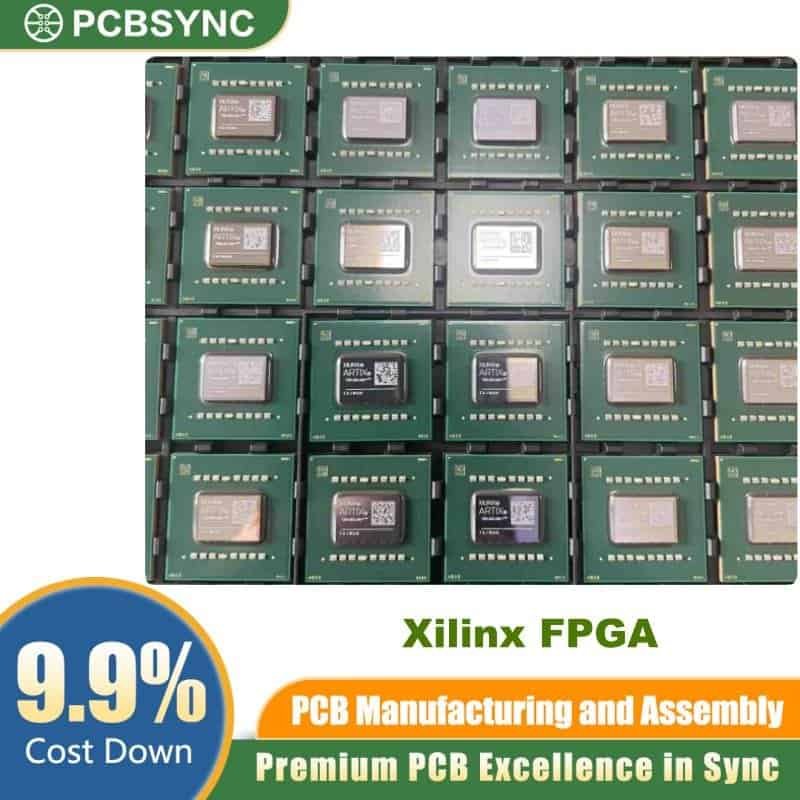
The XC3S2000-4FG676C is a high-performance, cost-optimized field-programmable gate array (FPGA) from AMD Xilinx, belonging to the widely adopted Spartan-3 family. Designed for high-volume, cost-sensitive applications, this device delivers 2 million system gates in a compact 676-ball Fine-pitch Ball Grid Array (FBGA) package. Whether you are an engineer designing embedded systems, communications hardware, or DSP applications, the XC3S2000-4FG676C offers the logic density, I/O flexibility, and proven reliability needed for demanding production designs.
If you are sourcing or evaluating Xilinx FPGA solutions for your next project, this guide covers everything you need to know about the XC3S2000-4FG676C — from core specifications and pinout details to power requirements and application use cases.
What Is the XC3S2000-4FG676C?
The XC3S2000-4FG676C is part of AMD Xilinx’s Spartan-3 generation, launched specifically to address the growing demand for low-cost, high-density programmable logic. The “XC3S2000” denotes the Spartan-3 series with 2,000,000 system gate capacity, “-4” indicates the speed grade, “FG676” specifies the 676-ball FBGA package, and “C” designates commercial temperature range operation.
This FPGA integrates configurable logic blocks (CLBs), block RAM, dedicated multipliers, digital clock managers (DCMs), and a large bank of programmable I/O — making it suitable for a wide spectrum of digital design challenges.
XC3S2000-4FG676C Key Specifications
General Device Specifications
| Parameter |
Value |
| Manufacturer |
AMD (Xilinx) |
| Series |
Spartan-3 |
| Part Number |
XC3S2000-4FG676C |
| System Gates |
2,000,000 |
| Logic Cells |
46,080 |
| CLB Array |
96 × 64 |
| CLB Flip-Flops |
46,080 |
| Distributed RAM |
720 Kbits |
| Block RAM |
720 Kbits |
| Dedicated Multipliers (18×18) |
40 |
| Digital Clock Managers (DCMs) |
4 |
Package and Pinout Specifications
| Parameter |
Value |
| Package Type |
FBGA (Fine-pitch Ball Grid Array) |
| Package Code |
FG676 |
| Ball Count |
676 |
| Package Dimensions |
27 mm × 27 mm |
| Ball Pitch |
1.0 mm |
| Maximum User I/O |
489 |
| Number of I/O Banks |
8 |
Electrical and Timing Specifications
| Parameter |
Value |
| Speed Grade |
-4 |
| Core Voltage (VCCINT) |
1.2 V |
| I/O Voltage (VCCO) |
1.2 V – 3.3 V |
| Operating Temperature (Commercial) |
0°C to +85°C |
| Configuration Voltage (VCCAUX) |
2.5 V |
I/O Standard Support
| I/O Standard |
Supported |
| LVCMOS (1.2V, 1.8V, 2.5V, 3.3V) |
✔ |
| LVTTL |
✔ |
| SSTL2 / SSTL3 |
✔ |
| HSTL |
✔ |
| PCI 3.3V |
✔ |
| LVDS (via external resistors) |
✔ |
| GTL / GTL+ |
✔ |
XC3S2000-4FG676C Architecture Overview
Configurable Logic Blocks (CLBs)
The heart of the XC3S2000-4FG676C is its array of 6,144 CLBs, each containing four slices. Every slice includes two 4-input look-up tables (LUTs), two storage elements (flip-flops or latches), and carry and control logic. This architecture enables efficient implementation of arithmetic functions, state machines, and complex combinational logic.
Block RAM and Distributed RAM
The device provides 720 Kbits of block RAM organized as 20 dual-port 18 Kbit RAM blocks. Each block RAM can be configured as single-port or dual-port memory with independent read/write widths ranging from 1 to 36 bits. In addition, the CLB LUTs can be configured as distributed RAM, providing an additional 720 Kbits of fast, flexible on-chip storage.
Dedicated Multipliers
With 40 dedicated 18×18 signed multipliers, the XC3S2000-4FG676C is well-suited for digital signal processing applications including FIR filters, FFTs, and arithmetic-intensive algorithms. These hardware multipliers operate significantly faster than LUT-based multiplications and consume no general logic resources.
Digital Clock Managers (DCMs)
Four on-chip DCMs provide precise clock management capabilities including frequency synthesis, phase shifting, deskewing, and spread-spectrum clocking. DCMs support a wide input frequency range and can multiply or divide clocks to match system requirements, reducing the need for external clock generation circuitry.
Pin Configuration and FG676 Package Details
The FG676 package places 676 solder balls on a 26×26 array with 1.0 mm pitch. Of the 676 total balls, 489 are available as user-configurable I/O pins across 8 I/O banks. Each I/O bank has an independent VCCO supply, allowing different voltage standards to coexist on the same device.
I/O Bank Distribution (FG676 Package)
| Bank |
Approximate I/O Count |
Typical Voltage Range |
| Bank 0 |
~50 |
1.2V – 3.3V |
| Bank 1 |
~60 |
1.2V – 3.3V |
| Bank 2 |
~65 |
1.2V – 3.3V |
| Bank 3 |
~65 |
1.2V – 3.3V |
| Bank 4 |
~60 |
1.2V – 3.3V |
| Bank 5 |
~65 |
1.2V – 3.3V |
| Bank 6 |
~62 |
1.2V – 3.3V |
| Bank 7 |
~62 |
1.2V – 3.3V |
Configuration Options for XC3S2000-4FG676C
The XC3S2000-4FG676C supports several standard configuration modes compatible with Xilinx configuration ICs and microprocessors:
| Configuration Mode |
Description |
| Master Serial (SPI) |
Uses a standard SPI serial flash device |
| Slave Serial |
Configuration data driven by an external master |
| Master SelectMAP (Parallel) |
High-speed byte-wide parallel configuration |
| Slave SelectMAP |
External controller drives parallel data bus |
| JTAG (IEEE 1149.1) |
Boundary scan and in-system programming |
| Master SPI (Quad) |
Fast quad SPI configuration interface |
The recommended companion configuration device is the Xilinx XCF series Platform Flash or any standard SPI NOR flash. JTAG-based configuration via the Xilinx iMPACT or Vivado tool chain is supported for prototyping and production programming.
Power Supply Requirements
The XC3S2000-4FG676C requires three supply voltages for normal operation:
| Supply Rail |
Voltage |
Purpose |
| VCCINT |
1.2 V |
Core logic power |
| VCCAUX |
2.5 V |
Auxiliary circuits (DCMs, config) |
| VCCO (per bank) |
1.2 V – 3.3 V |
I/O output drive voltage |
Careful power sequencing is recommended: VCCAUX and VCCINT should be powered before or simultaneously with VCCO. Use dedicated LDO regulators or switching regulators with adequate bypass capacitance (100 nF ceramic + 10 µF bulk per supply pin) placed as close as possible to the device.
Ordering Information
| Attribute |
Detail |
| Manufacturer Part Number |
XC3S2000-4FG676C |
| Manufacturer |
AMD (Xilinx) |
| Series |
Spartan-3 |
| Package |
676-FBGA |
| Temperature Grade |
Commercial (0°C to +85°C) |
| RoHS Compliance |
Yes |
| Moisture Sensitivity Level |
MSL 3 |
| ECCN |
EAR99 |
Typical Applications for the XC3S2000-4FG676C
The XC3S2000-4FG676C’s combination of high logic density, dedicated DSP resources, and broad I/O standard support makes it a strong fit for:
- Embedded Processing — Soft-core processors (MicroBlaze, PicoBlaze) with peripheral integration for custom SoC designs
- Communications Infrastructure — Line cards, protocol bridges, serializer/deserializer glue logic
- Industrial Automation — Motor control, servo drives, real-time sensor interfacing
- Video and Imaging — Pixel pipeline processing, frame buffering, video standard conversion
- Wireless and Baseband — Channel filtering, modulation/demodulation, control plane logic
- Test and Measurement — High-speed data capture, pattern generation, digital I/O expansion
- Consumer Electronics — Display controllers, home automation systems, smart appliance logic
XC3S2000-4FG676C vs. Other Spartan-3 Devices
| Device |
System Gates |
Logic Cells |
Block RAM |
Multipliers |
Max I/O |
Package Options |
| XC3S200 |
200K |
4,320 |
72 Kbits |
12 |
173 |
TQ144, FT256 |
| XC3S400 |
400K |
8,064 |
288 Kbits |
16 |
264 |
TQ144, FT256, FG456 |
| XC3S1000 |
1M |
17,280 |
432 Kbits |
24 |
391 |
FT256, FG320, FG456 |
| XC3S2000 |
2M |
46,080 |
720 Kbits |
40 |
489 |
FG456, FG676 |
| XC3S4000 |
4M |
62,208 |
1,728 Kbits |
96 |
633 |
FG676, FG900 |
| XC3S5000 |
5M |
74,880 |
1,872 Kbits |
104 |
633 |
FG676, FG900 |
The XC3S2000-4FG676C sits at a strong midpoint in the Spartan-3 family — offering significantly more resources than the XC3S1000 while remaining more cost-effective than the XC3S4000 for designs that don’t require the highest gate counts.
Design Tools and Development Support
Xilinx (now AMD) supports the XC3S2000-4FG676C with the following tools:
- ISE Design Suite — Legacy toolchain fully supporting all Spartan-3 devices; includes XST synthesis, NGDBUILD, MAP, PAR, and BITGEN
- Vivado — Not directly targeting Spartan-3; ISE 14.7 is the recommended tool
- IP Core Library — Ready-to-use IP for UART, SPI, I2C, Ethernet MAC, memory controllers, and more
- ChipScope Pro — In-system logic analysis via JTAG
- iMPACT — Configuration and JTAG boundary scan utility
The Xilinx ISE 14.7 tool suite is available as a free download from AMD’s support portal and supports all Spartan-3 family members, including the XC3S2000.
PCB Design Guidelines for FG676 BGA Package
Routing a 676-ball BGA requires careful PCB stack-up planning and via strategy:
- Minimum PCB Layers: 6-layer stack-up recommended for signal integrity and power distribution
- Via Strategy: Use microvias or dog-bone via escapes for inner-ball access; standard 0.2 mm drill on 1.0 mm pitch is feasible
- Decoupling: Place 100 nF X7R ceramic capacitors within 1 mm of each power ball; add 10 µF bulk capacitors per power domain
- Ground Planes: Dedicate inner layers to GND and power planes directly under the BGA footprint
- Signal Routing: Maintain controlled impedance (50 Ω single-ended, 100 Ω differential) for high-speed interface signals
- Thermal Relief: The device’s power dissipation at full utilization can require a thermal management strategy; consult the Spartan-3 packaging datasheet for junction-to-board thermal resistance values
Frequently Asked Questions (FAQ)
Q: What is the difference between XC3S2000-4FG676C and XC3S2000-5FG676C? The number following the dash indicates the speed grade. The “-5” grade has faster propagation delays and higher maximum operating frequency compared to “-4”. Both devices are functionally identical and pin-compatible.
Q: Is the XC3S2000-4FG676C RoHS compliant? Yes. The “C” suffix in the part number indicates commercial temperature range, and the FG676 package is manufactured in a lead-free, RoHS-compliant process.
Q: Can I migrate a design from XC3S2000-4FG676C to XC3S4000-4FG676C? Yes. Both devices share the FG676 package and are pin-compatible in that package, facilitating a straightforward density migration path without PCB changes.
Q: What configuration memory device should I use with the XC3S2000-4FG676C? Xilinx XCF04S or XCF08P Platform Flash devices are common choices. Alternatively, any standard 3.3V SPI NOR flash with sufficient capacity (the bitstream is approximately 1.7 MB) and compatible timing is suitable.
Q: What soft-core processors are supported? The device supports both the 32-bit MicroBlaze soft-core processor and the 8-bit PicoBlaze microcontroller, both available as free Xilinx IP cores.
Summary
The XC3S2000-4FG676C is a proven, versatile FPGA offering 2 million system gates, 46,080 logic cells, 720 Kbits of block RAM, 40 dedicated multipliers, and 489 user I/O pins in a 676-ball BGA package. Operating at a commercial temperature grade with full Xilinx ISE tool support, it is an excellent choice for engineers seeking a cost-effective, high-density programmable logic solution across communications, industrial, video, and embedded processing applications.