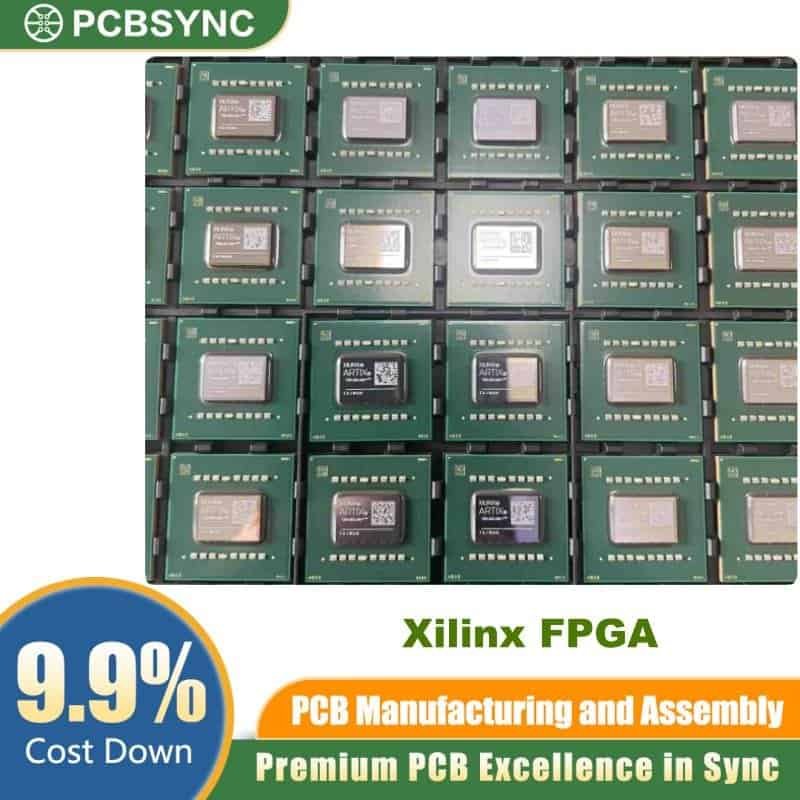
The XC3S200-4TQG144C is a field-programmable gate array (FPGA) from AMD Xilinx’s Spartan-3 family. Designed for cost-sensitive, high-volume applications, this device delivers a compelling balance of logic density, I/O flexibility, and low power consumption. If you’re evaluating Xilinx FPGA solutions for embedded systems, communications, or industrial control, the XC3S200-4TQG144C is a proven choice worth serious consideration.
What Is the XC3S200-4TQG144C?
The XC3S200-4TQG144C belongs to the Spartan-3 generation — a low-cost FPGA platform that made programmable logic accessible for mainstream product design. The part number breaks down as follows:
| Part Number Segment |
Meaning |
| XC3S200 |
Spartan-3 family, 200K system gates |
| -4 |
Speed grade -4 (slowest / most power-efficient) |
| TQ |
Thin Quad Flat Pack (TQFP) package |
| G |
Lead-free (RoHS compliant) |
| 144 |
144-pin package |
| C |
Commercial temperature grade (0°C to +85°C) |
Key Specifications at a Glance
| Parameter |
Value |
| Manufacturer |
AMD (Xilinx) |
| Series |
Spartan-3 |
| Part Number |
XC3S200-4TQG144C |
| Logic Cells |
4,320 |
| System Gates |
200,000 |
| CLB Flip-Flops |
3,840 |
| Distributed RAM |
30 Kb |
| Block RAM |
216 Kb |
| Multipliers (18×18) |
12 |
| DCM Blocks |
4 |
| Maximum User I/Os |
97 |
| Package Type |
TQFP (TQG144) |
| Package Pins |
144 |
| Voltage Supply (VCCINT) |
1.2V |
| Speed Grade |
-4 |
| Operating Temperature |
0°C to +85°C (Commercial) |
| RoHS Compliance |
Yes (Lead-Free) |
| Mounting Style |
SMD / SMT |
XC3S200-4TQG144C Architecture Overview
Configurable Logic Blocks (CLBs)
The XC3S200 contains 4,320 logic cells organized in an array of CLBs. Each CLB contains four logic slices, with each slice housing two 4-input LUTs (Look-Up Tables) and two flip-flops. This architecture allows designers to implement combinational or registered logic with high efficiency.
Block RAM and Distributed RAM
The device provides two forms of on-chip memory. Block RAM offers 216 Kb of dedicated dual-port SRAM, suitable for FIFOs, register files, and data buffers. Distributed RAM, derived from LUTs, adds 30 Kb of flexible single- or dual-port memory embedded within the logic fabric — ideal for small lookup tables and shift registers.
Digital Clock Managers (DCMs)
Four on-chip DCMs provide clock multiplication, division, phase shifting, and deskew capabilities. This eliminates the need for external clock management devices in most designs and dramatically simplifies PCB layout.
Dedicated Multipliers
Twelve 18×18-bit hardware multipliers enable efficient DSP and arithmetic operations. These hard multipliers significantly outperform LUT-based implementations in both speed and resource utilization.
Pin Configuration and I/O Details
XC3S200-4TQG144C Package Pinout Summary
| I/O Bank |
Supported Standards |
Differential Pairs |
| Bank 0 |
LVCMOS, LVTTL, PCI |
Yes |
| Bank 1 |
LVCMOS, LVTTL, SSTL |
Yes |
| Bank 2 |
LVCMOS, LVTTL, SSTL |
Yes |
| Bank 3 |
LVCMOS, LVTTL, PCI |
Yes |
The TQFP-144 package provides up to 97 user-configurable I/O pins, organized across four I/O banks. Each bank supports independent VCCO voltage settings, allowing mixed-voltage interfaces in a single design.
Supported I/O Standards
The XC3S200-4TQG144C supports a wide range of single-ended and differential I/O standards, including LVCMOS (3.3V, 2.5V, 1.8V, 1.5V), LVTTL, PCI (3.3V), SSTL2, SSTL3, HSTL, LVDS, LVPECL, and BLVDS. This versatility makes it compatible with a broad range of memory interfaces, processors, and peripheral ICs.
Power Supply Requirements
| Supply Rail |
Voltage |
Description |
| VCCINT |
1.2V |
Core logic supply |
| VCCO |
1.5V – 3.3V |
I/O bank supply (per bank) |
| VCCAUX |
2.5V |
Auxiliary supply (DCMs, DCI) |
Proper power sequencing is important: VCCAUX and VCCO should be stable before or during VCCINT power-up to ensure reliable configuration.
Configuration Modes
The XC3S200-4TQG144C supports multiple configuration methods, enabling flexible production programming:
| Mode |
Description |
Use Case |
| Master Serial (SPI) |
Loads bitstream from serial Flash |
Low-cost, simple PCB designs |
| Slave Serial |
Driven by external processor |
Processor-controlled boot |
| Master Parallel (BPI) |
Parallel NOR Flash interface |
Faster configuration |
| JTAG |
IEEE 1149.1 boundary scan |
Debug, in-system programming |
| Slave Parallel |
External host provides data |
Custom boot sequences |
Configuration bitstream size for the XC3S200 is approximately 1.02 Mb. Standard Xilinx tools (ISE Design Suite) generate the bitstream in .bit or .mcs format.
Performance Characteristics
Speed Grade -4 Performance
The -4 speed grade is the slowest (and most power-efficient) grade within the Spartan-3 family. Typical performance figures include:
| Metric |
Typical Value |
| Maximum Internal Clock (Fmax) |
~200 MHz (design-dependent) |
| DCM Input Frequency Range |
24 MHz – 280 MHz |
| DCM Output Frequency Range |
1 MHz – 280 MHz |
| Setup Time (Flip-Flop) |
~0.8 ns |
| Clock-to-Out (Flip-Flop) |
~1.2 ns |
Note: Actual timing performance depends on design implementation, place-and-route results, and operating conditions.
XC3S200 vs. Other Spartan-3 Devices
| Device |
Logic Cells |
Block RAM |
Multipliers |
Max I/O |
Package Options |
| XC3S50 |
1,728 |
72 Kb |
4 |
124 |
VQ100, CP132 |
| XC3S200 |
4,320 |
216 Kb |
12 |
173 |
TQ144, PQ208, CP132 |
| XC3S400 |
8,064 |
288 Kb |
16 |
264 |
PQ208, TQ144, FT256 |
| XC3S1000 |
17,280 |
432 Kb |
24 |
391 |
FT256, FG320, FG456 |
| XC3S1500 |
29,952 |
576 Kb |
32 |
487 |
FG320, FG456, FG676 |
The XC3S200 occupies a practical middle ground: significantly more capable than the entry-level XC3S50, while remaining affordable and available in easy-to-prototype packages like the TQFP-144.
Ordering Information
| Parameter |
Detail |
| Full Part Number |
XC3S200-4TQG144C |
| Manufacturer |
AMD (formerly Xilinx) |
| Manufacturer Part Number |
XC3S200-4TQG144C |
| DigiKey Part Number |
122-1448-ND |
| Package |
TQFP-144 (20×20mm, 0.5mm pitch) |
| RoHS Status |
Compliant |
| Moisture Sensitivity Level |
MSL 3 |
| Temperature Range |
Commercial (0°C to +85°C) |
Typical Applications
The XC3S200-4TQG144C is well-suited for a broad range of embedded and digital design applications:
- Motor control: Implement custom PWM generation, encoder interfaces, and real-time feedback loops
- Communications interfaces: Build custom UART, SPI, I²C, or proprietary serial protocols
- Glue logic replacement: Consolidate multiple TTL/CMOS logic ICs into a single programmable device
- Industrial control: PLC I/O expansion, sensor interfacing, and protocol bridging
- Video processing: Simple image scaling, synchronization, and pixel pipeline logic
- Prototyping and education: Rapid development of digital logic circuits and SoC architectures
Development Tools and Ecosystem
Xilinx ISE Design Suite
The XC3S200-4TQG144C is supported by Xilinx ISE Design Suite (version 14.7 is the final release). ISE provides a complete RTL-to-bitstream flow including synthesis, implementation, timing analysis, and JTAG programming via iMPACT.
Hardware Description Languages
Both VHDL and Verilog are fully supported. Xilinx also provides a library of pre-built IP cores (LogiCORE) covering functions such as FIFOs, memory controllers, DSP filters, and communication interfaces — reducing design time considerably.
Programming Hardware
The device supports programming via Xilinx Platform Cable USB II or compatible JTAG adapters. Third-party tools such as OpenOCD may also be used with appropriate BSDL files.
PCB Design Considerations
Decoupling and Power Integrity
- Place 100 nF ceramic decoupling capacitors on every VCCINT, VCCO, and VCCAUX pin
- Use a low-inductance 4-layer PCB with dedicated power and ground planes
- For the 0.5mm pitch TQFP-144, use IPC Class B or Class C solder mask openings to avoid solder bridging
Thermal Management
Under typical operating conditions, the XC3S200-4TQG144C dissipates modest power. A θJA of approximately 35°C/W is typical for the TQ144 package in still air. Active cooling is rarely required at speed grade -4 with moderate logic utilization.
JTAG Boundary Scan
The device supports IEEE 1149.1 JTAG for both configuration and board-level testing. Ensure TCK, TMS, TDI, and TDO are properly terminated on the PCB to prevent signal integrity issues during high-speed JTAG operations.
Frequently Asked Questions
Q: What is the difference between XC3S200-4TQG144C and XC3S200-4TQG144I? The “C” suffix denotes a Commercial temperature range (0°C to +85°C), while the “I” suffix indicates an Industrial temperature range (–40°C to +100°C). All other specifications are identical.
Q: Is the XC3S200-4TQG144C RoHS compliant? Yes. The “G” in the part number indicates a lead-free, RoHS-compliant device.
Q: Can I use Vivado to design for the XC3S200-4TQG144C? No. Vivado does not support Spartan-3 devices. You must use ISE Design Suite 14.7, which is available as a free download from the AMD/Xilinx website.
Q: What configuration memory is recommended for this device? Xilinx M25P10 (1 Mb SPI Flash) or the Spansion S25FL016A are commonly used. Any SPI Flash with ≥1 Mb capacity and 3.3V operation is compatible.
Q: What is the maximum operating frequency of the XC3S200? Theoretical Fmax depends heavily on the design. Simple pipelines with short logic paths can exceed 200 MHz. Designs with complex combinational paths will be slower. Always verify timing with post-implementation timing reports in ISE.
Summary
The XC3S200-4TQG144C is a mature, well-documented, and cost-effective FPGA that continues to see use in industrial, communications, and embedded control applications. Its 200K-gate logic capacity, 216 Kb of block RAM, 12 hardware multipliers, and 97 user I/Os in a compact TQFP-144 package make it an ideal candidate for designs that require programmable logic without the complexity or cost of larger FPGAs. With strong toolchain support via ISE 14.7 and a broad ecosystem of reference designs, it remains a reliable choice for both new designs and legacy system maintenance.