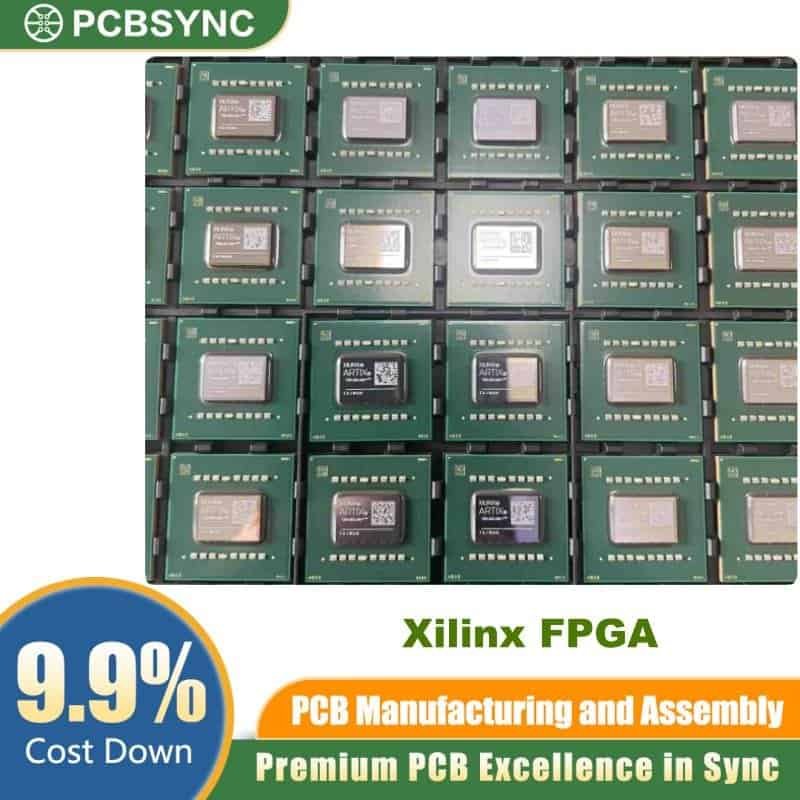
The XC3S200-4TQ144C is a high-performance, cost-effective field-programmable gate array (FPGA) from Xilinx (now AMD), part of the widely adopted Spartan-3 family. Designed for high-volume, cost-sensitive applications, the XC3S200-4TQ144C delivers 200,000 system gates, 144-pin TQFP packaging, and a commercial temperature rating — making it a go-to solution for embedded systems, consumer electronics, and industrial control designs.
Whether you are prototyping a digital system or moving into production, the XC3S200-4TQ144C offers the balance of logic density, I/O flexibility, and low power consumption that engineers demand. As a trusted Xilinx FPGA, this device continues to see strong design-in activity across global markets.
What Is the XC3S200-4TQ144C?
The XC3S200-4TQ144C is a Spartan-3 series FPGA manufactured by Xilinx. The part number breaks down as follows:
| Part Number Segment |
Meaning |
| XC3S |
Xilinx Spartan-3 Family |
| 200 |
200,000 System Gates |
| -4 |
Speed Grade -4 (slowest / most power-efficient) |
| TQ144 |
144-pin Thin Quad Flat Pack (TQFP) |
| C |
Commercial Temperature Range (0°C to +85°C) |
XC3S200-4TQ144C Key Specifications
The table below summarizes the most important electrical, logic, and packaging specifications for the XC3S200-4TQ144C.
General Logic & Memory Specifications
| Parameter |
Value |
| Series |
Spartan-3 |
| Number of System Gates |
200,000 |
| Number of Logic Cells |
4,320 |
| CLB Array (Rows × Columns) |
12 × 20 |
| Flip-Flops |
3,840 |
| Distributed RAM (bits) |
30,720 |
| Block RAM (bits) |
216,000 |
| DSP/Multiplier Blocks |
12 × 18-bit multipliers |
| Maximum User I/O Pins |
97 |
| Number of I/O Banks |
4 |
Electrical & Operating Characteristics
| Parameter |
Value |
| Core Supply Voltage (VCCINT) |
1.2 V |
| Auxiliary Voltage (VCCAUX) |
2.5 V |
| I/O Supply Voltage |
1.2 V – 3.3 V |
| Operating Temperature (Commercial) |
0°C to +85°C |
| Speed Grade |
-4 |
| Configuration Modes |
Master Serial, Slave Serial, SelectMAP, JTAG, SPI, BPI |
Package & Physical Specifications
| Parameter |
Value |
| Package Type |
TQFP (Thin Quad Flat Pack) |
| Pin Count |
144 |
| Package Code |
TQ144 |
| RoHS Compliant |
Yes |
| Moisture Sensitivity Level (MSL) |
3 |
| Height |
1.2 mm (max) |
| Body Size |
20 mm × 20 mm |
XC3S200-4TQ144C Detailed Description
## Spartan-3 Architecture Overview
The Spartan-3 family introduced a new generation of cost-optimized FPGAs that leverage an advanced 90 nm process technology. The XC3S200-4TQ144C is built on this platform and incorporates five fundamental programmable functional elements: CLBs (Configurable Logic Blocks), IOBs (Input/Output Blocks), Block RAM, Dedicated Multipliers, and DCMs (Digital Clock Managers).
Each CLB contains four slices, and each slice includes two 4-input look-up tables (LUTs), two storage elements (flip-flops or latches), and wide-function multiplexers — giving designers maximum logic flexibility within a compact footprint.
## Configurable Logic Blocks (CLBs)
The CLB is the fundamental building block of the XC3S200-4TQ144C. Key capabilities include:
- 4,320 logic cells organized in a 12×20 CLB array
- Each CLB slice contains two LUT4s capable of functioning as 16×1-bit RAM or a 16-bit shift register
- 3,840 flip-flops with set/reset and clock-enable controls
- 30,720 bits of distributed RAM
## Block RAM
The XC3S200-4TQ144C includes 216,000 bits of true dual-port block RAM, organized as twelve 18K-bit blocks. Each block can be independently configured as:
- 16K × 1 bit
- 8K × 2 bits
- 4K × 4 bits
- 2K × 9 bits (with parity)
- 1K × 18 bits (with parity)
- 512 × 36 bits
This flexibility makes on-chip memory design straightforward without requiring external SRAM in many applications.
## Dedicated 18×18-bit Multipliers
Twelve dedicated hardware multipliers are embedded in the XC3S200-4TQ144C. Each multiplier accepts two 18-bit inputs and produces an 18-bit product, significantly boosting DSP throughput for signal processing, motor control, and arithmetic-intensive applications — without consuming CLB resources.
## Digital Clock Manager (DCM)
The XC3S200-4TQ144C includes four Digital Clock Managers that deliver:
- Clock multiplication and division
- Phase shifting (fine and coarse)
- Deskewing of clocks relative to internal or external signals
- Frequency synthesis
DCMs ensure robust, jitter-minimized clock distribution across the entire device, which is critical for high-speed synchronous designs.
## I/O Capabilities and Standards
The 97 user I/O pins are organized into four independent I/O banks, each with its own VCCO supply rail. This allows different banks to operate at different voltages simultaneously.
Supported I/O Standards
| I/O Standard |
Category |
| LVCMOS 3.3V / 2.5V / 1.8V / 1.5V / 1.2V |
Single-Ended |
| LVTTL |
Single-Ended |
| PCI / PCI-X |
Single-Ended |
| LVDS |
Differential |
| RSDS |
Differential |
| PPDS |
Differential |
| BLVDS |
Differential |
| HSTL Class I / II / III / IV |
Single-Ended |
| SSTL 2 Class I / II |
Single-Ended |
| SSTL 3 Class I / II |
Single-Ended |
XC3S200-4TQ144C Configuration Options
The XC3S200-4TQ144C supports multiple configuration modes, offering flexibility for different board designs and production flows:
| Configuration Mode |
Interface |
Description |
| Master Serial |
SPI Flash |
Reads bitstream from external serial PROM |
| Slave Serial |
External Controller |
Controlled by host processor |
| SelectMAP (Slave Parallel) |
Parallel Bus |
Fast byte-wide configuration |
| JTAG |
IEEE 1149.1 |
Boundary scan and in-system programming |
| Master SPI |
SPI |
Direct connection to SPI Flash |
| Master BPI |
Parallel Flash |
Boot from parallel NOR Flash |
The device retains its configuration in volatile SRAM, requiring re-configuration on every power-up. Configuration data is typically stored in an external SPI Flash (e.g., Xilinx XCF series or compatible devices).
XC3S200-4TQ144C vs. Other Spartan-3 Devices
| Device |
System Gates |
Logic Cells |
Block RAM (bits) |
Multipliers |
Max I/O |
Package Options |
| XC3S50-4TQ144C |
50,000 |
1,728 |
72,000 |
4 |
97 |
TQ144 |
| XC3S200-4TQ144C |
200,000 |
4,320 |
216,000 |
12 |
97 |
TQ144, VQ100 |
| XC3S400-4TQ144C |
400,000 |
8,064 |
288,000 |
16 |
97 |
TQ144, PQ208 |
| XC3S1000-4FT256C |
1,000,000 |
17,280 |
432,000 |
24 |
173 |
FT256, FG320 |
The XC3S200-4TQ144C sits in the sweet spot of the Spartan-3 line — more logic density than the XC3S50 but still affordable and compact in the 144-pin TQFP package.
Ordering Information
| Attribute |
Detail |
| Manufacturer Part Number |
XC3S200-4TQ144C |
| Manufacturer / Brand |
AMD (Xilinx) |
| Series |
Spartan-3 |
| Product Category |
Embedded – FPGAs (Field Programmable Gate Array) |
| RoHS Status |
RoHS Compliant |
| Export Control (ECCN) |
3A991 |
| HTSUS |
8542.39.00.01 |
Typical Applications of the XC3S200-4TQ144C
The XC3S200-4TQ144C is well-suited for a wide range of embedded and digital design applications, including:
- Industrial automation – Motor control, machine vision interfaces, and PLC logic replacement
- Consumer electronics – Display controllers, set-top box logic, smart home devices
- Communications – Protocol bridging, UART/SPI/I2C expansion, data framing
- Automotive electronics – Body control modules, sensor interfaces (use appropriate extended-temp variant for harsh environments)
- Embedded processors – Implementing Xilinx PicoBlaze or MicroBlaze soft-core processors
- Test & measurement – Signal generation, logic capture, and custom instrument front-ends
- Prototyping and development – Rapid hardware prototyping of ASICs or DSP pipelines
Development Tools & Software Support
The XC3S200-4TQ144C is fully supported by Xilinx ISE Design Suite, the legacy toolchain for Spartan-3 devices. Key tools include:
| Tool |
Purpose |
| ISE Project Navigator |
HDL design entry and synthesis |
| XST (Xilinx Synthesis Technology) |
Logic synthesis from VHDL/Verilog |
| ISIM / ModelSim |
Functional and timing simulation |
| iMPACT |
Device programming and configuration file generation |
| ChipScope Pro |
In-system logic analysis (like a logic analyzer inside the FPGA) |
| PlanAhead |
Floorplanning and placement constraints |
Note: ISE Design Suite 14.7 is the final release supporting Spartan-3 devices. It runs on Windows 7/10 (32/64-bit) and Linux.
Power Consumption Guidance
The XC3S200-4TQ144C operates at a core voltage of 1.2V (VCCINT), which contributes to its low static and dynamic power characteristics compared to older 1.5V or 1.8V FPGA families. Key power domains:
| Power Rail |
Typical Voltage |
Connected To |
| VCCINT |
1.2 V |
Core logic, CLBs, Block RAM, Multipliers |
| VCCAUX |
2.5 V |
DCM, configuration logic, DCI termination |
| VCCO (Bank 0–3) |
1.2 V – 3.3 V |
I/O output drivers (per bank) |
Use Xilinx’s XPower Estimator tool to estimate power consumption for your specific design.
Frequently Asked Questions (FAQ)
Q: What is the difference between XC3S200-4TQ144C and XC3S200-4VQ100C? A: Both are Spartan-3 devices with 200K gates, but the TQ144 variant has a 144-pin TQFP package with 97 user I/O pins, while the VQ100 variant uses a 100-pin VQFP package with fewer available I/O pins (63 max user I/O).
Q: Is the XC3S200-4TQ144C still in production? A: The Spartan-3 family is in mature/end-of-life phase. While stock is still available through distributors, new designs should consider migration to Spartan-6, Spartan-7, or Artix-7 families.
Q: What configuration PROM is compatible with the XC3S200-4TQ144C? A: Common options include the Xilinx XCF01S (1Mbit), XCF02S (2Mbit) Platform Flash PROMs, or standard SPI Flash devices such as Winbond W25Q series.
Q: Can I run a soft processor on the XC3S200-4TQ144C? A: Yes. The XC3S200-4TQ144C has sufficient resources to implement Xilinx PicoBlaze (8-bit) soft-core processor. A MicroBlaze implementation may be resource-constrained at this density level.
Q: What HDL languages are supported? A: The device can be programmed using VHDL, Verilog, or ABEL. Schematic-based entry is also supported in ISE.
Summary
The XC3S200-4TQ144C is a proven, reliable, and cost-effective FPGA for designs requiring up to 200K system gates, 97 user I/O, and a compact 144-pin TQFP footprint. Its combination of distributed and block RAM, dedicated multipliers, and flexible clock management through DCMs makes it a capable device for a broad range of digital design projects. With strong tool support from Xilinx ISE and a large installed base in the industry, the XC3S200-4TQ144C remains a relevant choice for replacement, legacy support, and volume production applications.
For engineers exploring the full range of programmable logic solutions, browsing available Xilinx FPGA options can help identify the right device density, package, and speed grade for your next design.