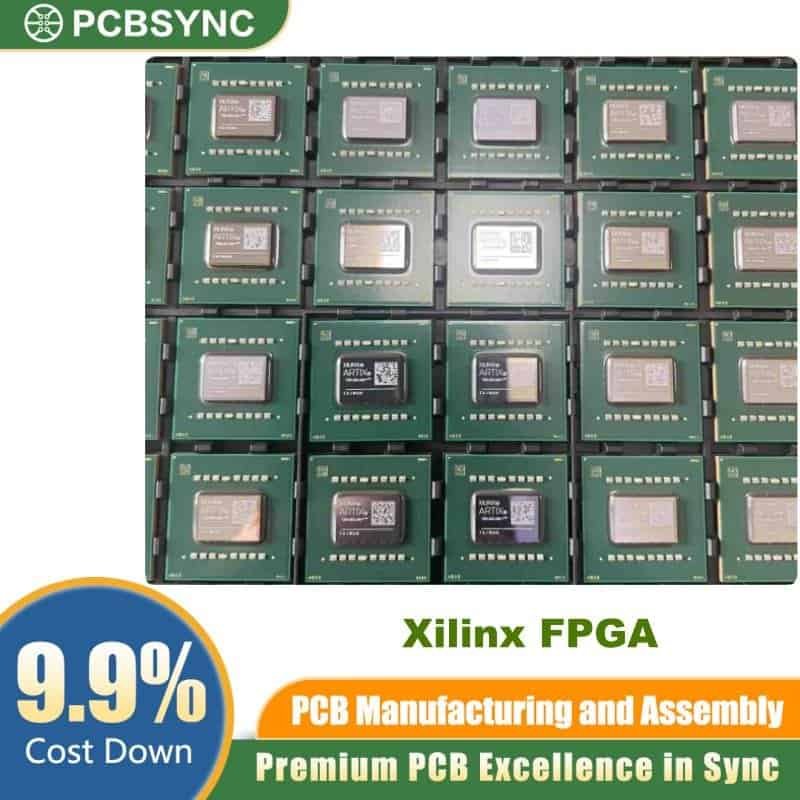
The XC3S200-4PQG208C is a high-value, cost-optimized Field-Programmable Gate Array (FPGA) from the Xilinx (now AMD) Spartan-3 family. Featuring 200K system gates, 4,320 logic cells, 90nm process technology, and a 208-pin PQFP package, this device delivers exceptional programmable logic performance for a wide range of embedded, consumer, and industrial applications. Whether you are prototyping a new design or deploying a production system, the XC3S200-4PQG208C offers the flexibility, density, and I/O versatility modern engineers demand.
What Is the XC3S200-4PQG208C?
The XC3S200-4PQG208C is part of AMD Xilinx’s Spartan-3 FPGA family — a product line engineered specifically for high-volume, cost-sensitive applications. The device is built on 90nm CMOS process technology and operates at a 1.2V core supply voltage, delivering a balance of logic density, speed, and power efficiency that makes it well-suited for both commercial and industrial use cases.
The part number breaks down as follows:
| Field |
Value |
Meaning |
| XC |
XC |
Xilinx Commercial Part |
| 3S |
3S |
Spartan-3 Family |
| 200 |
200 |
~200K System Gates |
| 4 |
-4 |
Speed Grade 4 |
| PQG |
PQG |
208-Pin Pb-Free PQFP Package |
| 208 |
208 |
208 Total Pins |
| C |
C |
Commercial Temp Range (0°C to +85°C) |
As a member of the broader Xilinx FPGA portfolio, the XC3S200-4PQG208C inherits architectural improvements derived from the Virtex-II platform, delivering more functionality per dollar than earlier Spartan generations.
XC3S200-4PQG208C Key Specifications
General Device Parameters
| Parameter |
Value |
| Manufacturer |
AMD (Xilinx) |
| Part Number |
XC3S200-4PQG208C |
| Family |
Spartan-3 |
| System Gates |
200,000 |
| Logic Cells |
4,320 |
| CLB Slices |
1,920 |
| CLB Flip-Flops |
3,840 |
| Max Distributed RAM (bits) |
30,720 |
| Block RAM (bits) |
216K (12 × 18Kb blocks) |
| Dedicated Multipliers |
12 |
| DCMs (Digital Clock Managers) |
4 |
| Max User I/O Pins |
141 |
| Speed Grade |
-4 |
| Process Technology |
90nm |
Electrical Characteristics
| Parameter |
Value |
| Core Supply Voltage (VCCINT) |
1.14V – 1.26V (nom. 1.2V) |
| I/O Supply Voltage (VCCO) |
1.2V, 1.5V, 1.8V, 2.5V, 3.3V |
| Max Internal Clock Frequency |
630 MHz |
| Max System Clock |
~280 MHz |
| Operating Temperature |
0°C to +85°C (Commercial) |
| ESD Protection |
Yes (per JEDEC standards) |
Package Information
| Parameter |
Value |
| Package Type |
PQFP (Plastic Quad Flat Package) |
| Package Code |
PQG208 |
| Total Pin Count |
208 |
| Package Style |
Pb-Free (RoHS-compliant with ‘G’ suffix) |
| Mounting Type |
Surface Mount (SMD) |
| Body Size |
28mm × 28mm |
| MSL Rating |
MSL 3 – 168 hours |
XC3S200-4PQG208C Architecture Overview
Logic Resources
The XC3S200-4PQG208C is organized around Configurable Logic Blocks (CLBs), each containing four slices. Every slice includes two 4-input Look-Up Tables (LUTs), which can be configured as logic functions, 16-bit shift registers (SRL16), or distributed RAM. Two flip-flops per slice enable synchronous sequential logic. With 1,920 slices in total, the device supports designs ranging from state machines and arithmetic units to full soft-processor implementations.
Block RAM
The device includes 12 dedicated 18Kb block RAM modules arranged in two columns, totaling 216Kb of on-chip memory. Each block RAM features a true dual-port architecture, allowing simultaneous independent access from two separate logic domains — ideal for FIFOs, lookup tables, and on-chip data buffers.
Dedicated Multipliers
Twelve 18×18-bit dedicated hardware multipliers are embedded alongside the block RAM modules. These co-located multiply-accumulate resources allow efficient implementation of DSP algorithms, digital filters, and arithmetic-heavy signal processing pipelines without consuming CLB resources.
Digital Clock Managers (DCMs)
Four on-chip Digital Clock Managers provide fully digital, zero-delay clock buffering, frequency synthesis (multiplication and division), and phase shifting. DCMs eliminate clock skew across the device and allow designers to derive multiple derived clocks from a single input reference.
I/O Block Architecture
Each user I/O pin is supported by a programmable Input/Output Block (IOB) with:
- Configurable input delay for hold-time elimination
- Programmable output drive strength (2mA to 24mA)
- Support for Double Data Rate (DDR) signaling
- Input and output registers/latches for pipelining
- Digitally Controlled Impedance (DCI) on select banks
Supported I/O Standards
The XC3S200-4PQG208C supports a broad range of single-ended and differential I/O standards, making it compatible with virtually all common digital interfaces:
| Standard Type |
Supported Standards |
| Single-Ended |
LVTTL, LVCMOS (3.3V, 2.5V, 1.8V, 1.5V, 1.2V) |
| PCI/PCI-X |
PCI 3.3V, PCI 5V-tolerant |
| High-Speed |
HSTL Class I/II/III/IV |
| Memory |
SSTL2 Class I/II, SSTL18 Class I/II |
| Differential |
LVDS, LVPECL, BLVDS, MLVDS |
| Others |
GTL, GTL+, LVCMOS15 |
Configuration Modes
The XC3S200-4PQG208C supports multiple configuration modes to suit different system architectures:
| Mode |
Description |
| Master Serial |
Uses an external Xilinx Platform Flash PROM |
| Slave Serial |
Driven by an external controller (e.g., microprocessor) |
| Master Parallel (x8) |
Byte-wide parallel interface with a PROM |
| Slave Parallel (SelectMAP) |
Byte-wide parallel download from a host |
| JTAG (IEEE 1149.1) |
In-system programming and boundary scan testing |
Configuration data can also be stored in third-party SPI or parallel NOR Flash devices for flexible system design.
Applications
The XC3S200-4PQG208C is a proven solution across a wide spectrum of industries and application types:
Consumer Electronics
- Digital television signal processing
- Display and projection systems
- Home networking and broadband access equipment
Industrial & Automation
- Motor control and drive systems
- Industrial communication interfaces (UART, SPI, I²C)
- PLC and embedded control systems
Communications
- Protocol bridging and conversion (PCIe, Ethernet, USB bridges)
- Wireless baseband front-end processing
- UART, HDLC, and custom serial interfaces
Embedded & Computing
- Soft-processor implementations (MicroBlaze, PicoBlaze)
- Co-processor acceleration for microcontroller systems
- Custom hardware accelerators
Automotive (with XA variant)
- Engine control unit interfaces
- In-vehicle infotainment (IVI) signal routing
- ADAS sensor interface logic
XC3S200-4PQG208C vs. Similar Spartan-3 Devices
| Part Number |
Gates |
Logic Cells |
Max I/O |
Package |
Temp Grade |
| XC3S50-4PQ208C |
50K |
1,728 |
124 |
PQ208 |
Commercial |
| XC3S200-4PQG208C |
200K |
4,320 |
141 |
PQG208 |
Commercial |
| XC3S400-4PQG208C |
400K |
8,064 |
141 |
PQG208 |
Commercial |
| XC3S1000-4FTG256C |
1M |
17,280 |
173 |
FTG256 |
Commercial |
Why Choose the XC3S200-4PQG208C Over an ASIC?
Traditional mask-programmed ASICs require large upfront NRE (Non-Recurring Engineering) costs, long development cycles, and cannot be updated once deployed. The XC3S200-4PQG208C eliminates all of these constraints:
- Zero NRE cost — start development with no mask investment
- In-field reconfigurability — update designs after deployment without hardware changes
- Rapid prototyping — go from design to working silicon in hours, not months
- Reduced inventory risk — one programmable device can serve multiple product variants
Development Tools & Ecosystem
The XC3S200-4PQG208C is fully supported by Xilinx’s legacy ISE Design Suite (recommended for Spartan-3) and benefits from a wide ecosystem of IP cores, reference designs, and evaluation boards.
| Tool / Resource |
Description |
| Xilinx ISE 14.7 |
Primary synthesis, implementation, and bitstream generation |
| ChipScope Pro |
On-chip logic analyzer for real-time debugging |
| MicroBlaze |
32-bit soft processor IP core |
| PicoBlaze |
Lightweight 8-bit soft microcontroller |
| XST (FPGA Synthesizer) |
Integrated synthesizer in ISE |
| JTAG/iMPACT |
In-circuit programming and device configuration |
Ordering Information
| Parameter |
Detail |
| Full Part Number |
XC3S200-4PQG208C |
| Manufacturer |
AMD (Xilinx) |
| ECCN |
EAR99 |
| RoHS Status |
RoHS Compliant (Pb-Free, ‘G’ suffix) |
| MSL |
MSL 3 – 168 hours |
| Package |
208-Pin PQFP (Gull Wing, Surface Mount) |
| Operating Temperature |
0°C to +85°C |
| Datasheet |
Xilinx DS099 – Spartan-3 FPGA Family |
Frequently Asked Questions (FAQ)
Q: What is the difference between XC3S200-4PQ208C and XC3S200-4PQG208C? The ‘G’ in PQG208C designates a Pb-free (lead-free) RoHS-compliant package. The XC3S200-4PQ208C uses a standard tin-lead solder finish, while the XC3S200-4PQG208C uses a Pb-free finish. Electrically, the two are identical.
Q: Is the XC3S200-4PQG208C still in production? The Spartan-3 family has entered mature/last-time-buy status. Designers starting new projects are encouraged to evaluate the Spartan-7 or Artix-7 families for long-term availability. The XC3S200-4PQG208C remains available through authorized distributors and component brokers for legacy and maintenance designs.
Q: What is the maximum operating frequency of the XC3S200-4PQG208C? The internal DCMs support up to 630 MHz. System-level logic performance depends on design complexity, but typical registered designs operate at up to 280 MHz with the -4 speed grade.
Q: Can the XC3S200-4PQG208C be programmed with Vivado? No. The Spartan-3 family is supported only by the Xilinx ISE Design Suite. Vivado supports 7-series devices and newer. Use ISE 14.7 (the final ISE release) for all Spartan-3 development.
Q: What configuration PROM is recommended for the XC3S200-4PQG208C? Xilinx Platform Flash PROMs such as the XCF02S (2Mb) or XCF04S (4Mb) are compatible and commonly used for Master Serial configuration mode.