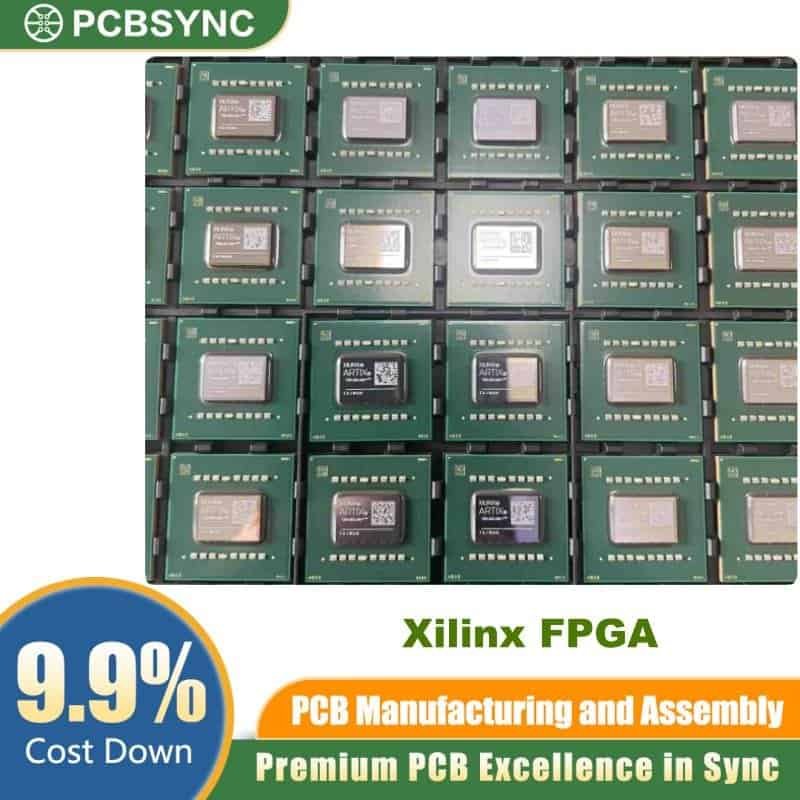
The XC3S200-4FTG256C is a high-performance, cost-optimized field-programmable gate array (FPGA) from AMD Xilinx, belonging to the popular Spartan-3 family. Designed for high-volume, cost-sensitive applications, this device delivers robust logic density, flexible I/O, and reliable performance in a compact fine-pitch BGA package. Whether you’re designing consumer electronics, communications equipment, or industrial control systems, the XC3S200-4FTG256C provides a compelling balance of capability and value.
For engineers looking to source or learn more about Xilinx FPGA solutions, this guide covers everything from core specifications to package details and application use cases.
What Is the XC3S200-4FTG256C?
The XC3S200-4FTG256C is part of AMD Xilinx’s Spartan-3 series — one of the most widely deployed FPGA families in history. The part number breaks down as follows:
| Part Number Segment |
Meaning |
| XC3S |
Xilinx Spartan-3 Family |
| 200 |
200K system gates (approximately 4,320 logic cells) |
| -4 |
Speed grade (-4 = slowest/commercial speed) |
| FTG |
Fine-pitch Thin BGA package type |
| 256 |
256-ball package |
| C |
Commercial temperature grade (0°C to +85°C) |
XC3S200-4FTG256C Key Specifications
Core Logic Resources
| Parameter |
Value |
| System Gates |
200,000 |
| Logic Cells |
4,320 |
| CLB Slices |
1,920 |
| CLB Flip-Flops |
3,840 |
| Maximum Distributed RAM |
30 Kb |
| Block RAM |
216 Kb (12 × 18 Kb blocks) |
| Dedicated Multipliers (18×18) |
12 |
| DCM (Digital Clock Manager) |
4 |
I/O and Package Details
| Parameter |
Value |
| Package Type |
FTG256 (Fine-pitch Thin BGA) |
| Total Package Balls |
256 |
| Maximum User I/O |
173 |
| I/O Standards Supported |
LVTTL, LVCMOS, SSTL, HSTL, GTL, PCI, and more |
| Differential I/O Pairs |
Up to 86 |
Electrical & Thermal Characteristics
| Parameter |
Value |
| Core Voltage (VCCINT) |
1.2V |
| I/O Voltage (VCCO) |
1.2V – 3.3V (bank configurable) |
| Operating Temperature |
0°C to +85°C (Commercial) |
| Configuration Interfaces |
Master Serial, Slave Serial, SelectMAP (x8), JTAG |
Speed & Performance
| Parameter |
Value |
| Speed Grade |
-4 (Slowest commercial grade) |
| Maximum System Clock |
Depends on design; DCMs support up to ~280 MHz input |
| Internal Logic Propagation |
Suitable for designs up to ~100+ MHz depending on path |
Package Dimensions – FTG256
The FTG256 is a Fine-pitch Thin Ball Grid Array (ftBGA) package. Its compact footprint makes it ideal for space-constrained PCB layouts.
| Package Attribute |
Value |
| Ball Count |
256 |
| Ball Pitch |
1.0 mm |
| Package Body Size |
17 mm × 17 mm |
| Package Height |
~1.2 mm (thin profile) |
| PCB Mount Type |
Surface Mount (SMD) |
XC3S200-4FTG256C vs. Other Spartan-3 Variants
Understanding where the XC3S200 sits within the Spartan-3 family helps engineers select the right device for their design.
| Part |
Gates |
Logic Cells |
Block RAM |
Multipliers |
Max I/O |
| XC3S50 |
50K |
1,728 |
72 Kb |
4 |
124 |
| XC3S200 |
200K |
4,320 |
216 Kb |
12 |
173 |
| XC3S400 |
400K |
8,064 |
288 Kb |
16 |
264 |
| XC3S1000 |
1M |
17,280 |
432 Kb |
24 |
391 |
| XC3S1500 |
1.5M |
29,952 |
576 Kb |
32 |
487 |
The XC3S200 strikes an ideal balance for mid-complexity designs that require more logic than entry-level FPGAs but don’t need the full density of larger devices.
Configuration Options for XC3S200-4FTG256C
The XC3S200-4FTG256C supports multiple configuration modes to suit various system architectures:
| Configuration Mode |
Description |
| Master Serial |
FPGA drives clock; uses external serial Flash (e.g., SPI) |
| Slave Serial |
External logic drives data and clock |
| Master SelectMAP (x8) |
Byte-wide parallel configuration interface |
| Slave SelectMAP (x8) |
Byte-wide with external clock control |
| JTAG |
IEEE 1149.1 boundary scan for debug and programming |
Tip: For production designs, pairing the XC3S200-4FTG256C with a Xilinx Platform Flash PROM (e.g., XCF02S) enables reliable, single-chip configuration storage.
Supported I/O Standards
The XC3S200-4FTG256C is highly flexible in its I/O voltage support, making it compatible with a wide range of interfacing standards:
| Standard |
Type |
Voltage |
| LVTTL |
Single-ended |
3.3V |
| LVCMOS33/25/18/15/12 |
Single-ended |
3.3V–1.2V |
| PCI / PCI-X |
Single-ended |
3.3V |
| SSTL2 / SSTL3 |
Single-ended/Differential |
2.5V / 3.3V |
| HSTL |
Differential |
1.5V |
| LVDS |
Differential |
Low-voltage |
| LVPECL |
Differential |
— |
| GTL / GTL+ |
Open-drain |
— |
Digital Clock Manager (DCM) Features
The four built-in Digital Clock Managers (DCMs) in the XC3S200 are among the most valuable features for system designers:
| DCM Feature |
Description |
| Clock Multiplication |
Multiply input clock frequency by M/D ratio |
| Clock Division |
Divide input clock frequency |
| Phase Shifting |
Fine-grained (1/256 of clock period) or coarse (0°, 90°, 180°, 270°) |
| Deskew |
Eliminates clock distribution delay |
| Clock Mirroring |
Output the same frequency as input, deskewed |
Typical Application Areas
The XC3S200-4FTG256C is well-suited for a broad range of embedded and digital design applications:
| Application Domain |
Use Case Examples |
| Communications |
Protocol bridging, UART/SPI/I²C controllers, custom PHY interfaces |
| Consumer Electronics |
Display controllers, audio processing, IR decode/encode |
| Industrial Control |
Motor control logic, sensor interface, SCADA front-ends |
| Test & Measurement |
Signal capture, pattern generation, data logging front-ends |
| Embedded Systems |
Co-processor offloading, glue logic, bus arbitration |
| Automotive |
Low-speed control logic, CAN interface, sensor fusion preprocessing |
| Education & Prototyping |
FPGA learning platforms, university labs, rapid prototyping |
Ordering Information
| Attribute |
Details |
| Manufacturer |
AMD (Xilinx) |
| Manufacturer Part Number |
XC3S200-4FTG256C |
| DigiKey Part Number |
122-1370-ND |
| Package |
FTG256 (17×17 mm, 1.0 mm pitch BGA) |
| Operating Temperature |
0°C ~ 85°C (Commercial) |
| RoHS Status |
RoHS Compliant |
| Series |
Spartan-3 |
| Moisture Sensitivity Level |
MSL 3 – 168 Hours |
Design Tools & Software Support
AMD Xilinx provides comprehensive EDA tool support for the XC3S200-4FTG256C:
| Tool |
Description |
| Vivado Design Suite |
Not supported (Spartan-3 is legacy) |
| ISE Design Suite |
Primary tool (ISE 14.7 — final version) |
| ChipScope Pro |
On-chip logic analyzer for debug |
| PlanAhead |
Floor-planning and timing closure |
| iMPACT |
Programming and configuration tool |
| ModelSim / ISim |
Functional and timing simulation |
Note: The Spartan-3 family is supported under Xilinx ISE 14.7, which remains available as a free download from AMD’s website. For new designs, consider migrating to Spartan-7 or Artix-7 families which are supported under the modern Vivado toolchain.
XC3S200-4FTG256C vs. Newer Xilinx Alternatives
Engineers evaluating this device for new designs may also want to consider pin-compatible or functionally similar modern alternatives:
| Parameter |
XC3S200-4FTG256C |
XC7S25-CSGA324 |
XC7S50-CSGA324 |
| Family |
Spartan-3 |
Spartan-7 |
Spartan-7 |
| Logic Cells |
4,320 |
23,360 |
52,160 |
| Block RAM |
216 Kb |
1,620 Kb |
2,700 Kb |
| DSP Slices |
12 (Mult) |
30 |
58 |
| Tool Support |
ISE 14.7 |
Vivado |
Vivado |
| Core Voltage |
1.2V |
1.0V |
1.0V |
Frequently Asked Questions (FAQ)
What is the difference between XC3S200-4FTG256C and XC3S200-4VQG100C?
Both parts use the same XC3S200 die (same logic resources), but differ in package. The FTG256 provides up to 173 user I/Os in a 256-ball BGA, while the VQG100 is a 100-pin VQFP offering fewer I/Os (68 maximum). Choose FTG256 when you need more I/O density or a smaller board footprint.
Is the XC3S200-4FTG256C still in production?
The Spartan-3 family is considered mature/legacy by AMD Xilinx. While the part may still be available through authorized distributors and inventory, it is not recommended for new designs. AMD has not announced an end-of-life date, but supply availability may vary.
Can I program the XC3S200-4FTG256C with a USB-JTAG cable?
Yes. The XC3S200-4FTG256C supports JTAG configuration. Xilinx Platform Cable USB II (DLC10) or compatible third-party JTAG programmers (e.g., Digilent JTAG-HS2) work with Xilinx iMPACT software.
What configuration PROM is compatible with XC3S200-4FTG256C?
The XCF02S (2 Mbit) or XCF04S (4 Mbit) Platform Flash PROMs are commonly used with this device. They support Master Serial mode and are available in SOIC or TSSOP packages.
Summary
The XC3S200-4FTG256C is a proven, reliable FPGA solution for cost-sensitive, mid-complexity digital designs. With 200K system gates, 173 user I/Os, 12 block RAMs, 12 dedicated multipliers, and 4 DCMs in a compact 17×17 mm BGA package, it remains a capable choice for legacy system support, education platforms, and industrial applications where the ISE toolchain is already established.
For new projects, evaluate the Spartan-7 or Artix-7 families for long-term tool support and enhanced performance. For existing designs and drop-in replacements, the XC3S200-4FTG256C continues to serve as a dependable workhorse.